Cooling Tower
ProductAlso known as: evaporative cooler, HVAC cooling tower
Overview
Cooling towers are large evaporative heat exchangers designed to reject condenser heat from chiller systems and other industrial processes to the outdoor atmosphere. A large open-circuit cooling tower circulates water falling through plastic or wooden fill media while an air stream (driven by a fan or natural draft) moves horizontally or upward through the same fill. As warm condenser water cascades across the fill surface, a portion evaporates, carrying away sensible and latent heat. The cooled water collects in a basin at the tower base and is pumped back to the chiller condenser, completing the refrigeration cycle. Cooling towers are ubiquitous in commercial HVAC central plants and can reject 100 to over 5,000 tons of thermal energy.
The economics of evaporative cooling are compelling: using the latent heat of water evaporation, cooling towers achieve approach temperatures (the difference between outlet water temperature and outdoor wet bulb) as low as 5 °F, far more efficient than air-cooled condensers. A 500-ton chiller rejecting roughly 650 tons of heat to a cooling tower requires a fan consuming perhaps 30–50 kW, whereas an air-cooled unit might require 150+ kW. The principal drawback is that cooling towers require outdoor placement, regular water treatment to prevent scaling and biological growth, and continuous blowdown to manage dissolved minerals.
How it works
Water distribution: Warm water from the chiller condenser enters a distribution basin above the fill media. Multiple spray nozzles spray this water downward onto the fill, creating a large surface area for heat and mass transfer. The water falls in small droplets and streams, interacting with both the fill surface and the moving air.
Fill media interaction: The fill, either plastic splash fill (splitter bars that force water into droplets) or film fill (thin vertical plastic sheets that water flows across), maximizes contact between water and air. The staggered or overlapping geometry ensures water cannot channel straight through without mixing.
Air movement: A large axial or centrifugal fan mounted above or at the side of the tower draws air upward through the fill matrix. Air velocity is typically 5–8 feet per second through the fill face. The air accelerates water evaporation and carries the evaporated moisture away. The air exiting at the top of the tower carries sensible heat (cooled water temperature has dropped) and latent heat (moisture has evaporated).
Cold water collection: Cooled water drips from the fill and accumulates in an insulated sump basin at the tower base. A suction strainer prevents debris from entering the condenser water circulation pump. The pump draws cold water from the sump (typically 80–90 °F) and supplies it back to the chiller condenser at 500–1,000 GPM or higher.
Water loss and treatment: As water evaporates, dissolved minerals (calcium, magnesium, silica) concentrate in the remaining water. Blowdown (periodic or continuous draining of a small fraction of circulating water) prevents mineral precipitation and scaling. Fresh make-up water compensates for evaporation losses. Water treatment chemicals inhibit corrosion (zinc or phosphate-based programs) and control algae and legionella (biocides).
Drift and noise management: Water droplets entrained in the exhaust air (drift) are captured by chevron or mesh-type drift eliminators, reducing environmental water loss from 0.5% to below 0.1% of circulated flow. Fill media and fan noise are the primary sound sources; larger capacity towers operating at lower fan speeds are quieter than smaller, high-speed units.
Subsystems
Fill Media Assembly is the primary heat transfer surface and accounts for significant surface area. Fan Assembly is the largest energy consumer; VFD modulation of fan speed (via Fan Control System) dramatically improves efficiency during partial-load conditions. Drift Eliminator reduces environmental impact. Cold Water Basin and Sump must be large enough to maintain residence time and must be insulated to prevent algae growth in the stagnant water.
Common failures
Biological growth (algae, legionella) in warm stagnant water is the most persistent problem and requires biocide treatment. Sediment and mineral scaling on fill media and tubes reduce water flow and heat transfer; chemical descaling is necessary. Fan bearing wear from vibration manifests as grinding noise and increased power draw. Drift eliminator media becomes clogged, increasing maintenance pressure drop. Water leaks at basin seams appear as slow loss of basin level and must be resealed or patched. Corrosion of structural steel occurs if galvanizing is damaged or if water treatment is inadequate.
Installation and commissioning
Cooling towers are usually assembled on-site from shipped components. A structural steel or concrete pad must be prepared with adequate slope for drainage. Water inlet and outlet piping must be sized for the design flow rate and minimized in length to reduce pressure drop. Electrical connections must be made through a disconnect and soft-start or VFD. The sump must be filled with fresh water and drained several times to flush out construction debris and oils. Water treatment chemicals (corrosion inhibitor, biocide) must be added before circulation begins. The fan should be rotated by hand to confirm impeller clearance and smoothness of rotation before power-up.
Seasonal operation
In cold climates, cooling towers shut down in winter when outdoor air can be used directly (waterside economizer) or when condenser water temperature approaches freezing. If the tower must operate in freezing conditions (rare, but required for data centers with continuous cooling needs), freeze protection measures including tower draining, heat tracing, or heated make-up water are essential. Spring and fall operation often employs fan cycling or VFD modulation to prevent excessive overcooling.
Cooling Tower parts and their functions
8 top-level parts · 89 parts in total · full bill of materials below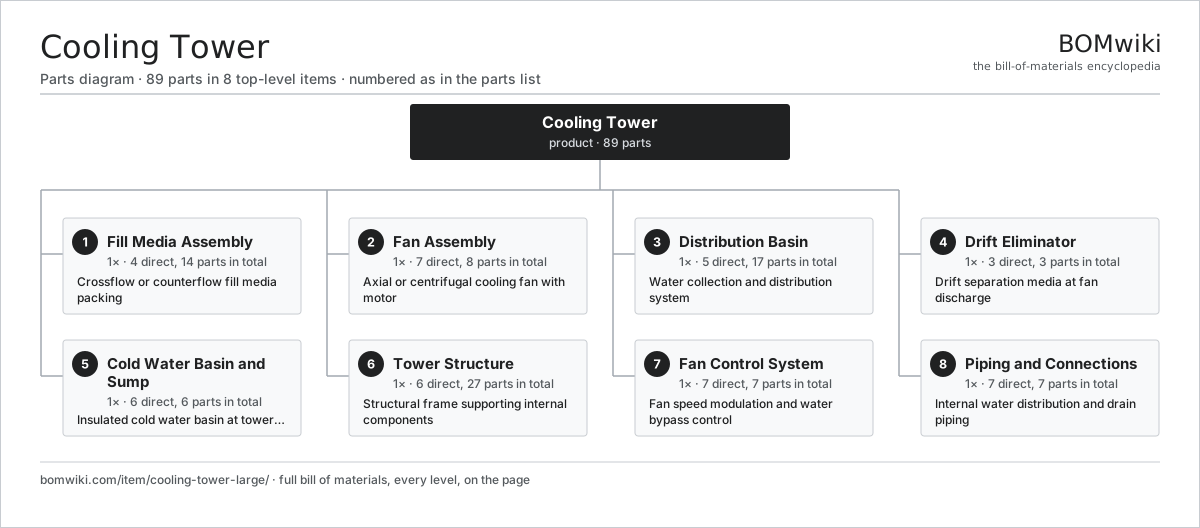
| # | Part | Qty | What it does |
|---|---|---|---|
| 1 | Fill Media Assembly 4 parts | 1× | Crossflow or counterflow fill media packing |
| 2 | Fan Assembly 7 parts | 1× | Axial or centrifugal cooling fan with motor |
| 3 | Distribution Basin 5 parts | 1× | Water collection and distribution system |
| 4 | Drift Eliminator 3 parts | 1× | Drift separation media at fan discharge |
| 5 | Cold Water Basin and Sump 6 parts | 1× | Insulated cold water basin at tower base |
| 6 | Tower Structure 6 parts | 1× | Structural frame supporting internal components |
| 7 | Fan Control System 7 parts | 1× | Fan speed modulation and water bypass control |
| 8 | Piping and Connections 7 parts | 1× | Internal water distribution and drain piping |
3D model
No 3D model yet. Have a CAD file of this? Add a 3D model. STL renders right on this page; STEP, FreeCAD, and OpenSCAD sources are welcome too (openly licensed, like all 3D models on BOMwiki).
Build & assembly graph
expand / collapse · shared sub-assemblies converge · links to related products · est. labourTap an assembly to expand/collapse · tap a part to open it · use “Open page” for any node · drag to pan, scroll to zoom.
Bill of materials for Cooling Tower
8 top-level lines · 53 rows shown · 89 parts total · indented to 3 levels| # | Item / sub-assembly | Part no. | Qty/assy | Ext. qty | Parts | Type |
|---|---|---|---|---|---|---|
| 1 | Fill Media Assembly 4 parts | cooling-tower-large-fill-media | 1× | 1 | 14 | assembly |
| 1.1 | Fill Support Frame | cooling-tower-large-fill-support | 1× | 1 | · | part |
| 1.2 | Fill Media Module | cooling-tower-large-fill-modules | 4× | 4 | · | part |
| 1.3 | Fill Nozzle | cooling-tower-large-fill-nozzles | 8× | 8 | · | part |
| 1.4 | Fill Support Beam | cooling-tower-large-fill-support-beam | 1× | 1 | · | part |
| 2 | Fan Assembly 7 parts | cooling-tower-large-fan | 1× | 1 | 8 | assembly |
| 2.1 | Fan Blade Rotor | cooling-tower-large-fan-blade | 1× | 1 | · | part |
| 2.2 | Fan Motor | cooling-tower-large-fan-motor | 1× | 1 | · | part |
| 2.3 | Fan Shaft | cooling-tower-large-fan-shaft | 1× | 1 | · | part |
| 2.4 | Ball Bearing | ball-bearing | 2× | 2 | · | part |
| 2.5 | Drive Belt | drive-belt | 1× | 1 | · | part |
| 2.6 | Fan Discharge Shroud | cooling-tower-large-fan-shroud | 1× | 1 | · | part |
| 2.7 | Variable Frequency Drive | cooling-tower-large-vfd-optional | 1× | 1 | · | part |
| 3 | Distribution Basin 5 parts | cooling-tower-large-distribution-basin | 1× | 1 | 17 | assembly |
| 3.1 | Distribution Trough | cooling-tower-large-distribution-troughs | 2× | 2 | · | part |
| 3.2 | Distribution Nozzle | cooling-tower-large-distribution-nozzle | 12× | 12 | · | part |
| 3.3 | Basin Water Inlet | cooling-tower-large-basin-connection | 1× | 1 | · | part |
| 3.4 | Basin Inlet Strainer | cooling-tower-large-basin-strainer | 1× | 1 | · | part |
| 3.5 | Orifice Plates | cooling-tower-large-orifice-plates | 1× | 1 | · | part |
| 4 | Drift Eliminator 3 parts | cooling-tower-large-drift-eliminator | 1× | 1 | 3 | assembly |
| 4.1 | Eliminator Frame | cooling-tower-large-eliminator-frame | 1× | 1 | · | part |
| 4.2 | Eliminator Media | cooling-tower-large-eliminator-media | 1× | 1 | · | part |
| 4.3 | Eliminator Drain | cooling-tower-large-eliminator-drain | 1× | 1 | · | part |
| 5 | Cold Water Basin and Sump 6 parts | cooling-tower-large-sump | 1× | 1 | 6 | assembly |
| 5.1 | Sump Basin | cooling-tower-large-sump-basin | 1× | 1 | · | part |
| 5.2 | Sump Insulation | cooling-tower-large-sump-insulation | 1× | 1 | · | part |
| 5.3 | Sump Drain Valve | cooling-tower-large-sump-drain | 1× | 1 | · | part |
| 5.4 | Sump Outlet | cooling-tower-large-sump-outlet | 1× | 1 | · | part |
| 5.5 | Sump Overflow | cooling-tower-large-sump-overflow | 1× | 1 | · | part |
| 5.6 | Sump Strainer | cooling-tower-large-sump-strainer | 1× | 1 | · | part |
| 6 | Tower Structure 6 parts | cooling-tower-large-structure | 1× | 1 | 27 | assembly |
| 6.1 | Frame Column | cooling-tower-large-frame-column | 4× | 4 | · | part |
| 6.2 | Frame Beam | cooling-tower-large-frame-beam | 8× | 8 | · | part |
| 6.3 | Casing Panel | cooling-tower-large-casing-panel | 6× | 6 | · | part |
| 6.4 | Air Intake Louver | cooling-tower-large-louver | 4× | 4 | · | part |
| 6.5 | Fastener Set | fastener-set | 1× | 1 | · | part |
| 6.6 | Vibration Isolation Pad | cooling-tower-large-vibration-pad | 4× | 4 | · | part |
| 7 | Fan Control System 7 parts | cooling-tower-large-controls | 1× | 1 | 7 | assembly |
| 7.1 | Temperature Sensor | cooling-tower-large-temperature-sensor | 1× | 1 | · | part |
| 7.2 | Temperature Controller | cooling-tower-large-control-module | 1× | 1 | · | part |
| 7.3 | Variable Frequency Drive | cooling-tower-large-vfd | 1× | 1 | · | part |
| 7.4 | Fan Contactor | cooling-tower-large-fan-contactor | 1× | 1 | · | part |
| 7.5 | Bypass Valve | cooling-tower-large-bypass-valve | 1× | 1 | · | part |
| 7.6 | Pressure Sensor | pressure-sensor | 1× | 1 | · | part |
| 7.7 | Relay | relay | 1× | 1 | · | part |
| 8 | Piping and Connections 7 parts | cooling-tower-large-piping | 1× | 1 | 7 | assembly |
| 8.1 | Inlet Pipe | cooling-tower-large-inlet-pipe | 1× | 1 | · | part |
| 8.2 | Outlet Pipe | cooling-tower-large-outlet-pipe | 1× | 1 | · | part |
| 8.3 | Drain Valve | cooling-tower-large-drain-valve | 1× | 1 | · | part |
| 8.4 | Check Valve | cooling-tower-large-check-valve | 1× | 1 | · | part |
| 8.5 | Isolation Ball Valve | cooling-tower-large-isolation-valve | 1× | 1 | · | part |
| 8.6 | Drain Strainer | cooling-tower-large-drain-strainer | 1× | 1 | · | part |
| 8.7 | Fastener Set | fastener-set | 1× | 1 | · | part |
Something wrong in this list? Report a problem with this BOM.
Related products
same domain, ranked by shared parts Rotary Heat Wheel
32 parts · shares 3 with this page
Rotary Heat Wheel
32 parts · shares 3 with this page
 Commercial Boiler Burner
42 parts · shares 3 with this page
Commercial Boiler Burner
42 parts · shares 3 with this page
 Air Handling Unit
631 parts · shares 4 with this page
Air Handling Unit
631 parts · shares 4 with this page
 Centrifugal Chiller
340 parts · shares 4 with this page
Centrifugal Chiller
340 parts · shares 4 with this page
Sourcing: possible vendors
Browse the supplier directory → Prices, MOQ, and lead times are algorithmic estimates, not quotes, and not claims about these companies. Company mappings are curated by keyword; est. price band $100–$20k. How estimates work| Vendor | HQ | Specialty | MOQ | Lead time |
|---|---|---|---|---|
|
🇺🇸Carrier
carrier.com ↗
|
Palm Beach Gardens, US | HVAC | 500 units | 8–14 wks |
| tranetechnologies.com ↗ | Davidson, US | HVAC | 500 units | 8–14 wks |
|
🇯🇵Daikin
daikin.com ↗
|
Osaka, JP | HVAC | 500 units | 8–14 wks |
|
🇺🇸Lennox
lennox.com ↗
|
Richardson, US | HVAC | 500 units | 8–14 wks |
| johnsoncontrols.com ↗ | Milwaukee, US | Building systems | 500 units | 8–14 wks |
923-word article