Carrier Core Router
ProductOverview
A carrier-grade core router is the backbone switching element in a service provider network, handling the highest traffic loads and linking together the entire internet. These devices are built for extreme availability: they forward terabits of traffic while remaining up during component failures, maintenance, and configuration changes. The architecture is modular, line cards slide into slots on a central chassis, all connected via a high-capacity switch fabric. The Chassis and Midplane is the skeleton, the Switch Fabric is the traffic highway, route control cards run the routing protocols, and line cards are the ingress/egress endpoints that connect the network segments.
How it works
The Route Control Card cards run BGP (Border Gateway Protocol) and other routing protocols, learning paths through the internet and building a forwarding table (FIB). Each line card has a local copy of this table and an on-board forwarding ASIC. When a packet arrives on a port (via a 10/40G PHY), the ASIC performs a table lookup and decides which outbound port to forward to, potentially on another line card. The packet travels across the Switch Fabric via high-speed SerDes links, then exits via another line card's port.
The routing fabric's bandwidth is the router's limiting throughput. With a 100 Tbps fabric, the router can sustain wire-rate forwarding on all ports in aggregate; a 10G port saturating ingress and egress simultaneously consumes negligible fabric bandwidth relative to the whole. Packets arriving faster than they can be forwarded are buffered in the packet memory; if buffers overflow, packets are dropped (tail-drop), a signal to TCP that the network is congested.
Redundancy is built into every subsystem. The control cards are N+1, so if one fails, the standby takes over without a routing protocol restart. Power supplies are redundant, and the fan subsystem can lose one tray without thermal shutdown. Line cards can be removed and replaced without bringing down the whole router; traffic on that line card is dropped, but all other forwarding continues. This modularity also means a carrier can start with a small configuration (e.g., 6 line cards) and add more over years without replacing the entire box.
Physical organization
The chassis frame provides the structure. The midplane is the copper or aluminum backplane PCB that carries data and control buses to every slot. The slot cage guides hot-swappable cards in and out with precision. A thermal baffle inside separates hot exhaust air on one side from cool intake on the other, ensuring efficient convective cooling. The fan system pulls cool air through the intake side, absorbs heat from the components, and pushes hot air out the rear.
Redundancy and resilience
Modern core routers are designed for five-nines availability (99.999% uptime), achievable only through N+1 or N+2 redundancy and careful engineering. The route processor cards run a synchronization protocol (often called "in-service software upgrade" or ISSU) that keeps the standby card's routing table and BGP session state in sync with the active card. If the active card fails or is removed for maintenance, the standby seamlessly takes over, possibly with a few seconds of microloop or packet loss, but without a full routing protocol restart that would flap upstream links.
The fabric itself is often redundant too, with N+1 or even full mesh interconnect, so a single chip failure does not partition the forwarding plane. Power and cooling redundancy mean no single PSU or fan failure stops the router. Line card failures are localized; only traffic on that card is affected, and downstream neighbors notice loss of signal on those circuits.
Scaling and evolution
Core routers are engineered to grow. Newer line cards with faster optics (e.g., 400G) can be inserted into older chassis, as long as the fabric bandwidth supports them. Control plane capacity, how many routes the route processor can hold, is limited by memory, but gigabyte-scale DRAM is now standard. A router holding 2 million BGP routes and 10 million FIB entries is common in carrier backbones.
The RAID controller (if present) manages any local disk storage for logging or software images, often using RAID-5 or RAID-6 for fault tolerance.
Carrier Core Router parts and their functions
7 top-level parts · 1,039 parts in total · full bill of materials below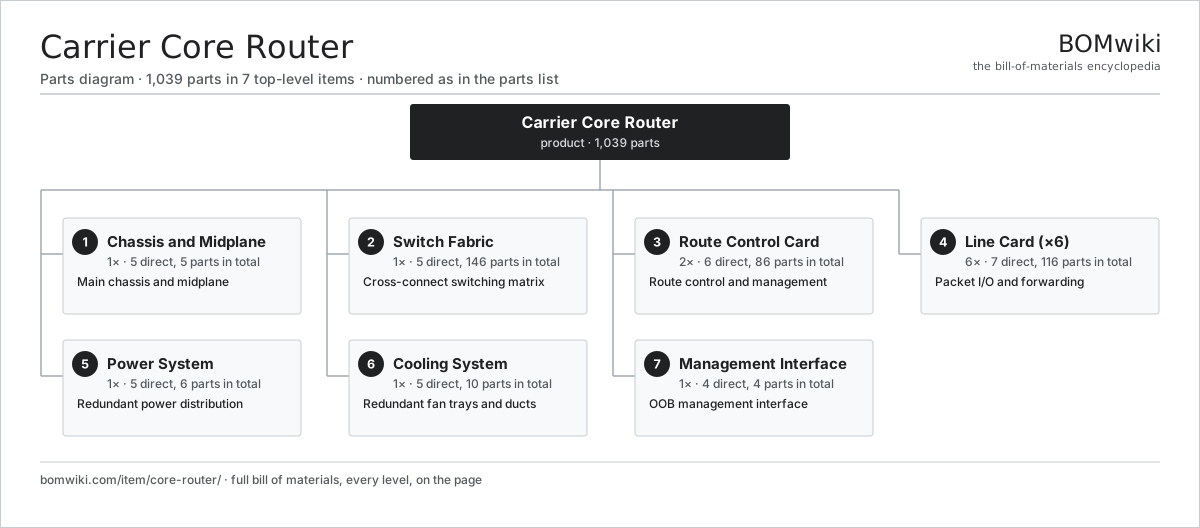
| # | Part | Qty | What it does |
|---|---|---|---|
| 1 | Chassis and Midplane 5 parts | 1× | Main chassis and midplane |
| 2 | Switch Fabric 5 parts | 1× | Cross-connect switching matrix |
| 3 | Route Control Card 6 parts | 2× | Route control and management |
| 4 | Line Card (×6) 7 parts | 6× | Packet I/O and forwarding |
| 5 | Power System 5 parts | 1× | Redundant power distribution |
| 6 | Cooling System 5 parts | 1× | Redundant fan trays and ducts |
| 7 | Management Interface 4 parts | 1× | OOB management interface |
Diagrams & photos


3D model
No 3D model yet. Have a CAD file of this? Add a 3D model. STL renders right on this page; STEP, FreeCAD, and OpenSCAD sources are welcome too (openly licensed, like all 3D models on BOMwiki).
Build & assembly graph
expand / collapse · shared sub-assemblies converge · links to related products · est. labourTap an assembly to expand/collapse · tap a part to open it · use “Open page” for any node · drag to pan, scroll to zoom.
Bill of materials for Carrier Core Router
7 top-level lines · 44 rows shown · 1,039 parts total · indented to 3 levels| # | Item / sub-assembly | Part no. | Qty/assy | Ext. qty | Parts | Type |
|---|---|---|---|---|---|---|
| 1 | Chassis and Midplane 5 parts | core-router-chassis | 1× | 1 | 5 | assembly |
| 1.1 | Frame | core-router-frame | 1× | 1 | · | part |
| 1.2 | Backplane | core-router-midplane | 1× | 1 | · | part |
| 1.3 | Slot Cage | core-router-slot-cage | 1× | 1 | · | part |
| 1.4 | Thermal Baffle | core-router-thermal-wall | 1× | 1 | · | part |
| 1.5 | Fastener Set | fastener-set | 1× | 1 | · | part |
| 2 | Switch Fabric 5 parts | core-router-switch-fabric | 1× | 1 | 146 | assembly |
| 2.1 | Fabric Switch ASIC | core-router-fabric-chips | 3× | 3 | · | part |
| 2.2 | SerDes Array | core-router-fabric-serdes | 1× | 1 | · | part |
| 2.3 | Packet Buffer | core-router-fabric-buffer | 1× | 1 | · | part |
| 2.4 | Fabric Board | core-router-fabric-pcb | 1× | 1 | · | part |
| 2.5 | SMD Passive (R/C/L) | smd-passives | 140× | 140 | · | part |
| 3 | Route Control Card 6 parts | core-router-route-processor | 2× | 2 | 86 | assembly |
| 3.1 | Control Plane SoC | core-router-rp-soc | 1× | 2 | · | part |
| 3.2 | RP Memory | core-router-rp-memory | 1× | 2 | · | part |
| 3.3 | Console Port | core-router-rp-console | 1× | 2 | · | part |
| 3.4 | Management Ethernet | core-router-rp-ethernet | 2× | 4 | · | part |
| 3.5 | RP Heatsink Fan | core-router-rp-cooling | 1× | 2 | · | part |
| 3.6 | SMD Passive (R/C/L) | smd-passives | 80× | 160 | · | part |
| 4 | Line Card (×6) 7 parts | core-router-line-cards | 6× | 6 | 116 | assembly |
| 4.1 | Forwarding Chip | core-router-lc-forwarding-chip | 1× | 6 | · | part |
| 4.2 | 10/40G PHY | core-router-lc-phy | 6× | 36 | · | part |
| 4.3 | Optical Port Cage | core-router-lc-connector | 6× | 36 | · | part |
| 4.4 | Packet Buffer | core-router-lc-buffer | 1× | 6 | · | part |
| 4.5 | Packet Processor | core-router-lc-pmac | 1× | 6 | · | part |
| 4.6 | LC Thermal Module | core-router-lc-cooling | 1× | 6 | · | part |
| 4.7 | SMD Passive (R/C/L) | smd-passives | 100× | 600 | · | part |
| 5 | Power System 5 parts | core-router-power-system | 1× | 1 | 6 | assembly |
| 5.1 | Primary PSU | core-router-psu-primary | 1× | 1 | · | part |
| 5.2 | Backup PSU | core-router-psu-secondary | 1× | 1 | · | part |
| 5.3 | Power Module | core-router-pdu | 1× | 1 | · | part |
| 5.4 | Fuse/Breaker | core-router-fuse-block | 1× | 1 | · | part |
| 5.5 | Power Harness | core-router-power-cable | 2× | 2 | · | part |
| 6 | Cooling System 5 parts | core-router-cooling | 1× | 1 | 10 | assembly |
| 6.1 | Main Fan Tray | core-router-fan-tray-1 | 1× | 1 | · | part |
| 6.2 | Backup Fan Tray | core-router-fan-tray-2 | 1× | 1 | · | part |
| 6.3 | Fan Blade | core-router-fan-blade | 6× | 6 | · | part |
| 6.4 | Air Filter | core-router-filter-pad | 1× | 1 | · | part |
| 6.5 | Thermal Probe | core-router-temp-sensor | 1× | 1 | · | part |
| 7 | Management Interface 4 parts | core-router-management | 1× | 1 | 4 | assembly |
| 7.1 | Console Port | core-router-console-port | 1× | 1 | · | part |
| 7.2 | Management Port | core-router-mgmt-ethernet | 1× | 1 | · | part |
| 7.3 | USB Port | core-router-mgmt-usb | 1× | 1 | · | part |
| 7.4 | Connector | connector | 1× | 1 | · | part |
Something wrong in this list? Report a problem with this BOM.
Related products
same domain, ranked by shared parts 5G Base Station
436 parts · shares 1 with this page
5G CPE Router
407 parts · shares 1 with this page
Data Center Switch (Spine)
3,264 parts · shares 1 with this page
5G Base Station
436 parts · shares 1 with this page
5G CPE Router
407 parts · shares 1 with this page
Data Center Switch (Spine)
3,264 parts · shares 1 with this page
 DECT Base Station
192 parts · shares 1 with this page
DECT Base Station
192 parts · shares 1 with this page
 DOCSIS Cable Modem
442 parts · shares 1 with this page
DOCSIS Cable Modem
442 parts · shares 1 with this page
 DSL Modem Router
56 parts · shares 1 with this page
DSL Modem Router
56 parts · shares 1 with this page
Sourcing: possible vendors
Browse the supplier directory → Prices, MOQ, and lead times are algorithmic estimates, not quotes, and not claims about these companies. Company mappings are curated by keyword; est. price band $30–$50k. How estimates work| Vendor | HQ | Specialty | MOQ | Lead time |
|---|---|---|---|---|
|
🇺🇸Cisco
cisco.com ↗
|
San Jose, US | Networking | 500 units | 8–14 wks |
|
🇺🇸Juniper
juniper.net ↗
|
Sunnyvale, US | Networking | 500 units | 8–14 wks |
| arista.com ↗ | Santa Clara, US | Networking | 500 units | 8–14 wks |
|
🇫🇮Nokia
nokia.com ↗
|
Espoo, FI | Telecom equipment | 500 units | 8–14 wks |
|
🇨🇳Huawei
huawei.com ↗
|
Shenzhen, CN | Networking & telecom | 500 units | 8–14 wks |
774-word article