Flaking Cooker System
ProductOverview
The Flaking Cooker System is an integrated continuous production line for manufacturing breakfast cereal flakes, transforming cooked corn meal into thin, toasted flakes ready for packaging. The line comprises five main stages: a rotary pressure cooker that hydrothermally conditions the corn meal; a multi-deck dryer reducing moisture for flaking; counter-rotating grooved rolls that press the dough into thin sheets; a gas-fired tunnel oven toasting the flakes to desired crispness and color; and a conveyor network connecting all sections with elevation transitions.
The process converts raw corn meal and water into gelatinized dough under controlled heat and pressure, then progressively removes moisture while forming thin sheets that fracture during handling or post-harvest sieving into the final flake product. This approach yields a distinctive crumbly, layered texture with low bulk density (8–12 g/100 mL), bright color, and shelf-stable crispness, the hallmark of premium breakfast cereals.
How It Works
Raw corn meal is fed by volumetric screw feeder into the Main Cooker, where it mixes with water and recirculated process condensate. The Cooker Drum rotates at 30–50 rpm, advancing the meal-water mixture along its 1.5 m length while the Cooker Jacket supplies 6 bar saturated steam heating the mass to 100–120°C. Internal paddle blades welded to the drum's central shaft keep material moving and breaking up agglomeration, promoting uniform thermal penetration. Pressure inside the drum builds to 2–3 bar as steam condenses and releases latent heat; the internal relative humidity approaches saturation, causing starch granules to swell and absorb water. The residence time is approximately 15–20 minutes, sufficient for complete starch gelatinization and protein partial denaturation.
At the discharge end, a Discharge Valve (rotary airlock) meters the cooked dough at a controlled rate, preventing back-flow and pressure loss. The hot dough (95–100°C, approximately 55–60% moisture) then transfers via inclined Conveyor System to the Dryer Unit.
The dryer is a four-tier stacked conveyor system with independently driven Dryer Belt. Hot air (100–120°C) from a gas burner or steam coil is blown upward through the dough by a Dryer Fan, percolating through the product layer. Moisture evaporates rapidly during the 6–10 minute residence time on the dryer. A Moisture Sensor using near-infrared reflection measures the dough moisture real-time; the controller adjusts Dryer Heater intensity and fan speed to maintain target 12–15% moisture at the dryer exit. This moisture level is critical: too high and the dough sticks to the flaking rolls; too low and it becomes brittle and difficult to sheet.
Partially dried dough exits the dryer as a slightly flexible sheet, falling by gravity onto the Flaking Rolls, two hardened cast-iron cylinders rotating at equal speeds with their nip gap set to 1–3 mm. As the dough passes between the Flaking Roll Pair, mechanical compression removes additional free moisture (down to ~10%) while the grooves in the roll surface create stress patterns that weaken the dough structure along planes parallel to the roll surface. Upon exiting the rolls, the thin (0.5–1.5 mm) sheet is inherently weak and prone to fracturing into irregularly sized fragments, pre-flakes. A Roll Scraper removes any dough residue from the roll surface, improving product release and preventing buildup.
The pre-flakes transfer via conveyor to the Toasting Oven, a 6 m long insulated tunnel with three independently controlled gas burner zones. Temperature is set 140–180°C depending on desired flake color (light blond at 145°C, golden at 160°C, dark brown at 175°C). Residence time in the oven is 2–4 minutes. High temperature and low moisture (remaining 8–10%) cause the residual starch to undergo further gelatinization and caramelization, developing crispness and flavor notes. The Oven Conveyor runs the product continuously through all three zones, while an Exhaust Fan removes moisture vapor and excess heat, maintaining oven humidity below 40% to ensure proper drying and browning.
Post-oven, flakes are cooled to room temperature on a final conveyor mesh, then gravimetrically sized via vibratory sieve to separate the ideal 8–12 mm flakes from fines (< 2 mm) and oversized fragments. The oversized material may be re-moistened and recycled back to the dryer or cooker, maximizing yield.
Key Control Parameters
Starch gelatinization is the primary determinant of texture and mouthfeel; it requires a minimum of 70°C and 50% relative humidity inside the cooker for 10+ minutes. Undercooking yields a granular, gritty product; overcooking produces a mushy, dense cereal. The Cooker Motor speed adjustment (30–60 rpm) allows operators to vary residence time and mixing intensity to accommodate seasonal corn lot variations in hardness.
Dryer moisture target of 12–15% is empirically derived: this range allows the dough to flow freely onto the flaking rolls without sticking, while retaining enough plasticizing moisture for uniform sheeting. If moisture drops below 10% before flaking, the dough becomes brittle and shatters into fine dust; if above 18%, the sheets become gummy and stick to the rolls, requiring operator intervention.
Roll gap and speed control are manual. A larger gap (3–4 mm) produces thicker flakes; a narrower gap (0.5–1.5 mm) yields thin, crispy flakes. Roll speed (surface velocity) is typically 0.5–1.0 m/s; faster speeds reduce dwell time and produce lighter-colored flakes, while slower speeds allow more mechanical compression and moisture removal.
Oven temperature and residence time are the final tuning points for color development and crispness. A light golden color (140–150°C) is preferred for whole-grain and health-focused brands; darker browns (165–180°C) suit chocolate or caramel-coated products, as the robust toast flavor pairs well with sweet additions.
Energy and Utility Considerations
The cooker is thermally integrated: condensate from the jacket at 95°C is re-used to temper incoming water, reducing fresh steam demand. In larger facilities, waste heat from the oven exhaust gas (80–90°C) is recovered via a plate heat exchanger to preheat dryer air, reducing overall burner load.
Total installed electrical load is approximately 18 kW; steam consumption is 800–1200 kg/h at 6 bar; natural gas demand is 150–250 kWth depending on ambient temperature and dryer efficiency. Compressed air (6 bar, ~50 L/min) is required for the Gap Adjuster and any pneumatic actuators.
The line is suitable for both prototype development (producing 100–150 kg batches with different recipes daily) and small-scale commercial production (continuous 400–600 kg/h runs for regional brands). Screw geometry and dough recipes can be modified to produce corn flakes, wheat bran flakes, or ancient grain flakes (amaranth, quinoa) with minimal equipment changes.
Flaking Cooker System parts and their functions
6 top-level parts · 48 parts in total · full bill of materials below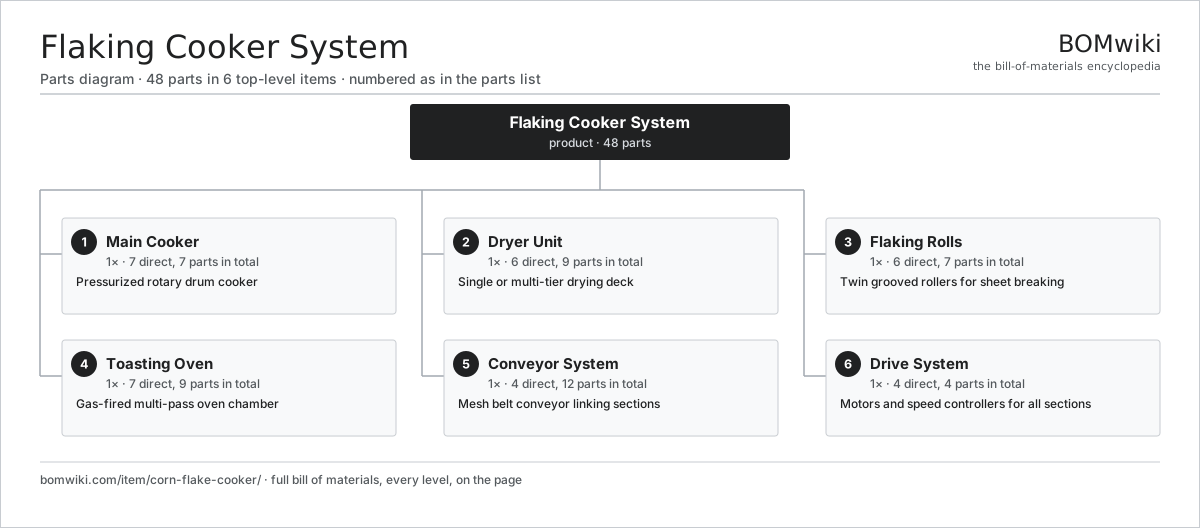
| # | Part | Qty | What it does |
|---|---|---|---|
| 1 | Main Cooker 7 parts | 1× | Pressurized rotary drum cooker |
| 2 | Dryer Unit 6 parts | 1× | Single or multi-tier drying deck |
| 3 | Flaking Rolls 6 parts | 1× | Twin grooved rollers for sheet breaking |
| 4 | Toasting Oven 7 parts | 1× | Gas-fired multi-pass oven chamber |
| 5 | Conveyor System 4 parts | 1× | Mesh belt conveyor linking sections |
| 6 | Drive System 4 parts | 1× | Motors and speed controllers for all sections |
3D model
No 3D model yet. Have a CAD file of this? Add a 3D model. STL renders right on this page; STEP, FreeCAD, and OpenSCAD sources are welcome too (openly licensed, like all 3D models on BOMwiki).
Build & assembly graph
expand / collapse · shared sub-assemblies converge · links to related products · est. labourTap an assembly to expand/collapse · tap a part to open it · use “Open page” for any node · drag to pan, scroll to zoom.
Bill of materials for Flaking Cooker System
6 top-level lines · 40 rows shown · 48 parts total · indented to 3 levels| # | Item / sub-assembly | Part no. | Qty/assy | Ext. qty | Parts | Type |
|---|---|---|---|---|---|---|
| 1 | Main Cooker 7 parts | corn-flake-cooker-main-cooker | 1× | 1 | 7 | assembly |
| 1.1 | Cooker Drum | corn-flake-cooker-cooker-drum | 1× | 1 | · | part |
| 1.2 | Cooker Jacket | corn-flake-cooker-cooker-jacket | 1× | 1 | · | part |
| 1.3 | Cooker Internals | corn-flake-cooker-cooker-internals | 1× | 1 | · | part |
| 1.4 | Cooker Seals | corn-flake-cooker-cooker-seals | 1× | 1 | · | part |
| 1.5 | Cooker Motor | corn-flake-cooker-cooker-motor | 1× | 1 | · | part |
| 1.6 | Discharge Valve | corn-flake-cooker-discharge-valve | 1× | 1 | · | part |
| 1.7 | Pressure Sensor | pressure-sensor | 1× | 1 | · | part |
| 2 | Dryer Unit 6 parts | corn-flake-cooker-dryer-unit | 1× | 1 | 9 | assembly |
| 2.1 | Dryer Frame | corn-flake-cooker-dryer-frame | 1× | 1 | · | part |
| 2.2 | Dryer Belt | corn-flake-cooker-dryer-belts | 4× | 4 | · | part |
| 2.3 | Dryer Heater | corn-flake-cooker-dryer-heater | 1× | 1 | · | part |
| 2.4 | Dryer Fan | corn-flake-cooker-dryer-fan | 1× | 1 | · | part |
| 2.5 | Dryer Motor | corn-flake-cooker-dryer-motor | 1× | 1 | · | part |
| 2.6 | Moisture Sensor | corn-flake-cooker-moisture-sensor | 1× | 1 | · | part |
| 3 | Flaking Rolls 6 parts | corn-flake-cooker-flaking-rolls | 1× | 1 | 7 | assembly |
| 3.1 | Flaking Roll Pair | corn-flake-cooker-roll-pair | 1× | 1 | · | part |
| 3.2 | Roll Bearing | corn-flake-cooker-roll-bearings | 2× | 2 | · | part |
| 3.3 | Roll Motor | corn-flake-cooker-roll-motor | 1× | 1 | · | part |
| 3.4 | Roll Gearbox | corn-flake-cooker-roll-gearbox | 1× | 1 | · | part |
| 3.5 | Roll Scraper | corn-flake-cooker-roll-scraper | 1× | 1 | · | part |
| 3.6 | Gap Adjuster | corn-flake-cooker-gap-adjuster | 1× | 1 | · | part |
| 4 | Toasting Oven 7 parts | corn-flake-cooker-toasting-oven | 1× | 1 | 9 | assembly |
| 4.1 | Oven Chamber | corn-flake-cooker-oven-chamber | 1× | 1 | · | part |
| 4.2 | Oven Burner | corn-flake-cooker-oven-burners | 3× | 3 | · | part |
| 4.3 | Oven Conveyor | corn-flake-cooker-oven-conveyor | 1× | 1 | · | part |
| 4.4 | Oven Motor | corn-flake-cooker-oven-motor | 1× | 1 | · | part |
| 4.5 | Exhaust Fan | corn-flake-cooker-exhaust-fan | 1× | 1 | · | part |
| 4.6 | Oven Thermostat | corn-flake-cooker-oven-thermostat | 1× | 1 | · | part |
| 4.7 | Damper Actuator | corn-flake-cooker-damper-actuator | 1× | 1 | · | part |
| 5 | Conveyor System 4 parts | corn-flake-cooker-conveyor-system | 1× | 1 | 12 | assembly |
| 5.1 | Conveyor Belt | corn-flake-cooker-conveyor-belts | 3× | 3 | · | part |
| 5.2 | Conveyor Idler | corn-flake-cooker-conveyor-idlers | 6× | 6 | · | part |
| 5.3 | Conveyor Motor | corn-flake-cooker-conveyor-motors | 2× | 2 | · | part |
| 5.4 | Conveyor Frame | corn-flake-cooker-conveyor-frame | 1× | 1 | · | part |
| 6 | Drive System 4 parts | corn-flake-cooker-drive-system | 1× | 1 | 4 | assembly |
| 6.1 | Control Panel | corn-flake-cooker-main-panel | 1× | 1 | · | part |
| 6.2 | E-Stop Circuit | corn-flake-cooker-estop-circuit | 1× | 1 | · | part |
| 6.3 | Temperature Display | corn-flake-cooker-temperature-display | 1× | 1 | · | part |
| 6.4 | Gas Solenoid Valve | corn-flake-cooker-solenoid-gas-valve | 1× | 1 | · | part |
Something wrong in this list? Report a problem with this BOM.
Related products
same domain, ranked by shared parts Automatic Espresso Tamper
45 parts · shares 1 with this page
Automatic Filleting Machine
73 parts · shares 1 with this page
Automatic Espresso Tamper
45 parts · shares 1 with this page
Automatic Filleting Machine
73 parts · shares 1 with this page
 Bakery Deck Oven
44 parts · shares 1 with this page
Batter and Breading Line
127 parts · shares 1 with this page
Beverage Carbonator
95 parts · shares 1 with this page
Bakery Deck Oven
44 parts · shares 1 with this page
Batter and Breading Line
127 parts · shares 1 with this page
Beverage Carbonator
95 parts · shares 1 with this page
Sourcing: possible vendors
Browse the supplier directory → Prices, MOQ, and lead times are algorithmic estimates, not quotes, and not claims about these companies. Company mappings are curated by keyword; est. price band $1k–$500k. How estimates work| Vendor | HQ | Specialty | MOQ | Lead time |
|---|---|---|---|---|
| gea.com ↗ | Düsseldorf, DE | Process technology | 20 units | 12–20 wks |
| buhlergroup.com ↗ | Uzwil, CH | Food & materials processing | 20 units | 12–20 wks |
| tetrapak.com ↗ | Pully, CH | Food packaging & processing | 20 units | 12–20 wks |
| jbtc.com ↗ | Chicago, US | Food processing equipment | 20 units | 12–20 wks |
| alfalaval.com ↗ | Lund, SE | Heat transfer & separation | 20 units | 12–20 wks |
1,168-word article