Crab Pot Puller
ProductOverview
A crab pot puller is a specialized marine winch designed for commercial and recreational crab and lobster fishing. The motorized capstan pulls a rope attached to a submerged pot at controlled speed, while the davit arm, a rotating mechanical lever, lifts the pot from the water and positions it for emptying and re-baiting. The entire apparatus is mounted on the boat gunwale via through-bolts into the hull frame, transferring the 50–100 pound pot weight directly to the vessel's structure. Modern pullers include wireless remote controls and automatic load limiting, making single-operator hauling safe and ergonomic.
Capstan Drive and Line Pulling
The capstan drive is the core pulling mechanism. Unlike a traditional winch with helical grooves, a capstan is a smooth cylindrical drum (typically stainless steel, 6 inches in diameter) that rotates at 100–200 rpm. Rope laid in three turns around the drum is gripped by friction alone; there are no grooves or flanges. This design is ideal for crab/lobster because:
No rope damage: Smooth drum surface doesn't cut or abrade the rope, extending rope life 5–10× over grooved reels.
Easy line release: A quick slip of the rope releases tension instantly, essential if a trap snags or the operator needs to bail out immediately.
Load reversibility: If the operator eases tension, a pot hanging freely can be lowered slowly, unlike a grooved reel that tends to hold load.
Minimal wrapping: Only 3 turns of rope are needed (vs. 5–10 for a grooved reel), reducing deck clutter.
The motor is typically 2–3 hp electric AC induction (on vessels with 240V service) or 2–3 hp hydraulic (on working vessels with a central hydraulic system). Motor power is reduced via a 10:1 or 15:1 worm gearbox, outputting approximately 120–180 rpm at the capstan. At 6-inch capstan diameter and 150 rpm, rope pull rate is (6 × π × 150) ÷ 12 = 235 feet per minute, fast enough to haul a 100-foot-deep pot in 30–40 seconds.
A spring-applied holding brake engages whenever the motor stops, preventing a pot from slipping back into the water. The brake is rated for the maximum safe load (typically 50–100 pounds) and is electrically released only when the motor is running.
Davit Arm and Mechanical Advantage
The davit arm is a rotating crane that lifts the pot clear of the water and positions it over the boat deck. The arm is a rigid aluminum or steel tube, 6 feet long, angled 45° from vertical when stowed. A pivot pin near the gunwale allows the arm to rotate upward over the water and inboard toward the deck.
The rope from the capstan is threaded through a snatch block (pulley) at the davit boom tip. This creates a mechanical advantage: if the capstan pulls at 200 feet per minute, and the rope is redirected 90 degrees by the block, the davit boom tip moves at 200 feet per minute horizontally (as the boom rotates), which translates to vertical lift of the pot hanging below. The moment arm of the boom (distance from pivot to hook) is typically 5 feet; at full extension, pulling 100 pounds of rope tension lifts a 100-pound pot (mechanical advantage 1:1 in the vertical plane, ignoring boom weight).
The hook at the davit boom tip is a stainless steel rating latch-style rated for 200 pounds safe working load. The hook engages a line from the pot buoy or haul line, lifting the entire pot. Once the pot clears the water and swings inboard, the operator releases the hook by hand or via a trip line, dropping the pot onto the deck for processing.
Load Monitoring and Safety
Modern pullers include a strain gauge on the davit arm or a pressure transducer in the hydraulic line. The sensor continuously monitors load and triggers an alarm or automatic shutdown if load exceeds safe limits. For example, if a pot is snagged (load spikes to 200+ pounds), the controller automatically reduces motor power or stops pulling to prevent rope breakage or structural damage.
A deadman switch on the wireless remote control requires the operator to hold a button continuously. If the operator releases the button (due to injury, distraction, or falling), the winch stops and the holding brake engages, preventing uncontrolled pot descent. This is critical in rough seas where a sudden boat lurch could throw an operator off balance.
Gunwale Mounting and Hull Integration
The gunwale mount is the critical interface between the puller and the boat hull. The mounting plate is a 12 × 12 inch stainless steel 304 plate, 0.5 inch thick, bolted through the deck with eight 0.75-inch Grade 8 bolts penetrating 3–4 inches into the wooden or fiberglass hull structure. The interior is reinforced with a backing plate that distributes load across a large area, preventing localized crushing or delamination of the deck.
Vibration isolation is critical: a rubber shear mount at each bolt corner decouples the high-frequency vibration of the winch from the hull, reducing fatigue and crew fatigue. Without isolation, continuous winch operation would transmit vibration throughout the vessel, wearing out electrical systems and causing seasickness.
Load transfer to the hull frame must be verified during installation. A 100-pound pot load, multiplied by the davit arm moment arm and dynamic swing forces during boat rolling, can translate to 300–500 pounds of instantaneous force on the deck at the mount point. The mounting must penetrate to solid wood ribs or hull stringers; surface-only mounting on thin fiberglass will fail.
Line Management and Rope Selection
The rope management system includes guide tubes and guards that direct rope flow smoothly from the capstan to the davit pulley. A smooth flow prevents kinking, tangling, and rope damage. Rope cleats secure the line when not pulling, preventing unintended motion.
Rope choice is critical. Traditional manila or sisal rope absorbs water and rots; nylon or polypropylene rope is preferred for saltwater. A typical working rope is 0.5–0.75 inch diameter, with 5,000–8,000 pounds breaking strength (10× safety factor over the 100-pound pot load). Rope costs $0.50–$1.00 per foot; a 100-foot pot line costs $50–$100 and lasts 2–3 seasons before requiring replacement due to fraying, chafe, or UV degradation.
Control and Operation
The control system provides wireless or hardwired remote operation. A hand-held pendant allows the operator to stand anywhere on the deck with a clear view of the pot being hauled, adjusting speed and direction as needed. Wireless remotes operate at 50–100 foot range with encrypted signal to prevent accidental triggering by nearby equipment.
Operating sequence:
- Position: Operator lowers the davit arm to vertical (stowed position) before starting.
- Activate: Wireless button energizes the winch circuit; the capstan is ready to pull.
- Haul: Operator holds the "haul" button on the pendant, and the capstan begins pulling at the pre-set speed (adjustable from 50 to 200 feet per minute).
- Monitor: Operator watches load indicator; if load spikes (snag), operator can release the button or activate "lower" to ease tension and free the snag.
- Lift: As the pot breaks the water surface, the davit arm's snatch block ensures the rope transitions from horizontal to vertical pull, lifting the pot.
- Unload: Once the pot swings over the deck, the operator releases the hook manually or via a trip line, depositing the pot.
- Re-bait: Operator empties the catch, re-baits the trap, and resets for the next haul.
Processing time per pot is typically 3–5 minutes (including evaluation, culling, re-baiting), allowing a single operator to haul and process 20–30 pots per hour (600–900 pots per 12-hour fishing day).
Hydraulic Systems
Some large commercial vessels use closed-loop hydraulic systems instead of direct electric motors. A main variable-displacement pump draws power from the vessel's engine (via PTO or independent diesel engine) and supplies pressurized hydraulic fluid to the winch motor and brake.
Advantages:
- Power source flexibility: Uses existing engine power rather than dedicated electrical service.
- Better load management: Proportional valves allow smooth acceleration and speed control.
- Reliability in salt spray: Fewer exposed electrical connectors.
Disadvantages:
- Cost: Hydraulic systems cost 2–3× more than electric.
- Maintenance: Hydraulic fluid requires seasonal changes, hose inspection, and filter replacement.
- Efficiency: Hydraulic systems are 10–20% less efficient than electric, wasting energy as heat.
For modern small-to-medium vessels, electric pulls are increasingly favored due to lower cost and simpler maintenance.
Safety Considerations
Crab pot pullers are the second-leading cause of on-deck injury in fishing vessels, after slips/falls. Common hazards:
Rope entanglement: A hand caught in the rotating capstan or rope under tension can result in amputation. The safety cage and rope guards mitigate this but must be rigorously maintained.
Falling pots: If a rope breaks or hook fails, a 100-pound pot can drop onto the operator's foot, causing crush injury or amputation. Always wear steel-toed boots and clear the work area when hauling.
Hydraulic line failure: High-pressure fluid escaping a ruptured hose can injure skin instantly (injection injury). All hoses must be inspected monthly for leaks or bulging.
Electrocution: Saltwater and wet conditions increase electrical hazard. All electrical connections must be IP67-rated and regularly inspected. Ground-fault circuit interrupter (GFCI) breakers are mandatory.
Modern regulations (OSHA, Coast Guard) require integrated safety cages with deadman controls on all commercial pullers. Regular training and maintenance reduce injuries by >80%.
Crab Pot Puller parts and their functions
7 top-level parts · 40 parts in total · full bill of materials below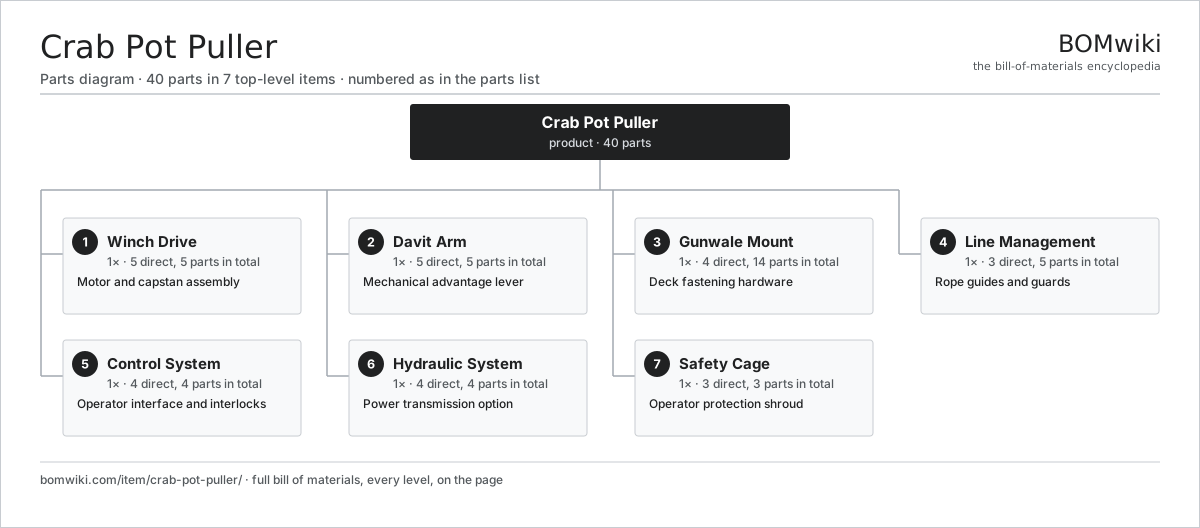
| # | Part | Qty | What it does |
|---|---|---|---|
| 1 | Winch Drive 5 parts | 1× | Motor and capstan assembly |
| 2 | Davit Arm 5 parts | 1× | Mechanical advantage lever |
| 3 | Gunwale Mount 4 parts | 1× | Deck fastening hardware |
| 4 | Line Management 3 parts | 1× | Rope guides and guards |
| 5 | Control System 4 parts | 1× | Operator interface and interlocks |
| 6 | Hydraulic System 4 parts | 1× | Power transmission option |
| 7 | Safety Cage 3 parts | 1× | Operator protection shroud |
3D model
No 3D model yet. Have a CAD file of this? Add a 3D model. STL renders right on this page; STEP, FreeCAD, and OpenSCAD sources are welcome too (openly licensed, like all 3D models on BOMwiki).
Build & assembly graph
expand / collapse · shared sub-assemblies converge · links to related products · est. labourTap an assembly to expand/collapse · tap a part to open it · use “Open page” for any node · drag to pan, scroll to zoom.
Bill of materials for Crab Pot Puller
7 top-level lines · 35 rows shown · 40 parts total · indented to 3 levels| # | Item / sub-assembly | Part no. | Qty/assy | Ext. qty | Parts | Type |
|---|---|---|---|---|---|---|
| 1 | Winch Drive 5 parts | crab-pot-puller-winch-drive | 1× | 1 | 5 | assembly |
| 1.1 | Winch Motor | crab-pot-puller-motor | 1× | 1 | · | part |
| 1.2 | Capstan Drum | crab-pot-puller-capstan-drum | 1× | 1 | · | part |
| 1.3 | Holding Brake | crab-pot-puller-brake | 1× | 1 | · | part |
| 1.4 | Reduction Gearbox | crab-pot-puller-gearbox | 1× | 1 | · | part |
| 1.5 | Motor Coupling | crab-pot-puller-coupling | 1× | 1 | · | part |
| 2 | Davit Arm 5 parts | crab-pot-puller-davit-arm | 1× | 1 | 5 | assembly |
| 2.1 | Davit Boom | crab-pot-puller-davit-boom | 1× | 1 | · | part |
| 2.2 | Davit Pivot | crab-pot-puller-davit-pivot | 1× | 1 | · | part |
| 2.3 | Davit Hook | crab-pot-puller-davit-hook | 1× | 1 | · | part |
| 2.4 | Davit Cable | crab-pot-puller-davit-cable | 1× | 1 | · | part |
| 2.5 | Davit Block | crab-pot-puller-davit-pulley | 1× | 1 | · | part |
| 3 | Gunwale Mount 4 parts | crab-pot-puller-gunwale-mount | 1× | 1 | 14 | assembly |
| 3.1 | Mount Base Plate | crab-pot-puller-mount-plate | 1× | 1 | · | part |
| 3.2 | Mount Bolt | crab-pot-puller-mount-bolts | 8× | 8 | · | part |
| 3.3 | Backing Plate | crab-pot-puller-mount-backing-plate | 1× | 1 | · | part |
| 3.4 | Vibration Isolator | crab-pot-puller-vibration-isolator | 4× | 4 | · | part |
| 4 | Line Management 3 parts | crab-pot-puller-line-management | 1× | 1 | 5 | assembly |
| 4.1 | Rope Guide | crab-pot-puller-rope-guide | 2× | 2 | · | part |
| 4.2 | Rope Guard | crab-pot-puller-rope-guard | 1× | 1 | · | part |
| 4.3 | Line Cleat | crab-pot-puller-line-cleats | 2× | 2 | · | part |
| 5 | Control System 4 parts | crab-pot-puller-control-system | 1× | 1 | 4 | assembly |
| 5.1 | Pendant Control | crab-pot-puller-pendant-switch | 1× | 1 | · | part |
| 5.2 | Speed Controller | crab-pot-puller-speed-controller | 1× | 1 | · | part |
| 5.3 | Load Sensor | crab-pot-puller-load-sensor | 1× | 1 | · | part |
| 5.4 | Emergency Stop | crab-pot-puller-emergency-stop | 1× | 1 | · | part |
| 6 | Hydraulic System 4 parts | crab-pot-puller-hydraulic-system | 1× | 1 | 4 | assembly |
| 6.1 | Hydraulic Pump | crab-pot-puller-hydraulic-pump | 1× | 1 | · | part |
| 6.2 | Hydraulic Hoses | crab-pot-puller-hydraulic-hoses | 1× | 1 | · | part |
| 6.3 | Hydraulic Filter | crab-pot-puller-hydraulic-filter | 1× | 1 | · | part |
| 6.4 | Hydraulic Tank | crab-pot-puller-hydraulic-reservoir | 1× | 1 | · | part |
| 7 | Safety Cage 3 parts | crab-pot-puller-safety-cage | 1× | 1 | 3 | assembly |
| 7.1 | Cage Frame | crab-pot-puller-cage-frame | 1× | 1 | · | part |
| 7.2 | Cage Mesh | crab-pot-puller-cage-mesh | 1× | 1 | · | part |
| 7.3 | Cage Gate | crab-pot-puller-cage-gate | 1× | 1 | · | part |
Something wrong in this list? Report a problem with this BOM.
Sourcing: possible vendors
Browse the supplier directory → Prices, MOQ, and lead times are algorithmic estimates, not quotes, and not claims about these companies. Company mappings are curated by keyword; est. price band $20–$2k. How estimates work| Vendor | HQ | Specialty | MOQ | Lead time |
|---|---|---|---|---|
|
🇺🇸Coleman
coleman.com ↗
|
Chicago, US | Camping gear | 1,000 units | 6–10 wks |
| thenorthface.com ↗ | Denver, US | Outdoor apparel & gear | 1,000 units | 6–10 wks |
|
🇺🇸YETI
yeti.com ↗
|
Austin, US | Coolers & drinkware | 1,000 units | 6–10 wks |
| decathlon.com ↗ | Villeneuve-d'Ascq, FR | Sporting goods | 1,000 units | 6–10 wks |
|
🇺🇸Garmin
garmin.com ↗
|
Olathe, US | GPS & wearables | 1,000 units | 6–10 wks |
1,738-word article