Crew Capsule
ProductOverview
A crew capsule is the part of a launch system that must work when everything else has failed: it carries its crew to orbit, keeps them alive for days, survives a 7.6 km/s atmospheric entry, and can also yank them away from an exploding booster with two seconds' notice. The blunt-body capsule shape has no wings to break and is passively stable in two attitudes, which is why the configuration has outlived every winged alternative for crew transport.
The vehicle divides into a Pressure Vessel that holds the crew, an expendable Heat Shield on its aft face, and systems packed into every remaining cavity: Life Support System, Reaction Control System thruster pods, the forward Parachute System bay, and battery power.
Structure
The Vessel Weldment is friction-stir-welded aluminum-lithium 2195, machined from thick plate into an integrally stiffened cone and proof-tested above 1.5 times cabin pressure. The crew enters through the Side Hatch, a plug-type design that cabin pressure forces harder into its seat, it cannot blow open in flight, and it still opens from inside in seconds on the pad. A forward Docking Tunnel leads to the docking adapter. Four Capsule Window units use triple panes, with a sacrificial fused-silica outer pane rated for entry heating. Backshell Panel composite panels covered in cork or tile protect the leeward surfaces, which see roughly a tenth of the windward heat flux.
Entry and the heat shield
Entry from low orbit dissipates about 2 gigajoules of kinetic energy per thousand kilograms of vehicle, nearly all of it into the air rather than the structure. The Ablator Block Array, phenolic-impregnated carbon ablator, manage the ~30 W/cm² peak heat flux by charring and receding, carrying energy away as pyrolysis gas that also thickens the boundary layer. The blocks bond to a composite Shield Carrier Structure dish with RTV Gap Filler sealing the joints against hot-gas sneak flow; Instrumentation Plug record in-depth temperatures for post-flight model correlation.
The capsule's center of mass is deliberately offset, giving a trim lift-to-drag ratio near 0.25. By rolling the lift vector with pulses from the RCS Thruster set, the guidance loop steers out entry dispersions and holds deceleration to 3–4 g; a ballistic backup mode reaches about 8 g. After main-chute deploy, Shield Separation Mechanism mechanisms jettison the spent shield.
Parachutes
Recovery is staged because no single canopy can open at 240 m/s without destroying itself or the crew. Near 7.5 km altitude, mortars (Deployment Mortar) fire two Drogue Parachute conical-ribbon canopies that stabilize and slow the capsule. Around 3 km, Pilot Parachute extraction chutes pull out the Main Parachute ring-sails, each about 35 m across, which inflate through two reefed stages sequenced by pyrotechnic cutters in the Riser and Reefing Set to keep opening shock under limits. The system is single-fault tolerant: the capsule lands safely on two of three mains. Splashdown arrives at about 7.5 m/s, and Couch Attenuator Strut struts under each Seat Assembly crush to keep crew spinal loads within limits.
Abort
The Launch Abort Interfaces make the capsule its own lifeboat. Abort Sensor Set watch booster rates, tank pressures, and breakwires; on a triggering signature the redundant Separation Controller fires Separation Bolt and Umbilical Cutter guillotines, and the escape system pulls the capsule away through the Abort Attach Fitting hardpoints at more than 10 g, clearing a fireball radius in roughly two seconds. The abort sequence is autonomous because human reaction time is too slow for pad-failure timelines.
Life support and power
For mission durations under a week, an open-loop system beats the mass of regenerative hardware. Oxygen Tank and Nitrogen Tank bottles maintain a 101 kPa two-gas atmosphere through the Pressure Valve Set; replaceable LiOH Canister cartridges absorb CO2 chemically; the Cabin Heat Exchanger condensing exchanger removes metabolic heat and humidity. During launch and entry the crew breathe through the Suit Air Loop, which isolates their suits automatically if the cabin depressurizes.
Power is all-battery: three Main Battery Li-ion packs with BMS Board management cover free flight and 24 hours of post-landing operations, while isolated Pyro Battery silver-zinc units fire ordnance independently of the main bus through the Power Controller.
Avionics
Three Flight Computer units vote every output, making the vehicle two-fault tolerant through entry, when plasma blackout cuts all communication for several minutes and the Inertial Measurement Unit triad navigates purely inertially. GPS Receiver receivers bound drift before and after blackout. The crew monitor everything on the Display Console glass cockpit and can fly manually with the Hand Controller pair, a capability retained for proximity operations and degraded-mode entries, though a nominal mission needs no piloting at all.
Crew Capsule parts and their functions
9 top-level parts · 257 parts in total · full bill of materials below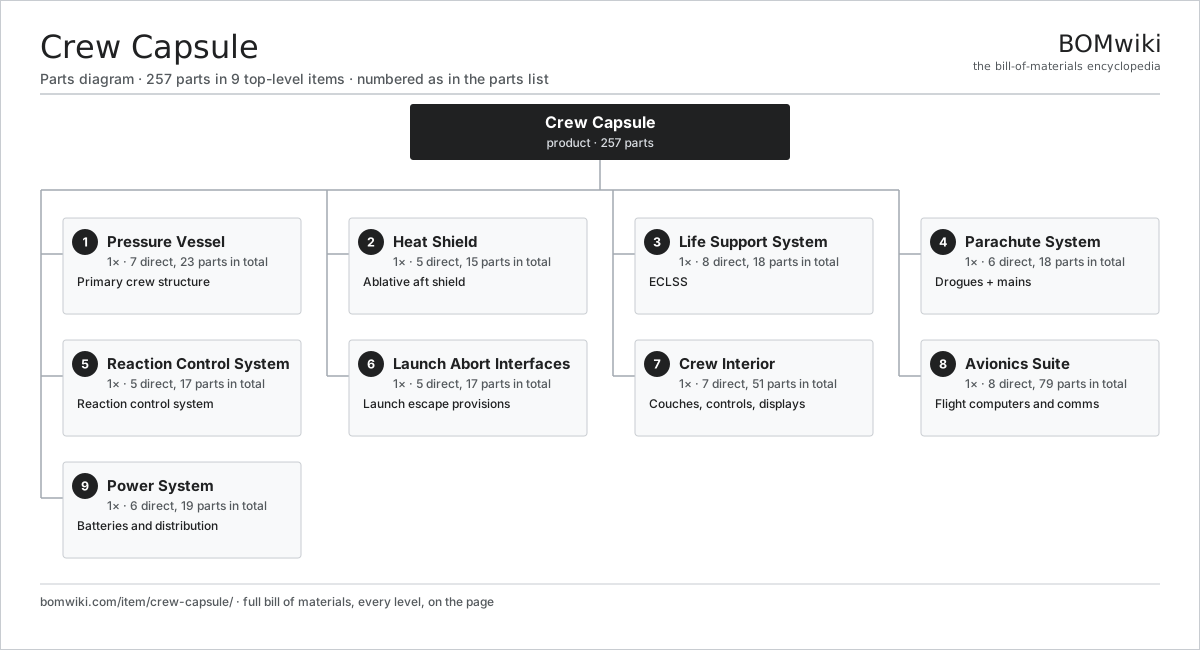
| # | Part | Qty | What it does |
|---|---|---|---|
| 1 | Pressure Vessel 7 parts | 1× | Primary crew structure |
| 2 | Heat Shield 5 parts | 1× | Ablative aft shield |
| 3 | Life Support System 8 parts | 1× | ECLSS |
| 4 | Parachute System 6 parts | 1× | Drogues + mains |
| 5 | Reaction Control System 5 parts | 1× | Reaction control system |
| 6 | Launch Abort Interfaces 5 parts | 1× | Launch escape provisions |
| 7 | Crew Interior 7 parts | 1× | Couches, controls, displays |
| 8 | Avionics Suite 8 parts | 1× | Flight computers and comms |
| 9 | Power System 6 parts | 1× | Batteries and distribution |
3D model
No 3D model yet. Have a CAD file of this? Add a 3D model. STL renders right on this page; STEP, FreeCAD, and OpenSCAD sources are welcome too (openly licensed, like all 3D models on BOMwiki).
Build & assembly graph
expand / collapse · shared sub-assemblies converge · links to related products · est. labourTap an assembly to expand/collapse · tap a part to open it · use “Open page” for any node · drag to pan, scroll to zoom.
Bill of materials for Crew Capsule
9 top-level lines · 71 rows shown · 257 parts total · indented to 3 levels| # | Item / sub-assembly | Part no. | Qty/assy | Ext. qty | Parts | Type |
|---|---|---|---|---|---|---|
| 1 | Pressure Vessel 7 parts | crew-capsule-pressure-vessel | 1× | 1 | 23 | assembly |
| 1.1 | Vessel Weldment | crew-capsule-vessel-weldment | 1× | 1 | · | part |
| 1.2 | Side Hatch | crew-capsule-side-hatch | 1× | 1 | · | part |
| 1.3 | Docking Tunnel | crew-capsule-docking-tunnel | 1× | 1 | · | part |
| 1.4 | Capsule Window | crew-capsule-window | 4× | 4 | · | part |
| 1.5 | Backshell Panel | crew-capsule-backshell-panel | 12× | 12 | · | part |
| 1.6 | Umbilical Port | crew-capsule-umbilical-port | 2× | 2 | · | part |
| 1.7 | O-Ring Set | oring-set | 2× | 2 | · | part |
| 2 | Heat Shield 5 parts | crew-capsule-heat-shield | 1× | 1 | 15 | assembly |
| 2.1 | Ablator Block Array | crew-capsule-ablator-blocks | 1× | 1 | · | part |
| 2.2 | Shield Carrier Structure | crew-capsule-shield-carrier | 1× | 1 | · | part |
| 2.3 | Shield Separation Mechanism | crew-capsule-shield-separation | 4× | 4 | · | part |
| 2.4 | RTV Gap Filler | crew-capsule-rtv-gapfill | 1× | 1 | · | part |
| 2.5 | Instrumentation Plug | crew-capsule-instrumentation-plugs | 8× | 8 | · | part |
| 3 | Life Support System 8 parts | crew-capsule-life-support | 1× | 1 | 18 | assembly |
| 3.1 | Oxygen Tank | crew-capsule-oxygen-tank | 2× | 2 | · | part |
| 3.2 | Nitrogen Tank | crew-capsule-nitrogen-tank | 1× | 1 | · | part |
| 3.3 | LiOH Canister | crew-capsule-lioh-canister | 6× | 6 | · | part |
| 3.4 | Cabin Heat Exchanger | crew-capsule-cabin-hx | 1× | 1 | · | part |
| 3.5 | Suit Air Loop | crew-capsule-suit-loop | 1× | 1 | · | part |
| 3.6 | Blower Motor | blower-motor | 2× | 2 | · | part |
| 3.7 | Pressure Sensor | pressure-sensor | 4× | 4 | · | part |
| 3.8 | Pressure Valve Set | crew-capsule-pressure-valve-set | 1× | 1 | · | part |
| 4 | Parachute System 6 parts | crew-capsule-parachute-system | 1× | 1 | 18 | assembly |
| 4.1 | Drogue Parachute | crew-capsule-drogue-chute | 2× | 2 | · | part |
| 4.2 | Pilot Parachute | crew-capsule-pilot-chute | 4× | 4 | · | part |
| 4.3 | Main Parachute | crew-capsule-main-chute | 4× | 4 | · | part |
| 4.4 | Deployment Mortar | crew-capsule-mortar | 6× | 6 | · | part |
| 4.5 | Riser and Reefing Set | crew-capsule-riser-set | 1× | 1 | · | part |
| 4.6 | Parachute Bay | crew-capsule-chute-bay | 1× | 1 | · | part |
| 5 | Reaction Control System 5 parts | crew-capsule-rcs | 1× | 1 | 17 | assembly |
| 5.1 | RCS Thruster | crew-capsule-rcs-thruster | 12× | 12 | · | part |
| 5.2 | RCS Propellant Tank | crew-capsule-rcs-tank | 2× | 2 | · | part |
| 5.3 | RCS Helium Tank | crew-capsule-rcs-helium-tank | 1× | 1 | · | part |
| 5.4 | RCS Valve Module | crew-capsule-rcs-valve-module | 1× | 1 | · | part |
| 5.5 | RCS Plumbing Set | crew-capsule-rcs-plumbing | 1× | 1 | · | part |
| 6 | Launch Abort Interfaces 5 parts | crew-capsule-abort-interfaces | 1× | 1 | 17 | assembly |
| 6.1 | Abort Attach Fitting | crew-capsule-abort-attach-fitting | 4× | 4 | · | part |
| 6.2 | Separation Bolt | crew-capsule-separation-bolts | 8× | 8 | · | part |
| 6.3 | Abort Sensor Set | crew-capsule-abort-sensors | 1× | 1 | · | part |
| 6.4 | Separation Controller | crew-capsule-sep-controller | 2× | 2 | · | part |
| 6.5 | Umbilical Cutter | crew-capsule-umbilical-cutter | 2× | 2 | · | part |
| 7 | Crew Interior 7 parts | crew-capsule-crew-interior | 1× | 1 | 51 | assembly |
| 7.1 | Seat Assembly 5 parts | seat-assembly | 4× | 4 | 7 | assembly |
| 7.1.1 | Seat Frame | seat-frame | 1× | 4 | · | part |
| 7.1.2 | Seat Foam | seat-foam | 2× | 8 | · | part |
| 7.1.3 | Seat Cover | seat-cover | 1× | 4 | · | part |
| 7.1.4 | Seat Motor | seat-motor | 2× | 8 | · | part |
| 7.1.5 | Seat Heater Mat | seat-heater | 1× | 4 | · | part |
| 7.2 | Couch Attenuator Strut | crew-capsule-couch-attenuator | 8× | 8 | · | part |
| 7.3 | Display Console | crew-capsule-display-console | 1× | 1 | · | part |
| 7.4 | Hand Controller | crew-capsule-hand-controller | 2× | 2 | · | part |
| 7.5 | Stowage Locker | crew-capsule-stowage-locker | 6× | 6 | · | part |
| 7.6 | Touch Digitizer | touch-digitizer | 3× | 3 | · | part |
| 7.7 | LCD Panel | lcd-panel | 3× | 3 | · | part |
| 8 | Avionics Suite 8 parts | crew-capsule-avionics | 1× | 1 | 79 | assembly |
| 8.1 | Flight Computer | crew-capsule-flight-computer | 3× | 3 | · | part |
| 8.2 | Inertial Measurement Unit | crew-capsule-imu-unit | 3× | 3 | · | part |
| 8.3 | GPS Receiver | crew-capsule-gps-unit | 2× | 2 | · | part |
| 8.4 | Comms Transceiver | crew-capsule-comms-radio | 2× | 2 | · | part |
| 8.5 | Antenna Set | crew-capsule-antenna-set | 1× | 1 | · | part |
| 8.6 | Wire Bundle | wire-bundle | 12× | 12 | · | part |
| 8.7 | Connector | connector | 50× | 50 | · | part |
| 8.8 | Microcontroller | mcu | 6× | 6 | · | part |
| 9 | Power System 6 parts | crew-capsule-power-system | 1× | 1 | 19 | assembly |
| 9.1 | Main Battery | crew-capsule-main-battery | 3× | 3 | · | part |
| 9.2 | BMS Board | bms-board | 3× | 3 | · | part |
| 9.3 | Power Controller | crew-capsule-power-controller | 1× | 1 | · | part |
| 9.4 | Pyro Battery | crew-capsule-pyro-battery | 2× | 2 | · | part |
| 9.5 | Wire Bundle | wire-bundle | 4× | 4 | · | part |
| 9.6 | Thermal Fuse | thermal-fuse | 6× | 6 | · | part |
Something wrong in this list? Report a problem with this BOM.
Related products
same domain, ranked by shared parts Space Station Module
700 parts · shares 3 with this page
Space Station Module
700 parts · shares 3 with this page
 Crewed Space Capsule
7,222 parts · shares 4 with this page
Crewed Space Capsule
7,222 parts · shares 4 with this page
 Space Station Treadmill
151 parts · shares 2 with this page
Space Station Treadmill
151 parts · shares 2 with this page
 Cargo Resupply Spacecraft
574 parts · shares 4 with this page
Cargo Resupply Spacecraft
574 parts · shares 4 with this page
 GPS Navigation Satellite
2,640 parts · shares 4 with this page
GPS Navigation Satellite
2,640 parts · shares 4 with this page
 Lunar Lander
1,803 parts · shares 4 with this page
Lunar Lander
1,803 parts · shares 4 with this page
Sourcing: possible vendors
Browse the supplier directory → Prices, MOQ, and lead times are algorithmic estimates, not quotes, and not claims about these companies. Company mappings are curated by keyword; est. price band $50k–$500M. How estimates work| Vendor | HQ | Specialty | MOQ | Lead time |
|---|---|---|---|---|
|
🇺🇸SpaceX
spacex.com ↗
|
Hawthorne, US | Launch & spacecraft | made to order | 52–104 wks |
| northropgrumman.com ↗ | Falls Church, US | Space & defense | made to order | 52–104 wks |
|
🇫🇷Airbus
airbus.com ↗
|
Toulouse, FR | Aerospace OEM | made to order | 52–104 wks |
| rocketlabusa.com ↗ | Long Beach, US | Launch & spacecraft | made to order | 52–104 wks |
| thalesaleniaspace.com ↗ | Cannes, FR | Satellites | made to order | 52–104 wks |
869-word article