Croissant Moulder
ProductOverview
The croissant moulder (or croissant rolling machine) shapes butter-laminated dough into uniform crescent pastries. It is purpose-built for laminated dough, which consists of alternating layers of dough and butter (or fat), and requires gentle handling to preserve the layering without squashing the butter.
Unlike a simple dough sheeter, the croissant moulder adds a critical curving step. After the dough is stretched and slightly compressed by Rolling Pins, it flows onto a Curving Belt System that has a gentle curve. The moving belt (and sometimes gravity on an angled platform) rolls the dough into a crescent shape, with the point of the triangle ending at the tip of the croissant.
This machine is essential for high-volume French pastry production, producing 1800–9000 uniform croissants per hour depending on size.
Triangle Feeder
Laminated dough arrives pre-cut into triangles (typically 40–60 mm base, 80–120 mm long) by an upstream cutting machine or manually by the operator. The Triangle Feeder positions each triangle precisely:
- Feed Gate: A pneumatic actuator places the triangle into the entry zone.
- Guide Rails: Two stainless-steel side rails center the triangle in the rolling gap (±5 mm tolerance).
- Registration Sensor: An inductive sensor confirms the triangle is positioned and triggers the rolling motors.
The positioning must be accurate; if a triangle is misaligned, the rollers will deflect it, resulting in an asymmetrical croissant.
Rolling Section
The Rolling Pins extend the triangle width-wise (parallel to the base of the triangle). The Top Rolling Pin and Bottom Rolling Pin rotate in opposite directions at 20–50 rpm, pulling the dough through a narrowing gap (1–3 mm adjustable). This stretches the dough, thinning it and preparing it for rolling.
The Gap Adjuster is critical: too wide a gap leaves the dough too thick and difficult to curve; too narrow crushes the layers. Typical settings are 1.5–2.5 mm for croissants.
The Pin Bearings are heavy-duty roller bearings supporting radial loads up to 10 kN from the dough compression.
Curving Section: The Signature Feature
The Curving Belt System is the heart of the croissant moulder. It is a vulcanized or seamless rubber belt (300–500 mm wide, 2–3 mm thick) stretched across an entry roller (large diameter) and an exit roller (smaller diameter or angled). As the belt moves at 10–30 m/min, the dough piece is carried onto the belt, where the curve naturally rolls the flat rectangle into a crescent.
The mechanics: the dough enters the belt horizontally, travels 1–2 meters along the curve, and exits as a crescent, with the pointed tip of the triangle forming the croissant tip. Some designs use a 3D-curved platform under the belt (like a skateboard ramp) to assist the curving.
The Belt Motor (1–3 kW gearmotor) drives the belt. The Belt Tension (spring-loaded or eccentric) maintains 10–20 mm sag under dough load, preventing belt slip.
Motor System & Speed Control
The Main Drive Motor (3–7.5 kW, three-phase with VFD) drives everything through a Main Gearbox (3:1 to 10:1 ratio). The Drive Pulley distributes torque to the rolling-pin shafts and belt motor via independent V-belts.
The VFD Drive allows speed adjustment from 30–100%. Operators choose speed based on dough type:
- Soft, high-hydration doughs: 30–50% speed for gentle stretching.
- Standard laminated doughs: 70–100% speed for normal production.
- Stiff, cold doughs: May require brief preconditioning and 50% speed.
A typical setup running at 70 pieces/minute produces ~4200 croissants/hour.
Dough Properties for Optimal Shaping
Laminated dough for croissant moulders must be:
- Lamination quality: Butter layers fully encased in dough, no visible gaps or exposed butter.
- Temperature: 12–16°C (cold but not brittle). Warm laminated dough (>18°C) will burst and exude butter.
- Pre-cutting: Triangle pieces cut to consistent size; frayed or torn edges reduce final crescent appearance.
- Hydration: Typically 55–65% (lower than bread doughs) for structural integrity during shaping.
Discharge & Downstream Process
The Discharge Conveyor belt (0.5–1.5 m/min) collects shaped croissants and moves them to a proofer (typically a retarder-proofer set to 8°C overnight, then 28°C for 45 min final proof before baking).
Many integrated lines have a tray-placement system after discharge: robotic arms or pneumatic indexers place croissants on perforated trays (20–40 pieces per tray) for the proofer.
Maintenance & Wear
The Rolling Pins accumulate flour and butter residue, requiring daily steam cleaning to prevent buildup. The Pin Bearings should be checked monthly for grease level and relubricated.
The Curving Belt System experiences stretching and wear; typical belt life is 18–36 months under daily use. Glazed or hardened belts last longer but cost more.
The Main Gearbox oil level should be checked quarterly; oil changes every 2000 operating hours.
Troubleshooting Common Issues
| Problem | Cause | Solution |
|---|---|---|
| Asymmetrical croissants | Misaligned triangle feeding | Check Feed Gate and Guide Rails alignment; recalibrate sensor |
| Dough torn or butter leaking | Rolling pins too close or belt speed too high | Increase roller gap; reduce speed to 50%; check dough temperature |
| Croissant not curving fully | Belt tension too low or dough stiff | Tighten Belt Tension; warm dough to 14–16°C |
| Belt slipping | Insufficient tension or belt glaze | Increase tension; clean belt with warm water and light soap |
| Roller gap drift | Adjuster loosening | Re-tighten Gap Adjuster lock nut every week |
Comparison with Manual Shaping
| Aspect | Machine | Manual |
|---|---|---|
| Speed | 30–150 pieces/min | 10–20 pieces/min |
| Consistency | ±2 mm dimension variation | ±10 mm variation |
| Labor | 1 operator (feeding) | 3–5 shapers |
| Uniformity | Excellent; repeatable geometry | Variable; artisan character |
| Cost per unit | €25,000–50,000 upfront; low per-piece | High labor cost; scalability limited |
The moulder is most economical at >5000 croissants/day; smaller bakeries typically hand-shape or use a simple laminator + manual finishing.
Croissant Moulder parts and their functions
7 top-level parts · 31 parts in total · full bill of materials below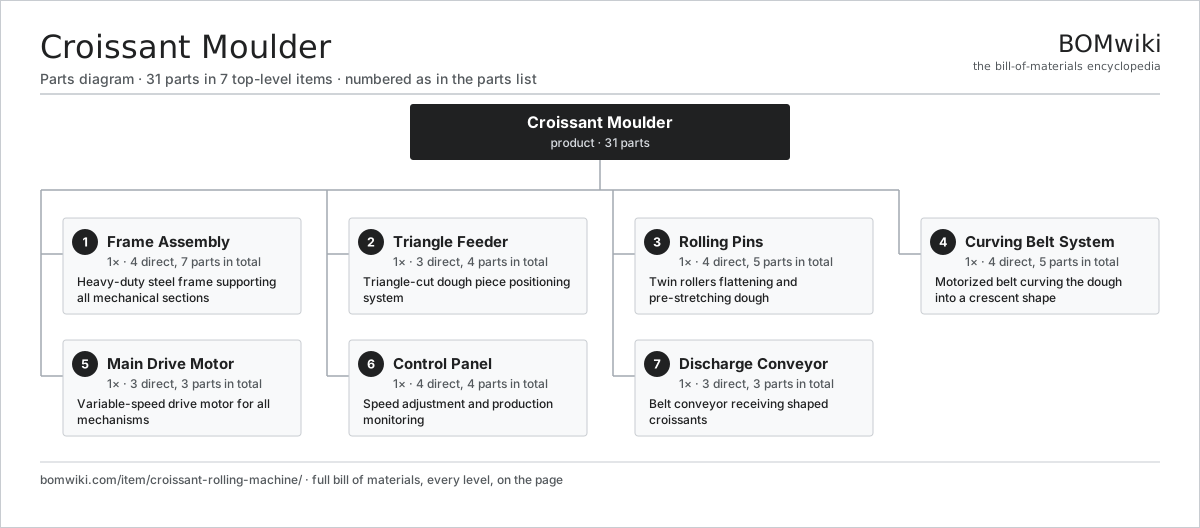
| # | Part | Qty | What it does |
|---|---|---|---|
| 1 | Frame Assembly 4 parts | 1× | Heavy-duty steel frame supporting all mechanical sections |
| 2 | Triangle Feeder 3 parts | 1× | Triangle-cut dough piece positioning system |
| 3 | Rolling Pins 4 parts | 1× | Twin rollers flattening and pre-stretching dough |
| 4 | Curving Belt System 4 parts | 1× | Motorized belt curving the dough into a crescent shape |
| 5 | Main Drive Motor 3 parts | 1× | Variable-speed drive motor for all mechanisms |
| 6 | Control Panel 4 parts | 1× | Speed adjustment and production monitoring |
| 7 | Discharge Conveyor 3 parts | 1× | Belt conveyor receiving shaped croissants |
3D model
No 3D model yet. Have a CAD file of this? Add a 3D model. STL renders right on this page; STEP, FreeCAD, and OpenSCAD sources are welcome too (openly licensed, like all 3D models on BOMwiki).
Build & assembly graph
expand / collapse · shared sub-assemblies converge · links to related products · est. labourTap an assembly to expand/collapse · tap a part to open it · use “Open page” for any node · drag to pan, scroll to zoom.
Bill of materials for Croissant Moulder
7 top-level lines · 32 rows shown · 31 parts total · indented to 3 levels| # | Item / sub-assembly | Part no. | Qty/assy | Ext. qty | Parts | Type |
|---|---|---|---|---|---|---|
| 1 | Frame Assembly 4 parts | croissant-rolling-machine-frame | 1× | 1 | 7 | assembly |
| 1.1 | Frame Base | croissant-rolling-machine-frame-base | 1× | 1 | · | part |
| 1.2 | Frame Posts | croissant-rolling-machine-frame-posts | 4× | 4 | · | part |
| 1.3 | Frame Rails | croissant-rolling-machine-frame-rails | 1× | 1 | · | part |
| 1.4 | Fastener Set | fastener-set | 1× | 1 | · | part |
| 2 | Triangle Feeder 3 parts | croissant-rolling-machine-triangle-feeder | 1× | 1 | 4 | assembly |
| 2.1 | Feed Gate | croissant-rolling-machine-feed-gate | 1× | 1 | · | part |
| 2.2 | Guide Rails | croissant-rolling-machine-guide-rails | 2× | 2 | · | part |
| 2.3 | Registration Sensor | croissant-rolling-machine-registration-sensor | 1× | 1 | · | part |
| 3 | Rolling Pins 4 parts | croissant-rolling-machine-rolling-pins | 1× | 1 | 5 | assembly |
| 3.1 | Top Rolling Pin | croissant-rolling-machine-pin-top | 1× | 1 | · | part |
| 3.2 | Bottom Rolling Pin | croissant-rolling-machine-pin-bottom | 1× | 1 | · | part |
| 3.3 | Pin Bearings | croissant-rolling-machine-pin-bearings | 2× | 2 | · | part |
| 3.4 | Gap Adjuster | croissant-rolling-machine-pin-gap-adjuster | 1× | 1 | · | part |
| 4 | Curving Belt System 4 parts | croissant-rolling-machine-curving-belt | 1× | 1 | 5 | assembly |
| 4.1 | Curving Belt | croissant-rolling-machine-belt-span | 1× | 1 | · | part |
| 4.2 | Belt Motor | croissant-rolling-machine-belt-motor | 1× | 1 | · | part |
| 4.3 | Belt Rollers | croissant-rolling-machine-belt-rollers | 2× | 2 | · | part |
| 4.4 | Belt Tension | croissant-rolling-machine-belt-tension | 1× | 1 | · | part |
| 5 | Main Drive Motor 3 parts | croissant-rolling-machine-main-motor | 1× | 1 | 3 | assembly |
| 5.1 | Motor Unit | croissant-rolling-machine-motor-unit | 1× | 1 | · | part |
| 5.2 | Main Gearbox | croissant-rolling-machine-main-gearbox | 1× | 1 | · | part |
| 5.3 | Drive Pulley | croissant-rolling-machine-belt-pulley | 1× | 1 | · | part |
| 6 | Control Panel 4 parts | croissant-rolling-machine-control-panel | 1× | 1 | 4 | assembly |
| 6.1 | VFD Drive | croissant-rolling-machine-vfd-drive | 1× | 1 | · | part |
| 6.2 | Speed Potentiometer | croissant-rolling-machine-speed-potentiometer | 1× | 1 | · | part |
| 6.3 | Relay | relay | 1× | 1 | · | part |
| 6.4 | Connector | connector | 1× | 1 | · | part |
| 7 | Discharge Conveyor 3 parts | croissant-rolling-machine-discharge-conveyor | 1× | 1 | 3 | assembly |
| 7.1 | Discharge Belt | croissant-rolling-machine-discharge-belt | 1× | 1 | · | part |
| 7.2 | Discharge Motor | croissant-rolling-machine-discharge-motor | 1× | 1 | · | part |
| 7.3 | Drive Belt | drive-belt | 1× | 1 | · | part |
Something wrong in this list? Report a problem with this BOM.
Related products
same domain, ranked by shared parts Bottle Washing Machine
2,388 parts · shares 2 with this page
Bread Moulder
32 parts · shares 2 with this page
Brine Chilling System
239 parts · shares 2 with this page
Bottle Washing Machine
2,388 parts · shares 2 with this page
Bread Moulder
32 parts · shares 2 with this page
Brine Chilling System
239 parts · shares 2 with this page
 Can Seaming Machine
658 parts · shares 2 with this page
Can Seaming Machine
658 parts · shares 2 with this page
Sourcing: possible vendors
Browse the supplier directory → Prices, MOQ, and lead times are algorithmic estimates, not quotes, and not claims about these companies. Company mappings are curated by keyword; est. price band $1k–$500k. How estimates work| Vendor | HQ | Specialty | MOQ | Lead time |
|---|---|---|---|---|
| gea.com ↗ | Düsseldorf, DE | Process technology | 20 units | 12–20 wks |
| buhlergroup.com ↗ | Uzwil, CH | Food & materials processing | 20 units | 12–20 wks |
| tetrapak.com ↗ | Pully, CH | Food packaging & processing | 20 units | 12–20 wks |
| jbtc.com ↗ | Chicago, US | Food processing equipment | 20 units | 12–20 wks |
| alfalaval.com ↗ | Lund, SE | Heat transfer & separation | 20 units | 12–20 wks |
1,058-word article