Curling Stone
ProductOverview
A curling stone is a massive granite block engineered to slide and stop predictably on ice during the game of curling. The sport requires teams to deliver stones with controlled velocity and rotation, sliding them down a sheet of ice toward a target. The Granite Body provides the mass and density necessary for stable motion; the Running Band curves concavely to minimize contact with the ice, reducing friction and enabling extended gliding; the Handle Assembly allows the thrower to deliver the stone with the desired direction and spin.
Curling stones are among the most precisely engineered sporting equipment, subject to strict international standards specifying weight, diameter, handle design, and running band geometry. Stones from different quarries behave differently due to subtle variations in granite composition and crystalline structure, making stone selection a strategic factor in competitive curling.
The modern curling stone design emerged in 19th-century Scotland. Contemporary stones employ granite quarried from two primary sources: Ailsa Craig in Scotland (known for fine, homogeneous granite), and Trelex in Canada (known for dense, durable granite). Both sources produce granite suitable for competition stones, though some teams and curlers prefer one source over the other based on perceived gliding characteristics.
How it works
The thrower steps into the hack (starting position) with one foot on a footrest and the other in a frame, gripping the Handle Assembly. The team's strategist calls a shot: the desired location and trajectory for the stone. The thrower pushes off, sliding down the ice on a slider (a low-friction device worn on one shoe), extending their arm and releasing the stone at the hog line (a marked line partway down the sheet).
At release, the thrower imparts a specific rotational direction (curl direction) and velocity. The Running Band, the only part of the stone in contact with the ice, glides on a thin film of water created by the stone's weight and the friction-driven melting of the ice surface. The stone's rotation causes it to curve slightly as it slows, a phenomenon called "curl" (the namesake of the sport).
As the stone travels, team members follow it down the sheet, using brushes or brooms to reduce friction on the ice directly in front of the stone, allowing it to travel farther and curve less. Conversely, not brushing allows friction to increase, shortening travel distance and increasing curl. The stone eventually comes to rest near or within the target, called the "house."
The curling-stone-seat (a shallow depression on the top surface) provides a grip point for initial delivery; the handle is then released. The shape and mass of the Granite Body ensure stable, predictable motion. The Bumper Ring protects the stone from damage when striking other stones or the sideboards.
Materials and engineering
The Granite Raw is quarried and rough-shaped at the source. The Body Finish is precision-ground to international specifications, with a tolerance of ±6 mm on diameter and weight. The stone is typically cylindrical, about 290–300 mm in diameter and 130–140 mm tall.
The Running Band is the critical engineered surface. Rather than a flat base, it is concavely curved, with the deepest point approximately 150–160 mm from the stone's center. This means the stone contacts the ice in a narrow ring around the base, not the entire bottom surface. The concave profile is ground to within ±0.5 mm of a spherical surface, ensuring that the stone rocks stably on the ice and glides in a predictable manner.
The Handle Assembly is typically made from plastic or composite material, shaped ergonomically for grip. The handle is attached to the stone via a Tang Attachment, a metal or composite rod extending from the handle into the stone. The tang is secured in a Insert Bushing, a threaded metal insert bonded into the granite using Bushing Adhesive.
The curling-stone-seat is a shallow depression (100–110 mm diameter, 10–15 mm deep) on the top surface, providing a depression for the thrower's fingers during delivery. The side surfaces are sometimes engraved with team names or identification marks.
Some stones include a Sensor Bracket, a mounting point for optional electronic sensors or telemetry equipment. These sensors measure stone velocity, spin rate, or impact forces, providing data for team analysis and coaching. Sensor-equipped stones are not permitted in official competition but are used in practice and analysis.
The Bumper Ring, typically made from plastic or rubber, encircles the base and provides impact protection. When two stones collide, the bumper absorbs some energy and protects both the granite edges from chipping and the Running Band from damage.
Friction and gliding characteristics
The coefficient of friction between the Running Band and clean ice is approximately 0.008–0.016, extraordinarily low. By comparison, steel on ice is about 0.05, and rubber on ice is about 0.1. This ultra-low friction is achieved through the stone's weight (nearly 20 kg), which melts a thin film of water between the stone and ice surface. The water film acts as a lubricant, reducing friction to nearly zero.
Brushing the ice directly in front of the stone increases friction by removing the water film and creating a slightly rougher ice surface, allowing the stone to travel farther. Conversely, not brushing allows the water film to accumulate, reducing friction and shortening travel distance. The curl effect (the stone's tendency to curve as it slows) is partly due to differential friction across the width of the stone and differential ice conditions caused by the stone's own water trail.
Ice texture and temperature significantly affect stone behavior. Pebbled ice (ice surface that has been roughened with tiny water droplets and frozen) causes the stone to grip and curl more; smooth ice reduces curl. Professional curling events use specialized ice maintenance protocols to ensure consistent conditions. The temperature differential between the stone (typically colder than the ice) and the ice surface also affects the water film and gliding characteristics.
Maintenance and specifications
Curling stones require minimal maintenance. The Running Band should be cleaned and inspected regularly; dirt or debris on the band can disrupt gliding. Small chips or cracks in the granite are cosmetic and do not affect performance, but large cracks exposing the interior should be repaired or the stone retired. The Handle Assembly can be replaced if damaged; the stone body remains serviceable.
Stones occasionally require re-profiling of the Running Band. If the stone is accidentally dropped or striking other stones has caused wear, the band can be re-ground to restore the precise concave profile. This is typically performed by specialized stone refinishing shops and costs a fraction of purchasing a new stone.
International competition stones must meet strict specifications: weight within 19.8–20.1 kg, diameter within 290–300 mm, and running band geometry verified by precise measurement. Stones can be certified and registered for competition. Non-certified stones are legal for recreational play but not for sanctioned events.
A curling stone can remain in service for 20–30 years or more with normal use. The granite is essentially inert and will not degrade over time. The Handle Assembly may require replacement after heavy use, and the Bumper Ring may wear and need re-gluing or replacement. Well-maintained stones are passed down through clubs and families, making them long-term investments.
Professional curling teams often own multiple sets of stones, allowing them to adjust stone behavior and characteristics for different ice conditions. A team might have lighter stones for fast ice and heavier stones (within the weight limit) for slow ice, or stones from different quarries for varied gliding characteristics.
Curling Stone parts and their functions
8 top-level parts · 17 parts in total · full bill of materials below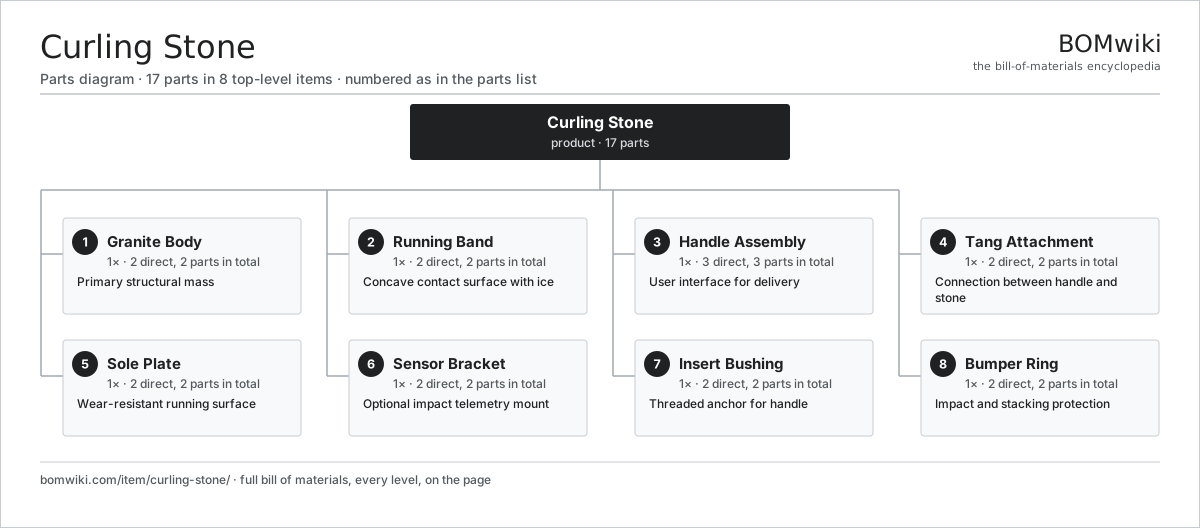
| # | Part | Qty | What it does |
|---|---|---|---|
| 1 | Granite Body 2 parts | 1× | Primary structural mass |
| 2 | Running Band 2 parts | 1× | Concave contact surface with ice |
| 3 | Handle Assembly 3 parts | 1× | User interface for delivery |
| 4 | Tang Attachment 2 parts | 1× | Connection between handle and stone |
| 5 | Sole Plate 2 parts | 1× | Wear-resistant running surface |
| 6 | Sensor Bracket 2 parts | 1× | Optional impact telemetry mount |
| 7 | Insert Bushing 2 parts | 1× | Threaded anchor for handle |
| 8 | Bumper Ring 2 parts | 1× | Impact and stacking protection |
3D model
No 3D model yet. Have a CAD file of this? Add a 3D model. STL renders right on this page; STEP, FreeCAD, and OpenSCAD sources are welcome too (openly licensed, like all 3D models on BOMwiki).
Build & assembly graph
expand / collapse · shared sub-assemblies converge · links to related products · est. labourTap an assembly to expand/collapse · tap a part to open it · use “Open page” for any node · drag to pan, scroll to zoom.
Bill of materials for Curling Stone
8 top-level lines · 25 rows shown · 17 parts total · indented to 3 levels| # | Item / sub-assembly | Part no. | Qty/assy | Ext. qty | Parts | Type |
|---|---|---|---|---|---|---|
| 1 | Granite Body 2 parts | curling-stone-granite-body | 1× | 1 | 2 | assembly |
| 1.1 | Granite Raw | curling-stone-granite-raw | 1× | 1 | · | part |
| 1.2 | Body Finish | curling-stone-body-finish | 1× | 1 | · | part |
| 2 | Running Band 2 parts | curling-stone-running-band | 1× | 1 | 2 | assembly |
| 2.1 | Band Geometry | curling-stone-band-geometry | 1× | 1 | · | part |
| 2.2 | Band Surface | curling-stone-band-surface | 1× | 1 | · | part |
| 3 | Handle Assembly 3 parts | curling-stone-handle-assembly | 1× | 1 | 3 | assembly |
| 3.1 | Handle Material | curling-stone-handle-material | 1× | 1 | · | part |
| 3.2 | Handle Grip | curling-stone-handle-grip | 1× | 1 | · | part |
| 3.3 | Handle Insert | curling-stone-handle-insert | 1× | 1 | · | part |
| 4 | Tang Attachment 2 parts | curling-stone-tang-attachment | 1× | 1 | 2 | assembly |
| 4.1 | Tang Material | curling-stone-tang-material | 1× | 1 | · | part |
| 4.2 | Tang Fastener | curling-stone-tang-fastener | 1× | 1 | · | part |
| 5 | Sole Plate 2 parts | curling-stone-sole-plate | 1× | 1 | 2 | assembly |
| 5.1 | Plate Material | curling-stone-plate-material | 1× | 1 | · | part |
| 5.2 | Plate Adhesive | curling-stone-plate-adhesive | 1× | 1 | · | part |
| 6 | Sensor Bracket 2 parts | curling-stone-sensor-bracket | 1× | 1 | 2 | assembly |
| 6.1 | Bracket Material | curling-stone-bracket-material | 1× | 1 | · | part |
| 6.2 | Bracket Fastener | curling-stone-bracket-fastener | 1× | 1 | · | part |
| 7 | Insert Bushing 2 parts | curling-stone-insert-bushing | 1× | 1 | 2 | assembly |
| 7.1 | Bushing Material | curling-stone-bushing-material | 1× | 1 | · | part |
| 7.2 | Bushing Adhesive | curling-stone-bushing-adhesive | 1× | 1 | · | part |
| 8 | Bumper Ring 2 parts | curling-stone-bumper-ring | 1× | 1 | 2 | assembly |
| 8.1 | Bumper Material | curling-stone-bumper-material | 1× | 1 | · | part |
| 8.2 | Bumper Adhesive | curling-stone-bumper-adhesive | 1× | 1 | · | part |
Something wrong in this list? Report a problem with this BOM.
Sourcing: possible vendors
Browse the supplier directory → Prices, MOQ, and lead times are algorithmic estimates, not quotes, and not claims about these companies. Company mappings are curated by keyword; est. price band $20–$2k. How estimates work| Vendor | HQ | Specialty | MOQ | Lead time |
|---|---|---|---|---|
|
🇺🇸Coleman
coleman.com ↗
|
Chicago, US | Camping gear | 1,000 units | 6–10 wks |
| thenorthface.com ↗ | Denver, US | Outdoor apparel & gear | 1,000 units | 6–10 wks |
|
🇺🇸YETI
yeti.com ↗
|
Austin, US | Coolers & drinkware | 1,000 units | 6–10 wks |
| decathlon.com ↗ | Villeneuve-d'Ascq, FR | Sporting goods | 1,000 units | 6–10 wks |
|
🇺🇸Garmin
garmin.com ↗
|
Olathe, US | GPS & wearables | 1,000 units | 6–10 wks |
1,326-word article