Curve Tracer
ProductOverview
A curve tracer is a specialized semiconductor test instrument that characterizes the electrical behavior of transistors, diodes, integrated circuits, and other active devices by measuring their current-voltage (I-V) relationships. The instrument applies a swept voltage to the device under test while stepping a control signal (base current for BJTs, gate voltage for FETs) in discrete increments, recording the resulting collector/drain current for each combination. This produces a family of I-V curves displayed on a CRT screen, revealing the device's operating regions, parasitic effects, and failure modes.
Curve tracers have been essential diagnostic tools since the 1960s, used in design validation, failure analysis, device characterization, and educational laboratories. A single measurement showing multiple I-V curves enables engineers to immediately assess whether a device is functioning correctly, has shorted or opened internal structures, or exhibits anomalous behavior indicating damage or contamination. Modern curve tracers offer programmable step generators, digital current and voltage readouts, and safety interlocks to protect expensive devices from accidental destruction.
Measurement Architecture
The collector supply applies a ramp voltage (0–1000V in 10–1000 ms) between the collector and emitter of the device under test. Simultaneously, the step generator applies discrete base current steps (e.g., 1 µA, 2 µA, 3 µA..., 10 µA) in separate measurement cycles. For each base current level, the collector voltage sweeps from zero to maximum, and the resulting collector current is measured via a transimpedance amplifier and displayed as the Y-axis voltage on the CRT display.
The X-axis of the CRT is driven by the collector voltage ramp, so each horizontal trace represents one complete collector voltage sweep at a fixed base current. Superimposing 10–100 such traces (one for each base step level) produces a characteristic transistor I-V curve family, showing how collector current increases with both collector voltage (vertical axis) and base current (trace spacing).
Key features visible on the display:
- Saturation region: Far left (low Vce), curves nearly horizontal, indicating constant current independent of collector voltage.
- Active region: Center, curves rise steeply with negative slope indicating constant transconductance (β).
- Cutoff region: Far right (high Vce), near-zero current, indicating gate/base is inactive.
- Breakdown: Top-right corner, curve bends sharply upward indicating junction avalanche or thermal runaway.
Safety and Protection
Testing semiconductor devices at high voltages and currents risks catastrophic failure, a shorted transistor can draw hundreds of amperes, instantly vaporizing bond wires and destroying the device. Modern curve tracers employ multiple safeguards:
The safety assembly includes:
- Over-current shutdown: A fast comparator detects when measured current exceeds the programmed limit and latches off the high-voltage supply within 1 microsecond.
- Arc detection: A dI/dt sensing circuit monitors the rate of current change. A sudden current spike (e.g., dI/dt > 100 A/µs) indicates an arc (short circuit), triggering immediate supply cutoff.
- Soft-start circuit: Upon power-on, the collector voltage ramps slowly (avoiding inrush current spikes) to the test level.
- Device shield: An insulated compartment physically isolates the test device from the operator and external RF fields.
- Safety interlock: A mechanical switch on the test device access door disables high voltage when opened.
These protections enable safe exploration of device limits: engineers can deliberately stress a transistor to its breakdown voltage without risk of uncontrolled destruction. The fast current-limiting latch typically shuts off the supply in less than 1 µs, limiting energy dissipation to millijoules rather than joules.
Display and Controls
The 5-inch CRT display operates at 2 kV accelerating voltage, providing sharp focus and rapid deflection up to 5 kHz bandwidth. The X-axis amplifier drives the horizontal ramp (collector voltage), while the Y-axis amplifier drives the vertical deflection (collector current). Both amplifiers use class A linear stages to minimize distortion and phase lag that would warp the displayed curves.
Front-panel controls allow the user to:
- Select collector voltage range (10V, 100V, or 1000V full scale).
- Choose collector current range (10 µA, 100 µA, 1 mA, 10 mA, 100 mA, 1 A).
- Set base/gate current range and increment (e.g., steps of 10 µA from 0 to 100 µA).
- Adjust sweep speed (10–1000 ms per horizontal trace).
- Enable auto-repeat mode to cycle continuously, or single-shot mode for detailed examination of a specific base current.
A 12-bit monitoring ADC samples both axes at 1 kHz, enabling digital readout of the current cursor position on the display. This allows operators to measure specific points on the curve (e.g., Vbe at IC = 10 mA) without reading analog meter scales.
Interpretation of Curves
A healthy BJT transistor displays:
- Saturation region (Vce < 0.2V): Nearly flat curves, Ic ≈ constant, independent of Vce.
- Active region (0.2V < Vce < Vceo): Curves slope upward, with constant spacing between base current steps, indicating constant β ≈ Ic/Ib.
- Cutoff region (Vce > Vceo): Curves cluster near zero, with Ic << expected, indicating gate/base drive is off.
Anomalies:
- Drooping curves: Negative differential resistance (curves bend backward) indicates thermal instability or secondary breakdown, the device is overheating.
- Leakage at cutoff: Curves in the cutoff region should drop to near-zero; visible current suggests substrate leakage or parasitic conduction paths.
- Non-uniform spacing: Variable spacing between base steps suggests non-linear transconductance, possible junction damage or saturation effects.
- Soft breakdown: Curves bending sharply in the high-Vce region indicate avalanche multiplication; hard breakdown (vertical rise to 1 A) suggests junction rupture or metallic conduction path.
Device Characterization Applications
Curve tracers are used to extract transistor parameters for circuit simulation models:
- Early voltage (VA): Inverse of the slope of active-region curves; higher VA indicates better current source behavior.
- Transconductance (gm): Slope of Ic vs Ib in the active region; larger gm indicates stronger gain.
- Leakage current (ICBO): Collector current at cutoff (Ib = 0); should be <100 pA for silicon BJTs.
- Breakdown voltage (VCE(BR)): Vce where curves turn vertical; must exceed design margin.
In failure analysis, curve tracers help diagnose the root cause: a shorted transistor displays curves that immediately saturate at low Vce and high Ic, while an open base shows no current regardless of Vce, and parametric failures show curves shifted in Vce or Ic from nominal values.
Curve Tracer parts and their functions
7 top-level parts · 36 parts in total · full bill of materials below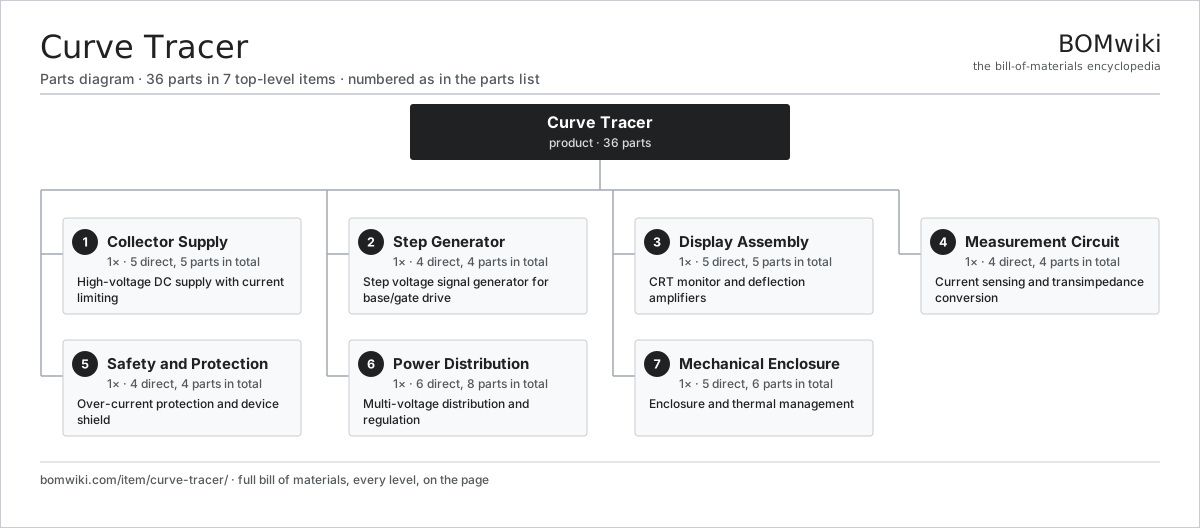
| # | Part | Qty | What it does |
|---|---|---|---|
| 1 | Collector Supply 5 parts | 1× | High-voltage DC supply with current limiting |
| 2 | Step Generator 4 parts | 1× | Step voltage signal generator for base/gate drive |
| 3 | Display Assembly 5 parts | 1× | CRT monitor and deflection amplifiers |
| 4 | Measurement Circuit 4 parts | 1× | Current sensing and transimpedance conversion |
| 5 | Safety and Protection 4 parts | 1× | Over-current protection and device shield |
| 6 | Power Distribution 6 parts | 1× | Multi-voltage distribution and regulation |
| 7 | Mechanical Enclosure 5 parts | 1× | Enclosure and thermal management |
3D model
No 3D model yet. Have a CAD file of this? Add a 3D model. STL renders right on this page; STEP, FreeCAD, and OpenSCAD sources are welcome too (openly licensed, like all 3D models on BOMwiki).
Build & assembly graph
expand / collapse · shared sub-assemblies converge · links to related products · est. labourTap an assembly to expand/collapse · tap a part to open it · use “Open page” for any node · drag to pan, scroll to zoom.
Bill of materials for Curve Tracer
7 top-level lines · 40 rows shown · 36 parts total · indented to 3 levels| # | Item / sub-assembly | Part no. | Qty/assy | Ext. qty | Parts | Type |
|---|---|---|---|---|---|---|
| 1 | Collector Supply 5 parts | curve-tracer-collector-supply | 1× | 1 | 5 | assembly |
| 1.1 | HV Supply Module | curve-tracer-hvdc-module | 1× | 1 | · | part |
| 1.2 | Voltage Ramp Generator | curve-tracer-sweep-circuit | 1× | 1 | · | part |
| 1.3 | Programmable Current Limiter | curve-tracer-current-limit | 1× | 1 | · | part |
| 1.4 | Soft-Start Circuit | curve-tracer-soft-start | 1× | 1 | · | part |
| 1.5 | Test Probe Connector | curve-tracer-output-connector | 1× | 1 | · | part |
| 2 | Step Generator 4 parts | curve-tracer-step-generator | 1× | 1 | 4 | assembly |
| 2.1 | Step DAC | curve-tracer-step-dac | 1× | 1 | · | part |
| 2.2 | Step Amplifier | curve-tracer-step-amplifier | 1× | 1 | · | part |
| 2.3 | Step Current Source | curve-tracer-step-output | 1× | 1 | · | part |
| 2.4 | Range Selector | curve-tracer-step-range | 1× | 1 | · | part |
| 3 | Display Assembly 5 parts | curve-tracer-display-system | 1× | 1 | 5 | assembly |
| 3.1 | CRT Display Tube | curve-tracer-crt | 1× | 1 | · | part |
| 3.2 | X Deflection Amplifier | curve-tracer-x-amplifier | 1× | 1 | · | part |
| 3.3 | Y Deflection Amplifier | curve-tracer-y-amplifier | 1× | 1 | · | part |
| 3.4 | CRT HV Supply | curve-tracer-high-voltage-final | 1× | 1 | · | part |
| 3.5 | Anode Cooling Fan | curve-tracer-crt-cooling | 1× | 1 | · | part |
| 4 | Measurement Circuit 4 parts | curve-tracer-measurement | 1× | 1 | 4 | assembly |
| 4.1 | Transimpedance Amplifier | curve-tracer-tia | 1× | 1 | · | part |
| 4.2 | Current Sense Resistor | curve-tracer-current-sense-resistor | 1× | 1 | · | part |
| 4.3 | Display Buffer Amplifier | curve-tracer-output-buffer | 1× | 1 | · | part |
| 4.4 | Monitoring ADC | curve-tracer-adc-monitor | 1× | 1 | · | part |
| 5 | Safety and Protection 4 parts | curve-tracer-safety | 1× | 1 | 4 | assembly |
| 5.1 | Over-Current Latch | curve-tracer-over-current-latch | 1× | 1 | · | part |
| 5.2 | Arc Detector | curve-tracer-arc-detector | 1× | 1 | · | part |
| 5.3 | Device Shield Enclosure | curve-tracer-device-shield | 1× | 1 | · | part |
| 5.4 | Safety Interlock Switch | curve-tracer-interlock | 1× | 1 | · | part |
| 6 | Power Distribution 6 parts | curve-tracer-power-supply | 1× | 1 | 8 | assembly |
| 6.1 | Power Transformer | curve-tracer-transformer | 1× | 1 | · | part |
| 6.2 | Main Rectifier Module | curve-tracer-rectifier-main | 1× | 1 | · | part |
| 6.3 | +15V Linear Regulator | curve-tracer-regulator-pos15 | 1× | 1 | · | part |
| 6.4 | -15V Linear Regulator | curve-tracer-regulator-neg15 | 1× | 1 | · | part |
| 6.5 | 5V Switching Regulator | curve-tracer-regulator-5v | 1× | 1 | · | part |
| 6.6 | Bulk Capacitor | curve-tracer-filter-bank | 3× | 3 | · | part |
| 7 | Mechanical Enclosure 5 parts | curve-tracer-housing | 1× | 1 | 6 | assembly |
| 7.1 | Welded Steel Chassis | curve-tracer-steel-frame | 1× | 1 | · | part |
| 7.2 | Front Aluminum Panel | curve-tracer-front-panel | 1× | 1 | · | part |
| 7.3 | High-Voltage Shield Barrier | curve-tracer-internal-shield | 2× | 2 | · | part |
| 7.4 | Cooling Fan | curve-tracer-fan-motor | 1× | 1 | · | part |
| 7.5 | Fastener Set | fastener-set | 1× | 1 | · | part |
Something wrong in this list? Report a problem with this BOM.
Sourcing: possible vendors
Browse the supplier directory → Prices, MOQ, and lead times are algorithmic estimates, not quotes, and not claims about these companies. Company mappings are curated by keyword; est. price band $1k–$500k. How estimates work| Vendor | HQ | Specialty | MOQ | Lead time |
|---|---|---|---|---|
| thermofisher.com ↗ | Waltham, US | Lab instruments | 100 units | 10–18 wks |
|
🇺🇸Agilent
agilent.com ↗
|
Santa Clara, US | Analytical instruments | 100 units | 10–18 wks |
|
🇺🇸Bruker
bruker.com ↗
|
Billerica, US | Scientific instruments | 100 units | 10–18 wks |
|
🇯🇵Shimadzu
shimadzu.com ↗
|
Kyoto, JP | Analytical instruments | 100 units | 10–18 wks |
|
🇺🇸Waters
waters.com ↗
|
Milford, US | Chromatography & MS | 100 units | 10–18 wks |
1,066-word article