CWDM Multiplexer
ProductOverview
A CWDM (Coarse Wavelength Division Multiplexer) is a passive optical component that combines or separates multiple laser wavelengths on a single fiber, multiplying the fiber's carrying capacity without adding active equipment. Eight independent optical channels, each carrying a different data rate and protocol, can travel on one fiber strand. At each end of the link, a CWDM demultiplexes the combined signal back into eight separate channels.
The device is called "coarse" because the wavelength spacing (20 nm) is much larger than DWDM (Dense WDM, which uses 0.4 nm spacing). CWDM is simpler and cheaper than DWDM, no temperature tuning needed, and filters are easier to design. A carrier using CWDM avoids the cost and complexity of running eight separate fibers, instead multiplexing them onto one, cutting fiber infrastructure costs by up to 8×.
Optical architecture
The heart of the CWDM is the thin-film dichroic filter cascade. Each filter is a precisely-engineered multilayer optical coating on a glass substrate. The first filter (1470 nm) sits at a 45° angle in the light path: it reflects 1470 nm light strongly but transmits longer wavelengths (1490–1610 nm) with little loss. The reflected 1470 signal peels off and exits toward its pigtail connector.
The transmitted light (1490–1610) encounters the second filter (1490 nm), which reflects 1490 and transmits 1510–1610. This cascades through all eight filters. By the end of the stack, all eight wavelengths are separated spatially, each heading toward its own individual fiber pigtail.
Reversing the light path (multiplexing) works the same way: eight pigtails each feed one wavelength into the cascade in reverse. All eight wavelengths combine onto a single common output fiber.
Filter specifications
Each dichroic filter is tuned to a specific wavelength. The filter's passband (transmission peak) is roughly 13 nm wide for CWDM, wide enough that wavelength drift due to temperature does not push the signal out of band. Each filter is oriented at an angle to the incident light, exploiting the wavelength-dependent reflectance of the multilayer coating.
The optical bench holds the filters at precise angles, typically a cascade geometry where each filter is slightly tilted, so the reflected light exits at a different angle than the transmitted light. This spatial separation is key: the eight wavelengths exit the multiplexer at different angles, each heading toward its own pigtail via the fiber connector.
Isolation between channels is critical. If light from the 1550 nm channel (the strongest, often used for the highest-power laser) leaks into the 1530 nm channel, it adds noise and degrades performance. Filters provide >25 dB isolation, meaning unwanted wavelength power is attenuated by 25 dB or more. This is sufficient for most networks but can be supplemented with fiber-optic isolators in high-noise environments.
Passive and low-loss operation
Unlike a switch or router, a CWDM is entirely passive: no power, no electronics, no moving parts. Light enters and exits through fiber pigtails; internal optics do all the work. This brings several benefits: zero electrical power consumption, infinite mean time between failures (failures are almost unheard of), and no heat dissipation.
The insertion loss (typically <4 dB) is the main trade-off. Each filter reflects some light and scatters a small amount due to coating imperfections. Accumulated loss across the cascade means the 1610 nm channel at the end of the stack experiences higher loss (~4 dB) than the 1470 nm channel at the start (~2 dB). This is acceptable for most links: a 10 dBm input on a 4 dB loss channel still delivers +6 dBm output, easily detected by a receiver.
Wavelength assignment and planning
The eight CWDM channels are standardized (ITU G.694.2 CWDM grid), so any vendor's CWDM mux is compatible with any other. A carrier assigns wavelengths to applications strategically. For example:
- 1470 nm: Voice/TDM circuit traffic (legacy, slow modulation)
- 1490 nm: Slow IP backbone link (2.5 Gbps)
- 1510 nm: Fast IP backbone link (10 Gbps)
- 1530 nm: Business customer metro link (10 Gbps)
- 1550 nm: High-power long-distance link (40 Gbps, uses Erbium-Doped Fiber Amplifier (EDFA) at junctions)
- 1570–1610 nm: Additional customer or redundancy links
The 1550 nm wavelength is special: erbium-doped fiber amplifiers (EDFAs) amplify almost exclusively in the 1530–1565 nm window (C-band), so 1550 nm is standard for long-distance links. 1470 and 1490 nm are outside the EDFA window, so they are used for shorter distances.
Temperature and tuning
A CWDM filter's passband is relatively wide (13 nm), so temperature-induced wavelength drift is tolerable. As temperature rises, the filter's peak shifts slightly toward longer wavelengths. A laser at 1550 nm might drift to 1550.5 nm at 40°C; this is still within the 13 nm passband, so isolation remains >25 dB. CWDM does not require active temperature tuning like DWDM does.
Some systems use temperature-stabilized lasers (with feedback control) to minimize drift, but it is not required for CWDM. This simplicity is why CWDM is popular in enterprise and regional networks where cost is more important than density.
Physical deployment
A CWDM mux is typically a small 1U rack-mount module or a standalone unit installed in a patch panel. Eight pigtails (one per channel, plus one common output) are routed to patch panels or directly to transceivers. Installation is straightforward: route the fiber to the mux, click the pigtails into the patch panel, and the link is active.
For upgrades, wavelengths can be reused by replacing only the transceiver on that wavelength, not the entire mux. This flexibility makes CWDM popular for capacity growth.
Link architecture with amplification
For long distances (>80 km), optical amplifiers (EDFAs) are added inline. A CWDM mux output (with eight wavelengths combined on one fiber) feeds into an EDFA, which amplifies all wavelengths simultaneously. The amplified signal travels hundreds of kilometers, then another EDFA at the receiving end amplifies it again before demultiplexing. The CWDM is transparent to the EDFA; all it sees is a broadband optical signal.
The sealed package housing protects the optics from dust and vibration during installation and transport, and the desiccant packet inside prevents moisture from degrading the coatings over decades.
CWDM Multiplexer parts and their functions
7 top-level parts · 85 parts in total · full bill of materials below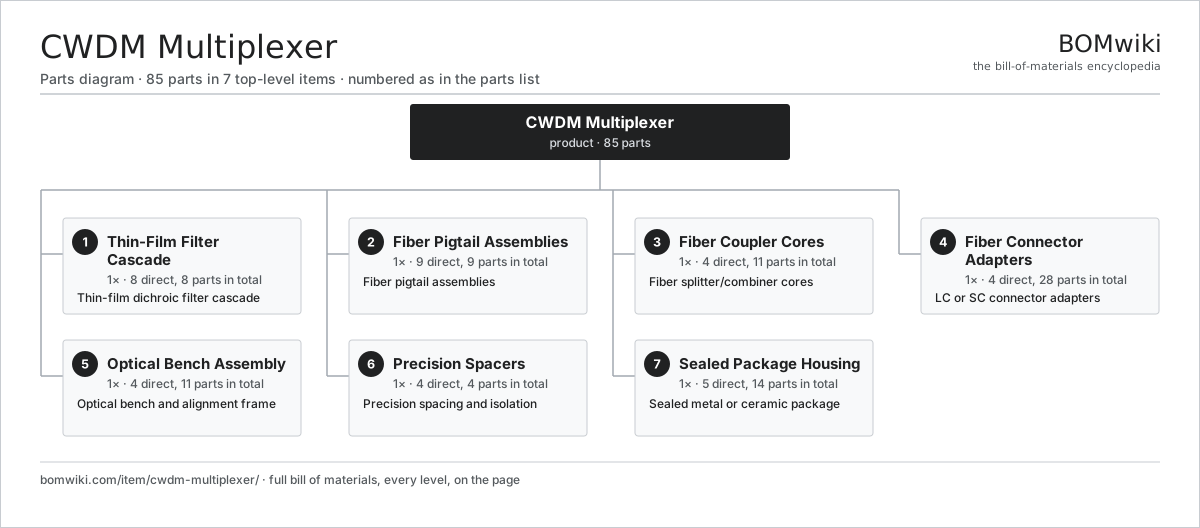
| # | Part | Qty | What it does |
|---|---|---|---|
| 1 | Thin-Film Filter Cascade 8 parts | 1× | Thin-film dichroic filter cascade |
| 2 | Fiber Pigtail Assemblies 9 parts | 1× | Fiber pigtail assemblies |
| 3 | Fiber Coupler Cores 4 parts | 1× | Fiber splitter/combiner cores |
| 4 | Fiber Connector Adapters 4 parts | 1× | LC or SC connector adapters |
| 5 | Optical Bench Assembly 4 parts | 1× | Optical bench and alignment frame |
| 6 | Precision Spacers 4 parts | 1× | Precision spacing and isolation |
| 7 | Sealed Package Housing 5 parts | 1× | Sealed metal or ceramic package |
3D model
No 3D model yet. Have a CAD file of this? Add a 3D model. STL renders right on this page; STEP, FreeCAD, and OpenSCAD sources are welcome too (openly licensed, like all 3D models on BOMwiki).
Build & assembly graph
expand / collapse · shared sub-assemblies converge · links to related products · est. labourTap an assembly to expand/collapse · tap a part to open it · use “Open page” for any node · drag to pan, scroll to zoom.
Bill of materials for CWDM Multiplexer
7 top-level lines · 45 rows shown · 85 parts total · indented to 3 levels| # | Item / sub-assembly | Part no. | Qty/assy | Ext. qty | Parts | Type |
|---|---|---|---|---|---|---|
| 1 | Thin-Film Filter Cascade 8 parts | cwdm-filter-stack | 1× | 1 | 8 | assembly |
| 1.1 | 1470 nm Filter | cwdm-filter-element-1470 | 1× | 1 | · | part |
| 1.2 | 1490 nm Filter | cwdm-filter-element-1490 | 1× | 1 | · | part |
| 1.3 | 1510 nm Filter | cwdm-filter-element-1510 | 1× | 1 | · | part |
| 1.4 | 1530 nm Filter | cwdm-filter-element-1530 | 1× | 1 | · | part |
| 1.5 | 1550 nm Filter | cwdm-filter-element-1550 | 1× | 1 | · | part |
| 1.6 | 1570 nm Filter | cwdm-filter-element-1570 | 1× | 1 | · | part |
| 1.7 | 1590 nm Filter | cwdm-filter-element-1590 | 1× | 1 | · | part |
| 1.8 | 1610 nm Filter | cwdm-filter-element-1610 | 1× | 1 | · | part |
| 2 | Fiber Pigtail Assemblies 9 parts | cwdm-fiber-pigtails | 1× | 1 | 9 | assembly |
| 2.1 | Common Pigtail | cwdm-pigtail-common | 1× | 1 | · | part |
| 2.2 | Channel 1 Pigtail | cwdm-pigtail-ch1 | 1× | 1 | · | part |
| 2.3 | Channel 2 Pigtail | cwdm-pigtail-ch2 | 1× | 1 | · | part |
| 2.4 | Channel 3 Pigtail | cwdm-pigtail-ch3 | 1× | 1 | · | part |
| 2.5 | Channel 4 Pigtail | cwdm-pigtail-ch4 | 1× | 1 | · | part |
| 2.6 | Channel 5 Pigtail | cwdm-pigtail-ch5 | 1× | 1 | · | part |
| 2.7 | Channel 6 Pigtail | cwdm-pigtail-ch6 | 1× | 1 | · | part |
| 2.8 | Channel 7 Pigtail | cwdm-pigtail-ch7 | 1× | 1 | · | part |
| 2.9 | Channel 8 Pigtail | cwdm-pigtail-ch8 | 1× | 1 | · | part |
| 3 | Fiber Coupler Cores 4 parts | cwdm-fiber-couplers | 1× | 1 | 11 | assembly |
| 3.1 | 1×8 Coupler Core | cwdm-coupler-core-1x8 | 1× | 1 | · | part |
| 3.2 | Optical Isolator | cwdm-coupler-isolator | 1× | 1 | · | part |
| 3.3 | Fusion Point | cwdm-coupler-fusion-point | 8× | 8 | · | part |
| 3.4 | Buffer Tube | cwdm-coupler-buffer-tube | 1× | 1 | · | part |
| 4 | Fiber Connector Adapters 4 parts | cwdm-lc-adapter-set | 1× | 1 | 28 | assembly |
| 4.1 | LC Ferrule | cwdm-lc-connector-ferrule | 9× | 9 | · | part |
| 4.2 | Spring Mechanism | cwdm-lc-connector-spring | 9× | 9 | · | part |
| 4.3 | Connector Boot | cwdm-lc-connector-boot | 9× | 9 | · | part |
| 4.4 | Cleave Reference | cwdm-connector-cleave-tip | 1× | 1 | · | part |
| 5 | Optical Bench Assembly 4 parts | cwdm-internal-mounting | 1× | 1 | 11 | assembly |
| 5.1 | Baseplate | cwdm-bench-baseplate | 1× | 1 | · | part |
| 5.2 | Filter Mount | cwdm-bench-filter-mounts | 8× | 8 | · | part |
| 5.3 | Coupler Mount | cwdm-bench-coupler-mount | 1× | 1 | · | part |
| 5.4 | Alignment Mark | cwdm-bench-alignment-laser-marks | 1× | 1 | · | part |
| 6 | Precision Spacers 4 parts | cwdm-alignment-spacers | 1× | 1 | 4 | assembly |
| 6.1 | Shim Pack | cwdm-spacer-shim-set | 1× | 1 | · | part |
| 6.2 | Standoff Bolts | cwdm-spacer-standoff-set | 1× | 1 | · | part |
| 6.3 | Damping Pad | cwdm-spacer-isolation-pad | 1× | 1 | · | part |
| 6.4 | Thermal Buffer | cwdm-spacer-thermal-compensation | 1× | 1 | · | part |
| 7 | Sealed Package Housing 5 parts | cwdm-housing | 1× | 1 | 14 | assembly |
| 7.1 | Housing Tube | cwdm-housing-can | 1× | 1 | · | part |
| 7.2 | End Cap | cwdm-housing-end-cap | 2× | 2 | · | part |
| 7.3 | Pigtail Port | cwdm-housing-pigtail-port | 9× | 9 | · | part |
| 7.4 | Potting Epoxy | cwdm-housing-potting-compound | 1× | 1 | · | part |
| 7.5 | Desiccant | cwdm-housing-desiccant-packet | 1× | 1 | · | part |
Something wrong in this list? Report a problem with this BOM.
Sourcing: possible vendors
Browse the supplier directory → Prices, MOQ, and lead times are algorithmic estimates, not quotes, and not claims about these companies. Company mappings are curated by keyword; est. price band $30–$50k. How estimates work| Vendor | HQ | Specialty | MOQ | Lead time |
|---|---|---|---|---|
|
🇺🇸Cisco
cisco.com ↗
|
San Jose, US | Networking | 500 units | 8–14 wks |
|
🇺🇸Juniper
juniper.net ↗
|
Sunnyvale, US | Networking | 500 units | 8–14 wks |
| arista.com ↗ | Santa Clara, US | Networking | 500 units | 8–14 wks |
|
🇫🇮Nokia
nokia.com ↗
|
Espoo, FI | Telecom equipment | 500 units | 8–14 wks |
|
🇨🇳Huawei
huawei.com ↗
|
Shenzhen, CN | Networking & telecom | 500 units | 8–14 wks |
1,060-word article