Deadbolt Assembly
ProductOverview
A deadbolt assembly is a standalone locking device designed to supplement or replace simpler push-button or turn-knob locks on residential and commercial doors. Unlike spring latches (which automatically seat when a door closes), a deadbolt is manually controlled, it must be explicitly rotated (via an exterior key or interior thumbturn) to extend or retract. This explicit control prevents accidental unlocking and provides superior security against forced entry.
Deadbolts are the industry standard for front doors, sliding doors, and any entry point requiring security beyond a simple push-button latch. A residential deadbolt typically costs €50–150, takes 30–90 minutes to install, and lasts 10–20 years with minimal maintenance.
The deadbolt mechanism
The Bolt Mechanism is the core working element. The Bolt Bar, a hardened steel rod typically 16–20 mm in diameter, extends 40–50 mm beyond the door face into a corresponding opening in the Strike Plate on the frame. Unlike a spring latch (which is beveled and self-closing), the deadbolt is perfectly straight and remains extended only when manually held by the locking mechanism.
The bolt is driven by a Bolt Cam, a rotating element coupled to the Cylinder Core. When the correct key is turned in the exterior cylinder, the plug rotates ~90°, rotating the cam, which retracts the bolt. Interior operation is via a Thumbturn, a manual knob or lever that directly rotates the cam without requiring a key.
The Bolt Spring is a light coil spring biasing the bolt toward the locked (extended) position. This prevents accidental retraction from door vibration or accidental knob manipulation. The spring force (typically 3–5 N) is weak enough that manual operation is easy but strong enough to return the bolt after turning a key.
Pin-tumbler cylinder
The Cylinder Core is a standard 5- or 6-pin tumbler cylinder functionally identical to those in mortise locks or padlocks. The rotating Plug contains the keyway and Key Pins (bottom pins matched to the user's key). The stationary Bible contains the Driver Pins (top pins).
When the correct key is inserted and turned, it lifts the pins to the shear line, allowing the plug to rotate approximately 90°. This plug rotation is mechanically transmitted to the Bolt Cam via the Tailpiece, a rigid stem protruding from the plug's rear end.
Common deadbolt cylinders use ANSI pin stacks (1–5 grade), permitting professional rekeying by locksmiths. The cylinder can often be removed (after unbolting the deadbolt from the door) and reinstalled in a different keyed state, or replaced entirely with a new pre-keyed cylinder.
Housing and installation
The Bolt Housing contains the bolt rod, cylinder, spring, and cam mechanism in a protective aluminum or steel case, typically 100–150 mm long and 40–60 mm wide. The housing is mounted to the door face using the Latch Bracket, a steel plate bolted through the door thickness or surface-mounted depending on the installation type.
Installation methods vary:
- Surface-mounted: The housing sits on the door surface; the bolt extends through a predrilled hole in the frame. Easiest installation, common in rentals and retrofits.
- Mortise-mounted: A cavity is routed into the door edge; the housing sits flush. More elegant but requires careful carpentry.
- Rim-mounted: For metal or glass doors; the housing mounts on the exterior face with a vertical bolt rod extending downward to the door bottom.
Most residential deadbolts are surface-mounted for ease of installation; commercial buildings favor mortise or integrated designs.
Exterior key and interior thumbturn
Professional deadbolts use independent control mechanisms for security:
- Exterior: Keyed cylinder, accessible only to keyholders.
- Interior: Thumbturn (a manual knob or lever), accessible to anyone inside the building.
This dual-control design ensures that residents cannot be locked out even if they lose exterior keys, but also prevents someone outside from gaining access. If a key is lost, the exterior cylinder can be rekeyed or replaced without affecting the interior thumbturn.
Some specialty deadbolts include a thumbturn lock, a rotating lever with a deadlock feature that, when activated, disables the interior control. This is useful in hotels, offices, or situations where occupants want to ensure a door cannot be opened from inside (fire code permitting).
Strike plate and door frame
The Strike Plate is mounted on the door frame, aligned with the bolt rod projection. The strike has an opening (typically 13–16 mm wide and 20–25 mm tall) into which the bolt rod inserts. The strike must be steel or heavy-duty stainless steel to resist prying.
A Strike Reinforcement, an extended lip or wrap-around extension, is standard on security deadbolts. This reinforcement anchors the strike deep into the frame studs (with long bolts), preventing the strike from being ripped off during forced-entry attacks. A basic strike mounted only to the door casing (veneer) is easily defeated; a reinforced strike anchored to the frame's 2×4 studs is highly resistant.
Professional security audits recommend:
- Hardened steel strikes (not aluminum or plastic).
- Long bolts (2–3 inches) securing the strike to the frame studs.
- Multiple bolt holes (typically 3–4) distributing load.
Keying and master systems
Standard deadbolt cylinders can be rekeyed to any combination by locksmiths using standard pin sets. This allows:
- Rental properties: Rekeying after each tenant moves out.
- Lost key replacement: Rekeying to a new master key set.
- Master key systems: Pinning multiple deadbolts to operate with both individual keys and a master key (for property managers or emergency access).
The master key concept uses special wafer pins (master pins) allowing two different keys to operate the same lock. This is common in apartments, offices, and commercial buildings where a manager needs master access.
Cylinder protection and drilling resistance
Modern deadbolts include anti-drilling features to prevent attackers from drilling out the cylinder and forcing the mechanism:
- Hardened steel pins: Tempered to resist drill bit penetration.
- Hardened steel collars: Surrounding the cylinder, requiring the drill to go through additional hardened material.
- Drilling-resistant inserts: Carbide or case-hardened steel sleeves inside the keyway.
- Pin tumbler design: The pins themselves, if drilled, collapse asymmetrically, jamming the mechanism.
ANSI Grade 1 deadbolts are resistant to 10 minutes of drilling with power tools; Grade 2 resists 5 minutes.
Installation backset and alignment
The Cylinder Core is mounted at a specific distance from the door's edge, called the backset. Standard backsets are 38 mm, 44 mm, or 48 mm (measured from the edge of the door to the center of the cylinder). The backset determines the bolt rod projection distance into the frame.
Proper installation requires:
- Measuring and marking the backset on the door.
- Drilling a hole for the cylinder (typically 21 mm diameter).
- Installing the bolt housing on the edge (routed mortise or surface-mounted).
- Aligning the bolt rod with the strike hole.
- Installing the strike plate on the frame, offset to align with the bolt.
Misalignment, bolt not centered in the strike opening, causes jamming or uneven wear. Professional installers use jigs and alignment guides to ensure accuracy.
Dual deadbolts for sliding doors
Sliding glass doors and patio doors often use two deadbolts (one at the top, one at the bottom) to distribute load and prevent the door from being forced open. The two bolts are controlled by a single key or by independent keys, depending on the design.
Electronic deadbolts
Modern variations include electronic deadbolts with motorized locking, keypad entry, smartphone control, or biometric sensors. These retain the basic pin-tumbler backup (mechanical key access) for emergency situations but add electronic convenience.
Cost and lifespan
Residential deadbolts range from €30 (budget) to €150 (high-security) per unit. Installation (if DIY) takes 30–60 minutes; professional installation adds €75–150 in labor. A quality deadbolt lasts 10–20 years under normal use before requiring replacement due to wear or corrosion.
In rental properties with frequent tenant turnover, deadbolts are rekeyed 2–4 times per decade; full replacement is less common unless the mechanism is damaged or seized.
Standards and compliance
Deadbolts are regulated by:
- ANSI/BHMA Grade 1–3: Establishes durability and security ratings.
- UL Standards: For fire-rated and safety applications.
- ADA: Deadbolts must be operable without fine motor control (thumbturn design must not require twisting motions).
- Building codes: May require deadbolts on all exterior doors, with specific security ratings.
Most residential deadbolts sold meet ANSI Grade 2 or 3, providing adequate security for typical residential use.
Deadbolt Assembly parts and their functions
6 top-level parts · 41 parts in total · full bill of materials below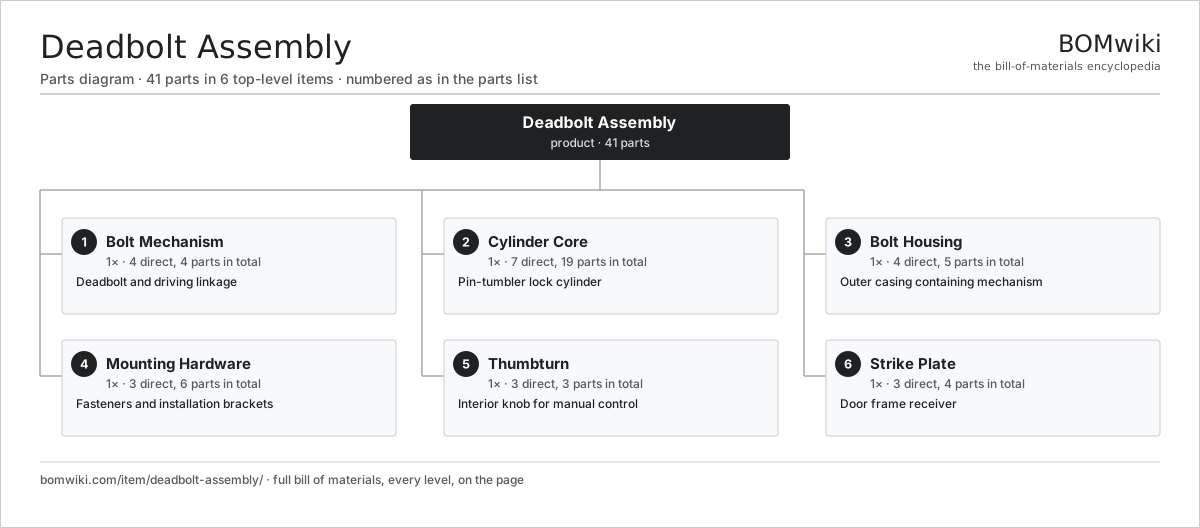
| # | Part | Qty | What it does |
|---|---|---|---|
| 1 | Bolt Mechanism 4 parts | 1× | Deadbolt and driving linkage |
| 2 | Cylinder Core 7 parts | 1× | Pin-tumbler lock cylinder |
| 3 | Bolt Housing 4 parts | 1× | Outer casing containing mechanism |
| 4 | Mounting Hardware 3 parts | 1× | Fasteners and installation brackets |
| 5 | Thumbturn 3 parts | 1× | Interior knob for manual control |
| 6 | Strike Plate 3 parts | 1× | Door frame receiver |
3D model
No 3D model yet. Have a CAD file of this? Add a 3D model. STL renders right on this page; STEP, FreeCAD, and OpenSCAD sources are welcome too (openly licensed, like all 3D models on BOMwiki).
Build & assembly graph
expand / collapse · shared sub-assemblies converge · links to related products · est. labourTap an assembly to expand/collapse · tap a part to open it · use “Open page” for any node · drag to pan, scroll to zoom.
Bill of materials for Deadbolt Assembly
6 top-level lines · 30 rows shown · 41 parts total · indented to 3 levels| # | Item / sub-assembly | Part no. | Qty/assy | Ext. qty | Parts | Type |
|---|---|---|---|---|---|---|
| 1 | Bolt Mechanism 4 parts | deadbolt-assembly-bolt-mechanism | 1× | 1 | 4 | assembly |
| 1.1 | Bolt Bar | deadbolt-assembly-bolt-bar | 1× | 1 | · | part |
| 1.2 | Bolt Cam | deadbolt-assembly-bolt-cam | 1× | 1 | · | part |
| 1.3 | Bolt Spring | deadbolt-assembly-bolt-spring | 1× | 1 | · | part |
| 1.4 | Tailpiece Link | deadbolt-assembly-tailpiece-link | 1× | 1 | · | part |
| 2 | Cylinder Core 7 parts | deadbolt-assembly-cylinder-core | 1× | 1 | 19 | assembly |
| 2.1 | Plug | deadbolt-assembly-plug | 1× | 1 | · | part |
| 2.2 | Bible | deadbolt-assembly-bible | 1× | 1 | · | part |
| 2.3 | Driver Pins | deadbolt-assembly-driver-pins | 5× | 5 | · | part |
| 2.4 | Key Pins | deadbolt-assembly-key-pins | 5× | 5 | · | part |
| 2.5 | Coil Spring | coil-spring | 5× | 5 | · | part |
| 2.6 | Tailpiece | deadbolt-assembly-tailpiece | 1× | 1 | · | part |
| 2.7 | Retaining Ring | deadbolt-assembly-retaining-ring | 1× | 1 | · | part |
| 3 | Bolt Housing 4 parts | deadbolt-assembly-bolt-housing | 1× | 1 | 5 | assembly |
| 3.1 | Housing Body | deadbolt-assembly-housing-body | 1× | 1 | · | part |
| 3.2 | Escutcheon Ring | deadbolt-assembly-escutcheon-ring | 1× | 1 | · | part |
| 3.3 | Internal Bracket | deadbolt-assembly-internal-bracket | 1× | 1 | · | part |
| 3.4 | Fastener Set | fastener-set | 2× | 2 | · | part |
| 4 | Mounting Hardware 3 parts | deadbolt-assembly-mounting-hardware | 1× | 1 | 6 | assembly |
| 4.1 | Latch Bracket | deadbolt-assembly-latch-bracket | 1× | 1 | · | part |
| 4.2 | Strike Bracket | deadbolt-assembly-strike-mounting-bracket | 1× | 1 | · | part |
| 4.3 | Fastener Set | fastener-set | 4× | 4 | · | part |
| 5 | Thumbturn 3 parts | deadbolt-assembly-thumbturn | 1× | 1 | 3 | assembly |
| 5.1 | Thumbturn Knob | deadbolt-assembly-thumbturn-knob | 1× | 1 | · | part |
| 5.2 | Thumbturn Spindle | deadbolt-assembly-thumbturn-spindle | 1× | 1 | · | part |
| 5.3 | Thumbturn Mount | deadbolt-assembly-thumbturn-mount | 1× | 1 | · | part |
| 6 | Strike Plate 3 parts | deadbolt-assembly-strike-plate | 1× | 1 | 4 | assembly |
| 6.1 | Strike Body | deadbolt-assembly-strike-body | 1× | 1 | · | part |
| 6.2 | Strike Reinforcement | deadbolt-assembly-strike-reinforcement | 1× | 1 | · | part |
| 6.3 | Fastener Set | fastener-set | 2× | 2 | · | part |
Something wrong in this list? Report a problem with this BOM.
Related products
same domain, ranked by shared parts Access Control Panel
52 parts · shares 1 with this page
Automatic Smoke Vent
60 parts · shares 1 with this page
Access Control Panel
52 parts · shares 1 with this page
Automatic Smoke Vent
60 parts · shares 1 with this page
 Automatic Swing Door Operator
43 parts · shares 1 with this page
Automatic Swing Door Operator
43 parts · shares 1 with this page
 Clay Brick Extruder
154 parts · shares 1 with this page
Concrete Pipe Making Machine
154 parts · shares 1 with this page
Clay Brick Extruder
154 parts · shares 1 with this page
Concrete Pipe Making Machine
154 parts · shares 1 with this page
 Electric Mortise Lock
47 parts · shares 1 with this page
Electric Mortise Lock
47 parts · shares 1 with this page
Sourcing: possible vendors
Browse the supplier directory → Prices, MOQ, and lead times are algorithmic estimates, not quotes, and not claims about these companies. Company mappings are curated by keyword; est. price band $50–$10k. How estimates work| Vendor | HQ | Specialty | MOQ | Lead time |
|---|---|---|---|---|
| assaabloy.com ↗ | Stockholm, SE | Locks & access | 1,000 units | 8–12 wks |
|
🇺🇸Allegion
allegion.com ↗
|
Dublin, US | Security products (Schlage) | 1,000 units | 8–12 wks |
| dormakaba.com ↗ | Rümlang, CH | Access & door systems | 1,000 units | 8–12 wks |
| honeywell.com ↗ | Charlotte, US | Building & safety tech | 1,000 units | 8–12 wks |
| hikvision.com ↗ | Hangzhou, CN | Surveillance & security | 1,000 units | 8–12 wks |
1,448-word article