Delivery Drone
ProductOverview
A delivery drone is an unmanned multirotor aircraft carrying a package payload, designed for autonomous or remote-piloted flight from a distribution hub to a customer's location. The system combines quadrotor/hexarotor flight mechanics (vertical lift from electric motors), GPS-based autonomous navigation, and cargo-release mechanisms, enabling last-mile delivery without human pilots or ground infrastructure.
The enabler is BVLOS (beyond-visual-line-of-sight) regulatory approval: rather than require line-of-sight to a remote pilot, the drone flies pre-planned waypoint missions using GNSS positioning and a telemetry datalink (radio or cellular) for monitoring and emergency intervention. This allows one ground operator to supervise multiple autonomous deliveries in parallel.
Airframe and structure
The Multirotor Airframe is a simple cruciform or X-pattern frame: four Boom Arm arms radiating from a central Center Plate hub, with a Brushless Motor and rotor at each boom end. The booms are carbon-fiber tubes for light weight (typically 1–2 kg total frame mass). The center plate houses the flight computer, battery, and payload mechanisms.
A Landing Gear skid or collapsible leg set allows the drone to rest on the ground without tipping or damaging sensors mounted on the bottom. For delivery operations, this landing gear is often extended after the package is released, so the drone itself can land safely and be retrieved.
Propulsion and power
Four Brushless Motor outrunner motors (400–800 W each) drive fixed-pitch Propeller rotors. Each motor is controlled by an ESC (electronic speed controller) that converts pulse-width-modulation (PWM) signals from the flight controller into three-phase AC commutation current. The motor mounts are damped with elastomer Motor Mount vibration isolators to prevent motor noise and vibration from corrupting IMU and barometer sensors.
Power comes from the Battery Pack: typically 6S (22.2 V nominal) LiPo cells configured for 3–6 kWh total energy. The Battery Management System battery management system monitors cell voltages and temperature, balancing cells during charge and disconnecting if any cell fails. A high-current Battery Connector feeds the main power distribution, with inline fusing to prevent short-circuit damage.
Autonomous flight
The Flight Controller is the brain: an ARM Cortex microprocessor running firmware that stabilizes the drone and navigates to delivery coordinates. The IMU (nine-axis: gyro, accelerometer, magnetometer) measures angular rates and linear accelerations at ~400 Hz. The Barometer provides altitude feedback via pressure measurement. A sensor-fusion algorithm (Extended Kalman filter) combines all sensors to estimate vehicle attitude (roll, pitch, yaw) and position.
Stabilization is automatic: if a gust tilts the drone 5° to the right, the gyro detects the rotation and the processor commands the right motors to spin faster and left motors slower, keeping the drone level. Similarly, if the barometer shows the drone sinking, the altitude-hold loop increases collective thrust to maintain altitude.
Navigation uses the GNSS Receiver GPS module, a dual- or triple-frequency receiver achieving ±2–5 m accuracy in normal conditions. The pilot (or ground operator) loads a flight plan: "Take off, fly to lat/lon 37.4°N 122.1°W, descend to 50 m, release payload, return to home base." The flight controller executes these waypoints autonomously, adjusting motor thrust to follow the desired path.
Optional RTK Module real-time kinematic correction improves GNSS accuracy to ±0.1 m using correction signals from a ground station, valuable for precision landing on small rooftops or in tight urban spaces.
Payload and delivery
The Payload Bay is a rigid Cargo Container (typically 10–30 L) secured under the fuselage. The package sits inside with padding, and the container is latched shut with mechanical Container Latch pins. At the delivery location, the flight controller commands a Release Servo servo motor that pulls the latch pins, opening the container door and allowing the package to drop safely onto the customer's porch (or into a designated safe zone).
The cargo container is damped to the airframe via Shock Absorber mounts, isolating vibration during flight and protecting sensitive cargo from motor noise.
Safety and redundancy
The Emergency Parachute System is the critical safety mechanism: a compact Parachute Pack with bridle, stowed on the airframe and deployed via an explosive or spring-based Deployment Motor cartridge. If the flight controller detects loss of GPS signal, motor failure, or battery voltage drop below safe levels, it automatically fires the parachute, allowing the entire drone to descend safely under the chute rather than falling unpowered.
This ballistic parachute capability is why delivery drones can operate BVLOS: they're not dependent on continuous radio uplink or line-of-sight recovery. If communications are lost, the drone uses its last known GPS position to navigate home, and if it fails to do so, the parachute ensures a controlled descent.
Communications
The Communication System system provides telemetry and control. The Radio Module is a 900 MHz or 2.4 GHz transceiver transmitting drone status (battery voltage, GPS position, signal strength) and receiving updated waypoints or emergency commands. Range is typically 5–50 km depending on antenna height and terrain.
The Remote ID Module broadcasts the drone's identity and location via WiFi or Bluetooth, per regulatory requirements (U.S. Remote ID rules, EASA registration). This allows authorized personnel to identify any drone in airspace and track its location.
An optional Cellular Modem 4G/LTE module enables cellular command uplink, allowing the operator to update missions or trigger emergency procedures even if the dedicated radio link is jammed or saturated.
Regulatory and operational context
Delivery drones operate under Part 107 (USA), EASA Special Operations (EU), or equivalent national UAS regulations. Requirements typically include:
- BVLOS waiver or approval from the aviation authority.
- Parachute or other means of ensuring controlled descent.
- Remote ID and tracking (GPS broadcast or cellular).
- Operator training and certification (Remote Pilot License).
- Airspace coordination with air traffic control (if near airports).
- Third-party liability insurance.
Modern delivery-drone operators (Amazon Prime Air, Wing Aviation, UPS Drone) deploy fleets of 4–10 kg machines from neighborhood distribution centers, targeting 2–4 mile delivery ranges and 30 min round-trip cycle time. Regulatory evolution is shifting toward more autonomous operation: fewer pilots per fleet, longer range, all-weather capability.
Delivery Drone parts and their functions
8 top-level parts · 80 parts in total · full bill of materials below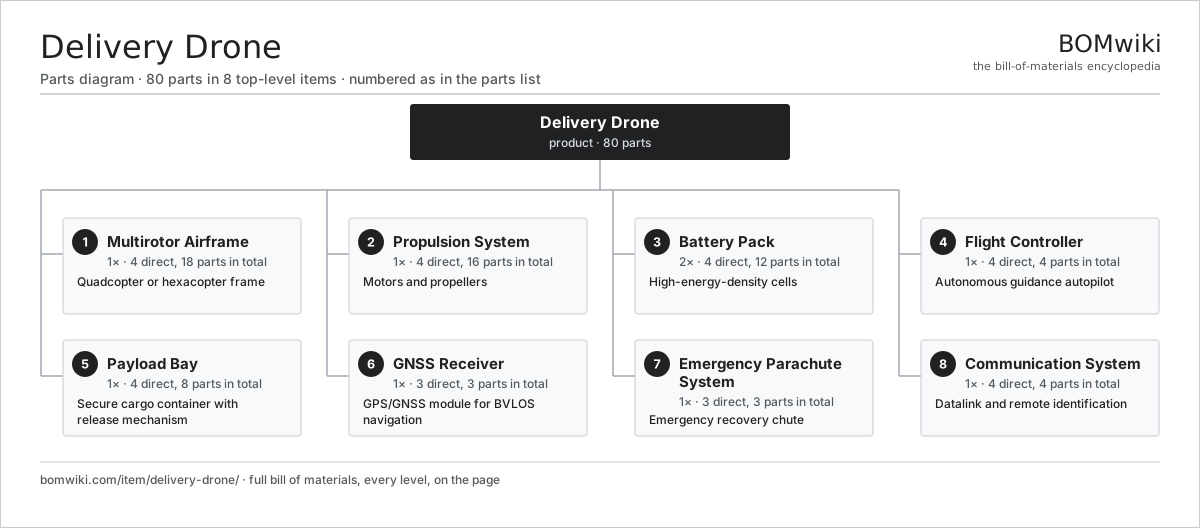
| # | Part | Qty | What it does |
|---|---|---|---|
| 1 | Multirotor Airframe 4 parts | 1× | Quadcopter or hexacopter frame |
| 2 | Propulsion System 4 parts | 1× | Motors and propellers |
| 3 | Battery Pack 4 parts | 2× | High-energy-density cells |
| 4 | Flight Controller 4 parts | 1× | Autonomous guidance autopilot |
| 5 | Payload Bay 4 parts | 1× | Secure cargo container with release mechanism |
| 6 | GNSS Receiver 3 parts | 1× | GPS/GNSS module for BVLOS navigation |
| 7 | Emergency Parachute System 3 parts | 1× | Emergency recovery chute |
| 8 | Communication System 4 parts | 1× | Datalink and remote identification |
3D model
No 3D model yet. Have a CAD file of this? Add a 3D model. STL renders right on this page; STEP, FreeCAD, and OpenSCAD sources are welcome too (openly licensed, like all 3D models on BOMwiki).
Build & assembly graph
expand / collapse · shared sub-assemblies converge · links to related products · est. labourTap an assembly to expand/collapse · tap a part to open it · use “Open page” for any node · drag to pan, scroll to zoom.
Bill of materials for Delivery Drone
8 top-level lines · 38 rows shown · 80 parts total · indented to 3 levels| # | Item / sub-assembly | Part no. | Qty/assy | Ext. qty | Parts | Type |
|---|---|---|---|---|---|---|
| 1 | Multirotor Airframe 4 parts | delivery-drone-airframe | 1× | 1 | 18 | assembly |
| 1.1 | Boom Arm | delivery-drone-boom | 4× | 4 | · | part |
| 1.2 | Center Plate | delivery-drone-center-plate | 1× | 1 | · | part |
| 1.3 | Landing Gear | delivery-drone-landing-gear | 1× | 1 | · | part |
| 1.4 | Frame Connector | delivery-drone-frame-connector | 12× | 12 | · | part |
| 2 | Propulsion System 4 parts | delivery-drone-propulsion | 1× | 1 | 16 | assembly |
| 2.1 | Brushless Motor | delivery-drone-brushless-motor | 4× | 4 | · | part |
| 2.2 | ESC | delivery-drone-esc | 4× | 4 | · | part |
| 2.3 | Propeller | delivery-drone-propeller | 4× | 4 | · | part |
| 2.4 | Motor Mount | delivery-drone-motor-mount | 4× | 4 | · | part |
| 3 | Battery Pack 4 parts | delivery-drone-battery-pack | 2× | 2 | 12 | assembly |
| 3.1 | LiPo Cell | lipo-cell | 8× | 16 | · | part |
| 3.2 | Battery Management System | delivery-drone-bms | 1× | 2 | · | part |
| 3.3 | Battery Connector | delivery-drone-battery-connector | 2× | 4 | · | part |
| 3.4 | Battery Case | delivery-drone-battery-case | 1× | 2 | · | part |
| 4 | Flight Controller 4 parts | delivery-drone-flight-controller | 1× | 1 | 4 | assembly |
| 4.1 | IMU | delivery-drone-imu | 1× | 1 | · | part |
| 4.2 | Barometer | delivery-drone-barometer | 1× | 1 | · | part |
| 4.3 | Processor | delivery-drone-processor | 1× | 1 | · | part |
| 4.4 | Sensor Fusion | delivery-drone-sensor-fusion | 1× | 1 | · | part |
| 5 | Payload Bay 4 parts | delivery-drone-payload-bay | 1× | 1 | 8 | assembly |
| 5.1 | Cargo Container | delivery-drone-cargo-container | 1× | 1 | · | part |
| 5.2 | Release Servo | delivery-drone-release-servo | 1× | 1 | · | part |
| 5.3 | Container Latch | delivery-drone-container-latch | 2× | 2 | · | part |
| 5.4 | Shock Absorber | delivery-drone-shock-absorber | 4× | 4 | · | part |
| 6 | GNSS Receiver 3 parts | delivery-drone-gnss-receiver | 1× | 1 | 3 | assembly |
| 6.1 | GNSS Module | delivery-drone-gnss-module | 1× | 1 | · | part |
| 6.2 | GNSS Antenna | delivery-drone-gnss-antenna | 1× | 1 | · | part |
| 6.3 | RTK Module | delivery-drone-rtk-module | 1× | 1 | · | part |
| 7 | Emergency Parachute System 3 parts | delivery-drone-parachute-system | 1× | 1 | 3 | assembly |
| 7.1 | Parachute Pack | delivery-drone-parachute-pack | 1× | 1 | · | part |
| 7.2 | Deployment Motor | delivery-drone-deployment-motor | 1× | 1 | · | part |
| 7.3 | Deployment Sensor | delivery-drone-deployment-sensor | 1× | 1 | · | part |
| 8 | Communication System 4 parts | delivery-drone-comm-link | 1× | 1 | 4 | assembly |
| 8.1 | Radio Module | delivery-drone-radio-module | 1× | 1 | · | part |
| 8.2 | Remote ID Module | delivery-drone-remote-id-module | 1× | 1 | · | part |
| 8.3 | Cellular Modem | delivery-drone-cellular-modem | 1× | 1 | · | part |
| 8.4 | Antenna | delivery-drone-antenna | 1× | 1 | · | part |
Something wrong in this list? Report a problem with this BOM.
Related products
same domain, ranked by shared parts Cargo Delivery Drone
545 parts · shares 1 with this page
Cargo Delivery Drone
545 parts · shares 1 with this page
 Fixed-Wing Survey Drone
382 parts · shares 1 with this page
Fixed-Wing Survey Drone
382 parts · shares 1 with this page
 Fixed-Wing UAV
308 parts · shares 1 with this page
Fixed-Wing UAV
308 parts · shares 1 with this page
 Hang Glider
135 parts · shares 1 with this page
Hang Glider
135 parts · shares 1 with this page
 Hot Air Balloon
146 parts · shares 1 with this page
Hot Air Balloon
146 parts · shares 1 with this page
 Micro Racing Quadcopter
506 parts · shares 1 with this page
Micro Racing Quadcopter
506 parts · shares 1 with this page
Sourcing: possible vendors
Browse the supplier directory → Prices, MOQ, and lead times are algorithmic estimates, not quotes, and not claims about these companies. Company mappings are curated by keyword; est. price band $50k–$300M. How estimates work| Vendor | HQ | Specialty | MOQ | Lead time |
|---|---|---|---|---|
|
🇺🇸Boeing
boeing.com ↗
|
Arlington, US | Aerospace OEM | made to order | 40–80 wks |
|
🇫🇷Airbus
airbus.com ↗
|
Toulouse, FR | Aerospace OEM | made to order | 40–80 wks |
| lockheedmartin.com ↗ | Bethesda, US | Aerospace & defense | made to order | 40–80 wks |
|
🇧🇷Embraer
embraer.com ↗
|
São José dos Campos, BR | Aircraft OEM | made to order | 40–80 wks |
| txtav.com ↗ | Wichita, US | Aircraft OEM | made to order | 40–80 wks |
1,085-word article