Dense Media Separation Plant
ProductOverview
Dense media separation (DMS) is a gravity-based beneficiation technique that exploits density differences between minerals to achieve separation. Ore particles are suspended in a dense liquid (heavy liquid) or dense slurry (dense medium suspension) at a controlled density. Heavy ore particles sink while light gangue particles float, allowing clean separation of valuable mineral from waste.
The two main dense media types are:
- Magnetite suspension (Fe₃O₄, density 4.8 g/cm³): Economical, recoverable via magnetic separation, widely used.
- Ferrosilicon suspension (FeSi, density 6.5+ g/cm³): Denser, suitable for separating closer-density ores, but more expensive and harder to recover.
A typical DMS plant comprises a separation cyclone, media circulation system, drain screens, rinse spray, and densifier thickener to recover and recycle the medium. DMS is particularly effective for iron ore, coal, diamond, and cassiterite (tin) beneficiation where density differences are favorable.
How it works
Ore feed (typically crushed to −50 mm or finer, sized to a narrow range) is mixed with dense medium from the storage tank and fed into the DMS cyclone. Inside the cyclone, the mixture spins at high velocity. Centrifugal force accelerates the density segregation:
- Heavy particles (higher density than medium) are pushed outward and downward, exiting at the underflow spigot (heavy product).
- Light particles (lower density than medium) migrate toward the axis and exit at the overflow launder (light product).
The partition density (cut density) is user-adjustable by varying the pump flow rate and pressure, which affects medium density inside the cyclone. Higher flow or pressure raises medium density; lower flow reduces it.
Both product streams still carry significant dense medium cling (coating of medium on particles). To recover this medium, both streams flow onto drain screens that vibrate and shed liquid back to a collection hopper. The screens typically remove 80–90% of cling.
Remaining cling is removed in the rinse system, where fresh water is sprayed over both products. Rinse water carries medium back to the densifier thickener, a large settling tank where magnetite or ferrosilicon is concentrated via gravity and returned to the feed tank. This recovery loop is essential for economic operation.
Cyclone Dynamics
The cyclone is a conical vessel, 1–3 m in diameter, receiving a tangential spray of ore and medium. The inlet is positioned tangentially, causing the slurry to spin rapidly, velocities of 5–8 m/s are typical. Inside, three forces act on each particle:
- Centrifugal force (proportional to mass, angular velocity, and radius)
- Viscous drag (from medium)
- Gravity (downward)
For a light particle (e.g., quartz, 2.6 g/cm³) in magnetite medium (4.8 g/cm³):
- Centrifugal force pushes it outward, but the buoyancy force (generated by medium's density) opposes this.
- Net inward force overcomes centrifugal drag, pushing it toward the axis.
- It exits with the overflow (light product).
For a heavy particle (e.g., hematite, 5.2 g/cm³) in the same medium:
- Centrifugal force pushes outward; buoyancy acts inward but is less than the centrifugal force.
- Net outward force is large; it migrates to the periphery and exits at underflow (heavy product).
The efficiency of separation depends on feed size distribution, medium density, cyclone diameter, and inlet pressure. Fine particles (<100 μm) are harder to separate because viscous drag dominates over centrifugal force, this is why DMS is most effective for coarser ores (−50 to +5 mm).
Media Circulation
The pump system continuously circulates medium from the tank at 50–200 m³/h through the cyclone inlet. A proportional valve regulates inlet pressure (typically 30–50 kPa above atmospheric). Higher inlet pressure increases cyclone throughput but slightly shifts the partition density (cut) toward lighter densities. The pump is variable-speed (VFD-controlled) to optimize circulation rate based on ore feed rate.
The density meter measures medium density in the feed tank, providing feedback to the controller. If density drops (due to ore feeding dilution), the densifier discharge increases to recirculate more concentrated medium. If density rises (concentration of medium), densifier discharge is reduced and more water is added.
Densifier Thickener
The densifier is a large circular tank (20–50 m diameter, 3–5 m deep) where rinse water carrying fine medium particles slowly settles. A rotating rake arm (1–3 rpm) gently propels settled solids toward a central discharge. Clear water overflows a perimeter weir at the top; concentrated medium (50–60% solids by mass) is extracted via a discharge pump and returned to the feed tank.
Densifier performance is critical: incomplete separation (carry-over of medium with discharged water) increases medium loss rates and operating cost. Poor settling (due to high slurry density or presence of clay) requires addition of settling aids (e.g., flocculants) or longer residence time.
Product Recovery
Both light and heavy products flow from the cyclone onto drain screens, which are typically 3–10 m long vibrating screens. Vibration frequency is 10–30 Hz; screens are inclined at 15–20° to promote flow. As material cascades across, dense medium drains downward through the screen mesh and is collected in a hopper below, returning directly to the tank.
Drain screens are robust industrial equipment, but the fine screen mesh clogs with clay or fine ore particles. High-pressure water washing between shifts can restore drain screen efficiency; if clogging is severe, a larger mesh and coarser feed specification may be needed.
After drain screening (80–90% of cling removed), products are sprayed with fresh water via rinse nozzles and transported to final dewatering (by thickener or filter) before storage or further processing.
Operational Variables
Cut density (partition density): The density at which equal proportions of ore sink and float, determined by medium density and cyclone design. It is adjusted by varying pump pressure and flow.
Medium density: Controlled by the balance between fresh medium additions (from supply) and recoveries (via densifier). A target density is set (e.g., 1.7 g/cm³) and maintained by PLC control of densifier discharge.
Ore feed size: Ideally −50 to +5 mm. Material finer than 5 mm reports to both products poorly (little separation efficiency). Material coarser than 50 mm may not be accelerated to equilibrium velocity within the cyclone, causing poor classification.
Ore feed rate: Increases throughput but may overload the cyclone, reducing residence time and worsening cut sharpness.
Magnetic Recovery (Magnetite Only)
If magnetite (Fe₃O₄) is used as the medium, it can be recovered magnetically from the densifier overflow water. A small wet magnetic separator can extract 99.8% of magnetite from treated water before discharge, reducing medium loss to <0.3 kg/t ore. This is economically justified for large plants.
Advantages and Limitations
Advantages:
- High separation density sharpness (cut curve narrower than flotation or gravity).
- Applicable to fine minerals (−50 μm) not recoverable by other gravity methods.
- Fast processing (residence time <2 minutes in cyclone).
- Scalable to very large throughputs (>500 t/h per cyclone).
Limitations:
- Medium cost and recovery (magnetite loss ~0.5–2 kg/t ore).
- Sensitivity to ore size distribution; narrow sizing required.
- Densifier design critical; poor densifier performance cascades to poor cycle efficiency.
- Clay minerals foul the cycle; washing may be required before DMS.
Typical Applications
Iron ore beneficiation: Separating high-grade hematite/magnetite from silica gangue, achieving −65% SiO₂ concentrates at high recovery.
Coal cleaning: Removing pyrite and mineral matter from coal, producing clean coal suitable for power plants.
Diamond mining: Separating diamondiferous kimberlite (1.3–2.0 g/cm³) from barren rock.
Tin and tungsten: Concentrating cassiterite (SnO₂, 6.8 g/cm³) and scheelite (CaWO₄, 6.1 g/cm³) from low-grade ores.
Large iron ore or coal plants operate multiple DMS circuits in parallel to achieve 200–500 t/h combined throughput, with dedicated densifier and recovery infrastructure.
Dense Media Separation Plant parts and their functions
8 top-level parts · 31 parts in total · full bill of materials below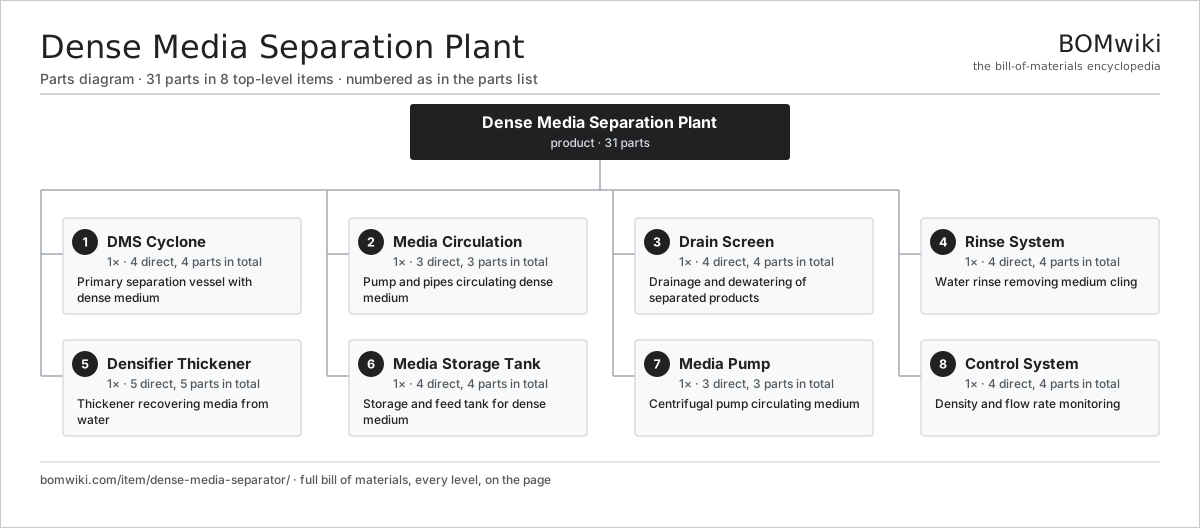
| # | Part | Qty | What it does |
|---|---|---|---|
| 1 | DMS Cyclone 4 parts | 1× | Primary separation vessel with dense medium |
| 2 | Media Circulation 3 parts | 1× | Pump and pipes circulating dense medium |
| 3 | Drain Screen 4 parts | 1× | Drainage and dewatering of separated products |
| 4 | Rinse System 4 parts | 1× | Water rinse removing medium cling |
| 5 | Densifier Thickener 5 parts | 1× | Thickener recovering media from water |
| 6 | Media Storage Tank 4 parts | 1× | Storage and feed tank for dense medium |
| 7 | Media Pump 3 parts | 1× | Centrifugal pump circulating medium |
| 8 | Control System 4 parts | 1× | Density and flow rate monitoring |
3D model
No 3D model yet. Have a CAD file of this? Add a 3D model. STL renders right on this page; STEP, FreeCAD, and OpenSCAD sources are welcome too (openly licensed, like all 3D models on BOMwiki).
Build & assembly graph
expand / collapse · shared sub-assemblies converge · links to related products · est. labourTap an assembly to expand/collapse · tap a part to open it · use “Open page” for any node · drag to pan, scroll to zoom.
Bill of materials for Dense Media Separation Plant
8 top-level lines · 39 rows shown · 31 parts total · indented to 3 levels| # | Item / sub-assembly | Part no. | Qty/assy | Ext. qty | Parts | Type |
|---|---|---|---|---|---|---|
| 1 | DMS Cyclone 4 parts | dense-media-separator-dms-cyclone | 1× | 1 | 4 | assembly |
| 1.1 | Cyclone Vessel | dense-media-separator-cyclone-body | 1× | 1 | · | part |
| 1.2 | Overflow Weir | dense-media-separator-cyclone-overflow | 1× | 1 | · | part |
| 1.3 | Underflow Spigot | dense-media-separator-cyclone-underflow | 1× | 1 | · | part |
| 1.4 | Feed Inlet | dense-media-separator-feed-inlet | 1× | 1 | · | part |
| 2 | Media Circulation 3 parts | dense-media-separator-media-circuit | 1× | 1 | 3 | assembly |
| 2.1 | Suction Pipe | dense-media-separator-suction-pipe | 1× | 1 | · | part |
| 2.2 | Discharge Pipe | dense-media-separator-discharge-pipe | 1× | 1 | · | part |
| 2.3 | Isolation Valve | dense-media-separator-isolation-valve | 1× | 1 | · | part |
| 3 | Drain Screen 4 parts | dense-media-separator-drain-screen | 1× | 1 | 4 | assembly |
| 3.1 | Screen Frame | dense-media-separator-drain-screen-frame | 1× | 1 | · | part |
| 3.2 | Screen Motor | dense-media-separator-drain-screen-motor | 1× | 1 | · | part |
| 3.3 | Screen Deck | dense-media-separator-screen-mesh | 1× | 1 | · | part |
| 3.4 | Drainage Hopper | dense-media-separator-drain-hopper | 1× | 1 | · | part |
| 4 | Rinse System 4 parts | dense-media-separator-rinse-system | 1× | 1 | 4 | assembly |
| 4.1 | Rinse Water Tank | dense-media-separator-rinse-tank | 1× | 1 | · | part |
| 4.2 | Rinse Pump | dense-media-separator-rinse-pump | 1× | 1 | · | part |
| 4.3 | Spray Nozzles | dense-media-separator-spray-nozzles | 1× | 1 | · | part |
| 4.4 | Rinse Return Pipe | dense-media-separator-rinse-water-return | 1× | 1 | · | part |
| 5 | Densifier Thickener 5 parts | dense-media-separator-densifier | 1× | 1 | 5 | assembly |
| 5.1 | Densifier Tank | dense-media-separator-densifier-tank | 1× | 1 | · | part |
| 5.2 | Densifier Rake | dense-media-separator-densifier-rake | 1× | 1 | · | part |
| 5.3 | Densifier Motor | dense-media-separator-densifier-motor | 1× | 1 | · | part |
| 5.4 | Overflow Weir | dense-media-separator-overflow-weir | 1× | 1 | · | part |
| 5.5 | Densifier Discharge Pump | dense-media-separator-underflow-pump | 1× | 1 | · | part |
| 6 | Media Storage Tank 4 parts | dense-media-separator-media-tank | 1× | 1 | 4 | assembly |
| 6.1 | Media Tank Body | dense-media-separator-tank-body | 1× | 1 | · | part |
| 6.2 | Tank Baffles | dense-media-separator-tank-baffles | 1× | 1 | · | part |
| 6.3 | Tank Outlet | dense-media-separator-tank-outlet | 1× | 1 | · | part |
| 6.4 | Tank Level Gauge | dense-media-separator-tank-level-gauge | 1× | 1 | · | part |
| 7 | Media Pump 3 parts | dense-media-separator-pump-system | 1× | 1 | 3 | assembly |
| 7.1 | Circulation Pump | dense-media-separator-pump | 1× | 1 | · | part |
| 7.2 | Pump Motor | dense-media-separator-pump-motor | 1× | 1 | · | part |
| 7.3 | Pump Valve | dense-media-separator-pump-control-valve | 1× | 1 | · | part |
| 8 | Control System 4 parts | dense-media-separator-control-system | 1× | 1 | 4 | assembly |
| 8.1 | Density Meter | dense-media-separator-density-meter | 1× | 1 | · | part |
| 8.2 | Flow Meter | dense-media-separator-flow-meter | 1× | 1 | · | part |
| 8.3 | Product Scale | dense-media-separator-product-scale | 1× | 1 | · | part |
| 8.4 | DMS Controller | dense-media-separator-plc | 1× | 1 | · | part |
Something wrong in this list? Report a problem with this BOM.
Sourcing: possible vendors
Browse the supplier directory → Prices, MOQ, and lead times are algorithmic estimates, not quotes, and not claims about these companies. Company mappings are curated by keyword; est. price band $200k–$5M. How estimates work| Vendor | HQ | Specialty | MOQ | Lead time |
|---|---|---|---|---|
| caterpillar.com ↗ | Irving, US | Construction & mining equipment | made to order | 20–36 wks |
|
🇯🇵Komatsu
komatsu.com ↗
|
Tokyo, JP | Construction & mining equipment | made to order | 20–36 wks |
|
🇸🇪Sandvik
rocktechnology.sandvik ↗
|
Stockholm, SE | Mining & rock technology | made to order | 20–36 wks |
|
🇸🇪Epiroc
epiroc.com ↗
|
Stockholm, SE | Mining & drilling equipment | made to order | 20–36 wks |
|
🇫🇮Metso
metso.com ↗
|
Helsinki, FI | Crushing & minerals processing | made to order | 20–36 wks |
1,421-word article