Dental Air Polisher
ProductOverview
An air polisher removes dental plaque, biofilm, and extrinsic stain by firing a jet of fine abrasive powder, carried in compressed air and wrapped in a water curtain, at the tooth surface. Compared with rubber-cup prophylaxis it cleans fissures, interproximal spaces, and orthodontic brackets that a cup cannot reach, and with modern low-abrasive powders it is gentle enough for exposed root dentine and even subgingival biofilm management around implants. The handpiece-mounted type described here connects directly to the dental unit's turbine hose through the Turbine Coupling Connection, drawing its air and water from the unit, so it needs no console of its own.
The instrument has four functional groups: the Powder Chamber where powder is stored and fluidized, the Air Regulation Circuit that regulates pressure and meters powder, the Water Circuit feeding the slurry water, and the Nozzle Handpiece that delivers the jet through a replaceable Nozzle Tip.
How it works
When the clinician presses the unit's foot control, drive air at 4–6 bar enters through the Coupling Body and passes the Inlet Air Filter and Air Pressure Regulator, which drops it to a working pressure of 2.7–4 bar. Part of this air pressurizes the Chamber Bowl; the Vortex Fluidizing Insert swirls it through the powder bed, fluidizing the particles so they flow like a liquid rather than packing. The Powder Pickup Tube draws the powder-laden air out of the bed, and the Powder Metering Valve sets how much of the carrier stream routes through the chamber, the powder-to-air ratio, from a light polishing mist to an aggressive stain-removal jet consuming up to 4 g of powder per minute.
Powder and water travel to the tip in separate passages: the abrasive stream through the central Powder-Air Channel, water through the annular Water Jacket Channel. They must not meet earlier, because wet powder cakes and blocks the 0.8 mm bore within seconds. Only at the exit of the Nozzle Tip does the conical water curtain converge on the powder jet, forming the slurry at the moment of impact. The water both moderates abrasion and binds the dust aerosol. Particles strike the surface at high velocity and remove deposits by micro-impact; cleaning efficiency depends on pressure, powder rate, working distance, and angle, which is why technique specifies 3–5 mm distance and a 60–90° attack angle, always moving, never aimed into the sulcus with abrasive powders.
Powders and clinical use
The classic powder is sodium bicarbonate at a mean grain size near 65 µm, effective on tobacco and chlorhexidine stain but too abrasive for dentine, cementum, and composite margins. Glycine and erythritol powders at 14–25 µm cut abrasion by an order of magnitude and are approved for subgingival use with dedicated perio nozzles; erythritol is the current standard for implant maintenance because it cleans titanium without roughening it. Calcium carbonate and aluminium trihydroxide occupy the middle of the range. The Water Flow Valve is typically opened further with coarser powders to control the dust plume, and high-volume evacuation is mandatory because the aerosol carries oral bacteria.
Construction and maintenance
The Body Shell houses a drilled Internal Manifold Block that routes all air and water internally between the coupling, regulator, chamber, and handpiece, there is no external tubing to snag or split. The Swivel Joint lets the handpiece rotate freely against hose torque during instrumentation. Return air leaves through the Exhaust Return Port into the hose exhaust channel rather than blowing into the operatory, and the Air Check Valve keeps powder from migrating back into the unit's air line.
Powder handling dominates maintenance. The chamber must be emptied at the end of each day, bicarbonate is hygroscopic and cakes overnight, and the Chamber Relief Valve vents bowl pressure within seconds of shutoff so the Chamber Screw Cap can be opened safely; the cap's bayonet thread will not release under pressure. The Handpiece Body and tip are removed and autoclaved at 134 °C between patients, with a cleaning wire passed through the bore first. The nozzle tip is a wear part: powder erodes the bore oversize after roughly two to four weeks of daily use, broadening the jet and raising consumption, and the O-Ring Set seals at the chamber and coupling are replaced whenever air leakage or powder dusting appears at the joints.
Dental Air Polisher parts and their functions
6 top-level parts · 29 parts in total · full bill of materials below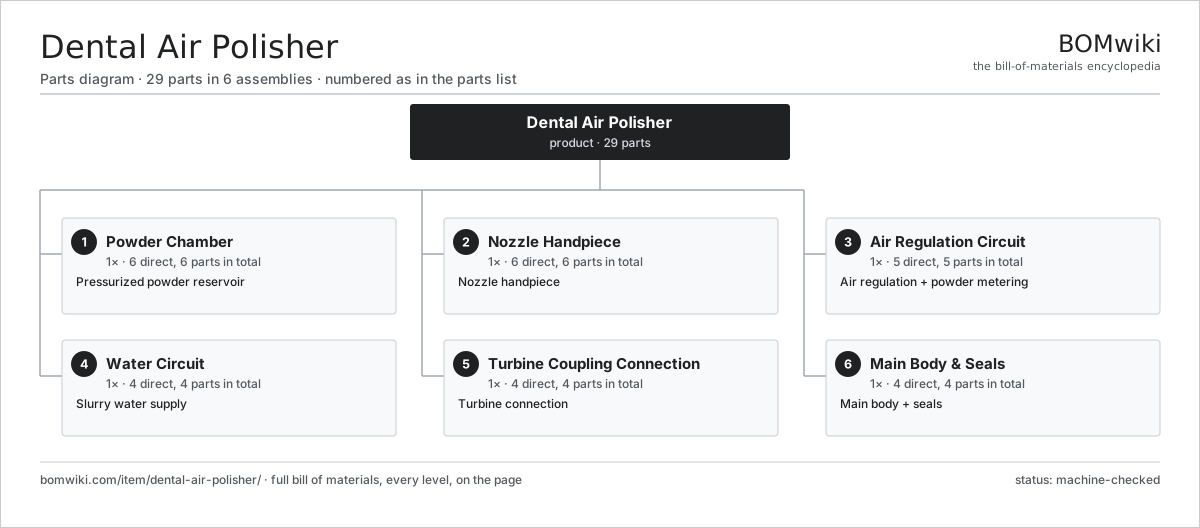
| # | Part | Qty | What it does |
|---|---|---|---|
| 1 | Powder Chamber 6 parts | 1× | Pressurized powder reservoir |
| 2 | Nozzle Handpiece 6 parts | 1× | Nozzle handpiece |
| 3 | Air Regulation Circuit 5 parts | 1× | Air regulation + powder metering |
| 4 | Water Circuit 4 parts | 1× | Slurry water supply |
| 5 | Turbine Coupling Connection 4 parts | 1× | Turbine connection |
| 6 | Main Body & Seals 4 parts | 1× | Main body + seals |
3D model
No 3D model yet. Have a CAD file of this? Add a 3D model — STL renders right on this page; STEP, FreeCAD, and OpenSCAD sources are welcome too (openly licensed, like all 3D models on BOMwiki).
Build & assembly graph
expand / collapse · shared sub-assemblies converge · links to related products · est. labourTap an assembly to expand/collapse · tap a part to open it · use “Open page” for any node · drag to pan, scroll to zoom.
Bill of materials for Dental Air Polisher
6 top-level lines · 35 rows shown · 29 parts total · indented to 3 levels| # | Item / sub-assembly | Part no. | Qty/assy | Ext. qty | Parts | Type |
|---|---|---|---|---|---|---|
| 1 | Powder Chamber 6 parts | dental-air-polisher-powder-chamber | 1× | 1 | 6 | assembly |
| 1.1 | Chamber Bowl | dental-air-polisher-chamber-bowl | 1× | 1 | · | part |
| 1.2 | Chamber Screw Cap | dental-air-polisher-chamber-cap | 1× | 1 | · | part |
| 1.3 | Vortex Fluidizing Insert | dental-air-polisher-vortex-insert | 1× | 1 | · | part |
| 1.4 | Powder Pickup Tube | dental-air-polisher-pickup-tube | 1× | 1 | · | part |
| 1.5 | Chamber Relief Valve | dental-air-polisher-relief-valve | 1× | 1 | · | part |
| 1.6 | O-Ring Set | oring-set | 1× | 1 | · | part |
| 2 | Nozzle Handpiece 6 parts | dental-air-polisher-handpiece | 1× | 1 | 6 | assembly |
| 2.1 | Nozzle Tip | dental-air-polisher-nozzle-tip | 1× | 1 | · | part |
| 2.2 | Handpiece Body | dental-air-polisher-handpiece-body | 1× | 1 | · | part |
| 2.3 | Powder-Air Channel | dental-air-polisher-powder-channel | 1× | 1 | · | part |
| 2.4 | Water Jacket Channel | dental-air-polisher-water-jacket | 1× | 1 | · | part |
| 2.5 | Swivel Joint | dental-air-polisher-swivel | 1× | 1 | · | part |
| 2.6 | O-Ring Set | oring-set | 1× | 1 | · | part |
| 3 | Air Regulation Circuit 5 parts | dental-air-polisher-air-circuit | 1× | 1 | 5 | assembly |
| 3.1 | Air Pressure Regulator | dental-air-polisher-air-regulator | 1× | 1 | · | part |
| 3.2 | Inlet Air Filter | dental-air-polisher-air-filter | 1× | 1 | · | part |
| 3.3 | Powder Metering Valve | dental-air-polisher-metering-valve | 1× | 1 | · | part |
| 3.4 | Air Check Valve | dental-air-polisher-check-valve | 1× | 1 | · | part |
| 3.5 | O-Ring Set | oring-set | 1× | 1 | · | part |
| 4 | Water Circuit 4 parts | dental-air-polisher-water-circuit | 1× | 1 | 4 | assembly |
| 4.1 | Water Flow Valve | dental-air-polisher-water-valve | 1× | 1 | · | part |
| 4.2 | Water Inlet Filter | dental-air-polisher-water-filter | 1× | 1 | · | part |
| 4.3 | Internal Water Tubing | dental-air-polisher-water-tube | 1× | 1 | · | part |
| 4.4 | O-Ring Set | oring-set | 1× | 1 | · | part |
| 5 | Turbine Coupling Connection 4 parts | dental-air-polisher-coupling | 1× | 1 | 4 | assembly |
| 5.1 | Coupling Body | dental-air-polisher-coupling-body | 1× | 1 | · | part |
| 5.2 | Coupling Gasket | dental-air-polisher-coupling-gasket | 1× | 1 | · | part |
| 5.3 | Exhaust Return Port | dental-air-polisher-exhaust-port | 1× | 1 | · | part |
| 5.4 | O-Ring Set | oring-set | 1× | 1 | · | part |
| 6 | Main Body & Seals 4 parts | dental-air-polisher-body | 1× | 1 | 4 | assembly |
| 6.1 | Body Shell | dental-air-polisher-body-shell | 1× | 1 | · | part |
| 6.2 | Internal Manifold Block | dental-air-polisher-manifold-block | 1× | 1 | · | part |
| 6.3 | O-Ring Set | oring-set | 1× | 1 | · | part |
| 6.4 | Fastener Set | fastener-set | 1× | 1 | · | part |
Related products
same domain, ranked by shared parts Dental Apex Locator
208 parts · shares 1 with this page
Dental Autoclave (Class B)
305 parts · shares 1 with this page
Dental Apex Locator
208 parts · shares 1 with this page
Dental Autoclave (Class B)
305 parts · shares 1 with this page
 Dental Chair Unit
202 parts · shares 1 with this page
Dental Chair Unit
202 parts · shares 1 with this page
 Dental Curing Light
26 parts · shares 1 with this page
Dental Curing Light
26 parts · shares 1 with this page
 Dental Handpiece
27 parts · shares 1 with this page
Dental Milling Machine
443 parts · shares 1 with this page
Dental Handpiece
27 parts · shares 1 with this page
Dental Milling Machine
443 parts · shares 1 with this page
Sourcing: possible vendors
Prices, MOQ, and lead times are algorithmic estimates, not quotes, and not claims about these companies. Company mappings are curated by keyword; est. price band $200–$200k. How estimates work| Vendor | HQ | Specialty | MOQ | Lead time |
|---|---|---|---|---|
| dentsplysirona.com ↗ | Charlotte, US | Dental equipment | 100 units | 10–16 wks |
|
🇺🇸Envista
envistaco.com ↗
|
Brea, US | Dental (KaVo, Nobel) | 100 units | 10–16 wks |
|
🇫🇮Planmeca
planmeca.com ↗
|
Helsinki, FI | Dental units & imaging | 100 units | 10–16 wks |
|
🇺🇸A-dec
a-dec.com ↗
|
Newberg, US | Dental chairs & delivery | 100 units | 10–16 wks |
|
🇺🇸Midmark
midmark.com ↗
|
Versailles, US | Medical & veterinary equipment | 100 units | 10–16 wks |
787-word article