Depalletizer
ProductOverview
Depalletizers are the entry point to high-speed bottling lines, removing full layers of bottles from pallets and directing them into infeed conveyors. A typical beverage pallet holds 8–15 layers of 24–36 bottles per layer, stacked on slip-sheets (corrugated or plastic separators). The depalletizer automatically extracts one layer at a time, separates slip-sheets, and singulates bottles onto accumulation conveyors that feed the main bottling line.
Industrial depalletizers operate at 10–30 pallets per hour and are designed for gentle handling to prevent glass breakage or plastic bottle cracking. They integrate upstream with pallet dispensers and downstream with rinser or filler infeed systems via line-rate synchronization.
How it works
Pallet Infeed and Registration
Loaded pallets arrive on an infeed conveyor and are pushed by a mechanical stop into a fixed registration position. An inductive or photoelectric sensor detects pallet presence and triggers the depalletizer start sequence. The pallet remains stationary on the deck during layer removal.
Layer Pusher Mechanism
A pneumatic or servo-driven pusher frame (2–4 cylinders delivering 1–2 tons force) advances horizontally across the pallet face at 0.5–2.0 m/s. The pusher plates contact the bottom of one bottle layer and sweep it forward onto an outfeed accumulation conveyor. The pusher retracts to its original position and waits for the pallet to be lowered by one layer height before repeating.
Synchronized Hoist Lift
As bottles are removed, the pallet deck sinks, creating a void. A hydraulic or pneumatic hoist system (four synchronized cylinders at pallet corners) lifts the remaining bottle stack by 150–200 mm, raising the next layer into the pusher-sweep zone. A proportional pressure valve ensures all four cylinders rise simultaneously, preventing pallet tilt. Linear or ultrasonic position sensors on the hoist confirm deck height and signal when the next layer is properly positioned.
Slip-Sheet Removal
Slip-sheets (corrugated or plastic boards separating bottle layers) are removed either manually or by an automated gripper system. An automatic slip-sheet gripper with pneumatic or servo actuation grabs the edge of the exposed slip-sheet and pulls it clear of the pallet, ejecting it to a disposal chute. This prevents slip-sheets from mixing with bottles on the outfeed line.
Bottle Singulation
Bottles pushed from the pallet arrive as a single layer onto an accumulation conveyor. Mechanical singulators or width-adjustable lane guides separate the bottles into individual lanes (typically 2–4 lanes per depalletizer, depending on line design). An optional air-jet or mechanical diverter directs lanes to different bottling lines or accumulation tables.
Outfeed Integration
The accumulation conveyor speed is adjustable via servo or AC motor VFD, matching the downstream bottling-line infeed rate. Encoder feedback from the filler inlet synchronizes depalletizer pusher cycles with bottle demand, preventing line starvation or backup.
Typical Pallet Configurations
Beverage 24-Pack (330 mL cans or bottles)
Pallet dimensions: 800 × 1200 mm. Per-layer load: 24 bottles in 2-row × 12-column grid. Layers: 12–14 per pallet = 288–336 bottles. Single-layer removal time: 3–5 seconds. Pallet depalletization time: 40–70 seconds.
6-Pack Cartons (larger bottles)
Cartons (6 × 1.5 L bottles per carton) stacked 4-wide × 3-deep per layer = 72 bottles per layer. Layers: 8–10 per pallet = 576–720 bottles. Removal is by carton layer (not individual bottles), then cartons are singulated.
Pusher Force and Bottle Handling
Pusher force is adjusted via pneumatic pressure regulator (typically 6 bar air inlet = 1–2 tons force across 2–4 cylinders). Servo-modulated pushers are optional for delicate plastic bottles; they reduce impact shock and accelerate more gently. Glass bottles tolerate higher impact.
Slip-Sheet Material Recycling
Removed slip-sheets fall into a disposal chute and are stacked for recycling or landfill. Heavy-duty corrugated slip-sheets (5 mm thick) are preferred for strength; plastic slip-sheets (2 mm HDPE) are lighter and reusable.
Hoist Synchronization and Pallet Stability
Four-point hoist with proportional pilot-operated valve prevents pallet rocking. Height sensor on at least one hoist corner provides feedback for PLC-controlled proportional valve opening, ensuring parallel lift. Annual hoist service includes rod straightness check and seal replacement to prevent oil weeping.
Accumulator Conveyor Speeds
Accumulation conveyor must match or exceed bottling-line demand. For a 200 bottles/minute filler, depalletizer pusher cycles are triggered at 200/bottles-per-layer rate. If a layer contains 24 bottles, pusher cycles every 7 seconds. Infeed conveyor variable speed compensates for mismatch between depalletizer push rate and line infeed rate.
Common Failure Modes and Maintenance
Uneven Pallet Lift
Caused by: (1) Hoist pressure regulator malfunction, (2) Unequal cylinder bore wear, (3) Pallet frame twist. Solutions: proportional valve test and calibration, hoist cylinder replacement, pallet inspection.
Pusher Stalling
Caused by: (1) Layer stuck to pallet (moisture or high friction), (2) Insufficient pusher air pressure, (3) Pusher rod bent. Solutions: increase pusher pressure (within pneumatic limits), inspect pallet surface, measure pusher rod straightness.
Slip-Sheet Gripper Misfire
Caused by: (1) Gripper vacuum loss (vacuum-cup type), (2) Servo gripper pad wear. Solutions: vacuum pump and cup inspection, gripper pad replacement.
Safety and Guarding
All pusher and hoist zones require interlocked guarding. Operator access gates halt the depalletizer if opened during operation. Emergency stop buttons are positioned at infeed and outfeed ends for quick-stop capability.
Compatibility with Multiple Pallet Types
Depalletizers are configurable for different pallet footprints (800 × 1200 mm Euro pallet, 1000 × 1200 mm, or proprietary sizes). Mechanical stops and infeed conveyor width can be adjusted in 30–60 minutes for size changeover. PLC recipes store layer count and pusher cycle parameters per pallet type.
Depalletizer parts and their functions
7 top-level parts · 27 parts in total · full bill of materials below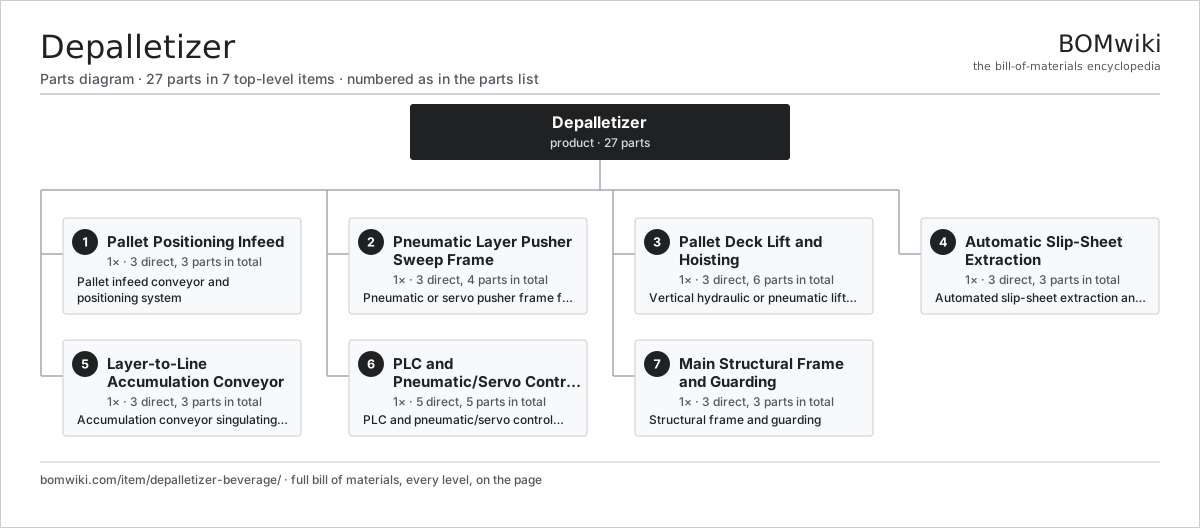
| # | Part | Qty | What it does |
|---|---|---|---|
| 1 | Pallet Positioning Infeed 3 parts | 1× | Pallet infeed conveyor and positioning system |
| 2 | Pneumatic Layer Pusher Sweep Frame 3 parts | 1× | Pneumatic or servo pusher frame for layer separation |
| 3 | Pallet Deck Lift and Hoisting 3 parts | 1× | Vertical hydraulic or pneumatic lift for pallet deck adjustment |
| 4 | Automatic Slip-Sheet Extraction 3 parts | 1× | Automated slip-sheet extraction and disposal |
| 5 | Layer-to-Line Accumulation Conveyor 3 parts | 1× | Accumulation conveyor singulating bottles from layer |
| 6 | PLC and Pneumatic/Servo Control Module 5 parts | 1× | PLC and pneumatic/servo control module |
| 7 | Main Structural Frame and Guarding 3 parts | 1× | Structural frame and guarding |
3D model
No 3D model yet. Have a CAD file of this? Add a 3D model. STL renders right on this page; STEP, FreeCAD, and OpenSCAD sources are welcome too (openly licensed, like all 3D models on BOMwiki).
Build & assembly graph
expand / collapse · shared sub-assemblies converge · links to related products · est. labourTap an assembly to expand/collapse · tap a part to open it · use “Open page” for any node · drag to pan, scroll to zoom.
Bill of materials for Depalletizer
7 top-level lines · 31 rows shown · 27 parts total · indented to 3 levels| # | Item / sub-assembly | Part no. | Qty/assy | Ext. qty | Parts | Type |
|---|---|---|---|---|---|---|
| 1 | Pallet Positioning Infeed 3 parts | depalletizer-beverage-pallet-infeed | 1× | 1 | 3 | assembly |
| 1.1 | Infeed Conveyor Motor | depalletizer-beverage-conveyor-motor | 1× | 1 | · | part |
| 1.2 | Pallet Mechanical Stop | depalletizer-beverage-pallet-stop | 1× | 1 | · | part |
| 1.3 | Pallet Presence Sensor | depalletizer-beverage-pallet-sensor | 1× | 1 | · | part |
| 2 | Pneumatic Layer Pusher Sweep Frame 3 parts | depalletizer-beverage-layer-sweep | 1× | 1 | 4 | assembly |
| 2.1 | Pneumatic Pusher Cylinder | depalletizer-beverage-pusher-cylinders | 2× | 2 | · | part |
| 2.2 | Pusher Plate or Beam | depalletizer-beverage-pusher-beam | 1× | 1 | · | part |
| 2.3 | Pusher Speed Servo Motor (optional) | depalletizer-beverage-pusher-servo | 1× | 1 | · | part |
| 3 | Pallet Deck Lift and Hoisting 3 parts | depalletizer-beverage-hoist-lift | 1× | 1 | 6 | assembly |
| 3.1 | Synchronous Hoist Cylinder | depalletizer-beverage-hoist-cylinders | 4× | 4 | · | part |
| 3.2 | Hoist System Pump and Regulator 1 parts | depalletizer-beverage-hoist-pump | 1× | 1 | 1 | assembly |
| 3.2.1 | Hoist Pump Motor | depalletizer-beverage-hoist-main-pump | 1× | 1 | · | part |
| 3.3 | Pallet Deck Height Sensor | depalletizer-beverage-hoist-sensor | 1× | 1 | · | part |
| 4 | Automatic Slip-Sheet Extraction 3 parts | depalletizer-beverage-slipsheet-remover | 1× | 1 | 3 | assembly |
| 4.1 | Slip-Sheet Gripper Clamp | depalletizer-beverage-slipsheet-gripper | 1× | 1 | · | part |
| 4.2 | Gripper Servo Motor | depalletizer-beverage-slipsheet-motor | 1× | 1 | · | part |
| 4.3 | Slip-Sheet Disposal Chute | depalletizer-beverage-slipsheet-chute | 1× | 1 | · | part |
| 5 | Layer-to-Line Accumulation Conveyor 3 parts | depalletizer-beverage-bottle-infeed | 1× | 1 | 3 | assembly |
| 5.1 | Accumulation Conveyor Motor | depalletizer-beverage-accumulator-motor | 1× | 1 | · | part |
| 5.2 | Bottle Singulator or Lane Guide | depalletizer-beverage-singulator | 1× | 1 | · | part |
| 5.3 | Lane Diverter or Sorter (optional) | depalletizer-beverage-transfer-sorter | 1× | 1 | · | part |
| 6 | PLC and Pneumatic/Servo Control Module 5 parts | depalletizer-beverage-servo-drives | 1× | 1 | 5 | assembly |
| 6.1 | Depalletizer Control PLC | depalletizer-beverage-plc | 1× | 1 | · | part |
| 6.2 | Pneumatic Solenoid Manifold | depalletizer-beverage-pneu-manifold | 1× | 1 | · | part |
| 6.3 | Hoist Pressure Control Valve | depalletizer-beverage-hoist-controller | 1× | 1 | · | part |
| 6.4 | Optional Servo Amplifier | depalletizer-beverage-servo-amp | 1× | 1 | · | part |
| 6.5 | Touch Digitizer | touch-digitizer | 1× | 1 | · | part |
| 7 | Main Structural Frame and Guarding 3 parts | depalletizer-beverage-frame | 1× | 1 | 3 | assembly |
| 7.1 | Structural Steel Frame | depalletizer-beverage-frame-struct | 1× | 1 | · | part |
| 7.2 | Electrical Control Enclosure | depalletizer-beverage-enclosure | 1× | 1 | · | part |
| 7.3 | Safety Guard Assembly | depalletizer-beverage-guard | 1× | 1 | · | part |
Something wrong in this list? Report a problem with this BOM.
Related products
same domain, ranked by shared parts Aerosol Filling Machine
119 parts · shares 1 with this page
Automatic Labeling Machine
104 parts · shares 1 with this page
Automatic Screen Printing Machine
640 parts · shares 1 with this page
Aerosol Filling Machine
119 parts · shares 1 with this page
Automatic Labeling Machine
104 parts · shares 1 with this page
Automatic Screen Printing Machine
640 parts · shares 1 with this page
 Automatic Strapping Machine
251 parts · shares 1 with this page
Banner Welder
90 parts · shares 1 with this page
Automatic Strapping Machine
251 parts · shares 1 with this page
Banner Welder
90 parts · shares 1 with this page
 Blister Packaging Machine
256 parts · shares 1 with this page
Blister Packaging Machine
256 parts · shares 1 with this page
Sourcing: possible vendors
Browse the supplier directory → Prices, MOQ, and lead times are algorithmic estimates, not quotes, and not claims about these companies. Company mappings are curated by keyword; est. price band $10k–$3M. How estimates work| Vendor | HQ | Specialty | MOQ | Lead time |
|---|---|---|---|---|
| heidelberg.com ↗ | Heidelberg, DE | Printing presses | 10 units | 12–22 wks |
|
🇨🇭Bobst
bobst.com ↗
|
Lausanne, CH | Packaging machinery | 10 units | 12–22 wks |
| koenig-bauer.com ↗ | Würzburg, DE | Printing presses | 10 units | 12–22 wks |
| wuh-group.com ↗ | Lengerich, DE | Flexible packaging machines | 10 units | 12–22 wks |
| markandy.com ↗ | Chesterfield, US | Label presses | 10 units | 12–22 wks |
937-word article