Destemmer-Crusher
ProductOverview
The destemmer-crusher is the first machine in any winery's processing line, transforming whole grape clusters into fermentation-ready crushed must (skins + seeds + juice). The machine performs two essential separations: removing green stems (which impart herbaceous, unripe flavors) and gently crushing individual berries to break the skin and allow juice contact with yeast. A rotating perforated cage separates berries from stems via size differential; simultaneously, fluted roller mills crush berries with minimal seed damage. The discharge pump routes the crushed must directly to open fermentation tanks or closed fermenters.
Variable-speed operation (80–200 RPM via VFD) allows a single machine to handle delicate Pinot Noir grapes (soft, low RPM to preserve whole berries and minimize tannin extraction) and robust Cabernet Sauvignon (higher RPM, more aggressive crushing). The machine is the gateway to consistent, professional-quality winemaking, replacing labor-intensive manual crushing and stemming that demands 4+ people for several hours.
Destemming: The Perforated Cage
The rotating cage is the destemming heart. Whole grape clusters enter via the hopper chute; as the cage rotates (80–200 RPM), internal paddles tumble berries against the perforated outer wall (6 mm hexagonal holes). Berries, being ~20 mm spheres, fall through the perforations into a collection chamber below. Stems, being thin and longer, cannot fit through and are carried by cage momentum to the axial outlet, exiting onto a conveyor or pile for compost.
Key design parameters:
- Cage diameter (600 mm): Provides sufficient surface area for good contact and separation
- Hole diameter (6 mm): Large enough to pass individual berries freely, small enough to reliably stop stems
- RPM selection:
- 80–100 RPM (delicate extraction) – slow tumbling, minimal berry breakage, whole berries preserved
- 120–150 RPM (standard) – balanced destemming and some berry softening
- 180–200 RPM (aggressive) – vigorous tumbling, some berries break during destemming, higher juice contact
- Paddle design: Rubber-faced to avoid bruising berries as they tumble
The efficiency is >98 %: fewer than 2 % of stems escape into crushed must (acceptable for fermentation; complete cleanliness is impossible and unnecessary).
Crushing: Fluted Roller Mills
Once destemmed, whole berries cascade down into the roller mill section. Two rotating fluted rollers (8 mm deep helical flutes) compress berries between them, breaking skins and releasing juice while leaving seeds largely intact. The gap adjuster (typically 1.5–2.5 mm) determines crushing intensity:
- 1–1.5 mm gap (light crushing): Skins break, seeds remain whole. Ideal for white wines, delicate reds (Pinot Noir, Gamay)
- 2–2.5 mm gap (moderate crushing): Most skins split, ~5 % seeds break. Standard for Cabernet, Merlot, Syrah
- 3 mm gap (heavy crushing): Aggressive compression, seeds may crack slightly. Rarely used; excessive seed breakage creates bitter green tannins
The flute pattern is crucial: helical grooves (not flat surfaces) gently guide berries between rollers, creating a massaging action rather than crushing impact. This preserves seed structure; even crushed seeds release less harsh tannin when slowly compressed than when violently impacted.
Roller RPM typically matches cage RPM (both driven by the same VFD motor via gearbox), ensuring a steady stream of berries from destemmer to crusher. If roller speed were independent, jams could occur.
The Hopper & Feed System
The hopper is a 150 L stainless cone with a soft agitator motor (20–40 RPM). Operators shovel whole grape clusters into the hopper opening. The agitator paddles gently break up cluster bridges (which can jam and stop flow), encouraging berries and small debris to flow continuously toward the cage inlet.
The hopper is sized to hold roughly one 100 kg bin of grapes. During an 8-hour vintage day, an operator refills the hopper every 15–20 minutes, a manageable rhythm. The agitator ensures steady gravity feed without requiring manual prodding.
A screen grate (8 mm holes) below the hopper allows loose berries and small stems to bypass the cage entirely, falling directly to the crusher. This speeds processing slightly for already-soft grapes.
Must Discharge & Integration
Destemmed and crushed berries, now "must" (skins + seeds + juice mixed), fall through the roller mills into a collection chamber. The positive-displacement pump (40 L/min) draws this must and delivers it via 50 mm hose to the fermentation vessel. This pump design is critical:
- Rotary gear/helical pump: Handles seeds and pulp without damage. Centrifugal pumps would cavitate on soft seeds; positive-displacement pumps protect fruit integrity
- Variable speed (VFD): Pump RPM adjusts to match crusher output, preventing backup or starvation
- Check valve: Prevents backflow when pump stops, avoiding siphon-back through the crusher
A strainer basket at pump inlet removes large stems or debris that escaped destemming, protecting the pump impeller.
Typical workflow: As the hopper feeds the destemmer at 3–5 tons/hour, the must pump simultaneously discharges into an open fermentation tank or closed fermentation vessel. By day's end, the entire day's harvest is crushed, destemmed, and in fermentation, a seamless operation.
Variable-Speed Operation & Harvest Strategy
The VFD-driven main motor (3 kW) allows the operator to smoothly dial processing speed 0–100 % via the speed potentiometer. This enables:
Early Harvest (Lower RPM 80–100): Grape skins are thick, seeds are green and bitter. Gentle destemming and minimal crushing preserve whole berries, reducing seed contact and harsh tannin extraction. Fermentation proceeds slowly, developing delicate aromatics. Resulting wine is light, floral, suitable for Pinot Noir or Riesling.
Peak Ripeness (Moderate RPM 120–150): Grapes are fully ripe, skins supple, seeds mature. Standard machine settings balance efficient destemming with controlled crushing. Skin contact during fermentation extracts full color and tannin structure. Resulting wine has balance and age-ability.
Late Harvest (Higher RPM 180+): Grapes may be overripe, some damaged by birds/mold. Aggressive crushing maximizes juice extraction and skin contact, compensating for lower sugar in marginal fruit. Fermentation is vigorous. Resulting wine is bold and full, suitable for heavy reds.
A skilled winemaker changes RPM settings daily based on incoming fruit condition, a capability impossible with fixed-speed machines.
Practical Fermentation Integration
The must exiting the destemmer-crusher pump is warm (20–25°C) and freshly aerated by the pump. For red wine fermentation:
- Warm must (25°C) enters open tank or closed fermenter
- Yeast is pitched (cultured or wild airborne microbes)
- Fermentation begins within 2–6 hours
- Must is pumped over solids 1–2 × daily to extract color/tannin
- After 7–14 days, must is pressed via pneumatic press
For white wine fermentation:
- After crushing, must sits 2–8 hours to allow juice to separate from skins
- Must is transferred to press; juice is separated and cooled to 10–15°C
- Clean juice (without skins) is transferred to clean fermenter
- Fermentation proceeds cool and slow, developing delicate aromatics
- No further skin contact occurs
The destemmer-crusher's flexibility accommodates both workflows: red wine fermentation uses freshly crushed must with skins; white wine production separates juice immediately post-crushing.
Maintenance & Cleaning
Daily maintenance (post-harvest):
- Disassemble hopper agitator
- Remove jam of whole clusters stuck in cage or roller area
- Flush cage perforations with 40°C water to remove pulp residue
- Visually inspect roller surfaces for deep gouges or uneven wear
Weekly (during harvest):
- Inspect roller gaps; adjust if one roller has worn 0.5 mm smaller than the other
- Check cage bearings for abnormal noise; if squeaking, bearing may need grease
- Monitor pump discharge pressure (typically 1–2 bar); if pressure spikes, suction filter may be clogged
End-of-season (post-vintage):
- Disassemble entire crusher and cage, soak in hot water + 2 % NaOH caustic
- Scrub all surfaces with soft brush (caustic is corrosive; never use abrasive steel wool on stainless)
- Rinse thoroughly with fresh water and mild acid (1 % citric) to remove caustic residue
- Air-dry completely, apply light food-grade oil to prevent rust
- Inspect bearings, seals, and coupling for wear; replace any suspect components
Typical replacement parts over 10-year lifespan:
- Cage perforated wall (oxidation/pitting): $1K
- Roller drums (surface wear): $2K per pair
- Bearings and seals: $500–1K
- Pump (internal wear): $2K
These are manageable costs for a $15K–25K initial machine investment and decades of reliable service.
Batch Variability & Fruit Condition
No two harvests are identical. A destemmer-crusher's variable-speed flexibility accommodates:
- Whole clusters vs. pre-crushed fruit: Whole clusters feed best; pre-crushed or damaged grapes may jam cage or pump
- Sugar levels: High-sugar grapes are softer, need lower RPM; lower-sugar grapes (early harvest) are firmer, tolerate higher RPM
- Mold/rot: Moldy grapes may clog cage perforations; slower speeds help avoid jamming
- Seed maturity: Green seeds are hard; fully mature seeds are softer and tolerate crushing better
Professional winemakers taste incoming grapes, assess ripeness and condition, and adjust RPM accordingly, a critical quality control step that separates premium producers from bulk processors.
This machine represents the bridge between vineyard and fermentation, the first major value-add step in professional winemaking.
Destemmer-Crusher parts and their functions
6 top-level parts · 52 parts in total · full bill of materials below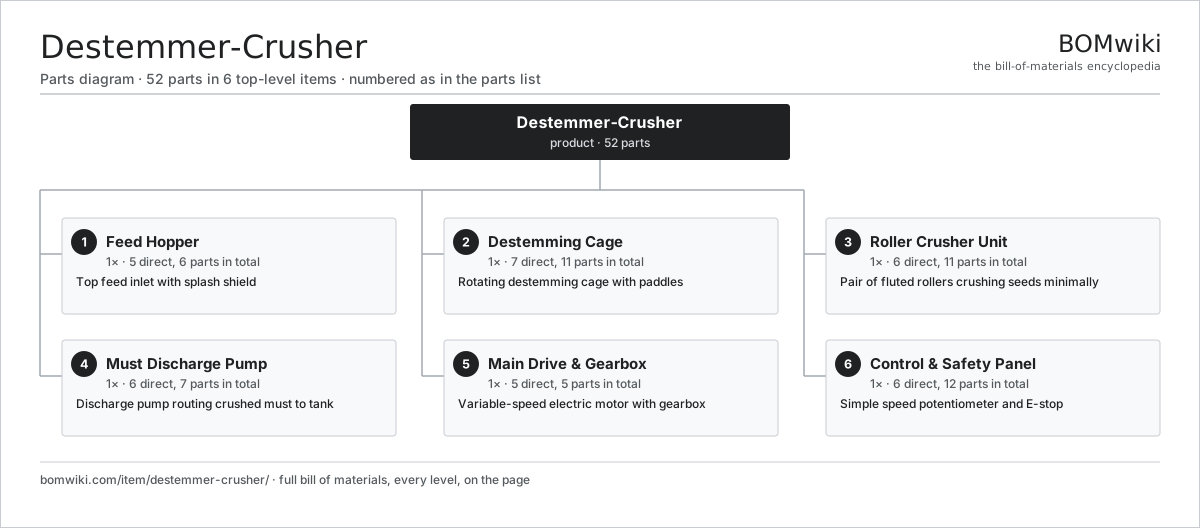
| # | Part | Qty | What it does |
|---|---|---|---|
| 1 | Feed Hopper 5 parts | 1× | Top feed inlet with splash shield |
| 2 | Destemming Cage 7 parts | 1× | Rotating destemming cage with paddles |
| 3 | Roller Crusher Unit 6 parts | 1× | Pair of fluted rollers crushing seeds minimally |
| 4 | Must Discharge Pump 6 parts | 1× | Discharge pump routing crushed must to tank |
| 5 | Main Drive & Gearbox 5 parts | 1× | Variable-speed electric motor with gearbox |
| 6 | Control & Safety Panel 6 parts | 1× | Simple speed potentiometer and E-stop |
3D model
No 3D model yet. Have a CAD file of this? Add a 3D model. STL renders right on this page; STEP, FreeCAD, and OpenSCAD sources are welcome too (openly licensed, like all 3D models on BOMwiki).
Build & assembly graph
expand / collapse · shared sub-assemblies converge · links to related products · est. labourTap an assembly to expand/collapse · tap a part to open it · use “Open page” for any node · drag to pan, scroll to zoom.
Bill of materials for Destemmer-Crusher
6 top-level lines · 41 rows shown · 52 parts total · indented to 3 levels| # | Item / sub-assembly | Part no. | Qty/assy | Ext. qty | Parts | Type |
|---|---|---|---|---|---|---|
| 1 | Feed Hopper 5 parts | destemmer-crusher-hopper | 1× | 1 | 6 | assembly |
| 1.1 | Hopper Main Vessel | destemmer-crusher-hopper-body | 1× | 1 | · | part |
| 1.2 | Hopper Agitator Paddle | destemmer-crusher-agitator-paddle | 2× | 2 | · | part |
| 1.3 | Hopper Agitator Motor | destemmer-crusher-agitator-motor | 1× | 1 | · | part |
| 1.4 | Hopper Screen Grate | destemmer-crusher-hopper-grate | 1× | 1 | · | part |
| 1.5 | Discharge Chute | destemmer-crusher-discharge-lip | 1× | 1 | · | part |
| 2 | Destemming Cage 7 parts | destemmer-crusher-cage-assembly | 1× | 1 | 11 | assembly |
| 2.1 | Cage Drum Cylinder | destemmer-crusher-cage-drum | 1× | 1 | · | part |
| 2.2 | Cage Internal Paddle | destemmer-crusher-cage-paddles | 4× | 4 | · | part |
| 2.3 | Cage Perforated Wall | destemmer-crusher-cage-perforations | 1× | 1 | · | part |
| 2.4 | Cage Inlet Opening | destemmer-crusher-cage-inlet-port | 1× | 1 | · | part |
| 2.5 | Stem Discharge Outlet | destemmer-crusher-stem-outlet | 1× | 1 | · | part |
| 2.6 | Cage Support Bearing | destemmer-crusher-cage-bearing | 2× | 2 | · | part |
| 2.7 | Cage Shaft Seal | destemmer-crusher-cage-seal | 1× | 1 | · | part |
| 3 | Roller Crusher Unit 6 parts | destemmer-crusher-roller-mills | 1× | 1 | 11 | assembly |
| 3.1 | Roller Drive Shaft | destemmer-crusher-roller-shaft | 2× | 2 | · | part |
| 3.2 | Fluted Roller Drum | destemmer-crusher-roller-drum | 2× | 2 | · | part |
| 3.3 | Roller Shaft Bearing | destemmer-crusher-roller-bearing | 4× | 4 | · | part |
| 3.4 | Gap Adjustment Mechanism | destemmer-crusher-roller-gap-adjuster | 1× | 1 | · | part |
| 3.5 | Roller Motor with VFD | destemmer-crusher-roller-motor-drive | 1× | 1 | · | part |
| 3.6 | Roller Guard Housing | destemmer-crusher-roller-housing | 1× | 1 | · | part |
| 4 | Must Discharge Pump 6 parts | destemmer-crusher-must-pump | 1× | 1 | 7 | assembly |
| 4.1 | Must Pump Assembly | destemmer-crusher-pump-unit | 1× | 1 | · | part |
| 4.2 | Pump Inlet Filter | destemmer-crusher-pump-suction-filter | 1× | 1 | · | part |
| 4.3 | Discharge Hose | destemmer-crusher-pump-discharge-hose | 1× | 1 | · | part |
| 4.4 | Pump Check Valve | destemmer-crusher-pump-check-valve | 1× | 1 | · | part |
| 4.5 | Pump Drive Motor | destemmer-crusher-pump-motor | 1× | 1 | · | part |
| 4.6 | Connector | connector | 2× | 2 | · | part |
| 5 | Main Drive & Gearbox 5 parts | destemmer-crusher-motor-drive | 1× | 1 | 5 | assembly |
| 5.1 | Main Drive Motor | destemmer-crusher-main-motor | 1× | 1 | · | part |
| 5.2 | Variable Frequency Drive | destemmer-crusher-vfd-drive | 1× | 1 | · | part |
| 5.3 | Helical Gearbox | destemmer-crusher-gearbox | 1× | 1 | · | part |
| 5.4 | Vibration Damping Mounts | destemmer-crusher-motor-mount | 1× | 1 | · | part |
| 5.5 | Flexible Coupling | destemmer-crusher-coupling | 1× | 1 | · | part |
| 6 | Control & Safety Panel 6 parts | destemmer-crusher-control-panel | 1× | 1 | 12 | assembly |
| 6.1 | Speed Control Potentiometer | destemmer-crusher-speed-potentiometer | 1× | 1 | · | part |
| 6.2 | Emergency Stop Button | destemmer-crusher-emergency-stop | 1× | 1 | · | part |
| 6.3 | Overload Protection Relay | destemmer-crusher-overload-relay | 2× | 2 | · | part |
| 6.4 | Power Contactor Switch | destemmer-crusher-contactor | 2× | 2 | · | part |
| 6.5 | Status Indicator Light | destemmer-crusher-indicator-lights | 2× | 2 | · | part |
| 6.6 | Connector | connector | 4× | 4 | · | part |
Something wrong in this list? Report a problem with this BOM.
Related products
same domain, ranked by shared parts Automatic Espresso Tamper
45 parts · shares 1 with this page
Automatic Filleting Machine
73 parts · shares 1 with this page
Bagel Former
43 parts · shares 1 with this page
Automatic Espresso Tamper
45 parts · shares 1 with this page
Automatic Filleting Machine
73 parts · shares 1 with this page
Bagel Former
43 parts · shares 1 with this page
 Bakery Deck Oven
44 parts · shares 1 with this page
Beverage Carbonator
95 parts · shares 1 with this page
Bin Sweep Auger
103 parts · shares 1 with this page
Bakery Deck Oven
44 parts · shares 1 with this page
Beverage Carbonator
95 parts · shares 1 with this page
Bin Sweep Auger
103 parts · shares 1 with this page
Sourcing: possible vendors
Browse the supplier directory → Prices, MOQ, and lead times are algorithmic estimates, not quotes, and not claims about these companies. Company mappings are curated by keyword; est. price band $1k–$500k. How estimates work| Vendor | HQ | Specialty | MOQ | Lead time |
|---|---|---|---|---|
| gea.com ↗ | Düsseldorf, DE | Process technology | 20 units | 12–20 wks |
| buhlergroup.com ↗ | Uzwil, CH | Food & materials processing | 20 units | 12–20 wks |
| tetrapak.com ↗ | Pully, CH | Food packaging & processing | 20 units | 12–20 wks |
| jbtc.com ↗ | Chicago, US | Food processing equipment | 20 units | 12–20 wks |
| alfalaval.com ↗ | Lund, SE | Heat transfer & separation | 20 units | 12–20 wks |
1,578-word article