Destratification Fan
ProductOverview
A destratification fan is a simple, elegant solution to a common problem in tall buildings with high ceilings: warm air naturally rises and accumulates at the peak while the occupied zone stays cold, wasting heating energy. A destratification fan is a large-diameter low-speed propeller suspended from the ceiling on cables; it runs slowly (50–300 rpm) and gently pushes the warm air downward in a wide columnar pattern, mixing the layers and bringing peak-accumulated heat back to the occupied zones. In a warehouse or factory with a 10 m ceiling, destratification fans can cut heating energy by 10–25% during winter operation.
The unit is minimalist: a Blade Assembly driven by a Low-Speed Direct-Drive Motor, mounted on a Motor Mounting Bracket, suspended from the ceiling via Suspension & Isolation System, with a Discharge Diffuser to smooth the discharge, and basic controls. The propeller diameter ranges from 1 m for a small office to 3 m for a large factory floor. Sizes larger than 3 m are rare because the downward momentum becomes excessive and the benefit plateaus.
Low-speed design philosophy
The key to destratification fan design is operating speed and propeller diameter. A destratification fan moves air at 1–15 m³/s, comparable to a small air-conditioner, but does it at 50–300 rpm instead of 1200–3600 rpm. This low speed is achieved by using a 4- or 6-pole motor instead of a standard 2-pole motor, or by gearing (uncommon). The large Blade Assembly and low speed mean each blade produces lift with minimal turbulence and noise, in stark contrast to a small high-speed fan that would screech at the same duty. The result is exceptionally quiet operation, often 60–75 dB(A), despite moving a significant volume.
Propeller and motor
The Blade Assembly is an aluminum or laminated composite Propeller Blade set, typically 3–5 blades, twisted along the radius so the pitch angle decreases from root to tip, maintaining angle of attack at each radius as the tangential velocity increases. The blades are bolted to an aluminum Propeller Hub via Blade Fastener Set hardware. The Low-Speed Direct-Drive Motor is a three-phase induction machine pole-wound for low speed; a 2 kW motor at 6-pole rating produces 1000 rpm, and a Blade Assembly 1.5 m diameter running at 100 rpm (via a 10:1 gearbox or a 10-pole winding) will move 5–8 m³/s with a gentle push.
Mounting and suspension
The motor and blades are rigidly bolted to a Motor Mounting Bracket, a structural steel frame that presents four lifting lugs. The entire assembly is suspended from the ceiling structure (roof truss, joist, or steel beam) via four Hanger Cable or Rod cables or rods, typically 3–6 mm diameter stainless aircraft cable. Each cable passes through an Hanger Elastomer Isolator damper, a neoprene or spring insert, before terminating at a Ceiling Attachment anchor. The elastomer absorbs low-frequency vibration, ensuring the suspension cables do not transmit 100 Hz hum to the structure. A Safety Chain Backup safety line, a secondary cable or chain, is looped between the bracket and a structural member; if a primary cable fails, the secondary catches the fan before it falls.
The Motor Mount Pads under the motor itself isolate residual vibration from the bracket. Despite the very low operating frequency (a 1 m fan at 100 rpm is less than 2 Hz), vibration isolation is still important because the blades can resonate with building modes if not damped.
Flow control
The Discharge Diffuser is a shroud fitted around the blades with internal guide vanes that capture the swirling slipstream and redirect it into a smooth columnar jet downward. Without the diffuser, the fan discharge would spiral; with it, the jet is uniform and reaches the occupied zone without breaking up. Some designs omit the diffuser for simplicity, accepting slightly wider and shorter penetration depth.
Control and operation
Most destratification fans are controlled by a simple Thermostat or Sensor mounted on a wall: when the room temperature falls below the setpoint, the thermostat energizes a contactor in the Electrical Box & Controls, running the fan at full speed. As the room warms (from the mix of returned warm air), the thermostat opens, shutting off the fan. More sophisticated systems integrate with the building BMS and run the fan on a demand schedule, e.g., run destratification fans during unoccupied hours in winter to pre-warm the space, or during occupied hours when stratification is detected via multiple thermocouples.
Optional inlet ductwork
Many installations allow the fan to draw directly from the high ceiling air, no ductwork needed. Some systems include optional Optional Inlet Duct, a short run of insulated flexible Flexible Inlet Duct that routes air from a return ductwork or dedicated ceiling plenum to the fan inlet, allowing recirculation of already-conditioned air for additional thermal benefit.
Energy impact
In a typical high-bay warehouse with 10 m ceiling and a 4 °C temperature difference between peak and occupied zone, running a destratification fan 2–3 hours per day during winter can reduce heating fuel consumption by 15–25%, offsetting the fan's electrical draw many times over. In low-ceiling or well-mixed spaces, destratification fans provide no benefit. The payback is fastest in cold climates with tall ceilings and strong heating loads.
Destratification Fan parts and their functions
7 top-level parts · 62 parts in total · full bill of materials below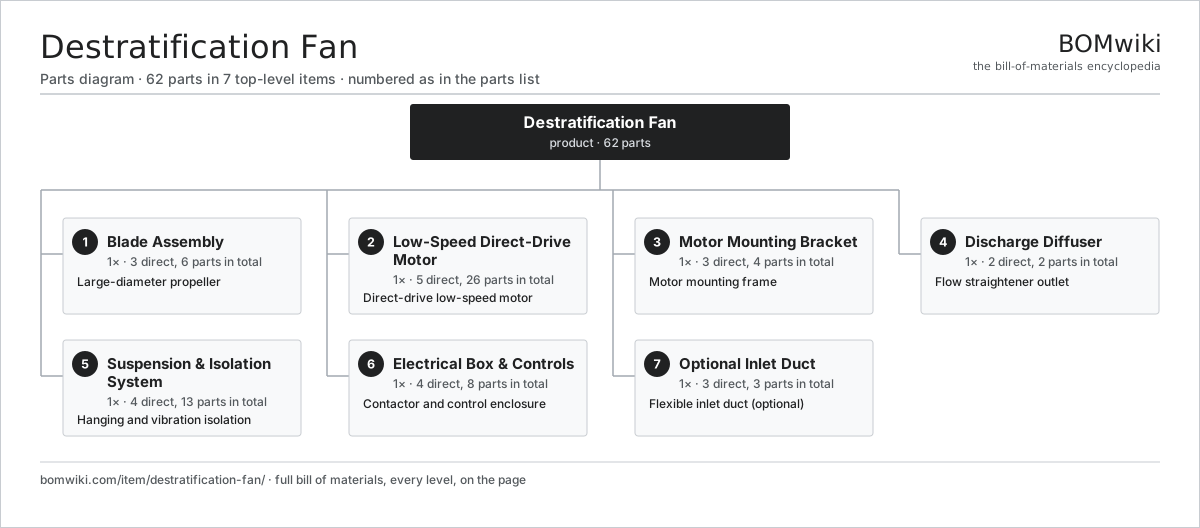
| # | Part | Qty | What it does |
|---|---|---|---|
| 1 | Blade Assembly 3 parts | 1× | Large-diameter propeller |
| 2 | Low-Speed Direct-Drive Motor 5 parts | 1× | Direct-drive low-speed motor |
| 3 | Motor Mounting Bracket 3 parts | 1× | Motor mounting frame |
| 4 | Discharge Diffuser 2 parts | 1× | Flow straightener outlet |
| 5 | Suspension & Isolation System 4 parts | 1× | Hanging and vibration isolation |
| 6 | Electrical Box & Controls 4 parts | 1× | Contactor and control enclosure |
| 7 | Optional Inlet Duct 3 parts | 1× | Flexible inlet duct (optional) |
3D model
No 3D model yet. Have a CAD file of this? Add a 3D model. STL renders right on this page; STEP, FreeCAD, and OpenSCAD sources are welcome too (openly licensed, like all 3D models on BOMwiki).
Build & assembly graph
expand / collapse · shared sub-assemblies converge · links to related products · est. labourTap an assembly to expand/collapse · tap a part to open it · use “Open page” for any node · drag to pan, scroll to zoom.
Bill of materials for Destratification Fan
7 top-level lines · 38 rows shown · 62 parts total · indented to 3 levels| # | Item / sub-assembly | Part no. | Qty/assy | Ext. qty | Parts | Type |
|---|---|---|---|---|---|---|
| 1 | Blade Assembly 3 parts | destratification-fan-blade-assembly | 1× | 1 | 6 | assembly |
| 1.1 | Propeller Hub | destratification-fan-hub | 1× | 1 | · | part |
| 1.2 | Propeller Blade | destratification-fan-blade | 4× | 4 | · | part |
| 1.3 | Blade Fastener Set | destratification-fan-blade-fastener | 1× | 1 | · | part |
| 2 | Low-Speed Direct-Drive Motor 5 parts | destratification-fan-motor | 1× | 1 | 26 | assembly |
| 2.1 | Stator Assembly 3 parts | stator-assembly | 1× | 1 | 3 | assembly |
| 2.1.1 | Stator Core (laminations) | stator-core | 1× | 1 | · | part |
| 2.1.2 | Copper Winding | copper-winding | 1× | 1 | · | part |
| 2.1.3 | Slot Insulation | stator-insulation | 1× | 1 | · | part |
| 2.2 | Rotor Assembly 4 parts | rotor-assembly | 1× | 1 | 19 | assembly |
| 2.2.1 | Rotor Shaft | rotor-shaft | 1× | 1 | · | part |
| 2.2.2 | Rotor Core | rotor-core | 1× | 1 | · | part |
| 2.2.3 | Neodymium Magnet | neodymium-magnet | 16× | 16 | · | part |
| 2.2.4 | Ball Bearing | ball-bearing | 1× | 1 | · | part |
| 2.3 | Copper Winding | copper-winding | 1× | 1 | · | part |
| 2.4 | Motor Housing | motor-housing | 1× | 1 | · | part |
| 2.5 | Ball Bearing | ball-bearing | 2× | 2 | · | part |
| 3 | Motor Mounting Bracket 3 parts | destratification-fan-motor-bracket | 1× | 1 | 4 | assembly |
| 3.1 | Bracket Frame | destratification-fan-bracket-frame | 1× | 1 | · | part |
| 3.2 | Motor Mount Pads | destratification-fan-motor-mount-pad | 1× | 1 | · | part |
| 3.3 | Fastener Set | fastener-set | 2× | 2 | · | part |
| 4 | Discharge Diffuser 2 parts | destratification-fan-diffuser | 1× | 1 | 2 | assembly |
| 4.1 | Diffuser Shroud & Guide Vanes | destratification-fan-diffuser-ring | 1× | 1 | · | part |
| 4.2 | Diffuser Fasteners | destratification-fan-diffuser-fastener | 1× | 1 | · | part |
| 5 | Suspension & Isolation System 4 parts | destratification-fan-suspension | 1× | 1 | 13 | assembly |
| 5.1 | Hanger Cable or Rod | destratification-fan-hanger-cable | 4× | 4 | · | part |
| 5.2 | Hanger Elastomer Isolator | destratification-fan-hanger-elastomer | 4× | 4 | · | part |
| 5.3 | Ceiling Attachment | destratification-fan-ceiling-mount | 4× | 4 | · | part |
| 5.4 | Safety Chain Backup | destratification-fan-chain-coupling | 1× | 1 | · | part |
| 6 | Electrical Box & Controls 4 parts | destratification-fan-electrical-box | 1× | 1 | 8 | assembly |
| 6.1 | Electrical Enclosure | destratification-fan-enclosure | 1× | 1 | · | part |
| 6.2 | Relay | relay | 2× | 2 | · | part |
| 6.3 | Connector | connector | 4× | 4 | · | part |
| 6.4 | Thermostat or Sensor | destratification-fan-thermostat-switch | 1× | 1 | · | part |
| 7 | Optional Inlet Duct 3 parts | destratification-fan-ductwork | 1× | 1 | 3 | assembly |
| 7.1 | Inlet Collar | destratification-fan-inlet-ring | 1× | 1 | · | part |
| 7.2 | Flexible Inlet Duct | destratification-fan-inlet-duct-flex | 1× | 1 | · | part |
| 7.3 | Manual Inlet Damper | destratification-fan-inlet-damper | 1× | 1 | · | part |
Something wrong in this list? Report a problem with this BOM.
Related products
same domain, ranked by shared parts Air Curtain
115 parts · shares 13 with this page
Air Curtain
115 parts · shares 13 with this page
 Air Handling Unit
631 parts · shares 13 with this page
Air Handling Unit
631 parts · shares 13 with this page
 Ceiling Cassette AC
395 parts · shares 13 with this page
Ceiling Cassette AC
395 parts · shares 13 with this page
 Centrifugal Chiller
340 parts · shares 13 with this page
Centrifugal Chiller
340 parts · shares 13 with this page
 Dehumidifier
217 parts · shares 13 with this page
Dehumidifier
217 parts · shares 13 with this page
 Fan Coil Unit
118 parts · shares 13 with this page
Fan Coil Unit
118 parts · shares 13 with this page
Sourcing: possible vendors
Browse the supplier directory → Prices, MOQ, and lead times are algorithmic estimates, not quotes, and not claims about these companies. Company mappings are curated by keyword; est. price band $100–$20k. How estimates work| Vendor | HQ | Specialty | MOQ | Lead time |
|---|---|---|---|---|
|
🇺🇸Carrier
carrier.com ↗
|
Palm Beach Gardens, US | HVAC | 500 units | 8–14 wks |
| tranetechnologies.com ↗ | Davidson, US | HVAC | 500 units | 8–14 wks |
|
🇯🇵Daikin
daikin.com ↗
|
Osaka, JP | HVAC | 500 units | 8–14 wks |
|
🇺🇸Lennox
lennox.com ↗
|
Richardson, US | HVAC | 500 units | 8–14 wks |
| johnsoncontrols.com ↗ | Milwaukee, US | Building systems | 500 units | 8–14 wks |
920-word article