Dewatering Screen
ProductOverview
A dewatering screen is the final step in aggregate wash plant processing, removing surface moisture from fine sand and washed product. Using high-frequency vibration (1500–3000 oscillations per minute) and 1–2 mm polyurethane mesh, dewatering screens can reduce product moisture from 35–40% (wet slurry) to 8–12% (acceptable for stockpiling and concrete production) in a single pass. This is achieved by mechanical separation of water droplets from sand grains via differential motion created by the screen oscillation.
Dewatering screens are economically justified because:
- Reduced moisture content allows faster processing and direct truck loading without draining time
- Energy cost is minimal compared to centrifuges (no power-intensive spinning)
- Polyurethane panels last longer in wet conditions than steel mesh
- Simple operation requires minimal training
- Modular design allows rapid panel replacement (15–30 minutes)
Dewatering Mechanism
The screen operates on a principle of differential motion. As the vibrating deck oscillates upward at 1500–3000 rpm with 3–6 mm amplitude, sand particles suspended in a water film experience an acceleration upward (g-force multiplier of 5–15× gravity). Water, being much lighter, responds more slowly to this acceleration.
At the peak upward motion, sand particles are lifted 1–3 mm above the mesh surface before gravity pulls them back down. During this brief flight, water droplets cling to the particles but some separate due to air resistance. As the deck decelerates and reverses, sand lands back on the mesh with kinetic energy, further shaking off water films.
Over the screen length (1.5–3 meters) and residence time (3–8 seconds), this repeated lifting and impact removes 15–20 percentage points of moisture. A wet sand slurry at 40% moisture can be reduced to 20% in one pass; a second pass brings it to 12%.
Component Design and Operation
Vibration Generation
The high-frequency motor at 1500–3000 rpm drives two eccentric bearing units mounted on the frame side members. These bearings are specially designed so that the rotating eccentric ring creates an oscillating motion of the deck. The oscillation frequency equals the motor speed divided by the number of eccentric throws (typically 1:1 ratio, so 1500 rpm motor = 1500 oscillations per minute).
A flexible coupling between motor and bearing shaft isolates torsional vibration, protecting the motor bearings. The entire screen assembly is mounted on four resilient spring pads bolted to a concrete foundation. These springs isolate vibration from the ground, preventing transmission to nearby structures and reducing noise complaints in urban areas.
Mesh and Deck Design
The vibrating deck is a welded steel frame supporting modular polyurethane or rubber mesh panels. Mesh aperture size is selected based on desired final product size:
- 1 mm aperture: For ultra-fine sand (100–200 microns final size) and maximum water removal
- 1.5 mm aperture: For general-purpose sand (150–300 microns)
- 2 mm aperture: For coarser aggregate (>300 microns)
Polyurethane mesh is preferred over steel or rubber because it:
- Lasts 6–12 months vs. 2–3 months for steel wire in wet service
- Reduces product degradation and dust generation
- Provides better water shedding due to hydrophobic surface
- Absorbs less vibration energy, allowing higher efficiency
Panels are bolted to the deck frame with Grade 8 bolts and sealed with rubber gaskets preventing slurry bypass. In high-production operations, 2–4 panels are replaced weekly; spare panels are kept on site for rapid changeout.
Drainage System
Discharged water flows into a collection pan beneath the deck. The pan is sloped toward a drain pipe that routes water to the plant sump or classifying tank for recirculation. A weir in the pan controls maximum water level; if the pan fills beyond the weir height, water overflows to an external drain.
Product Discharge
Dewatered sand exits the screen end on a product chute lined with wear-resistant rubber. The chute directs product to a belt conveyor or directly to a stockpile. The inclined discharge design (typically 25–35 degrees from horizontal) ensures product flows by gravity, minimizing further wetting.
Operational Variables and Optimization
Dewatering efficiency depends on:
Feed Moisture: A 30% moisture feed is ideal; too dry (15% moisture), and the screen wastes power oscillating dry material; too wet (>50%), and water saturation prevents further removal.
Vibration Frequency: Higher frequencies (2500–3000 rpm) are more effective for fine sand but increase wear and noise. Lower frequencies (1500 rpm) reduce wear and noise but dewater more slowly. Most plants operate at 1800–2000 rpm as a compromise.
Incline Angle: Screens are typically inclined 15–25 degrees. Steeper angles speed product transit but reduce residence time and moisture removal; shallow angles increase residence time but risk product pileup at the discharge.
Product Size: Fine sand (100 microns) requires 8–12 seconds residence for 15% final moisture. Coarse sand (500 microns) achieves the same result in 3–5 seconds. Thus, throughput varies significantly with product specification.
Overflow Caliber: The feed slurry density affects dewatering. Slurry at 70% solids dewater better than 50% solids (more sand particles per unit water), but high solids increase load on the screen and motor power demand.
Installation and Maintenance
Foundation Requirements
Dewatering screens require rigid concrete foundations with isolation springs. Without proper isolation, ground-transmitted vibration can damage adjacent equipment and facilities. The foundation pad is typically 1–2 meters square and 0.3–0.5 meters deep, designed to bear the screen weight plus dynamic loads from oscillation (often 2–3× static weight during peak acceleration).
Maintenance Schedule
Daily:
- Check for slurry leaks under deck
- Verify water level in collection pan
- Inspect mesh panels for tears
Weekly:
- Replace worn mesh panels as needed
- Grease eccentric bearing lubrication fittings
- Check motor temperature and vibration levels
Monthly:
- Clean collection pan sludge
- Inspect isolation springs for corrosion or fatigue cracks
- Verify motor soft-start or VFD operation
Quarterly:
- Full deck inspection for weld cracks
- Replace drainage filter (if installed)
- Check flexible coupling for wear
Annually:
- Rebuild eccentric bearing units (replace seals and repack with grease)
- Inspect and tighten all bolts in frame and bearing blocks
- Repaint exposed steel to prevent corrosion
Performance Comparison with Other Dewatering Methods
Centrifuges: Remove moisture to 10–15% in 2–3 minutes but consume 15–30 kW and require frequent basket replacement. Total operating cost is 2–3× higher than vibrating screens.
Belt Presses: Remove moisture to 12–18% via mechanical compression, consuming 10–20 kW. Effective for extreme fines content but require operator skill and frequent belt adjustment.
Stacking Screens (High-Frequency): Combine dewatering with product grading; can process multiple sizes on separate decks. More expensive but reduce the need for separate grading equipment.
Vibratory Screens (Low-Frequency): Classic 10–20 Hz screens dewater slowly; product moisture reduction is only 5–10 percentage points. Acceptable for stockpile material not requiring <15% moisture.
Integration with Wash Plant
Dewatering screens are typically the final stage of a wash plant, receiving underflow from classifying tanks or wash plant dewatering decks. Product moisture after screening is typically 10–12%, acceptable for all downstream uses:
- Concrete plants accept <8% moisture; stockpiling the screen product for 1–2 days allows additional air drying to reach this target
- Asphalt plants accept up to 15% moisture for warm-mix processes
- Fill and construction applications accept 15–20% moisture
In large integrated facilities, 2–4 dewatering screens operate in parallel, each sized to handle 10–20% of total plant capacity, ensuring product quality consistency.
Dewatering Screen parts and their functions
9 top-level parts · 73 parts in total · full bill of materials below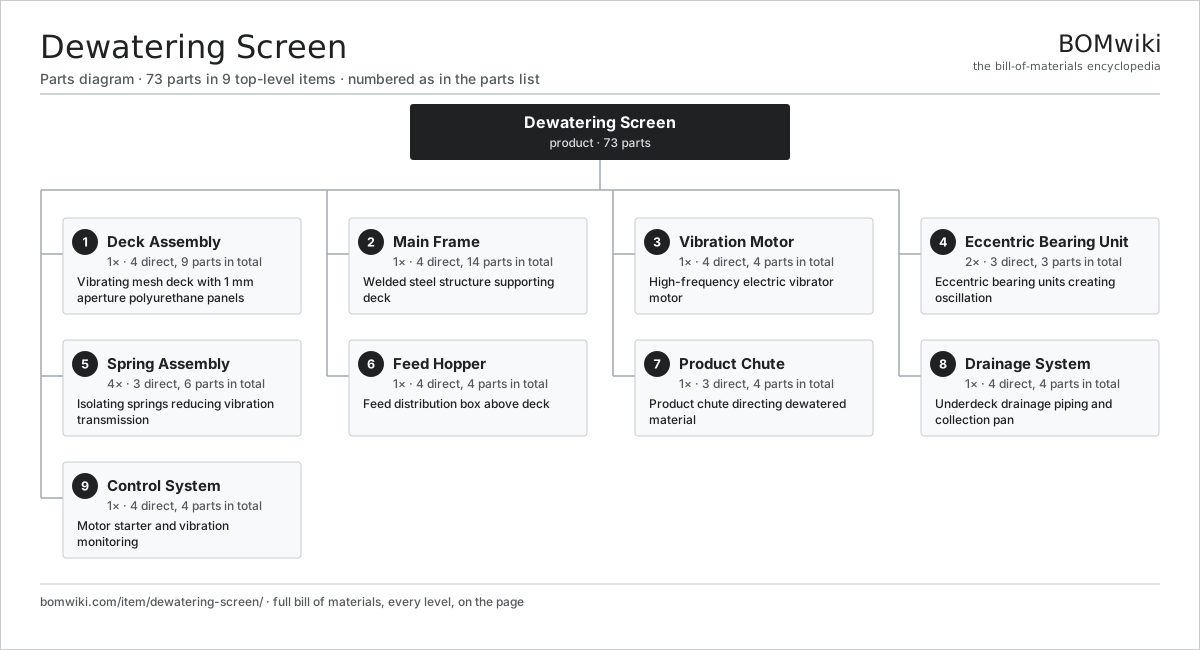
| # | Part | Qty | What it does |
|---|---|---|---|
| 1 | Deck Assembly 4 parts | 1× | Vibrating mesh deck with 1 mm aperture polyurethane panels |
| 2 | Main Frame 4 parts | 1× | Welded steel structure supporting deck |
| 3 | Vibration Motor 4 parts | 1× | High-frequency electric vibrator motor |
| 4 | Eccentric Bearing Unit 3 parts | 2× | Eccentric bearing units creating oscillation |
| 5 | Spring Assembly 3 parts | 4× | Isolating springs reducing vibration transmission |
| 6 | Feed Hopper 4 parts | 1× | Feed distribution box above deck |
| 7 | Product Chute 3 parts | 1× | Product chute directing dewatered material |
| 8 | Drainage System 4 parts | 1× | Underdeck drainage piping and collection pan |
| 9 | Control System 4 parts | 1× | Motor starter and vibration monitoring |
3D model
No 3D model yet. Have a CAD file of this? Add a 3D model. STL renders right on this page; STEP, FreeCAD, and OpenSCAD sources are welcome too (openly licensed, like all 3D models on BOMwiki).
Build & assembly graph
expand / collapse · shared sub-assemblies converge · links to related products · est. labourTap an assembly to expand/collapse · tap a part to open it · use “Open page” for any node · drag to pan, scroll to zoom.
Bill of materials for Dewatering Screen
9 top-level lines · 42 rows shown · 73 parts total · indented to 3 levels| # | Item / sub-assembly | Part no. | Qty/assy | Ext. qty | Parts | Type |
|---|---|---|---|---|---|---|
| 1 | Deck Assembly 4 parts | dewatering-screen-deck | 1× | 1 | 9 | assembly |
| 1.1 | Deck Frame | dewatering-screen-deck-frame | 1× | 1 | · | part |
| 1.2 | Mesh Panel | dewatering-screen-panel | 6× | 6 | · | part |
| 1.3 | Panel Bolt | dewatering-screen-frame-bolt | 1× | 1 | · | part |
| 1.4 | Panel Seal | dewatering-screen-seal | 1× | 1 | · | part |
| 2 | Main Frame 4 parts | dewatering-screen-frame | 1× | 1 | 14 | assembly |
| 2.1 | Side Beam | dewatering-screen-side-member | 2× | 2 | · | part |
| 2.2 | End Beam | dewatering-screen-end-member | 2× | 2 | · | part |
| 2.3 | Gusset Plate | dewatering-screen-gusset | 8× | 8 | · | part |
| 2.4 | Bearing Block | dewatering-screen-bearing-block | 2× | 2 | · | part |
| 3 | Vibration Motor 4 parts | dewatering-screen-motor | 1× | 1 | 4 | assembly |
| 3.1 | Electric Motor | dewatering-screen-electric-motor | 1× | 1 | · | part |
| 3.2 | Motor Shaft | dewatering-screen-motor-shaft | 1× | 1 | · | part |
| 3.3 | Flexible Coupling | dewatering-screen-coupling | 1× | 1 | · | part |
| 3.4 | Motor Mount | dewatering-screen-motor-mount | 1× | 1 | · | part |
| 4 | Eccentric Bearing Unit 3 parts | dewatering-screen-bearing | 2× | 2 | 3 | assembly |
| 4.1 | Eccentric Ring | dewatering-screen-eccentric-ring | 1× | 2 | · | part |
| 4.2 | Bearing Journal | dewatering-screen-bearing-journal | 1× | 2 | · | part |
| 4.3 | Bearing Bolt | dewatering-screen-bearing-bolt | 1× | 2 | · | part |
| 5 | Spring Assembly 3 parts | dewatering-screen-spring | 4× | 4 | 6 | assembly |
| 5.1 | Spring Pad | dewatering-screen-spring-pad | 4× | 16 | · | part |
| 5.2 | Spring Stud | dewatering-screen-spring-stud | 1× | 4 | · | part |
| 5.3 | Spring Plate | dewatering-screen-spring-plate | 1× | 4 | · | part |
| 6 | Feed Hopper 4 parts | dewatering-screen-hopper | 1× | 1 | 4 | assembly |
| 6.1 | Hopper Body | dewatering-screen-hopper-body | 1× | 1 | · | part |
| 6.2 | Hopper Baffle | dewatering-screen-hopper-baffle | 1× | 1 | · | part |
| 6.3 | Hopper Outlet | dewatering-screen-hopper-outlet | 1× | 1 | · | part |
| 6.4 | Feed Pipe | dewatering-screen-feed-pipe | 1× | 1 | · | part |
| 7 | Product Chute 3 parts | dewatering-screen-discharge-chute | 1× | 1 | 4 | assembly |
| 7.1 | Chute Panel | dewatering-screen-chute-panel | 2× | 2 | · | part |
| 7.2 | Chute Liner | dewatering-screen-chute-liner | 1× | 1 | · | part |
| 7.3 | Chute Support | dewatering-screen-chute-support | 1× | 1 | · | part |
| 8 | Drainage System 4 parts | dewatering-screen-drainage | 1× | 1 | 4 | assembly |
| 8.1 | Collection Pan | dewatering-screen-collection-pan | 1× | 1 | · | part |
| 8.2 | Drain Pipe | dewatering-screen-drain-pipe | 1× | 1 | · | part |
| 8.3 | Overflow Weir | dewatering-screen-overflow-weir | 1× | 1 | · | part |
| 8.4 | Drain Valve | dewatering-screen-drain-valve | 1× | 1 | · | part |
| 9 | Control System 4 parts | dewatering-screen-control | 1× | 1 | 4 | assembly |
| 9.1 | Motor Starter | dewatering-screen-motor-starter | 1× | 1 | · | part |
| 9.2 | Vibration Sensor | dewatering-screen-vibration-sensor | 1× | 1 | · | part |
| 9.3 | Emergency Stop | dewatering-screen-emergency-stop | 1× | 1 | · | part |
| 9.4 | Overload Relay | dewatering-screen-motor-overload | 1× | 1 | · | part |
Something wrong in this list? Report a problem with this BOM.
Sourcing: possible vendors
Browse the supplier directory → Prices, MOQ, and lead times are algorithmic estimates, not quotes, and not claims about these companies. Company mappings are curated by keyword; est. price band $200k–$5M. How estimates work| Vendor | HQ | Specialty | MOQ | Lead time |
|---|---|---|---|---|
| caterpillar.com ↗ | Irving, US | Construction & mining equipment | made to order | 20–36 wks |
|
🇯🇵Komatsu
komatsu.com ↗
|
Tokyo, JP | Construction & mining equipment | made to order | 20–36 wks |
|
🇸🇪Sandvik
rocktechnology.sandvik ↗
|
Stockholm, SE | Mining & rock technology | made to order | 20–36 wks |
|
🇸🇪Epiroc
epiroc.com ↗
|
Stockholm, SE | Mining & drilling equipment | made to order | 20–36 wks |
|
🇫🇮Metso
metso.com ↗
|
Helsinki, FI | Crushing & minerals processing | made to order | 20–36 wks |
1,312-word article