Digital USB Microscope
ProductOverview
A digital USB microscope is a portable, computer-integrated inspection instrument combining a fixed-focus lens, CMOS image sensor, coaxial LED illumination, and USB interface. Unlike traditional eyepiece microscopes, digital USB models are headless, they connect directly to a laptop or workstation for live preview, image capture, and measurement. With magnification ranging from 20× to 200× and no need for external power (bus-powered via USB), they are widely used for quality control, electronics inspection, jewelry evaluation, and educational demonstrations.
The Optical Head Assembly contains a CMOS CMOS Sensor and fixed Lens Stack, eliminating the need for manual refocusing across magnifications. The LED Ring Assembly provides shadowless coaxial illumination, and the USB Controller Module performs image processing and streaming. The Stand Assembly articulated arm allows flexible positioning of samples.
How it works
Light from the LED Array (12–24 white LEDs) passes through the Ring Diffuser into a frosted ring that surrounds the Lens Stack objective. This coaxial geometry ensures minimal shadows because the illumination comes from the same direction as the viewing axis. The light reflects off the specimen and enters the objective lens.
The Lens Stack is a fixed focal-length achromatic objective (typically 50–200 mm focal length, 0.3–0.5 NA) forming a real image of the specimen on the CMOS Sensor. Modern CMOS sensors have 1.4–2 μm pixel pitch, giving native pixel-limited resolution of 0.7–1 μm in the specimen plane at magnification corresponding to the lens focal length. Digital zooming via software upsamples the image without adding resolution.
The CMOS Sensor (5–13 Mpixel) captures the magnified specimen as a Bayer (RGGB) color filter array. The Image Processor performs:
- Demosaicing, interpolating missing color values to reconstruct full RGB.
- White balance, adjusting color channel gains for neutral illumination (avoiding yellow LED color cast).
- Compression, encoding images to JPEG or H.264 video for USB transmission.
The USB Controller handles USB 2.0 (480 Mbps) or USB 3.0 (5 Gbps) communication, streaming live video at 30–60 fps. The host computer runs microscope software (often bundled, sometimes TWAIN-compatible) that displays the live video, triggers capture, measures features, and records stacks.
The Focusing Mechanism allows manual Coarse Focus Wheel adjustment plus Fine Focus Micrometer (0.005 mm per division) for precise focal plane positioning. An optional Focus Motor enables autofocus via software control, detecting contrast peaks to automatically find the best focal plane.
Illumination and contrast
The LED Ring Assembly brightness is controlled via the LED Control Logic PWM circuit. Full brightness (100%) maximizes light gathering and minimizes noise but may blow out highlights on shiny surfaces. Lower brightness (30–70%) offers a compromise. For specimens with topography, side lighting (rotating the stand to angle the ring non-coaxially) enhances shadows and 3D appearance.
Some models replace the white LED ring with RGB LEDs, allowing:
- Red channel only: enhances contrast on golden/copper surfaces.
- Green channel only: emphasizes contrast on printed text.
- Blue channel only: improves contrast on dark surfaces.
- White (RGB combined): standard illumination.
Magnification and resolution
Digital USB microscopes advertise magnification in two forms:
- Optical magnification: determined by sensor pixel pitch and lens focal length. A typical fixed optical magnification is 20–40×.
- Digital magnification: upsampling in software, extending apparent magnification to 200× or higher.
Digital magnification does not increase true resolution (limited by diffraction and sensor pixel size) but can aid visibility of fine features near the Rayleigh diffraction limit. For measurements requiring accuracy, optical magnification is preferred.
Applications
Quality control: inspecting PCB solder joints, IC pins, surface defects in manufacturing. Electronics repair: diagnosing component failures, checking capacitor markings, inspecting traces. Jewelry: examining gemstone cut, clarity, and surface polish. Numismatics: evaluating coin mintmarks and die varieties. Bioscience: screening cells or small organisms in clinical or research labs. Education: live classroom demonstrations of microscopic worlds.
Software ecosystem
USB microscopes are TWAIN-compatible on Windows and Mac, integrating with image editing software (Photoshop) and measurement tools. Many manufacturers supply proprietary software featuring:
- Live video overlay with rulers and crosshairs.
- Image stacking (focus bracketing) to increase depth of field.
- Automated measurement of distances and areas.
- Video recording and time-lapse capture.
Digital USB Microscope parts and their functions
5 top-level parts · 22 parts in total · full bill of materials below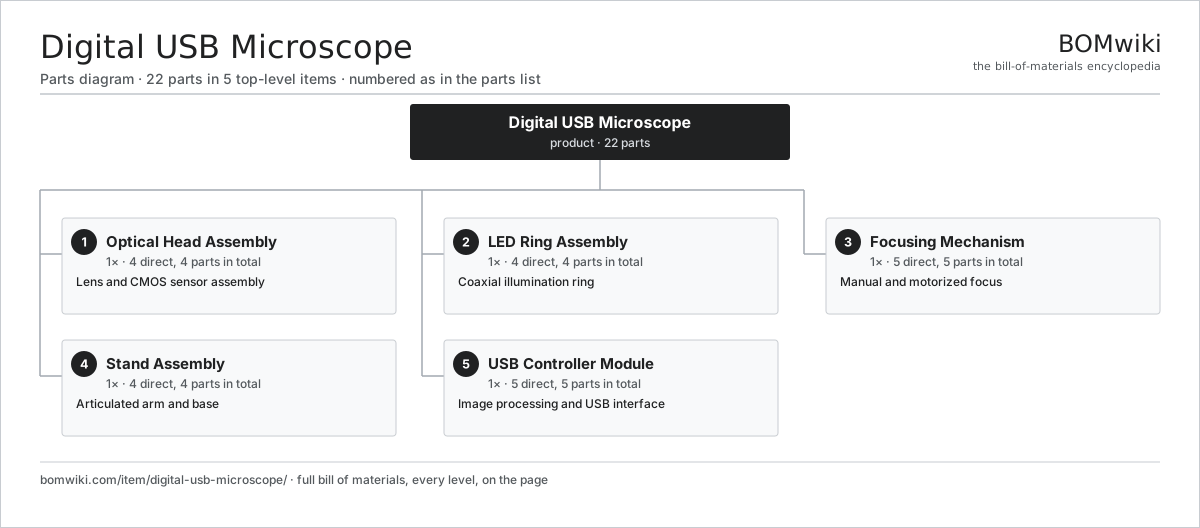
| # | Part | Qty | What it does |
|---|---|---|---|
| 1 | Optical Head Assembly 4 parts | 1× | Lens and CMOS sensor assembly |
| 2 | LED Ring Assembly 4 parts | 1× | Coaxial illumination ring |
| 3 | Focusing Mechanism 5 parts | 1× | Manual and motorized focus |
| 4 | Stand Assembly 4 parts | 1× | Articulated arm and base |
| 5 | USB Controller Module 5 parts | 1× | Image processing and USB interface |
3D model
No 3D model yet. Have a CAD file of this? Add a 3D model. STL renders right on this page; STEP, FreeCAD, and OpenSCAD sources are welcome too (openly licensed, like all 3D models on BOMwiki).
Build & assembly graph
expand / collapse · shared sub-assemblies converge · links to related products · est. labourTap an assembly to expand/collapse · tap a part to open it · use “Open page” for any node · drag to pan, scroll to zoom.
Bill of materials for Digital USB Microscope
5 top-level lines · 27 rows shown · 22 parts total · indented to 3 levels| # | Item / sub-assembly | Part no. | Qty/assy | Ext. qty | Parts | Type |
|---|---|---|---|---|---|---|
| 1 | Optical Head Assembly 4 parts | digital-usb-microscope-optical-head | 1× | 1 | 4 | assembly |
| 1.1 | CMOS Sensor | digital-usb-microscope-cmos-sensor | 1× | 1 | · | part |
| 1.2 | Lens Stack | digital-usb-microscope-lens-stack | 1× | 1 | · | part |
| 1.3 | Optical Tube | digital-usb-microscope-optical-tube | 1× | 1 | · | part |
| 1.4 | Sensor Interface | digital-usb-microscope-sensor-interface | 1× | 1 | · | part |
| 2 | LED Ring Assembly 4 parts | digital-usb-microscope-led-ring | 1× | 1 | 4 | assembly |
| 2.1 | LED Array | digital-usb-microscope-led-array | 1× | 1 | · | part |
| 2.2 | Ring Diffuser | digital-usb-microscope-ring-diffuser | 1× | 1 | · | part |
| 2.3 | LED Driver Board | digital-usb-microscope-led-driver-board | 1× | 1 | · | part |
| 2.4 | Heat Sink Ring | digital-usb-microscope-heat-sink-ring | 1× | 1 | · | part |
| 3 | Focusing Mechanism 5 parts | digital-usb-microscope-focusing-mechanism | 1× | 1 | 5 | assembly |
| 3.1 | Coarse Focus Wheel | digital-usb-microscope-coarse-focus-wheel | 1× | 1 | · | part |
| 3.2 | Fine Focus Micrometer | digital-usb-microscope-fine-focus-micrometer | 1× | 1 | · | part |
| 3.3 | Focus Motor | digital-usb-microscope-stepper-motor-focus | 1× | 1 | · | part |
| 3.4 | Focus Carriage | digital-usb-microscope-focus-carriage | 1× | 1 | · | part |
| 3.5 | Focus Bearing | digital-usb-microscope-focus-bearing | 1× | 1 | · | part |
| 4 | Stand Assembly 4 parts | digital-usb-microscope-stand-assembly | 1× | 1 | 4 | assembly |
| 4.1 | Articulated Arm | digital-usb-microscope-articulated-arm | 1× | 1 | · | part |
| 4.2 | Base Platform | digital-usb-microscope-base-platform | 1× | 1 | · | part |
| 4.3 | Specimen Stage | digital-usb-microscope-specimen-stage | 1× | 1 | · | part |
| 4.4 | Specimen Clip | digital-usb-microscope-specimen-clip | 1× | 1 | · | part |
| 5 | USB Controller Module 5 parts | digital-usb-microscope-usb-controller | 1× | 1 | 5 | assembly |
| 5.1 | Image Processor | digital-usb-microscope-image-processor | 1× | 1 | · | part |
| 5.2 | USB Controller | digital-usb-microscope-usb-transceiver | 1× | 1 | · | part |
| 5.3 | Memory Module | digital-usb-microscope-memory-module | 1× | 1 | · | part |
| 5.4 | Power Converter | digital-usb-microscope-power-converter | 1× | 1 | · | part |
| 5.5 | LED Control Logic | digital-usb-microscope-led-control-logic | 1× | 1 | · | part |
Something wrong in this list? Report a problem with this BOM.
Sourcing: possible vendors
Browse the supplier directory → Prices, MOQ, and lead times are algorithmic estimates, not quotes, and not claims about these companies. Company mappings are curated by keyword; est. price band $1k–$500k. How estimates work| Vendor | HQ | Specialty | MOQ | Lead time |
|---|---|---|---|---|
| thermofisher.com ↗ | Waltham, US | Lab instruments | 100 units | 10–18 wks |
|
🇺🇸Agilent
agilent.com ↗
|
Santa Clara, US | Analytical instruments | 100 units | 10–18 wks |
|
🇺🇸Bruker
bruker.com ↗
|
Billerica, US | Scientific instruments | 100 units | 10–18 wks |
|
🇯🇵Shimadzu
shimadzu.com ↗
|
Kyoto, JP | Analytical instruments | 100 units | 10–18 wks |
|
🇺🇸Waters
waters.com ↗
|
Milford, US | Chromatography & MS | 100 units | 10–18 wks |
752-word article