DAS Headend
ProductOverview
A Distributed Antenna System (DAS) headend is the central hub bridging macrocellular signals from a donor antenna to localized coverage zones via remote antenna units connected by optical fiber. Rather than sharing a single high-power macrocell site, DAS allows neutral-host operators to capture signals from multiple carriers and distribute them indoors or across campuses with minimal cross-interference.
The headend receives RF signals from a rooftop Donor Antenna, amplifies them through a Low-Noise Amplifier, downconverts to an intermediate frequency, modulates onto an optical carrier, and distributes the resulting optical signal via single-mode fiber to remote antenna units. Return-path signals (uplink from mobile devices) are received on a separate 1550 nm wavelength, demodulated, and transmitted back to the macrocell via a secondary donor antenna.
This architecture enables transparent RF-over-fiber distribution: mobile devices see standard cellular coverage without knowing they are communicating through remote units. Handover between DAS-served cells and macrocells is automatic and seamless.
How it works
The donor antenna sits on the rooftop or exterior wall of a building, aimed at the nearest macrocell site. RF signals (700 MHz to 2.7 GHz) are captured and routed via Heliax Coaxial Cable, a low-loss heliax transmission line, to the Low-Noise Amplifier. This low-noise amplifier provides 20 dB gain with only 1.5 dB noise figure, setting the overall system noise floor.
The amplified RF signal enters the RF-to-IF Downconverter, a mixer that translates the RF frequencies down to an intermediate frequency (IF) band spanning 0–300 MHz. This downconversion is necessary because optical modulators operate at baseband frequencies, not 2 GHz RF. The IF signal is typically single-sideband (USB or LSB) to minimize bandwidth.
The IF signal drives the Mach-Zehnder Modulator, a Mach-Zehnder modulator built from lithium niobate (LiNbO3) waveguide. A 1310 nm laser provides the optical carrier; the IF signal modulates the intensity of this light via electro-optic effect. The modulation is linear, preserving signal fidelity for OFDM and QAM modulations.
The modulated 1310 nm signal exits the modulator and enters the EDFA Booster, an EDFA providing 20 dB gain, to overcome splitter losses in long fiber runs. The signal then enters a 1310/1550 nm WDM Coupler, which combines it with 1550 nm return-path light from remote units on the same fiber.
The combined optical signal is fed into a Optical Splitter (1x4 or 1x8), which distributes it equally to multiple remote antenna units. Each remote unit demodulates the 1310 nm signal back to RF, amplifies it, and radiates it over a local antenna. This completes the downlink path.
Uplink traffic from mobile devices is received by the remote unit antenna, downconverted to IF, and modulated onto a 1550 nm laser. This return-path signal travels back through the fiber, passes through the WDM coupler, and is received by a 1550 nm PIN Photodiode. The recovered IF is upconverted back to RF and transmitted to the macrocell via the secondary donor antenna.
The Gain Control and Monitoring maintains constant output power despite fluctuations in donor signal strength. A RF Power Detector at the fiber output samples RF power and outputs a logarithmic voltage. An ADC and microcontroller close a servo loop, adjusting a Variable Optical Attenuator (variable optical attenuator) to hold output power constant. This prevents oscillation and ensures mobile device power control loops remain stable.
Optical Transport Advantages
RF-over-fiber transport offers several benefits over traditional coaxial distribution. First, fiber has negligible loss compared to coax: 0.3 dB/km in the 1550 nm window versus 0.5 dB/100 m for 7/8" heliax. A 5 km fiber run introduces only 1.5 dB loss; the equivalent coax would require intermediate amplifiers. Second, fiber is immune to electromagnetic interference: power lines, radar, and nearby RF transmitters cannot couple into single-mode fiber, unlike coax which radiates interference over long runs. Third, bidirectional single-fiber operation (using WDM) simplifies installation: a single fiber pair carries both downlink (1310 nm) and uplink (1550 nm).
Gain Flattening and Level Control
DAS headends must maintain equal signal levels at each remote unit despite unequal path losses. In an 8-unit splitter, the loss to each output is nominally equal (~9 dB), but manufacturing tolerances and fiber routing asymmetries introduce ±1 dB variations. The Variable Optical Attenuator allows manual adjustment of level post-installation, or a servo loop can automatically equalize levels per-band.
Further complication: different cellular bands (800 MHz, 1.8 GHz, 2.6 GHz) suffer different downconversion and RF propagation losses. A Multi-Band Passband Filter with multiple passbands ensures donor antenna rejection of out-of-band interference. The downconverter tuning voltage may be band-specific; modern headends include selectable downconverter modules or broadband designs accepting all bands simultaneously.
Return-Path Architecture
Uplink (return-path) signals from remote units are more challenging. Mobile devices transmit at -40 dBm to +23 dBm (variable power control); the weakest signals are -40 dBm from indoor phones far from antennas. These signals are captured by the remote unit antenna, transported back through fiber as 1550 nm modulated light, demodulated at the headend, and retransmitted to the macrocell via a secondary donor antenna.
The secondary donor antenna may be omnidirectional (radiating in all directions) or directional aimed at the macrocell. If the primary (downlink) and secondary (uplink) antennas are located on the same structure, proper isolation (wall, distance, orthogonal polarization) prevents downlink-to-uplink feedback. In some deployments, the secondary antenna is mounted on the opposite side of the building or on a nearby pole.
Redundancy and Fault Management
Critical DAS headends in hospitals, stadiums, or airports use redundant power supplies (N+1), redundant fans, and watchdog timers. The Power and Thermal Monitor IC continuously checks supply voltages and temperature. If a supply fails or temperature exceeds 55°C, an alarm relay triggers a Page alert to the network operations center. Some designs include a second headend in hot-standby mode, automatically switching traffic if the primary fails.
Integration with Small Cells
DAS headends are frequently deployed alongside Small Cell Base Station units that provide additional capacity beyond macrocell coverage. The headend serves as the backhaul aggregation point; small cells are backhauled over the same fiber network, often using CPRI protocol. This converged architecture reduces site complexity and enables load balancing between macrocell-via-DAS and small-cell-served zones.
DAS Headend parts and their functions
6 top-level parts · 34 parts in total · full bill of materials below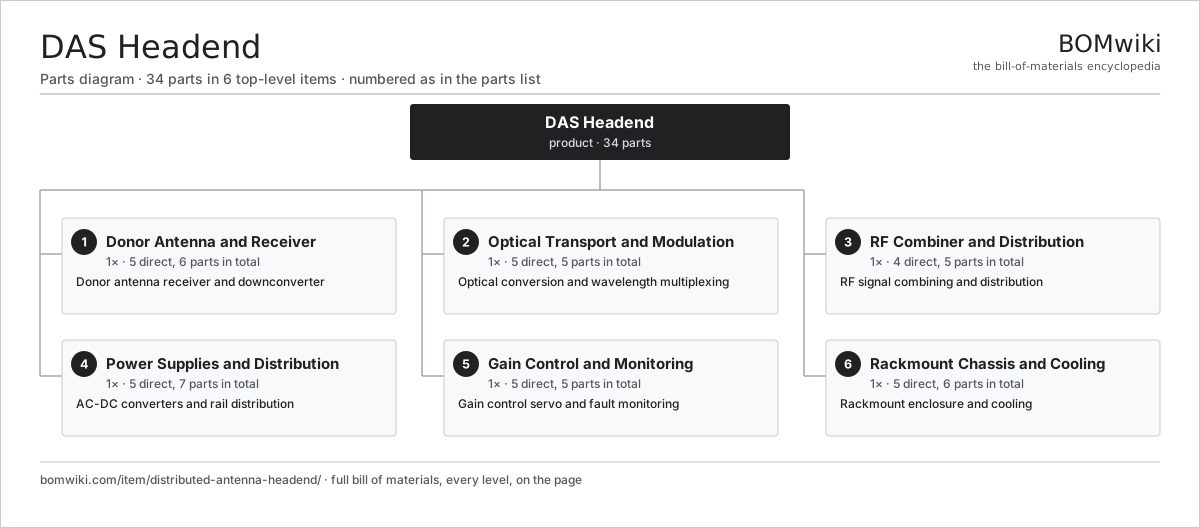
| # | Part | Qty | What it does |
|---|---|---|---|
| 1 | Donor Antenna and Receiver 5 parts | 1× | Donor antenna receiver and downconverter |
| 2 | Optical Transport and Modulation 5 parts | 1× | Optical conversion and wavelength multiplexing |
| 3 | RF Combiner and Distribution 4 parts | 1× | RF signal combining and distribution |
| 4 | Power Supplies and Distribution 5 parts | 1× | AC-DC converters and rail distribution |
| 5 | Gain Control and Monitoring 5 parts | 1× | Gain control servo and fault monitoring |
| 6 | Rackmount Chassis and Cooling 5 parts | 1× | Rackmount enclosure and cooling |
3D model
No 3D model yet. Have a CAD file of this? Add a 3D model. STL renders right on this page; STEP, FreeCAD, and OpenSCAD sources are welcome too (openly licensed, like all 3D models on BOMwiki).
Build & assembly graph
expand / collapse · shared sub-assemblies converge · links to related products · est. labourTap an assembly to expand/collapse · tap a part to open it · use “Open page” for any node · drag to pan, scroll to zoom.
Bill of materials for DAS Headend
6 top-level lines · 35 rows shown · 34 parts total · indented to 3 levels| # | Item / sub-assembly | Part no. | Qty/assy | Ext. qty | Parts | Type |
|---|---|---|---|---|---|---|
| 1 | Donor Antenna and Receiver 5 parts | distributed-antenna-headend-donor-subsystem | 1× | 1 | 6 | assembly |
| 1.1 | Donor Antenna | distributed-antenna-headend-donor-antenna | 1× | 1 | · | part |
| 1.2 | Low-Noise Amplifier | distributed-antenna-headend-lna-module | 1× | 1 | · | part |
| 1.3 | RF-to-IF Downconverter | distributed-antenna-headend-downconverter | 1× | 1 | · | part |
| 1.4 | Heliax Coaxial Cable | distributed-antenna-headend-donor-cable | 1× | 1 | · | part |
| 1.5 | SMD Passive (R/C/L) | smd-passives | 2× | 2 | · | part |
| 2 | Optical Transport and Modulation 5 parts | distributed-antenna-headend-optical-subsystem | 1× | 1 | 5 | assembly |
| 2.1 | Mach-Zehnder Modulator | distributed-antenna-headend-mzm-modulator | 1× | 1 | · | part |
| 2.2 | 1310 nm DFB Laser | distributed-antenna-headend-laser-tx | 1× | 1 | · | part |
| 2.3 | 1550 nm PIN Photodiode | distributed-antenna-headend-photodiode-rx | 1× | 1 | · | part |
| 2.4 | 1310/1550 nm WDM Coupler | distributed-antenna-headend-wdm-coupler-opt | 1× | 1 | · | part |
| 2.5 | EDFA Booster | distributed-antenna-headend-optical-amplifier | 1× | 1 | · | part |
| 3 | RF Combiner and Distribution 4 parts | distributed-antenna-headend-combiner-subsystem | 1× | 1 | 5 | assembly |
| 3.1 | Multi-Band Passband Filter | distributed-antenna-headend-passband-filter | 1× | 1 | · | part |
| 3.2 | Variable Optical Attenuator | distributed-antenna-headend-voa-module | 1× | 1 | · | part |
| 3.3 | Optical Splitter | distributed-antenna-headend-splitter | 1× | 1 | · | part |
| 3.4 | FC/APC Fiber Connector | distributed-antenna-headend-connectors-fc | 2× | 2 | · | part |
| 4 | Power Supplies and Distribution 5 parts | distributed-antenna-headend-power-subsystem | 1× | 1 | 7 | assembly |
| 4.1 | Power Supply | power-supply | 1× | 1 | · | part |
| 4.2 | 48V to 12V Buck | distributed-antenna-headend-dcdc-48v-12v | 1× | 1 | · | part |
| 4.3 | 12V to 5V Buck | distributed-antenna-headend-dcdc-12v-5v | 1× | 1 | · | part |
| 4.4 | Laser Diode Supply | distributed-antenna-headend-dcdc-laser | 1× | 1 | · | part |
| 4.5 | SMD Passive (R/C/L) | smd-passives | 3× | 3 | · | part |
| 5 | Gain Control and Monitoring 5 parts | distributed-antenna-headend-control-subsystem | 1× | 1 | 5 | assembly |
| 5.1 | RF Power Detector | distributed-antenna-headend-level-detector | 1× | 1 | · | part |
| 5.2 | 8-Bit Fast ADC | distributed-antenna-headend-adc-8bit | 1× | 1 | · | part |
| 5.3 | 6-Bit DAC | distributed-antenna-headend-dac-6bit | 1× | 1 | · | part |
| 5.4 | ARM Cortex-M3 MCU | distributed-antenna-headend-microcontroller | 1× | 1 | · | part |
| 5.5 | Power and Thermal Monitor IC | distributed-antenna-headend-fault-monitor | 1× | 1 | · | part |
| 6 | Rackmount Chassis and Cooling 5 parts | distributed-antenna-headend-chassis-subsystem | 1× | 1 | 6 | assembly |
| 6.1 | 2RU Rackmount Frame | distributed-antenna-headend-rack-frame | 1× | 1 | · | part |
| 6.2 | Intake Air Filter Panel | distributed-antenna-headend-intake-filter | 1× | 1 | · | part |
| 6.3 | Redundant Fan Tray | distributed-antenna-headend-fan-tray | 1× | 1 | · | part |
| 6.4 | Fiber Routing Panel | distributed-antenna-headend-cable-mgmt | 1× | 1 | · | part |
| 6.5 | Fastener Set | fastener-set | 2× | 2 | · | part |
Something wrong in this list? Report a problem with this BOM.
Sourcing: possible vendors
Browse the supplier directory → Prices, MOQ, and lead times are algorithmic estimates, not quotes, and not claims about these companies. Company mappings are curated by keyword; est. price band $30–$50k. How estimates work| Vendor | HQ | Specialty | MOQ | Lead time |
|---|---|---|---|---|
|
🇺🇸Cisco
cisco.com ↗
|
San Jose, US | Networking | 500 units | 8–14 wks |
|
🇺🇸Juniper
juniper.net ↗
|
Sunnyvale, US | Networking | 500 units | 8–14 wks |
| arista.com ↗ | Santa Clara, US | Networking | 500 units | 8–14 wks |
|
🇫🇮Nokia
nokia.com ↗
|
Espoo, FI | Telecom equipment | 500 units | 8–14 wks |
|
🇨🇳Huawei
huawei.com ↗
|
Shenzhen, CN | Networking & telecom | 500 units | 8–14 wks |
1,091-word article