Dive Computer
ProductOverview
A dive computer is a wrist-mounted electronic device measuring water pressure, temperature, and time, then computing real-time nitrogen loading across modeled body tissues. It displays depth, bottom time, ascent rate, and the maximum bottom time allowable without mandatory decompression stops, the "no-decompression limit" (NDL).
Modern dive computers are essential safety equipment. They monitor nitrogen absorption more accurately than manual tables, account for multi-level dives (where depth changes), and provide continuous real-time feedback enabling divers to manage decompression risk dynamically.
Core Components
The Pressure Transducer is a piezoelectric or capacitive transducer sensitive to water pressure. A small port on the wrist case exposes the sensor diaphragm to water; rising pressure generates a small electrical signal that the Main Algorithm Processor amplifies and digitizes.
The Main Algorithm Processor is an ultra-low-power microcontroller running a decompression algorithm. The two main algorithms in use are:
- Buhlmann ZH-L16: Classic Swiss tissue-model diving algorithm with 16 theoretical tissue compartments, each with different nitrogen uptake/offgassing rates.
- RGBM (Reduced Gradient Bubble Model): More conservative algorithm accounting for bubble nucleation, reducing decompression sickness risk.
Both require real-time depth and temperature input to compute nitrogen tissue loading and predict safe ascent profiles.
Display & User Interface
The LCD or LED Display Module shows depth (in meters or feet), elapsed dive time, ascent rate, current NDL (minutes remaining before mandatory stops), and warning indicators (fast ascent, no-decompression violation, low battery, sensor malfunction).
Most computers use a small LCD panel, segmented displays are simple and low-power; dot-matrix displays enable graphics and more information density. A LCD Backlight LED is standard, enabling night dives or low-light visibility.
Some computers integrate a Wireless Air Interface (Optional), a wireless receiver picking up tank pressure data from a transmitter on the regulator, eliminating the need for HP hose gauges. Wireless monitoring extends battery life by showing air consumption trends, enabling emergency planning.
Decompression Model
Dive computers assume "compartments" of body tissue, fast-loading tissues (blood, brain) and slow-loading tissues (fat, bone). Each compartment has a "half-time" (time to fully saturate to ambient nitrogen pressure). During descent and bottom time, these tissues absorb nitrogen according to partial pressure. During ascent, they offgas nitrogen.
If ascent is too fast or bottom time too long, bubble nucleation occurs, nitrogen can form bubbles in blood and tissues, causing decompression sickness (DCS or "the bends"). The algorithm computes safe ascent rates and required mandatory stops to minimize DCS risk.
A safety margin is built in, computers do not allow ascent that would violate the algorithm's bubble-formation thresholds. Some computers (technical models) allow deeper or longer bottom times than recreational models, requiring diver certification and experience.
Dive Logging & Retraceability
The Algorithm State RAM stores dive history, each dive's maximum depth, duration, temperature, and tissue loading at dive end. This enables dive sequence tracking: nitrogen saturation is partially retained between dives, and the computer accounts for this on subsequent dives.
Safety rules cap nitrogen saturation, divers who exceed limits must wait surface intervals (hours to days) before diving again. The computer enforces these rules dynamically.
Variations & Modes
Recreational computers are limited to shallow depths (40 m) and no mandatory decompression. Technical computers allow deeper dives (70+ m) and require explicit decompression stops on ascent.
Some computers feature altitude compensation, if a diver travels to a high-altitude lake, the computer adjusts ambient pressure calculations. Others have nitrox (enriched-air) modes allowing input of oxygen-enriched air blends, extending bottom time at safe oxygen exposure.
Freedom of choice in decompression profile varies by computer. Basic models compute a fixed optimal path; advanced models allow diver selection of ascent rate (e.g., 7 m/min vs. 10 m/min), trading bottom time for flexibility.
Reliability & Maintenance
Dive computers are sealed units, battery replacement requires manufacturer service on some models. Alkaline batteries last 12–36 months; rechargeable models require annual charging. After each saltwater dive, computers should be rinsed in fresh water and stored dry.
Sensor drift can occur over years of use, but modern sensor electronics are robust. Pressure accuracy of ±0.5% is typical, well within diving safety margins.
Dive Computer parts and their functions
6 top-level parts · 18 parts in total · full bill of materials below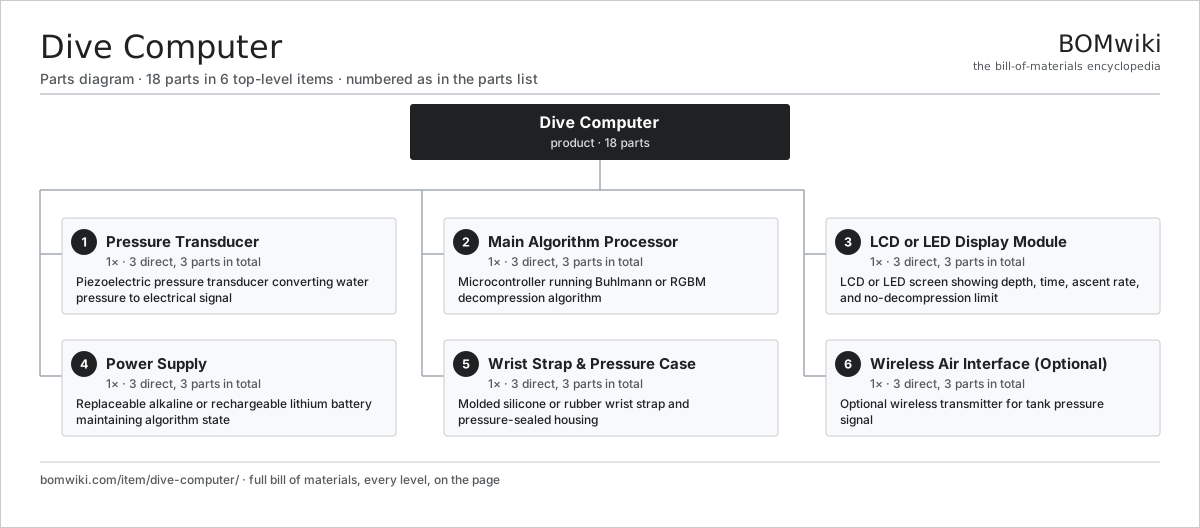
| # | Part | Qty | What it does |
|---|---|---|---|
| 1 | Pressure Transducer 3 parts | 1× | Piezoelectric pressure transducer converting water pressure to electrical signal |
| 2 | Main Algorithm Processor 3 parts | 1× | Microcontroller running Buhlmann or RGBM decompression algorithm |
| 3 | LCD or LED Display Module 3 parts | 1× | LCD or LED screen showing depth, time, ascent rate, and no-decompression limit |
| 4 | Power Supply 3 parts | 1× | Replaceable alkaline or rechargeable lithium battery maintaining algorithm state |
| 5 | Wrist Strap & Pressure Case 3 parts | 1× | Molded silicone or rubber wrist strap and pressure-sealed housing |
| 6 | Wireless Air Interface (Optional) 3 parts | 1× | Optional wireless transmitter for tank pressure signal |
3D model
No 3D model yet. Have a CAD file of this? Add a 3D model. STL renders right on this page; STEP, FreeCAD, and OpenSCAD sources are welcome too (openly licensed, like all 3D models on BOMwiki).
Build & assembly graph
expand / collapse · shared sub-assemblies converge · links to related products · est. labourTap an assembly to expand/collapse · tap a part to open it · use “Open page” for any node · drag to pan, scroll to zoom.
Bill of materials for Dive Computer
6 top-level lines · 24 rows shown · 18 parts total · indented to 3 levels| # | Item / sub-assembly | Part no. | Qty/assy | Ext. qty | Parts | Type |
|---|---|---|---|---|---|---|
| 1 | Pressure Transducer 3 parts | dive-computer-pressure-sensor | 1× | 1 | 3 | assembly |
| 1.1 | Piezoresistive Sensor Die | dive-computer-sensor-element | 1× | 1 | · | part |
| 1.2 | Sensor Signal Amplifier | dive-computer-sensor-amplifier | 1× | 1 | · | part |
| 1.3 | Temperature Compensation Thermistor | dive-computer-sensor-temperature | 1× | 1 | · | part |
| 2 | Main Algorithm Processor 3 parts | dive-computer-processor | 1× | 1 | 3 | assembly |
| 2.1 | Microcontroller | mcu | 1× | 1 | · | part |
| 2.2 | Firmware Flash Memory | dive-computer-algorithm-rom | 1× | 1 | · | part |
| 2.3 | Algorithm State RAM | dive-computer-algorithm-ram | 1× | 1 | · | part |
| 3 | LCD or LED Display Module 3 parts | dive-computer-display | 1× | 1 | 3 | assembly |
| 3.1 | LCD Panel | lcd-panel | 1× | 1 | · | part |
| 3.2 | LCD Backlight LED | dive-computer-display-backlight | 1× | 1 | · | part |
| 3.3 | Display Protective Film | dive-computer-display-polarizer | 1× | 1 | · | part |
| 4 | Power Supply 3 parts | dive-computer-battery | 1× | 1 | 3 | assembly |
| 4.1 | Battery Cell | dive-computer-battery-cell | 1× | 1 | · | part |
| 4.2 | Battery Terminal Contact | dive-computer-battery-contact | 1× | 1 | · | part |
| 4.3 | Waterproof Battery Cover | dive-computer-battery-door | 1× | 1 | · | part |
| 5 | Wrist Strap & Pressure Case 3 parts | dive-computer-strap-housing | 1× | 1 | 3 | assembly |
| 5.1 | Silicone Wrist Strap | dive-computer-strap-silicone | 1× | 1 | · | part |
| 5.2 | Watch Case Housing | dive-computer-case-plastic | 1× | 1 | · | part |
| 5.3 | Case Back O-Ring Seal | dive-computer-case-seal | 1× | 1 | · | part |
| 6 | Wireless Air Interface (Optional) 3 parts | dive-computer-air-interface | 1× | 1 | 3 | assembly |
| 6.1 | RF Transceiver Chip | dive-computer-transceiver-ic | 1× | 1 | · | part |
| 6.2 | RF Antenna | dive-computer-antenna | 1× | 1 | · | part |
| 6.3 | RF Band-Pass Filter | dive-computer-receiver-filter | 1× | 1 | · | part |
Something wrong in this list? Report a problem with this BOM.
Related products
same domain, ranked by shared parts


Sourcing: possible vendors
Browse the supplier directory → Prices, MOQ, and lead times are algorithmic estimates, not quotes, and not claims about these companies. Company mappings are curated by keyword; est. price band $20–$2k. How estimates work| Vendor | HQ | Specialty | MOQ | Lead time |
|---|---|---|---|---|
|
🇺🇸Coleman
coleman.com ↗
|
Chicago, US | Camping gear | 1,000 units | 6–10 wks |
| thenorthface.com ↗ | Denver, US | Outdoor apparel & gear | 1,000 units | 6–10 wks |
|
🇺🇸YETI
yeti.com ↗
|
Austin, US | Coolers & drinkware | 1,000 units | 6–10 wks |
| decathlon.com ↗ | Villeneuve-d'Ascq, FR | Sporting goods | 1,000 units | 6–10 wks |
|
🇺🇸Garmin
garmin.com ↗
|
Olathe, US | GPS & wearables | 1,000 units | 6–10 wks |
699-word article