Hydraulic Dock Leveler
ProductOverview
A hydraulic dock leveler bridges the vertical gap between a warehouse floor and the bed of a docked trailer so that forklifts and pallet trucks can drive straight in. Trailer-bed heights vary from about 1,100 to 1,500 mm depending on vehicle type, suspension and load, while the dock itself is fixed, typically 1,200–1,300 mm above grade. The leveler absorbs this mismatch with a hinged Deck Assembly that pivots through a working range of roughly 300 mm above to 300 mm below dock level, and a hinged Lip Assembly that swings out to rest on the trailer floor. The unit sits in a concrete pit at the door, finishing flush with the floor when stored, and is built to EN 1398 in Europe or ANSI MH30.1 in North America.
A standard unit is about 2 m wide by 2.5 m long with a dynamic rating of 60–100 kN; at a busy door it cycles tens of thousands of times a year under fully laden forklifts, so fatigue, not static strength, governs the structure.
How it works
The operator holds the raise button on the Control Station station. The HPU Motor starts the Gear Pump, and oil drives the single-acting Lift Cylinder to pivot the deck upward on its full-width Rear Hinge. Near the top of travel, a sequence valve in the Valve Block opens and the Lip Cylinder rotates the lip from its stored vertical position to fully extended. The operator releases the button; the motor stops and the deck floats down under gravity, metered through the valve block, until the Lip Plate lands on the trailer bed with at least 100 mm of overlap. The whole cycle takes 10–15 seconds.
While loading proceeds, the circuit holds no pressure, the deck simply rests through the lip on the trailer. This "float" matters: the trailer bed drops 50–100 mm as a forklift drives in and rises as pallets come off, and the leveler must follow continuously. The grade-bridging slope is limited (EN 1398 recommends ≤ 12.5 %) so that forklift masts and underclearances are not fouled.
To store the unit, the operator presses raise briefly; the lip falls back to vertical as the deck lifts off the trailer, drops into its Lip Keeper latches behind the Dock Bumper faces, and the deck settles onto the Cross-Traffic Support supports flush with the floor, able to carry forklift cross-traffic.
Structure
The deck is a 6–8 mm Deck Tread Plate welded over six or more Deck Stiffener Beam stiffeners, sized for the concentrated wheel loads of a loaded counterbalance truck rather than distributed load. The front Header Plate carries the interleaved hinge tubes and the continuous Lip Hinge Pin. Side Toe Guard skirts close the shear gap between the raised deck edge and the pit wall. Everything reacts into the Pit Frame, a welded base anchored to the pit floor with the rear Rear Curb Angle cast into the dock edge. The laminated rubber Dock Bumper blocks on the dock face, not the leveler, take the trailer's docking impact.
Safety systems
Two failure cases dominate dock-leveler safety. The first is premature trailer departure: if the truck pulls away while a forklift is on the deck, the deck loses its support and falls. The hydraulic Velocity Fuse in the lift-cylinder port senses the abnormal descent rate and hydraulically locks the deck within about 75 mm of drop. Mechanical Safety Leg supports under the deck provide a second, independent catch on frame steps. The proper prevention, however, is upstream: the Interlock I/O Module ties the leveler to a vehicle restraint that hooks the trailer's rear-impact guard, so the deck cannot be deployed until the trailer is captured and the truck cannot leave until the deck is stored.
The second case is under-deck entry during service. The lockable Maintenance Strut props the deck fully raised and is a mandatory lockout point before anyone works in the pit. A Night Lock secures the stored lip against the door being forced from outside.
Variants
Mechanical (spring-counterbalanced) levelers use the same deck and lip geometry but raise by stored spring energy and a pull chain; they cost less but need periodic spring adjustment. Air-powered units lift with a low-pressure airbag. Vertical-storing hydraulic levelers park the deck upright inside the building, sealing the door fully closed, preferred in cold storage and food plants. Edge-of-dock levelers handle small height differences (±125 mm) without a pit. The pit-style hydraulic unit described here remains the default at high-traffic distribution doors because it has the largest working range and the lowest operator effort.
Hydraulic Dock Leveler parts and their functions
7 top-level parts · 60 parts in total · full bill of materials below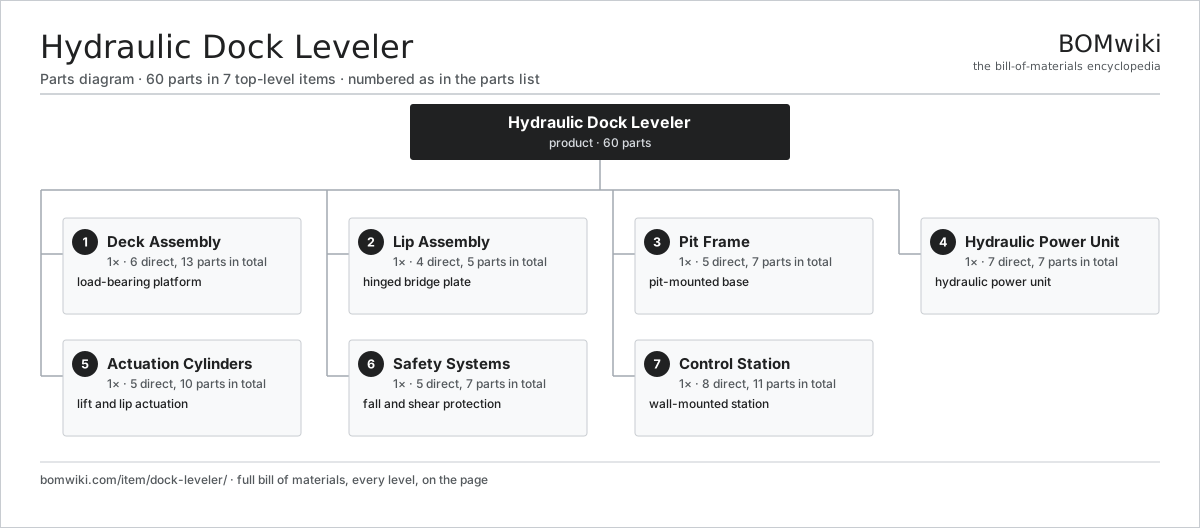
| # | Part | Qty | What it does |
|---|---|---|---|
| 1 | Deck Assembly 6 parts | 1× | load-bearing platform |
| 2 | Lip Assembly 4 parts | 1× | hinged bridge plate |
| 3 | Pit Frame 5 parts | 1× | pit-mounted base |
| 4 | Hydraulic Power Unit 7 parts | 1× | hydraulic power unit |
| 5 | Actuation Cylinders 5 parts | 1× | lift and lip actuation |
| 6 | Safety Systems 5 parts | 1× | fall and shear protection |
| 7 | Control Station 8 parts | 1× | wall-mounted station |
3D model
No 3D model yet. Have a CAD file of this? Add a 3D model. STL renders right on this page; STEP, FreeCAD, and OpenSCAD sources are welcome too (openly licensed, like all 3D models on BOMwiki).
Build & assembly graph
expand / collapse · shared sub-assemblies converge · links to related products · est. labourTap an assembly to expand/collapse · tap a part to open it · use “Open page” for any node · drag to pan, scroll to zoom.
Bill of materials for Hydraulic Dock Leveler
7 top-level lines · 47 rows shown · 60 parts total · indented to 3 levels| # | Item / sub-assembly | Part no. | Qty/assy | Ext. qty | Parts | Type |
|---|---|---|---|---|---|---|
| 1 | Deck Assembly 6 parts | dock-leveler-deck | 1× | 1 | 13 | assembly |
| 1.1 | Deck Tread Plate | dock-leveler-deck-plate | 1× | 1 | · | part |
| 1.2 | Deck Stiffener Beam | dock-leveler-deck-beam | 6× | 6 | · | part |
| 1.3 | Rear Hinge | dock-leveler-rear-hinge | 1× | 1 | · | part |
| 1.4 | Toe Guard | dock-leveler-toe-guard | 2× | 2 | · | part |
| 1.5 | Header Plate | dock-leveler-header-plate | 1× | 1 | · | part |
| 1.6 | Fastener Set | fastener-set | 2× | 2 | · | part |
| 2 | Lip Assembly 4 parts | dock-leveler-lip | 1× | 1 | 5 | assembly |
| 2.1 | Lip Plate | dock-leveler-lip-plate | 1× | 1 | · | part |
| 2.2 | Lip Hinge Pin | dock-leveler-lip-hinge-pin | 1× | 1 | · | part |
| 2.3 | Lip Keeper | dock-leveler-lip-keeper | 2× | 2 | · | part |
| 2.4 | Lip Edge Chamfer | dock-leveler-lip-chamfer | 1× | 1 | · | part |
| 3 | Pit Frame 5 parts | dock-leveler-frame | 1× | 1 | 7 | assembly |
| 3.1 | Base Frame Weldment | dock-leveler-base-weldment | 1× | 1 | · | part |
| 3.2 | Rear Curb Angle | dock-leveler-rear-angle | 1× | 1 | · | part |
| 3.3 | Anchor Set | dock-leveler-anchor-set | 1× | 1 | · | part |
| 3.4 | Dock Bumper | dock-leveler-bumper | 2× | 2 | · | part |
| 3.5 | Cylinder Mount | dock-leveler-cylinder-mount | 2× | 2 | · | part |
| 4 | Hydraulic Power Unit 7 parts | dock-leveler-powerpack | 1× | 1 | 7 | assembly |
| 4.1 | HPU Motor | dock-leveler-hpu-motor | 1× | 1 | · | part |
| 4.2 | Gear Pump | dock-leveler-gear-pump | 1× | 1 | · | part |
| 4.3 | Oil Reservoir | dock-leveler-reservoir | 1× | 1 | · | part |
| 4.4 | Valve Block | dock-leveler-valve-block | 1× | 1 | · | part |
| 4.5 | Velocity Fuse | dock-leveler-velocity-fuse | 1× | 1 | · | part |
| 4.6 | Hydraulic Hose Set | dock-leveler-hose-set | 1× | 1 | · | part |
| 4.7 | O-Ring Set | oring-set | 1× | 1 | · | part |
| 5 | Actuation Cylinders 5 parts | dock-leveler-cylinders | 1× | 1 | 10 | assembly |
| 5.1 | Lift Cylinder | dock-leveler-lift-cylinder | 1× | 1 | · | part |
| 5.2 | Lip Cylinder | dock-leveler-lip-cylinder | 1× | 1 | · | part |
| 5.3 | Cylinder Pivot Pin | dock-leveler-pivot-pin | 4× | 4 | · | part |
| 5.4 | O-Ring Set | oring-set | 2× | 2 | · | part |
| 5.5 | Oil Seal | oil-seal | 2× | 2 | · | part |
| 6 | Safety Systems 5 parts | dock-leveler-safety | 1× | 1 | 7 | assembly |
| 6.1 | Safety Leg | dock-leveler-safety-leg | 2× | 2 | · | part |
| 6.2 | Maintenance Strut | dock-leveler-maintenance-strut | 1× | 1 | · | part |
| 6.3 | Cross-Traffic Support | dock-leveler-cross-traffic-leg | 1× | 1 | · | part |
| 6.4 | Night Lock | dock-leveler-night-lock | 1× | 1 | · | part |
| 6.5 | Coil Spring | coil-spring | 2× | 2 | · | part |
| 7 | Control Station 8 parts | dock-leveler-controls | 1× | 1 | 11 | assembly |
| 7.1 | Control Enclosure | dock-leveler-control-enclosure | 1× | 1 | · | part |
| 7.2 | Push-Button Set | dock-leveler-pushbutton-set | 1× | 1 | · | part |
| 7.3 | Interlock I/O Module | dock-leveler-interlock-io | 1× | 1 | · | part |
| 7.4 | Position Switch | dock-leveler-position-switch | 2× | 2 | · | part |
| 7.5 | Relay | relay | 3× | 3 | · | part |
| 7.6 | Microcontroller | mcu | 1× | 1 | · | part |
| 7.7 | Power Supply | power-supply | 1× | 1 | · | part |
| 7.8 | Wire Bundle | wire-bundle | 1× | 1 | · | part |
Something wrong in this list? Report a problem with this BOM.
Related products
same domain, ranked by shared parts Articulated Forklift
2,417 parts · shares 3 with this page
Pop-Up Wheel Sorter
705 parts · shares 3 with this page
Articulated Forklift
2,417 parts · shares 3 with this page
Pop-Up Wheel Sorter
705 parts · shares 3 with this page
 Reach Truck
832 parts · shares 3 with this page
Reach Truck
832 parts · shares 3 with this page
 Bag Palletizer
951 parts · shares 2 with this page
Bag Palletizer
951 parts · shares 2 with this page
 Inclined Belt Conveyor
229 parts · shares 2 with this page
Narrow Belt Sorter
518 parts · shares 2 with this page
Inclined Belt Conveyor
229 parts · shares 2 with this page
Narrow Belt Sorter
518 parts · shares 2 with this page
Sourcing: possible vendors
Browse the supplier directory → Prices, MOQ, and lead times are algorithmic estimates, not quotes, and not claims about these companies. Company mappings are curated by keyword; est. price band $2k–$300k. How estimates work| Vendor | HQ | Specialty | MOQ | Lead time |
|---|---|---|---|---|
| toyota-industries.com ↗ | Kariya, JP | Forklifts & logistics | 20 units | 10–16 wks |
| kiongroup.com ↗ | Frankfurt, DE | Forklifts (Linde, STILL) | 20 units | 10–16 wks |
| jungheinrich.com ↗ | Hamburg, DE | Warehouse trucks | 20 units | 10–16 wks |
| crown.com ↗ | New Bremen, US | Forklifts | 20 units | 10–16 wks |
|
🇨🇳Hangcha
hcforklift.com ↗
|
Hangzhou, CN | Forklifts & material handling | 20 units | 10–16 wks |
830-word article