Drinking Fountain
ProductOverview
A drinking fountain (water cooler) is a self-contained public or workplace hydration station that chills and dispenses potable water via a bubbler valve and fills refillable bottles via a tall spout. The device combines refrigeration technology (compressor, evaporator, condenser) with plumbing (supply inlet, drain, filtration) and is ubiquitous in offices, schools, gyms, and public spaces. Modern models often include integrated water filtration, touchless sensors, and bottle-filling spouts to reduce single-use plastic cups.
The engineering challenge is balancing cooling efficiency (a slow chiller consumes less energy but frustrates users in high-demand environments) with sanitation (stagnant water in poorly-designed basins becomes a bacterial breeding ground).
Refrigeration Circuit
The Refrigeration Unit operates on the standard vapor-compression refrigeration cycle. A hermetic Compressor Motor (typically 1/4–1/2 HP, 115V or 230V) pumps refrigerant vapor from the Evaporator Coil to the Condenser Coil. In the condenser, an integral fan rejects heat to the room air, condensing the vapor to liquid. The liquid is throttled through a Expansion Valve and sprayed into the Evaporator Coil, where it boils again, absorbing heat from the water reservoir.
The Refrigerant Lines bundle carries high-pressure liquid (insulated) and low-pressure vapor (also insulated to prevent external condensation) between components. Most consumer-grade fountains use R-134a refrigerant; industrial models increasingly use low-GWP alternatives like R-513A.
The evaporator is a copper tubing coil submerged in a 2–5 gallon stainless steel water reservoir. Incoming cold water from the building supply fills this reservoir; the evaporator cools it to 40–50°F. A Water Level Controller float or solenoid valve maintains the reservoir at a constant level, ensuring the evaporator remains submerged.
Cooling capacity is typically 0.5–2.5 gallons per hour, meaning a busy office fountain (50+ users per day) may require 4–8 hours to build up a reserve of cold water. Most fountains have thermal mass sufficient to serve 10–15 sequential users before warming noticeably.
The Bubbler Valve
The iconic Bubbler Valve Assembly is a marvel of mechanical simplicity. A chrome-plated brass Bubbler Button on the basin rim connects via a linkage to a mechanical valve inside the basin. Pressing the button opens an inlet port, allowing cold water from the reservoir to flow through the Arc Spout.
The spout is engineered to deliver water in a predictable parabolic arc 4–6 inches high, allowing a person to bend and drink without splashing. The arc is achieved by shaping the spout exit (0.03–0.05 inch orifice) and setting inlet pressure to 15–20 PSI (below the building supply, typically 50–80 PSI, via an integral reducing valve).
A critical feature is the Bubbler Valve Body, which separates cold water (bubbler circuit) from warmer ambient or supply water (bottle filler circuit). This prevents thermal mixing, ensuring the bubbler delivers maximum chill.
Many modern fountains replace the mechanical button with an optional Touchless Solenoid (24V AC/DC) controlled by an infrared or capacitive sensor, eliminating the hand-contact point. Touchless operation has become standard in schools and medical facilities post-pandemic.
Bottle Filler Spout
The Bottle Filler Spout is a separate tall nozzle (8–12 inches above the basin rim) that delivers water at lower chill (often room temperature to moderately chilled) at a higher flow rate (1–2 GPM). The spout is tall enough to accommodate standard 1-gallon water jugs or personal insulated bottles.
The Bottle Fill Valve is typically a pull-down or lever-activated valve, allowing the user to direct water into their bottle. Some models offer a sensor here as well, automatically dispensing for 30–60 seconds and shutting off. The bottle filler water often bypasses the chiller entirely, being drawn from the building cold supply, to maximize the available chill for the bubbler.
Filtration and Water Quality
The Filter Cartridge is a point-of-use (POU) assembly that removes taste, odor, and chlorine before water reaches the bubbler or bottle filler. Standard media is activated carbon or a carbon-composite block with 5–20 micron filtration. Typical cartridge life is 1500–5000 gallons (3–12 months in busy locations).
The Filter Housing is a replaceable bowl (quarter-turn thread or spin-on style) that screws into a head mounted in the supply line. The Change Indicator is mechanical (color-change) or electronic (timer-based), alerting maintenance staff when the cartridge has reached end-of-life. Neglecting to change a saturated cartridge allows bacteria to colonize the filter media, negating the benefit.
Supply and Drain Plumbing
The Water Supply Lines includes a 1/2 inch cold-water Inlet Tubing from the building supply, with an integral Shutoff Valve ball valve for service isolation. A Water Level Controller solenoid or float maintains the chiller reservoir; when level drops, the control valve opens the inlet until full.
Optional: A Mixing Valve tempers incoming hot water if the building has both hot and cold supplies, preventing thermal shock to the compressor (sudden temperature spikes stress the refrigerant circuit).
The Drain and Waste Lines consists of a 1.5–2 inch waste line from the Basin Drain Tubing to a floor drain, with a standard P-Trap Assembly that maintains a water seal. This is critical: without the trap, gases and bacteria from the floor drain can migrate into the fountain.
Additionally, many fountains include a Chiller Drain Valve on the chiller reservoir for periodic blowdown, draining 10–20% of the water monthly to remove dissolved minerals and sediment that accumulate during cooling cycles (evaporative concentration effect).
Basin Design and Sanitation
The Basin and Drain is stainless steel (304 or 316 grade) or composite, shallow (6–10 inches deep), and designed with a visible drain. A seamless Basin Bowl prevents bacterial biofilm from settling in crevices. The Basin Drain incorporates a removable strainer cartridge that traps hair and debris; this strainer must be cleaned weekly in busy locations.
The basin lip or weir is sloped to direct splash water toward the drain, not the user. Well-designed fountains have a secondary outer catch pan or floor drain underneath to handle overflow in high-use scenarios.
Stagnant water in the basin (if drain is blocked or rarely used) will develop algae, mold, or Legionella growth within 2–4 days in warm climates. Regular draining and scrubbing of the basin every few days is essential maintenance in busy facilities.
Cabinet and Mounting
The Housing and Support Frame houses the chiller, reservoir, filter, and plumbing in an enclosed or semi-enclosed enclosure. Stainless steel cabinets are most durable (used in commercial kitchens and hospitals); plastic or composite cabinets are lighter and lower-cost for offices.
A Service Panel provides access for filter cartridge changes, drain valve operation, and compressor inspection. The Support Base are adjustable feet (for floor-standing models) or a wall-mount bracket (for wall-mounted models, saving floor space in tight environments).
Maintenance Schedule
Daily: Wipe down the cabinet exterior and basin. Weekly: Remove and clean the Basin Drain strainer; refill the P-trap if it has dried out. Monthly: Perform a chiller blowdown via the Chiller Drain Valve, draining 10–20% of the tank water. Every 3–6 months: Replace the Filter Cartridge (sooner in hard-water areas or high-use locations). Annually: Have a technician inspect the Compressor Motor and condenser coil; clean the condenser fan of dust.
Energy consumption is typically 200–500 watts while compressor runs; most units cycle intermittently, consuming 500–1000 kWh per year in office settings.
Drinking Fountain parts and their functions
8 top-level parts · 28 parts in total · full bill of materials below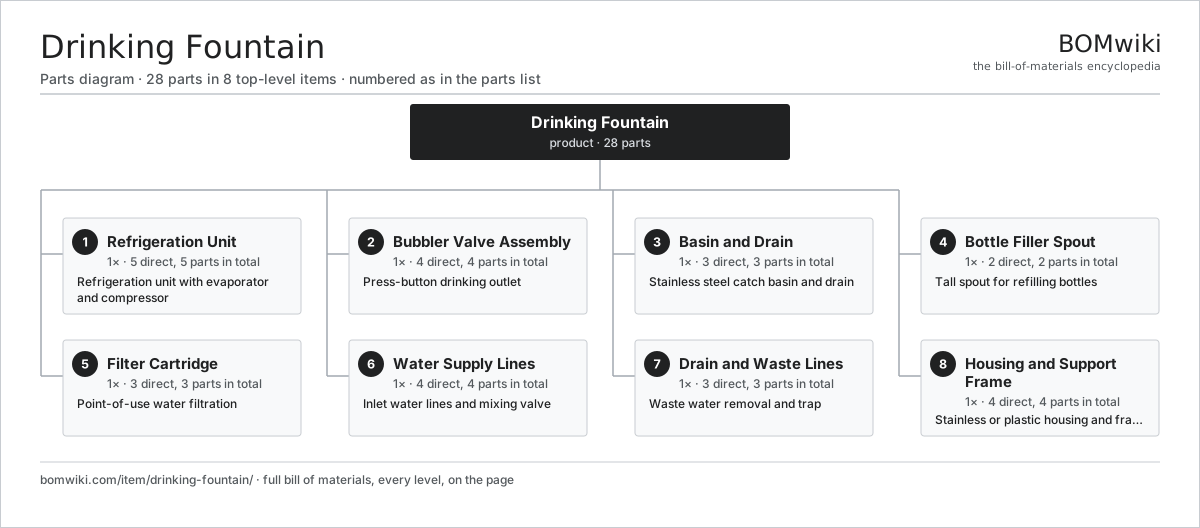
| # | Part | Qty | What it does |
|---|---|---|---|
| 1 | Refrigeration Unit 5 parts | 1× | Refrigeration unit with evaporator and compressor |
| 2 | Bubbler Valve Assembly 4 parts | 1× | Press-button drinking outlet |
| 3 | Basin and Drain 3 parts | 1× | Stainless steel catch basin and drain |
| 4 | Bottle Filler Spout 2 parts | 1× | Tall spout for refilling bottles |
| 5 | Filter Cartridge 3 parts | 1× | Point-of-use water filtration |
| 6 | Water Supply Lines 4 parts | 1× | Inlet water lines and mixing valve |
| 7 | Drain and Waste Lines 3 parts | 1× | Waste water removal and trap |
| 8 | Housing and Support Frame 4 parts | 1× | Stainless or plastic housing and frame |
3D model
No 3D model yet. Have a CAD file of this? Add a 3D model. STL renders right on this page; STEP, FreeCAD, and OpenSCAD sources are welcome too (openly licensed, like all 3D models on BOMwiki).
Build & assembly graph
expand / collapse · shared sub-assemblies converge · links to related products · est. labourTap an assembly to expand/collapse · tap a part to open it · use “Open page” for any node · drag to pan, scroll to zoom.
Bill of materials for Drinking Fountain
8 top-level lines · 36 rows shown · 28 parts total · indented to 3 levels| # | Item / sub-assembly | Part no. | Qty/assy | Ext. qty | Parts | Type |
|---|---|---|---|---|---|---|
| 1 | Refrigeration Unit 5 parts | drinking-fountain-chiller | 1× | 1 | 5 | assembly |
| 1.1 | Compressor Motor | drinking-fountain-compressor | 1× | 1 | · | part |
| 1.2 | Condenser Coil | drinking-fountain-condenser | 1× | 1 | · | part |
| 1.3 | Evaporator Coil | drinking-fountain-evaporator | 1× | 1 | · | part |
| 1.4 | Expansion Valve | drinking-fountain-expansion-valve | 1× | 1 | · | part |
| 1.5 | Refrigerant Lines | drinking-fountain-refrigerant-line | 1× | 1 | · | part |
| 2 | Bubbler Valve Assembly 4 parts | drinking-fountain-bubbler-valve | 1× | 1 | 4 | assembly |
| 2.1 | Bubbler Button | drinking-fountain-bubbler-button | 1× | 1 | · | part |
| 2.2 | Touchless Solenoid | drinking-fountain-bubbler-solenoid | 1× | 1 | · | part |
| 2.3 | Arc Spout | drinking-fountain-arc-spout | 1× | 1 | · | part |
| 2.4 | Bubbler Valve Body | drinking-fountain-bubbler-body | 1× | 1 | · | part |
| 3 | Basin and Drain 3 parts | drinking-fountain-basin | 1× | 1 | 3 | assembly |
| 3.1 | Basin Bowl | drinking-fountain-basin-bowl | 1× | 1 | · | part |
| 3.2 | Basin Rim | drinking-fountain-basin-rim | 1× | 1 | · | part |
| 3.3 | Basin Drain | drinking-fountain-basin-drain | 1× | 1 | · | part |
| 4 | Bottle Filler Spout 2 parts | drinking-fountain-bottle-filler | 1× | 1 | 2 | assembly |
| 4.1 | Bottle Spout | drinking-fountain-bottle-spout | 1× | 1 | · | part |
| 4.2 | Bottle Fill Valve | drinking-fountain-bottle-valve | 1× | 1 | · | part |
| 5 | Filter Cartridge 3 parts | drinking-fountain-filter-cartridge | 1× | 1 | 3 | assembly |
| 5.1 | Filter Housing | drinking-fountain-filter-housing | 1× | 1 | · | part |
| 5.2 | Filter Media | drinking-fountain-filter-media | 1× | 1 | · | part |
| 5.3 | Change Indicator | drinking-fountain-filter-cartridge-change-indicator | 1× | 1 | · | part |
| 6 | Water Supply Lines 4 parts | drinking-fountain-supply-plumbing | 1× | 1 | 4 | assembly |
| 6.1 | Inlet Tubing | drinking-fountain-inlet-line | 1× | 1 | · | part |
| 6.2 | Mixing Valve | drinking-fountain-mixing-valve | 1× | 1 | · | part |
| 6.3 | Shutoff Valve | drinking-fountain-inlet-shutoff | 1× | 1 | · | part |
| 6.4 | Water Level Controller | drinking-fountain-water-level-control | 1× | 1 | · | part |
| 7 | Drain and Waste Lines 3 parts | drinking-fountain-drain-plumbing | 1× | 1 | 3 | assembly |
| 7.1 | Basin Drain Tubing | drinking-fountain-basin-drain-line | 1× | 1 | · | part |
| 7.2 | P-Trap Assembly | drinking-fountain-p-trap | 1× | 1 | · | part |
| 7.3 | Chiller Drain Valve | drinking-fountain-drain-valve | 1× | 1 | · | part |
| 8 | Housing and Support Frame 4 parts | drinking-fountain-cabinet | 1× | 1 | 4 | assembly |
| 8.1 | Cabinet Housing | drinking-fountain-cabinet-body | 1× | 1 | · | part |
| 8.2 | Service Panel | drinking-fountain-cabinet-back-panel | 1× | 1 | · | part |
| 8.3 | Support Base | drinking-fountain-support-legs | 1× | 1 | · | part |
| 8.4 | Fastener Set | fastener-set | 1× | 1 | · | part |
Something wrong in this list? Report a problem with this BOM.
Sourcing: possible vendors
Browse the supplier directory → Prices, MOQ, and lead times are algorithmic estimates, not quotes, and not claims about these companies. Company mappings are curated by keyword; est. price band $20–$3k. How estimates work| Vendor | HQ | Specialty | MOQ | Lead time |
|---|---|---|---|---|
|
🇺🇸Kohler
kohler.com ↗
|
Kohler, US | Plumbing fixtures | 1,000 units | 6–12 wks |
|
🇯🇵TOTO
toto.com ↗
|
Kitakyushu, JP | Sanitaryware | 1,000 units | 6–12 wks |
|
🇯🇵LIXIL
lixil.com ↗
|
Tokyo, JP | Plumbing (Grohe, American Std) | 1,000 units | 6–12 wks |
|
🇺🇸Moen
moen.com ↗
|
North Olmsted, US | Faucets & fixtures | 1,000 units | 6–12 wks |
|
🇨🇭Geberit
geberit.com ↗
|
Rapperswil, CH | Sanitary systems | 1,000 units | 6–12 wks |
1,305-word article