Dropper Seatpost
ProductOverview
A dropper seatpost is a vertically telescoping tube that lowers the saddle on demand, typically 100–200 mm, allowing the rider to shift their center of gravity rearward on steep descents or jumps. Conversely, the saddle retracts upward for efficient pedaling on climbs, removing the mechanical disadvantage of a low seat. The mechanism combines pneumatic spring action (air cartridge at 200–300 psi) with cable-actuated control (lever on the handlebar), using a damper circuit to control descent rate and return speed.
Dropper posts are standard on modern mountain bikes (hardtail, full-suspension, and e-bikes alike) and have become essential for technical terrain. The system is engineered to survive mud, water, and repeated shock loading from drops and impacts.
How it works
When the rider squeezes the bar-mounted lever, a Bowden cable pulls a plunger rod inside the air cartridge. This opens a check valve, allowing pressurized oil to vent from the upper chamber. The rider's weight (and gravity) then pushes the stanchion downward into the barrel, collapsing the seatpost. A shim-stack damper controls the descent rate, typically 0.5–2 seconds per full stroke, so the saddle lowers smoothly without slamming.
Releasing the lever causes the coil spring in the remote to re-tension the cable, which closes the check valve and traps pressure. An internal spring-return mechanism (air spring or coil spring) then extends the stanchion back upward, raising the saddle again. The air spring is pressurized at 200–300 psi, tuned to the rider's weight; heavier riders need higher pressure to support the same load.
The air cartridge is a sealed unit containing a piston with dual seals, shim-stack damper, and pressurized oil. The stanchion slides inside the lower barrel on polymer or bronze bushings; dual wiper seals at the top of the barrel prevent mud and water from entering the damper cavity. Seal life is typically 200–400 hours before the wiper rings compress and allow small leaks.
Components
The stanchion tube is polished 6061-T6 aluminum, hard-anodized to 70+ microns and chrome-plated for corrosion resistance and smooth travel. It attaches to the saddle via a quick-release or bolt clamp with serrated washers to prevent slipping.
The lower barrel is a seamless aluminum tube internally reamed to ±0.05 mm tolerance. It houses the air cartridge, which screws or presses into a fixed bore. The cable anchor is either brazed or epoxied into a drilled hole on the barrel wall, positioning the cable sheath perpendicular to the lever.
The air cartridge is the mechanical heart. A hardened steel body (honed to precision fit) contains a polished rod, dual seals, and a damper shim-stack. The cartridge is pressurized to 200–300 psi via a Schraeder valve (similar to a car tire). Heavier riders or those wanting faster extension increase pressure slightly; lighter riders reduce it. The damper shims are hardened steel discs with controlled gaps; they meter oil flow during descent, creating resistance that slows the saddle drop.
The remote lever is mounted on the left handlebar (right-hand shifters take the main real estate). It contains a coil spring and cable anchor; squeezing the lever pulls the inner cable, which slides inside the sealed outer housing. Most levers also include a locking collar to prevent accidental height changes mid-ride.
The cable assembly is a sealed Bowden cable (1.6 mm inner wire, nylon-lined outer sheath) routed under the down tube and along the seat tube, minimizing flex and contamination. The ferrules at each end are compression fittings, sealed against water ingress.
Maintenance and durability
Bushing wear is the most common failure mode. After 200–400 hours of riding, the polymer or bronze wear rings compress, allowing side-play between the stanchion and barrel. Replacement bushing kits are available; the stanchion must be pulled from the barrel and the old bushings carefully driven out.
Air pressure drifts over time due to microscopical seal weeping. Every 50–100 hours, the Schraeder valve should be checked with a shock pump and re-pressurized as needed, maintaining the original setting.
Damper fluid (ISO VG 32 or 46 hydraulic oil) can also become contaminated or oxidized after prolonged exposure to heat and water. Some cartridges are serviceable (internal shims can be cleaned and resealed); others are sealed-for-life and must be replaced.
Cable life depends on routing and exposure. A kinked or corroded cable may fray, increasing friction and preventing smooth operation. The outer housing should be checked for splits; if moisture enters, corrosion accelerates and the inner cable may snap under load.
Remote levers are typically not serviceable beyond replacing the cable and spring. If the lever becomes stiff or difficult to engage, the entire lever is swapped out.
Standards and fit
Dropper posts are sized by seat tube diameter: 26.8 mm (older vintage), 30.9 mm, and 31.6 mm are the most common on modern bikes. The lower barrel must fit snugly inside the seat tube; spacing is taken up with a shim or shims to ensure zero play.
Saddle rails are standardized at 7 mm or 10 mm diameter (dual rails). Some saddles use offset rails; the clamp must accommodate both sizes. Cable routing follows frame-specific paths, and users may need to purchase extended or shortened cable assemblies for different frame geometries.
Most modern dropper posts integrate with electronic shifting (SRAM AXS, Shimano Di2) through wireless remote units, allowing simultaneous height and gear changes. Mechanical cable-actuated posts remain common on entry-level and mid-range bikes due to lower cost and durability in harsh conditions.
Market context
Dropper posts became mass-market in the late 2000s after RockShox released the first reliable air-spring design. Today, manufacturers like Fox, Specialized, KS (Kind Shock), Crank Brothers, and others offer models ranging from $150–$800. The technology is now nearly universal on trail, enduro, and gravity bikes, and increasingly common on cross-country and gravel setups where rough terrain benefits from dynamic seat control.
Dropper Seatpost parts and their functions
8 top-level parts · 24 parts in total · full bill of materials below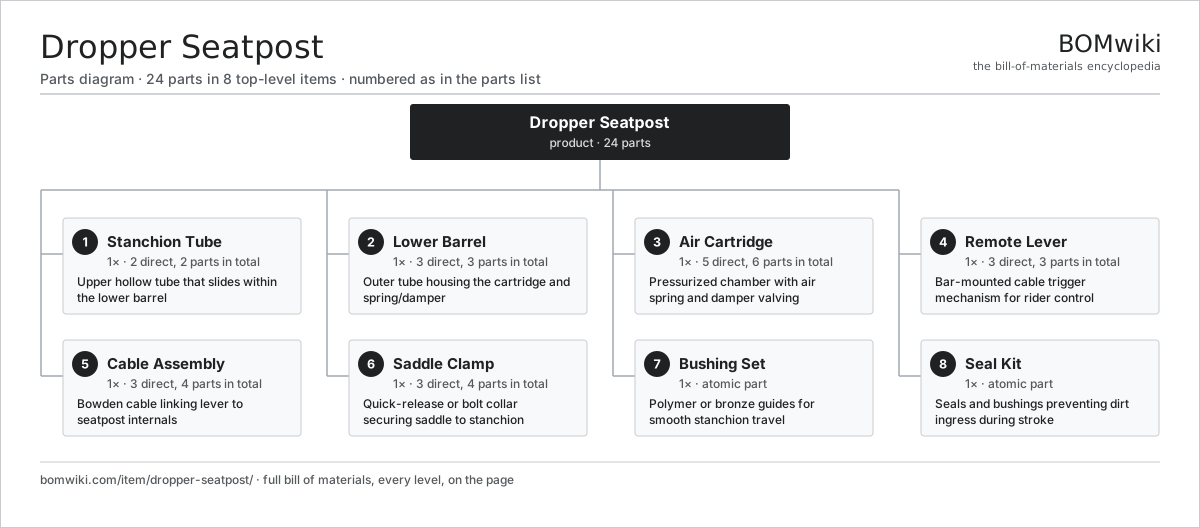
| # | Part | Qty | What it does |
|---|---|---|---|
| 1 | Stanchion Tube 2 parts | 1× | Upper hollow tube that slides within the lower barrel |
| 2 | Lower Barrel 3 parts | 1× | Outer tube housing the cartridge and spring/damper |
| 3 | Air Cartridge 5 parts | 1× | Pressurized chamber with air spring and damper valving |
| 4 | Remote Lever 3 parts | 1× | Bar-mounted cable trigger mechanism for rider control |
| 5 | Cable Assembly 3 parts | 1× | Bowden cable linking lever to seatpost internals |
| 6 | Saddle Clamp 3 parts | 1× | Quick-release or bolt collar securing saddle to stanchion |
| 7 | Bushing Set | 1× | Polymer or bronze guides for smooth stanchion travel |
| 8 | Seal Kit | 1× | Seals and bushings preventing dirt ingress during stroke |
3D model
No 3D model yet. Have a CAD file of this? Add a 3D model. STL renders right on this page; STEP, FreeCAD, and OpenSCAD sources are welcome too (openly licensed, like all 3D models on BOMwiki).
Build & assembly graph
expand / collapse · shared sub-assemblies converge · links to related products · est. labourTap an assembly to expand/collapse · tap a part to open it · use “Open page” for any node · drag to pan, scroll to zoom.
Bill of materials for Dropper Seatpost
8 top-level lines · 27 rows shown · 24 parts total · indented to 3 levels| # | Item / sub-assembly | Part no. | Qty/assy | Ext. qty | Parts | Type |
|---|---|---|---|---|---|---|
| 1 | Stanchion Tube 2 parts | dropper-seatpost-stanchion-tube | 1× | 1 | 2 | assembly |
| 1.1 | Stanchion Blank | dropper-seatpost-stanchion-blank | 1× | 1 | · | part |
| 1.2 | Top Cap | dropper-seatpost-top-cap | 1× | 1 | · | part |
| 2 | Lower Barrel 3 parts | dropper-seatpost-lower-barrel | 1× | 1 | 3 | assembly |
| 2.1 | Barrel Body | dropper-seatpost-barrel-body | 1× | 1 | · | part |
| 2.2 | Cable Anchor | dropper-seatpost-cable-anchor | 1× | 1 | · | part |
| 2.3 | Base Cap | dropper-seatpost-base-cap | 1× | 1 | · | part |
| 3 | Air Cartridge 5 parts | dropper-seatpost-air-cartridge | 1× | 1 | 6 | assembly |
| 3.1 | Cartridge Body | dropper-seatpost-cartridge-body | 1× | 1 | · | part |
| 3.2 | Piston Rod | dropper-seatpost-piston-rod | 1× | 1 | · | part |
| 3.3 | Spring Seal | dropper-seatpost-spring-seal | 1× | 1 | · | part |
| 3.4 | Damper Stack | dropper-seatpost-damper-stack | 1× | 1 | · | part |
| 3.5 | Ball Bearing | ball-bearing | 2× | 2 | · | part |
| 4 | Remote Lever 3 parts | dropper-seatpost-remote-lever | 1× | 1 | 3 | assembly |
| 4.1 | Lever Body | dropper-seatpost-lever-body | 1× | 1 | · | part |
| 4.2 | Cable Guide | dropper-seatpost-cable-guide | 1× | 1 | · | part |
| 4.3 | Spring Return | dropper-seatpost-spring-return | 1× | 1 | · | part |
| 5 | Cable Assembly 3 parts | dropper-seatpost-cable-assembly | 1× | 1 | 4 | assembly |
| 5.1 | Inner Cable | dropper-seatpost-inner-cable | 1× | 1 | · | part |
| 5.2 | Outer Housing | dropper-seatpost-outer-housing | 1× | 1 | · | part |
| 5.3 | Ferrule Pair | dropper-seatpost-ferrule-pair | 2× | 2 | · | part |
| 6 | Saddle Clamp 3 parts | dropper-seatpost-saddle-clamp | 1× | 1 | 4 | assembly |
| 6.1 | Clamp Body | dropper-seatpost-clamp-body | 1× | 1 | · | part |
| 6.2 | Clamp Screw | dropper-seatpost-clamp-screw | 2× | 2 | · | part |
| 6.3 | Fastener Set | fastener-set | 1× | 1 | · | part |
| 7 | Bushing Set | dropper-seatpost-bushing-set | 1× | 1 | · | part |
| 8 | Seal Kit | dropper-seatpost-seal-kit | 1× | 1 | · | part |
Something wrong in this list? Report a problem with this BOM.
Sourcing: possible vendors
Browse the supplier directory → Prices, MOQ, and lead times are algorithmic estimates, not quotes, and not claims about these companies. Company mappings are curated by keyword; est. price band $200–$12k. How estimates work| Vendor | HQ | Specialty | MOQ | Lead time |
|---|---|---|---|---|
|
🇹🇼Giant
giant-bicycles.com ↗
|
Taichung, TW | Bicycles | 500 units | 6–12 wks |
|
🇺🇸Trek
trekbikes.com ↗
|
Waterloo, US | Bicycles | 500 units | 6–12 wks |
| specialized.com ↗ | Morgan Hill, US | Bicycles | 500 units | 6–12 wks |
|
🇹🇼Merida
merida-bikes.com ↗
|
Yuanlin, TW | Bicycles | 500 units | 6–12 wks |
| cannondale.com ↗ | Wilton, US | Bicycles | 500 units | 6–12 wks |
1,003-word article