Dual-Axis Solar Tracker
ProductOverview
A dual-axis solar tracker orients photovoltaic panels or solar collectors to follow the sun's apparent path across the sky, maximizing incident solar flux throughout the day. By tracking azimuth (east to west) and elevation (north-south tilt), trackers increase annual energy yield 25–35% compared to fixed south-facing installations in temperate climates.
The controller runs a solar ephemeris algorithm (calculating sun position from date/time/location), issuing commands to stepper motors that rotate the azimuth axis and tilt the elevation axis. Real-time inclinometer feedback allows closed-loop correction, compensating for controller drift or mechanical hysteresis.
Typical applications: utility-scale PV farms (100+ trackers), concentrated photovoltaic (CPV) systems (requiring <0.3° accuracy), and solar-thermal collector arrays. Trackers add 15–20% capital cost but pay back through increased energy output in 3–5 years.
Azimuth Drive System
The Azimuth Drive rotates the entire tracker platform 360° via a NEMA 34 stepper motor (3.0 N·m holding torque) coupled through a worm-gear reducer (50:1 to 100:1) to a large slew bearing.
Stepper motors are preferred because they:
- Require no feedback for open-loop operation (holding position via magnetic detent)
- Are inherently synchronized (no drift without servo feedback)
- Can microstep to 1/16-step resolution (~0.1° accuracy per step)
- Are robust in outdoor environments with EMI
The absolute encoder on the motor shaft provides verification; if actual position diverges from commanded position by >1°, a fault flag is raised (indicating stalled motor or mechanical jam).
Slew speed is typically 2–3°/min, limiting acceleration torque and reducing mechanical stress. A gearbox reduction >50:1 provides low-speed, high-torque output while keeping stepper current reasonable (motors rated 2–3 A).
Elevation Drive System
The Elevation Drive tilts the panel frame ±60° from horizontal using a pair of synchronized stepper motors (one on each side) driving precision ball-screws. Synchronized dual-motor control prevents tilting asymmetry (which would damage the bearing).
Load cells on each jack detect torque imbalance; if left jack carries 60% of load, the controller retards left motor speed slightly until balance is restored. This active leveling prevents mechanical failure and maintains panel perpendicularity.
A spring-applied brake holds the panel in park position (0° elevation, northward azimuth) during high winds (>45 m/s). This minimizes wind loading and prevents drift during power loss.
Solar Tracking Algorithm
The microcontroller runs an ephemeris algorithm (Spencer, Michalsky, or NREL algorithm) computing sun azimuth (A) and elevation (E) from:
- Observer location: latitude φ, longitude λ (hardcoded or GPS-acquired)
- UTC time: hour, day, month, year (from RTC module)
- Equation of time: correction for Earth's elliptical orbit and axial tilt
At 40° N latitude, solar noon on the vernal equinox:
- Sun elevation: 50°
- Sun azimuth: 180° (south)
On winter solstice:
- Sun elevation: 26°
- Sun azimuth: 180° (south)
On summer solstice:
- Sun elevation: 74°
- Sun azimuth: 135° (early morning) to 225° (late afternoon)
The controller outputs:
- Azimuth target: 0–360°
- Elevation target: −10° to +90°
Motor commands are issued every 10–30 seconds, stepping the motors incrementally to track the sun's motion (which moves ~0.25°/min in azimuth near solar noon).
Feedback and Correction
The dual-axis inclinometer (MEMS accelerometer) measures frame tilt in real-time. If the controller commands 45° elevation but the accelerometer reads 44.5°, a −0.5° error exists. A proportional-integral (PI) loop corrects by stepping the elevation motors an additional 2–3 steps, closing the error loop.
This closed-loop scheme is critical for:
- Compensating mechanical hysteresis (friction, gearbox backlash)
- Correcting for structural deflection under wind load
- Recovering from transient faults (momentary stall)
Tracking accuracy of ±0.5° RMS is typical, sufficient for photovoltaic tracking (beam acceptance angle ~20°) but marginal for concentrated photovoltaic systems (requiring ±0.1° accuracy).
Power Consumption and Energy Balance
Stepper motors consume ~20–50 W continuous (motors at full step rate, holding torque). The controller, power supply, and brake solenoid add another 10–20 W. Total parasitic load is ~30–70 W.
A 4 kWp PV array generates ~4500 Wh/day (mid-latitude, clear sky). Tracker parasitic loss is 30 W × 8 hours (solar day) = 240 Wh/day, or ~5% of output. Energy payback time is 1–2 days, justifying the tracking investment.
Control Architecture
The MCU is typically an ARM Cortex-M7 (STM32H7 or equivalent) running:
- Ephemeris calculation (50 ms, once per update interval)
- PI closed-loop correction (100 ms per axis)
- Step/direction output to stepper drivers
- Watchdog monitoring (stall detection, thermal limit)
- Data logging (energy output, panel temperature, fault history)
An optional Ethernet or 4G LTE modem allows remote monitoring via Modbus TCP, enabling:
- Real-time energy production display
- Remote firmware updates
- Predictive maintenance alerts (bearing wear, motor current spike)
Installation and Mounting
The panel frame uses modular T-slot aluminum extrusion for easy assembly. Four to six PV modules (400–600 W each) mount directly on the frame via clamps and mid-clamps. The frame bolts to the azimuth slew bearing at the top and connects to elevation ball-screws via clevis pins.
The support pedestal is a welded steel tube tower (3–5 m height), anchored to a concrete foundation pad (1 m² × 0.8 m deep) by four anchor bolts (ASTM F1554, threaded for embedment).
Reliability and Maintenance
Stepper motors are inherently reliable due to no brushes or commutator. Main failure modes:
- Gearbox bearing wear (occurs after 10,000+ hours); lubrication and inspection every 2 years recommended
- Encoder failure (capacitive or optical aging); redundancy or optical backup advised
- Brake solenoid coil burn-out (electromechanical wear); spring-applied design is fail-safe
Expected design life is 10–15 years, with major component replacement every 5–7 years (bearings, seals).
Comparison to Single-Axis Trackers
Single-axis (azimuth-only) trackers are cheaper and simpler, providing ~15–25% yield gain. Dual-axis systems add 10–15% more energy but at 2× capital cost. Dual-axis is justified for:
- Concentrated photovoltaic (CPV) systems requiring high precision
- Utility-scale farms optimizing land-use intensity
- Off-grid systems where energy yield is critical
Fixed-tilt systems are best for small installations or high-latitude sites where tracker cost exceeds energy benefit.
Dual-Axis Solar Tracker parts and their functions
7 top-level parts · 41 parts in total · full bill of materials below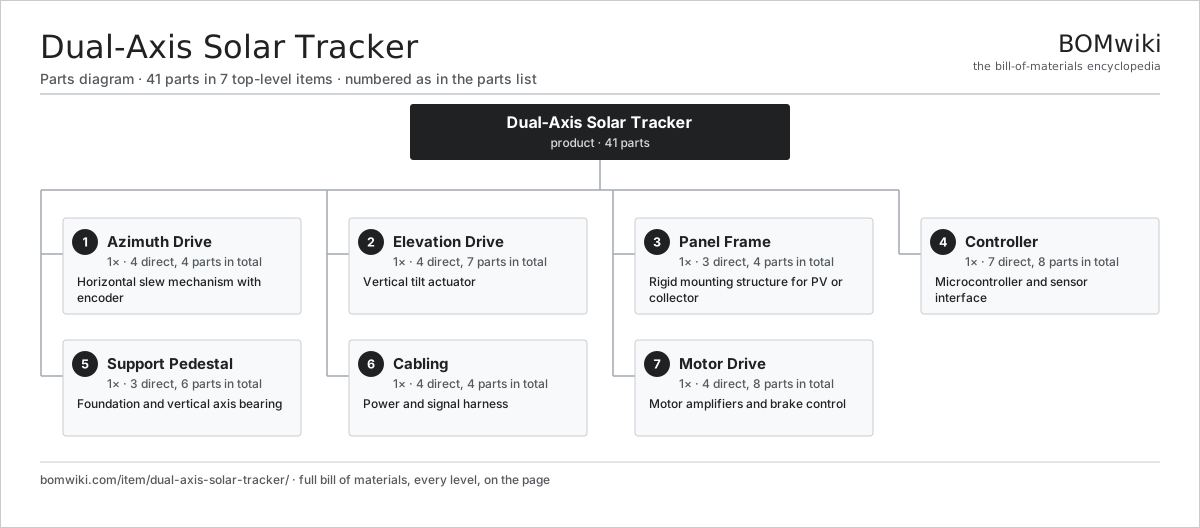
| # | Part | Qty | What it does |
|---|---|---|---|
| 1 | Azimuth Drive 4 parts | 1× | Horizontal slew mechanism with encoder |
| 2 | Elevation Drive 4 parts | 1× | Vertical tilt actuator |
| 3 | Panel Frame 3 parts | 1× | Rigid mounting structure for PV or collector |
| 4 | Controller 7 parts | 1× | Microcontroller and sensor interface |
| 5 | Support Pedestal 3 parts | 1× | Foundation and vertical axis bearing |
| 6 | Cabling 4 parts | 1× | Power and signal harness |
| 7 | Motor Drive 4 parts | 1× | Motor amplifiers and brake control |
3D model
No 3D model yet. Have a CAD file of this? Add a 3D model. STL renders right on this page; STEP, FreeCAD, and OpenSCAD sources are welcome too (openly licensed, like all 3D models on BOMwiki).
Build & assembly graph
expand / collapse · shared sub-assemblies converge · links to related products · est. labourTap an assembly to expand/collapse · tap a part to open it · use “Open page” for any node · drag to pan, scroll to zoom.
Bill of materials for Dual-Axis Solar Tracker
7 top-level lines · 36 rows shown · 41 parts total · indented to 3 levels| # | Item / sub-assembly | Part no. | Qty/assy | Ext. qty | Parts | Type |
|---|---|---|---|---|---|---|
| 1 | Azimuth Drive 4 parts | dual-axis-tracker-azimuth-drive | 1× | 1 | 4 | assembly |
| 1.1 | Azimuth Motor | dual-axis-tracker-azimuth-motor | 1× | 1 | · | part |
| 1.2 | Azimuth Gearbox | dual-axis-tracker-azimuth-gear-reduction | 1× | 1 | · | part |
| 1.3 | Azimuth Encoder | dual-axis-tracker-azimuth-encoder | 1× | 1 | · | part |
| 1.4 | Azimuth Bearing | dual-axis-tracker-azimuth-bearing | 1× | 1 | · | part |
| 2 | Elevation Drive 4 parts | dual-axis-tracker-elevation-drive | 1× | 1 | 7 | assembly |
| 2.1 | Elevation Motor | dual-axis-tracker-elevation-motor | 2× | 2 | · | part |
| 2.2 | Elevation Ballscrew | dual-axis-tracker-elevation-ballscrew | 2× | 2 | · | part |
| 2.3 | Elevation Load Cell | dual-axis-tracker-elevation-load-cell | 2× | 2 | · | part |
| 2.4 | Elevation Brake | dual-axis-tracker-elevation-brake | 1× | 1 | · | part |
| 3 | Panel Frame 3 parts | dual-axis-tracker-panel-frame | 1× | 1 | 4 | assembly |
| 3.1 | Frame Extrusion | dual-axis-tracker-frame-extrusion | 1× | 1 | · | part |
| 3.2 | Panel Mounts | dual-axis-tracker-panel-mounts | 1× | 1 | · | part |
| 3.3 | Frame Cross-Braces | dual-axis-tracker-frame-cross-braces | 2× | 2 | · | part |
| 4 | Controller 7 parts | dual-axis-tracker-controller | 1× | 1 | 8 | assembly |
| 4.1 | Controller MCU | dual-axis-tracker-controller-mcu | 1× | 1 | · | part |
| 4.2 | RTC Module | dual-axis-tracker-rtc-module | 1× | 1 | · | part |
| 4.3 | Inclinometer | dual-axis-tracker-inclinometer | 1× | 1 | · | part |
| 4.4 | Stepper Driver | dual-axis-tracker-stepper-driver | 2× | 2 | · | part |
| 4.5 | Brake Relay | dual-axis-tracker-brake-relay | 1× | 1 | · | part |
| 4.6 | Power Supply | dual-axis-tracker-power-supply | 1× | 1 | · | part |
| 4.7 | Ethernet Module | dual-axis-tracker-ethernet-module | 1× | 1 | · | part |
| 5 | Support Pedestal 3 parts | dual-axis-tracker-support-pedestal | 1× | 1 | 6 | assembly |
| 5.1 | Pedestal Column | dual-axis-tracker-pedestal-column | 1× | 1 | · | part |
| 5.2 | Pedestal Braces | dual-axis-tracker-pedestal-braces | 4× | 4 | · | part |
| 5.3 | Pedestal Base | dual-axis-tracker-pedestal-base | 1× | 1 | · | part |
| 6 | Cabling 4 parts | dual-axis-tracker-cabling | 1× | 1 | 4 | assembly |
| 6.1 | Power Cable | dual-axis-tracker-power-cable | 1× | 1 | · | part |
| 6.2 | Signal Bundle | dual-axis-tracker-signal-bundle | 1× | 1 | · | part |
| 6.3 | Cable Drag Chain | dual-axis-tracker-cable-drag-chain | 1× | 1 | · | part |
| 6.4 | Junction Box | dual-axis-tracker-junction-box | 1× | 1 | · | part |
| 7 | Motor Drive 4 parts | dual-axis-tracker-motor-drive | 1× | 1 | 8 | assembly |
| 7.1 | Stepper Power Module | dual-axis-tracker-stepper-power-module | 2× | 2 | · | part |
| 7.2 | Brake Contactor | dual-axis-tracker-brake-contactor | 1× | 1 | · | part |
| 7.3 | Power Cabinet | dual-axis-tracker-power-controller-cabinet | 1× | 1 | · | part |
| 7.4 | Status LED | dual-axis-tracker-status-led | 4× | 4 | · | part |
Something wrong in this list? Report a problem with this BOM.
Sourcing: possible vendors
Browse the supplier directory → Prices, MOQ, and lead times are algorithmic estimates, not quotes, and not claims about these companies. Company mappings are curated by keyword; est. price band $100–$20M. How estimates work| Vendor | HQ | Specialty | MOQ | Lead time |
|---|---|---|---|---|
|
🇩🇰Vestas
vestas.com ↗
|
Aarhus, DK | Wind turbines | 500 units | 12–24 wks |
| firstsolar.com ↗ | Tempe, US | PV modules | 500 units | 12–24 wks |
|
🇨🇳LONGi
longi.com ↗
|
Xi'an, CN | Solar wafers & modules | 500 units | 12–24 wks |
| enphase.com ↗ | Fremont, US | Microinverters & storage | 500 units | 12–24 wks |
|
🇨🇳Sungrow
sungrowpower.com ↗
|
Hefei, CN | Solar inverters & storage | 500 units | 12–24 wks |
1,154-word article