Duct Silencer
ProductOverview
A duct silencer (or in-duct attenuator) is an acoustic treatment element inserted into HVAC ductwork to reduce fan noise, equipment rumble, and air turbulence noise. It functions as a passive absorber: sound energy traveling through the duct strikes perforated metal baffles lined with acoustic fiber material (fiberglass or melamine foam). The sound is partially absorbed by the porous material and partially reflected back toward the source. The net result is 15–30 dB of sound attenuation across the mid and high frequencies (500–4000 Hz), where fan noise predominates.
Duct silencers are installed immediately downstream of high-noise sources (centrifugal fans, compressors, air handlers) or at junction points where multiple noisy streams converge. They are passive (require no power) and compact, making them ideal retrofit solutions. The trade-off is a small pressure drop (20–80 Pa) that slightly increases fan power consumption. In occupied spaces (offices, classrooms, hospitals), the noise reduction often justifies the modest energy penalty.
Acoustic Principle
Fan noise is broadband (many frequencies) and has strong components in the 125–500 Hz range (low-frequency rumble) and 1000–4000 Hz range (hissing). The perforated baffles (20–30% open area) allow air to flow through while presenting an acoustic impedance boundary. Sound waves striking the barrier lose energy to reflection and transmission into the acoustic fiber layer. The fiber absorbs sound via viscous dissipation: sound pressure causes fibers to vibrate, and friction converts acoustic energy to heat. Thicker fiber (50–100 mm) absorbs lower frequencies; thinner fiber (25–50 mm) works best for higher frequencies.
The spacing between baffles (50–100 mm) is tuned to maximize absorption in the target frequency range. A single baffle in a wide duct is ineffective; the sound can travel around it. Multiple parallel baffles force the sound to traverse fiber multiple times, improving attenuation.
Pressure Drop and Sizing
Air flowing through the perforated baffles experiences a pressure drop of 20–80 Pa (depending on velocity and fiber density). This added resistance means the fan must work slightly harder, consuming 1–5% more electrical energy to maintain the same airflow. In terms of life-cycle cost, this increased fan power is typically small compared to the benefit of noise reduction, especially in noise-sensitive applications (hospitals, libraries, apartments).
Proper silencer selection requires matching duct size and airflow velocity. Oversizing the silencer (low velocity) reduces pressure drop and improves both acoustic and energy performance. Undersizing (high velocity >5 m/s) increases turbulence noise and pressure drop, defeating the purpose.
Construction and Materials
The outer shell is standard galvanized steel or aluminum ductwork, fully sealed at all seams to prevent sound bypass. The baffle array is constructed from perforated metal (steel or aluminum, 1.5–2 mm thick) with 20–30% open area. Lower perforation percentages provide better attenuation but higher pressure drop.
Fiberglass (16–32 kg/m³ density, rigid board) is traditional and cost-effective, working to about 70°C. Melamine foam (yellow or blue color, 30–50 kg/m³ density) is more expensive but tolerates up to 100°C and has better fire rating (Class A, non-combustible in many melamine types). High-temperature ducts (over 80°C, common near furnace outlets or air handlers) require melamine foam.
The facing sheet (optional glass-fiber or polyester cloth) protects the fiber from being worn away by high-velocity air and particulates. Without facing, fiber fibers can shed into downstream components and enter the occupied space, aesthetically poor and a potential health concern (though modern fiberglass is Class A non-carcinogenic).
Noise Path and Location Strategy
The most effective placement is immediately downstream of the noise source: a silencer on the blower outlet of an air handler is more effective than one in the main duct 10 m away. Sound attenuates naturally as it propagates and reflects off duct walls, but active absorption (silencer) is much faster. In a branch ductwork system, placing small silencers at each branch takeoff (supply or return) is more effective and lower cost than one large unit at the main trunk.
Maintenance and Fiber Degradation
Fiberglass and melamine fiber slowly degrade when exposed to high velocity air (>6 m/s) and temperature cycling. Over 5–10 years, fiber can shed or compress, reducing acoustic effectiveness. The access panel allows inspection and manual fiber replacement or internal cleaning. If the silencer is exposed to high humidity (crawlspaces, outdoor air handling units), the fiber can absorb moisture and lose effectiveness.
Regular inspection every 2–3 years is recommended, especially if the silencer is in a return-air duct (collects dust and lint). Airflow velocity should be kept below 5 m/s; for higher flows, select a larger silencer to reduce velocity.
Acoustic Compliance and Standards
ASHRAE 70 specifies target noise levels for different building types: offices aim for NC 35–40, hospitals NC 30–35. Duct silencers are sized to meet these targets; the acoustic consultant estimates source noise (fan SPL) and selects silencer attenuation to achieve the target NC.
NFPA 90A governs smoke movement in ductwork; silencers with exposed fibers may impede smoke purging. Fire-rated silencers (encapsulated fiber or melamine foam) are specified in smoke-evacuation systems.
Alternatives and Hybrid Approaches
For extreme noise reduction, combinations are used: silencer on the fan outlet, resilient duct (lined with fiber, absorbs more low frequency), and flexible ductwork with damping wraps on hard ductwork. In tight acoustic budgets, silencer length might be doubled (two units in series) or arranged as a chamber (large plenum box with baffle array) rather than in-line.
Duct Silencer parts and their functions
6 top-level parts · 18 parts in total · full bill of materials below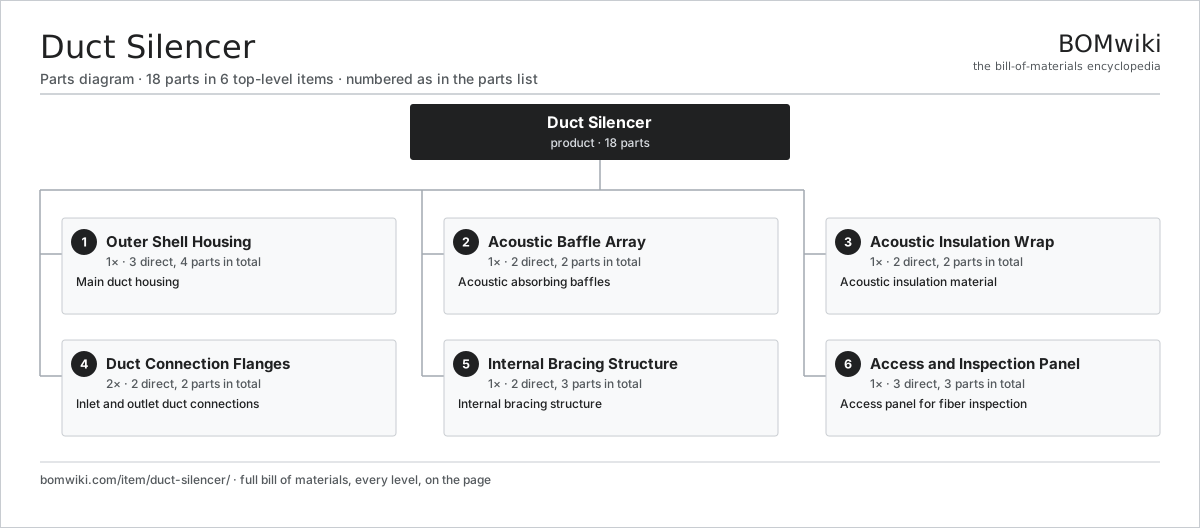
| # | Part | Qty | What it does |
|---|---|---|---|
| 1 | Outer Shell Housing 3 parts | 1× | Main duct housing |
| 2 | Acoustic Baffle Array 2 parts | 1× | Acoustic absorbing baffles |
| 3 | Acoustic Insulation Wrap 2 parts | 1× | Acoustic insulation material |
| 4 | Duct Connection Flanges 2 parts | 2× | Inlet and outlet duct connections |
| 5 | Internal Bracing Structure 2 parts | 1× | Internal bracing structure |
| 6 | Access and Inspection Panel 3 parts | 1× | Access panel for fiber inspection |
3D model
No 3D model yet. Have a CAD file of this? Add a 3D model. STL renders right on this page; STEP, FreeCAD, and OpenSCAD sources are welcome too (openly licensed, like all 3D models on BOMwiki).
Build & assembly graph
expand / collapse · shared sub-assemblies converge · links to related products · est. labourTap an assembly to expand/collapse · tap a part to open it · use “Open page” for any node · drag to pan, scroll to zoom.
Bill of materials for Duct Silencer
6 top-level lines · 20 rows shown · 18 parts total · indented to 3 levels| # | Item / sub-assembly | Part no. | Qty/assy | Ext. qty | Parts | Type |
|---|---|---|---|---|---|---|
| 1 | Outer Shell Housing 3 parts | duct-silencer-shell | 1× | 1 | 4 | assembly |
| 1.1 | Side Panels | duct-silencer-shell-sides | 1× | 1 | · | part |
| 1.2 | Top and Bottom Panel | duct-silencer-shell-top-bottom | 2× | 2 | · | part |
| 1.3 | Duct Sealing | duct-silencer-shell-seams | 1× | 1 | · | part |
| 2 | Acoustic Baffle Array 2 parts | duct-silencer-baffles | 1× | 1 | 2 | assembly |
| 2.1 | Perforated Baffle Plate | duct-silencer-baffle-plates | 1× | 1 | · | part |
| 2.2 | Baffle Support Frame | duct-silencer-baffle-support | 1× | 1 | · | part |
| 3 | Acoustic Insulation Wrap 2 parts | duct-silencer-fill | 1× | 1 | 2 | assembly |
| 3.1 | Acoustic Fiber | duct-silencer-fill-board | 1× | 1 | · | part |
| 3.2 | Facing Sheet | duct-silencer-fill-facing | 1× | 1 | · | part |
| 4 | Duct Connection Flanges 2 parts | duct-silencer-flanges | 2× | 2 | 2 | assembly |
| 4.1 | Inlet Flange | duct-silencer-flange-inlet | 1× | 2 | · | part |
| 4.2 | Outlet Flange | duct-silencer-flange-outlet | 1× | 2 | · | part |
| 5 | Internal Bracing Structure 2 parts | duct-silencer-support | 1× | 1 | 3 | assembly |
| 5.1 | Cross Brace | duct-silencer-support-cross-brace | 2× | 2 | · | part |
| 5.2 | Vertical Post | duct-silencer-support-vertical-post | 1× | 1 | · | part |
| 6 | Access and Inspection Panel 3 parts | duct-silencer-cleanout | 1× | 1 | 3 | assembly |
| 6.1 | Access Panel | duct-silencer-cleanout-panel | 1× | 1 | · | part |
| 6.2 | Panel Hinge or Fasteners | duct-silencer-cleanout-hinge | 1× | 1 | · | part |
| 6.3 | Gasket Seal | duct-silencer-cleanout-gasket | 1× | 1 | · | part |
Something wrong in this list? Report a problem with this BOM.
Sourcing: possible vendors
Browse the supplier directory → Prices, MOQ, and lead times are algorithmic estimates, not quotes, and not claims about these companies. Company mappings are curated by keyword; est. price band $100–$20k. How estimates work| Vendor | HQ | Specialty | MOQ | Lead time |
|---|---|---|---|---|
|
🇺🇸Carrier
carrier.com ↗
|
Palm Beach Gardens, US | HVAC | 500 units | 8–14 wks |
| tranetechnologies.com ↗ | Davidson, US | HVAC | 500 units | 8–14 wks |
|
🇯🇵Daikin
daikin.com ↗
|
Osaka, JP | HVAC | 500 units | 8–14 wks |
|
🇺🇸Lennox
lennox.com ↗
|
Richardson, US | HVAC | 500 units | 8–14 wks |
| johnsoncontrols.com ↗ | Milwaukee, US | Building systems | 500 units | 8–14 wks |
952-word article