Dunk Tank
ProductOverview
A dunk tank is a classic carnival game where players attempt to hit a target that triggers a mechanical mechanism, dunking a seated person into a tank of water. The game tests accuracy, strength, and timing. Players pay per throw (baseballs or similar projectiles); a successful hit triggers the dunking mechanism.
Modern dunk tanks feature adjustable difficulty (impact force required), water circulation and filtration, safety features, and portable construction for event deployment. They are found at carnivals, fundraisers, team-building events, and some amusement parks.
How it works
Water Tank Structure. The Water Tank is a sealed fiberglass or aluminum container holding 200–500 gallons. The interior has viewing windows so spectators can see the dunked person. The tank is mounted inside a Cage Structure, a steel framework that provides structural support and prevents unauthorized access to mechanical components.
Seat Mechanism and Dunking. The Seat Mechanism consists of a platform seat suspended above the water, held in place by a mechanical Seat Latch. The seat is positioned 1–2 feet above the water surface. When the Target Arm target is hit with sufficient force, the mechanical Mechanical Linkage releases the latch, allowing the seat to pivot backward on its Seat Pivot hinge, dumping the seated person into the water below.
Target Mechanism. Players throw projectiles (baseballs, beanbags) at a circular target button mounted on the extended Target Arm. The target button is pressure-sensitive; when impacted with sufficient force (typically 50–100 lbs, adjustable), it triggers a plunger that pulls on the Arm Cable. The cable tension actuates the Mechanical Linkage, pulling the Latch Release Pin that opens the seat latch.
Linkage and Reset. The mechanical linkage uses simple lever mechanics: force on the target arm cable pulls a lever that rotates about a pivot point, disengaging the latch. A Cable Tension Spring maintains tension on the return cable, automatically resetting the latch to engage position once the target impact is released.
Water Circulation and Maintenance. The Water Circulation System system includes a pump and filter cartridge that continuously circulates water through the tank, removing bacteria, algae, and debris. The pump runs intermittently (every 30–60 minutes if tank is idle) to maintain water quality. The Drain System allows the tank to be emptied completely for cleaning and refill.
Mechanical Details
The target button force required is adjustable via a simple mechanism: a turnbuckle on the cable allows the operator to increase or decrease tension in the return spring. Tighter spring tension requires harder impact to release the latch. This allows the carnival operator to adjust difficulty based on the arm power of typical throwers (children vs. adults).
The seat pivot is engineered to tip backward at approximately 30–45 degrees, launching the person forward into the center of the tank. The pivot axis is positioned such that the person's center of gravity passes outside the pivot point when released, creating a rotational moment that accelerates the seat tipping.
Safety Considerations
Safety features include:
- Manual override: A secondary latch can be manually pulled to reset the seat without impacting the target, allowing the person to exit safely even if the mechanism jams.
- Tank rim padding: The Cage Structure has rubberized bumpers around the tank rim to cushion the person being dunked.
- Water quality: Continuous circulation and filtration prevent algae and bacterial growth. Water is typically replaced weekly and tested for pH and chlorine levels.
- Entry ladder: An internal or external ladder allows the dunked person to exit the tank easily.
- Age restrictions: Young children or elderly persons are sometimes restricted from participating; the impact of dunking can be surprising and cause panic in some individuals.
Water Management and Hygiene
The Water Circulation System pump runs 8–12 hours daily during events, maintaining turnover of the entire tank volume every 2–4 hours. The Filter Cartridge captures particles; sediment settles at the bottom and is removed via the Drain System.
Water temperature is controlled by ambient air; heating elements or chilled water systems are added only in extreme climates (very cold events might use heated water to keep the person from experiencing shock).
Chlorine or salt-based sanitizers are added 1–2 times weekly. A test kit measures free chlorine (0.5–2 ppm ideal) and pH (7.0–7.4 ideal). Water is completely drained and replaced every 1–2 weeks depending on event attendance and water quality testing.
Carnival Operation
In carnival settings, the dunk tank is staffed with an operator who collects money, hands out balls, and resets the mechanism after each dunking. The person in the seat is typically a volunteer (sometimes a local celebrity, coach, or charity representative) who sits above the tank and taunts players to encourage throws.
The operator adjusts difficulty by tuning the spring tension, making the game easier for children and harder for adults. Some operators offer prizes or additional throws as incentives. A typical configuration allows 3–5 throws per player for a set price (e.g., $5 for three throws).
Operational downtime occurs if the mechanism jams or the latch fails to engage. This is usually resolved by manual reset or minor adjustment to cable tension.
Dunk Tank parts and their functions
7 top-level parts · 63 parts in total · full bill of materials below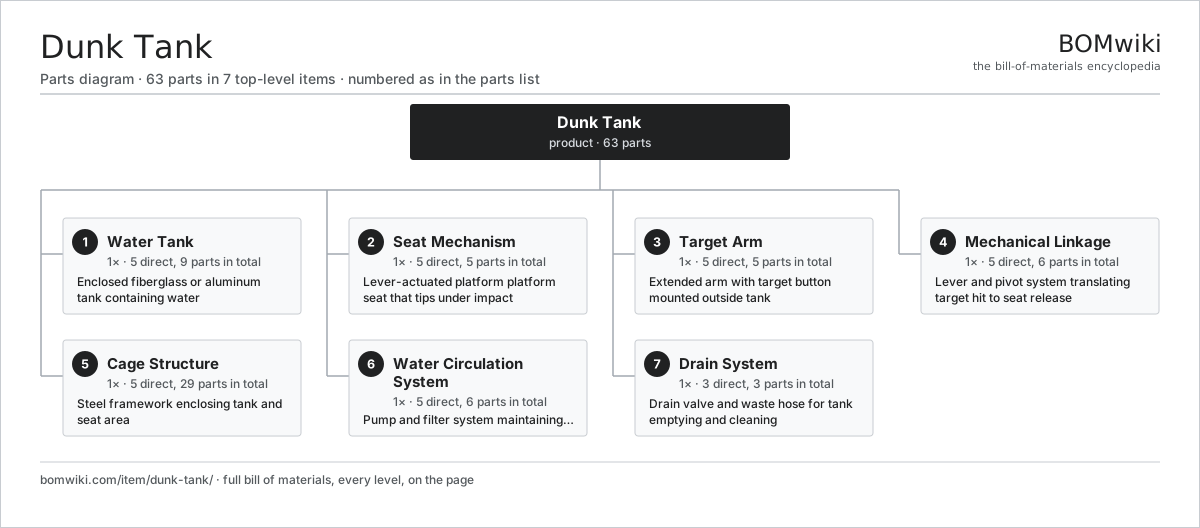
| # | Part | Qty | What it does |
|---|---|---|---|
| 1 | Water Tank 5 parts | 1× | Enclosed fiberglass or aluminum tank containing water |
| 2 | Seat Mechanism 5 parts | 1× | Lever-actuated platform platform seat that tips under impact |
| 3 | Target Arm 5 parts | 1× | Extended arm with target button mounted outside tank |
| 4 | Mechanical Linkage 5 parts | 1× | Lever and pivot system translating target hit to seat release |
| 5 | Cage Structure 5 parts | 1× | Steel framework enclosing tank and seat area |
| 6 | Water Circulation System 5 parts | 1× | Pump and filter system maintaining water cleanliness |
| 7 | Drain System 3 parts | 1× | Drain valve and waste hose for tank emptying and cleaning |
3D model
No 3D model yet. Have a CAD file of this? Add a 3D model. STL renders right on this page; STEP, FreeCAD, and OpenSCAD sources are welcome too (openly licensed, like all 3D models on BOMwiki).
Build & assembly graph
expand / collapse · shared sub-assemblies converge · links to related products · est. labourTap an assembly to expand/collapse · tap a part to open it · use “Open page” for any node · drag to pan, scroll to zoom.
Bill of materials for Dunk Tank
7 top-level lines · 40 rows shown · 63 parts total · indented to 3 levels| # | Item / sub-assembly | Part no. | Qty/assy | Ext. qty | Parts | Type |
|---|---|---|---|---|---|---|
| 1 | Water Tank 5 parts | dunk-tank-water-tank | 1× | 1 | 9 | assembly |
| 1.1 | Tank Body | dunk-tank-tank-body | 1× | 1 | · | part |
| 1.2 | Tank Bottom | dunk-tank-tank-bottom | 1× | 1 | · | part |
| 1.3 | Viewing Window | dunk-tank-viewing-window | 2× | 2 | · | part |
| 1.4 | Tank Seal | dunk-tank-tank-seal | 1× | 1 | · | part |
| 1.5 | Tank Bracket | dunk-tank-tank-bracket | 4× | 4 | · | part |
| 2 | Seat Mechanism 5 parts | dunk-tank-seat-mechanism | 1× | 1 | 5 | assembly |
| 2.1 | Seat Platform | dunk-tank-seat-platform | 1× | 1 | · | part |
| 2.2 | Seat Pivot | dunk-tank-seat-pivot | 1× | 1 | · | part |
| 2.3 | Seat Latch | dunk-tank-seat-latch | 1× | 1 | · | part |
| 2.4 | Latch Release Pin | dunk-tank-latch-release-pin | 1× | 1 | · | part |
| 2.5 | Seat Cable | dunk-tank-seat-cable | 1× | 1 | · | part |
| 3 | Target Arm 5 parts | dunk-tank-target-arm | 1× | 1 | 5 | assembly |
| 3.1 | Arm Tube | dunk-tank-arm-tube | 1× | 1 | · | part |
| 3.2 | Target Button | dunk-tank-target-button | 1× | 1 | · | part |
| 3.3 | Button Pad | dunk-tank-button-pad | 1× | 1 | · | part |
| 3.4 | Arm Mount | dunk-tank-arm-mount | 1× | 1 | · | part |
| 3.5 | Arm Cable | dunk-tank-arm-cable | 1× | 1 | · | part |
| 4 | Mechanical Linkage 5 parts | dunk-tank-mechanical-linkage | 1× | 1 | 6 | assembly |
| 4.1 | Primary Lever | dunk-tank-primary-lever | 1× | 1 | · | part |
| 4.2 | Pivot Point | dunk-tank-pivot-point | 1× | 1 | · | part |
| 4.3 | Linkage Cable | dunk-tank-linkage-cable | 1× | 1 | · | part |
| 4.4 | Cable Tension Spring | dunk-tank-cable-tension-spring | 1× | 1 | · | part |
| 4.5 | Linkage Bracket | dunk-tank-linkage-bracket | 2× | 2 | · | part |
| 5 | Cage Structure 5 parts | dunk-tank-cage-structure | 1× | 1 | 29 | assembly |
| 5.1 | Cage Frame Tube | dunk-tank-cage-frame-tube | 8× | 8 | · | part |
| 5.2 | Cage Cross Brace | dunk-tank-cage-cross-brace | 4× | 4 | · | part |
| 5.3 | Cage Grid | dunk-tank-cage-grid | 1× | 1 | · | part |
| 5.4 | Fastener Set | fastener-set | 12× | 12 | · | part |
| 5.5 | Corner Bracket | dunk-tank-corner-bracket | 4× | 4 | · | part |
| 6 | Water Circulation System 5 parts | dunk-tank-water-circulation | 1× | 1 | 6 | assembly |
| 6.1 | Circulation Pump | dunk-tank-circulation-pump | 1× | 1 | · | part |
| 6.2 | Filter Cartridge | dunk-tank-filter-cartridge | 1× | 1 | · | part |
| 6.3 | Circulation Hose | dunk-tank-circulation-hose | 2× | 2 | · | part |
| 6.4 | Flow Control Valve | dunk-tank-flow-control-valve | 1× | 1 | · | part |
| 6.5 | Filtration Housing | dunk-tank-filtration-housing | 1× | 1 | · | part |
| 7 | Drain System 3 parts | dunk-tank-drain-system | 1× | 1 | 3 | assembly |
| 7.1 | Drain Valve | dunk-tank-drain-valve | 1× | 1 | · | part |
| 7.2 | Drain Hose | dunk-tank-drain-hose | 1× | 1 | · | part |
| 7.3 | Drain Strainer | dunk-tank-drain-strainer | 1× | 1 | · | part |
Something wrong in this list? Report a problem with this BOM.
Sourcing: possible vendors
Browse the supplier directory → Prices, MOQ, and lead times are algorithmic estimates, not quotes, and not claims about these companies. Company mappings are curated by keyword; est. price band $20–$3k. How estimates work| Vendor | HQ | Specialty | MOQ | Lead time |
|---|---|---|---|---|
|
🇩🇰LEGO
lego.com ↗
|
Billund, DK | Construction toys | 2,000 units | 6–10 wks |
|
🇺🇸Mattel
mattel.com ↗
|
El Segundo, US | Toys | 2,000 units | 6–10 wks |
|
🇺🇸Hasbro
hasbro.com ↗
|
Pawtucket, US | Toys & games | 2,000 units | 6–10 wks |
| bandainamco.co.jp ↗ | Tokyo, JP | Toys & amusement | 2,000 units | 6–10 wks |
| spinmaster.com ↗ | Toronto, CA | Toys | 2,000 units | 6–10 wks |
892-word article