Baghouse Dust Collector
ProductOverview
A baghouse dust collector is an industrial air filtration system designed to capture fine dust and particulates from aggregate processing, conveyor transfer points, and handling equipment. Using hundreds of cylindrical fabric bags, the baghouse filters incoming air laden with dust particles (typically 10–100 g/m³) down to clean exhaust air (<0.5 mg/m³, meeting EPA standards). The core technology is pulse-jet cleaning: compressed air is automatically released in short bursts (0.1–0.2 second pulses every 10–60 seconds), forcing trapped dust to release from the filter bags and fall into a collection hopper for disposal or recovery.
Baghouses are essential in mining because they:
- Achieve 99.5–99.9% dust collection efficiency, meeting regulations in sensitive areas
- Operate continuously without requiring shutdowns for cleaning
- Allow dust recovery and recirculation (e.g., reprocessing <2 mm fines into product)
- Are cost-effective for high-volume air flow (10,000–100,000 m³/hour)
- Require minimal operator attention with automated pulse-jet cleaning
Filtration and Cleaning Principle
Dust-laden air enters the baghouse inlet at relatively low velocity (0.5–1.5 m/second) to avoid re-entrainment of settled dust. Air passes through an inlet baffle that redirects flow downward and inward, causing the largest particles to settle by gravity into the hopper. This primary settling removes 30–40% of dust mass before reaching the bags.
Air flows upward through the filter bags, cylindrical sleeves of polyester or glass fiber fabric 2–4 meters tall and 100–200 mm in diameter. As air passes through the cloth, dust particles are trapped on the surface and interior of the fabric. Particles accumulate in layers, forming a "cake" on the bag surface. This cake actually improves collection efficiency by acting as an additional filter medium, but it also increases pressure drop (resistance to air flow).
Pressure drop across the baghouse gradually increases as dust accumulates. A clean baghouse has 100–150 Pa drop; a heavily clogged baghouse reaches 300–500 Pa. At clog point, the pressure differential switch signals the PLC controller to initiate cleaning.
Pulse-Jet Cleaning Cycle
At a programmable interval (typically every 20–30 seconds, but adjustable from 10–60 seconds), a solenoid valve opens in the pulse-jet air system. Compressed air at 5–8 bar flows through a pulse manifold down a tube positioned above a row of bags. A brief pulse (0.1–0.2 seconds) of this high-pressure air enters each bag from the top, forcing the bag to expand suddenly.
This rapid expansion physically dislodges the dust cake from the fabric surface. The cake breaks away and falls through the bag's interior, exiting at the bottom and settling in the hopper. Immediately after the pulse, the solenoid closes, and normal filtration resumes. The entire pulse lasts only 0.1–0.2 seconds, so air filtration is interrupted only briefly.
Pulse cleaning is so gentle that it does not damage bag fabric or dislodge particles that have penetrated deep into the weave. Over the bag's lifetime (3–7 years), dust slowly consolidates into the fabric, gradually reducing efficiency. When efficiency drops below 95%, the bag is replaced.
Component Design and Operation
Filter Bags and Materials
Filter bags come in three primary fabrics:
- Polyester: Least expensive, durable to 65°C air temperature, effective for aggregate dust. Life: 3–5 years.
- Glass fiber: More durable, tolerates 120°C air temperature, preferred for hot-process exhausts (cement, lime). Life: 5–7 years. Cost: 2–3× polyester.
- PTFE membrane (Teflon-coated polyester): Most durable, handles sticky or moist dust, ideal for coal or blast furnace dust. Life: 7–10 years. Cost: 3–4× polyester.
Inside each bag is a lightweight wire cage (2–4 meters tall) preventing the bag from collapsing during the pulse. The cage is a critical design element: without it, the pulse would compress the bag against the manifold, damaging the fabric and reducing air flow.
The top of each bag has a reinforced collar that mounts onto the pulse manifold. A snap clip or clamp locks the collar in place. Installation takes 1–2 minutes per bag; complete baghouse replacement requires 4–8 hours for 200–800 bags depending on total count.
The Pulse-Jet System
The pulse-jet system is the heart of modern baghouses. It consists of:
- Dedicated air compressor (5–15 kW) supplying 5–8 bar clean dry air. This compressor is separate from plant air, ensuring pulse air is not contaminated with mill dust or water from the main system.
- Air receiver tank (25–50 liters) buffering compressor pulsations.
- Solenoid valve (fast-acting, 2–3 way) opening and closing the pulse air in rapid succession.
- Pulse manifold integrating all bag-row pulse tubes into a single header.
- Pulse tubes directing air into each bag row.
The PLC timer controls solenoid pulse frequency. Typical settings:
- Normal operation (clean bags, low pressure drop): Pulse every 30–60 seconds
- Moderate loading (intermediate dust accumulation): Pulse every 20–30 seconds
- Heavy loading (approaching clog): Pulse every 10–20 seconds
Operators manually adjust pulse interval based on observed pressure drop. Too-frequent pulsing wastes compressed air; too-infrequent pulsing allows bags to clog.
Fan and Exhaust
The exhaust fan is a centrifugal unit drawing clean air from the above-bag plenum through the bags and discharging to atmosphere (or to a stack for further treatment). Fan motor power (15–30 kW) is sized to overcome total baghouse pressure drop (typically 250–500 Pa) plus downstream ductwork resistance.
Modern baghouses employ variable-frequency drive (VFD) motors, allowing fan speed adjustment. If hopper empties (no incoming dust), the PLC automatically slows the fan to minimum, reducing power draw by 50% or more. On restart when material arrives, the fan ramps back up.
Dust Collection and Removal
Dust settling in the hopper is removed either by:
- Manual unloading: Operator opens a gate valve at hopper bottom, allowing dust to fall into bags or bins for disposal.
- Automated airlock: A rotary airlock valve continuously removes dust at a set rate, feeding it to a screw conveyor or truck for processing.
- Vibrator assist: A hopper vibrator (electric, eccentric mass) runs periodically to dislodge dust compacted by moisture or electrostatic forces.
For dust recovery (reprocessing), the hopper discharge is routed to a secondary conveyor system and the dust is reintegrated into the process. This is economically justified when dust represents valuable product (e.g., fine ore fines worth recovering for resale).
Control and Monitoring
Pressure Differential Monitoring
The differential pressure switch measures the pressure difference between the inlet and outlet plenum. It is typically set to:
- Clean alarm: Triggers at 150–200 Pa drop (optional, indicates clean bags)
- Clog alarm: Triggers at 450–500 Pa drop (high pressure, initiate cleaning or alert operator)
Modern systems use electronic PLC controllers with continuous pressure monitoring and automated pulse scheduling rather than simple mechanical switches.
Alarms and Interlocks
An alarm lamp on the control panel lights if:
- Baghouse pressure drop exceeds 500 Pa (bags clogged)
- Hopper full sensor triggered (dust collection full)
- Compressor offline or low pressure (no pulse-jet air)
- Fan bearing overheating (>85°C)
If pressure remains high for >30 minutes despite pulsing, an alarm sounds, alerting operators to potential bag failure (tear or seal loss).
Maintenance and Bag Replacement
Baghouses are designed for low maintenance but require disciplined upkeep:
Bag Inspection and Replacement
Bags are inspected annually by visual inspection (open baghouse, look for tears or gray discoloration indicating saturation). Bags are replaced when:
- Pressure drop cannot be reduced below 400 Pa despite pulsing (saturation)
- Visible tears or seam failures
- Air leak detected at bag collar (seal failure)
- Color faded to light gray or white (fabric degradation)
In heavy-duty quarry service, expect 3–5 year bag life for polyester and 5–7 years for glass fiber.
Compressor and Air System Maintenance
- Monthly: Check compressor discharge air quality (should be dry, oil-free). Install moisture trap on discharge if needed.
- Quarterly: Drain air receiver tank (remove accumulated water).
- Annually: Replace compressor oil and air filter. Test solenoid valve response.
Compressor failure is the most common cause of baghouse downtime. Maintaining dedicated clean dry air is essential.
Hopper Cleanout
Hopper is emptied every 1–4 weeks depending on inlet dust loading. If dust is moist or electrostatic, it sticks to hopper walls and requires periodic scraping. Some operations install vibrators running on a timer to prevent bridging.
Environmental and Health Benefits
Baghouses reduce pit air dustiness from 50–200 mg/m³ (uncontrolled) to <1 mg/m³, meeting U.S. EPA standards (0.5 mg/m³ limit for many ores). For operators working near transfer points, dust exposure is reduced from 50+ mg/m³ (hazardous) to <5 mg/m³ (acceptable), dramatically improving worker respiratory health.
In urban quarries, baghouse-equipped operations eliminate visible dust plumes and reduce neighbor complaints. Some regions mandate baghouse installation on all transfer points as a condition of mining permit renewal.
Cost-Benefit Analysis
Capital cost: $200,000–1,000,000 (depending on air flow capacity) Operating cost: $0.50–2.00 per tonne processed (electricity, bag replacement, compressor maintenance) Lifespan: 15–25 years
The equipment pays for itself in reduced downtime, worker health claims, and permit renewals within 3–7 years in most large quarries. Payback is slower for small operations unless baghouse is driven by regulatory requirement.
Baghouse Dust Collector parts and their functions
9 top-level parts · 246 parts in total · full bill of materials below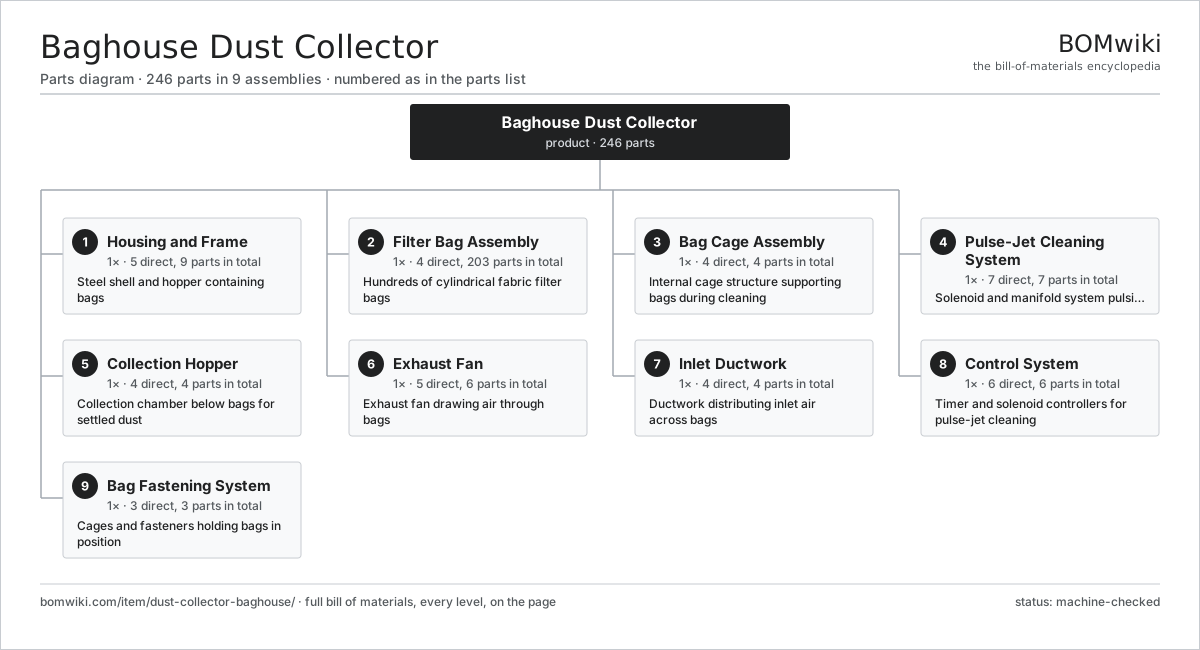
| # | Part | Qty | What it does |
|---|---|---|---|
| 1 | Housing and Frame 5 parts | 1× | Steel shell and hopper containing bags |
| 2 | Filter Bag Assembly 4 parts | 1× | Hundreds of cylindrical fabric filter bags |
| 3 | Bag Cage Assembly 4 parts | 1× | Internal cage structure supporting bags during cleaning |
| 4 | Pulse-Jet Cleaning System 7 parts | 1× | Solenoid and manifold system pulsing compressed air through bags |
| 5 | Collection Hopper 4 parts | 1× | Collection chamber below bags for settled dust |
| 6 | Exhaust Fan 5 parts | 1× | Exhaust fan drawing air through bags |
| 7 | Inlet Ductwork 4 parts | 1× | Ductwork distributing inlet air across bags |
| 8 | Control System 6 parts | 1× | Timer and solenoid controllers for pulse-jet cleaning |
| 9 | Bag Fastening System 3 parts | 1× | Cages and fasteners holding bags in position |
3D model
No 3D model yet. Have a CAD file of this? Add a 3D model — STL renders right on this page; STEP, FreeCAD, and OpenSCAD sources are welcome too (openly licensed, like all 3D models on BOMwiki).
Build & assembly graph
expand / collapse · shared sub-assemblies converge · links to related products · est. labourTap an assembly to expand/collapse · tap a part to open it · use “Open page” for any node · drag to pan, scroll to zoom.
Bill of materials for Baghouse Dust Collector
9 top-level lines · 51 rows shown · 246 parts total · indented to 3 levels| # | Item / sub-assembly | Part no. | Qty/assy | Ext. qty | Parts | Type |
|---|---|---|---|---|---|---|
| 1 | Housing and Frame 5 parts | dust-collector-baghouse-housing | 1× | 1 | 9 | assembly |
| 1.1 | Steel Shell | dust-collector-baghouse-shell | 1× | 1 | · | part |
| 1.2 | Roof Panel | dust-collector-baghouse-roof | 1× | 1 | · | part |
| 1.3 | Access Door | dust-collector-baghouse-door | 2× | 2 | · | part |
| 1.4 | Mounting Feet | dust-collector-baghouse-mounting-feet | 1× | 1 | · | part |
| 1.5 | Sheet Metal Panel | sheet-panel | 4× | 4 | · | part |
| 2 | Filter Bag Assembly 4 parts | dust-collector-baghouse-bags | 1× | 1 | 203 | assembly |
| 2.1 | Filter Bag | dust-collector-baghouse-bag | 200× | 200 | · | part |
| 2.2 | Bag Fabric | dust-collector-baghouse-bag-material | 1× | 1 | · | part |
| 2.3 | Bag Collar | dust-collector-baghouse-bag-collar | 1× | 1 | · | part |
| 2.4 | Bag Internal Cage | dust-collector-baghouse-bag-cage | 1× | 1 | · | part |
| 3 | Bag Cage Assembly 4 parts | dust-collector-baghouse-cage | 1× | 1 | 4 | assembly |
| 3.1 | Cage Main Frame | dust-collector-baghouse-cage-frame | 1× | 1 | · | part |
| 3.2 | Cage Rods | dust-collector-baghouse-cage-rods | 1× | 1 | · | part |
| 3.3 | Cage Clips | dust-collector-baghouse-cage-clips | 1× | 1 | · | part |
| 3.4 | Spacing Fixtures | dust-collector-baghouse-cage-spacing | 1× | 1 | · | part |
| 4 | Pulse-Jet Cleaning System 7 parts | dust-collector-baghouse-pulse-jet | 1× | 1 | 7 | assembly |
| 4.1 | Air Compressor | dust-collector-baghouse-air-compressor | 1× | 1 | · | part |
| 4.2 | Air Receiver | dust-collector-baghouse-air-tank | 1× | 1 | · | part |
| 4.3 | Solenoid Valve | dust-collector-baghouse-solenoid-valve | 1× | 1 | · | part |
| 4.4 | Pulse Manifold | dust-collector-baghouse-pulse-manifold | 1× | 1 | · | part |
| 4.5 | Pulse Tube | dust-collector-baghouse-pulse-tube | 1× | 1 | · | part |
| 4.6 | Timer | dust-collector-baghouse-timer | 1× | 1 | · | part |
| 4.7 | O-Ring Set | oring-set | 1× | 1 | · | part |
| 5 | Collection Hopper 4 parts | dust-collector-baghouse-hopper | 1× | 1 | 4 | assembly |
| 5.1 | Hopper Body | dust-collector-baghouse-hopper-body | 1× | 1 | · | part |
| 5.2 | Hopper Outlet | dust-collector-baghouse-hopper-outlet | 1× | 1 | · | part |
| 5.3 | Hopper Vibrator | dust-collector-baghouse-hopper-vibrator | 1× | 1 | · | part |
| 5.4 | Level Sensor | dust-collector-baghouse-hopper-level-sensor | 1× | 1 | · | part |
| 6 | Exhaust Fan 5 parts | dust-collector-baghouse-fan | 1× | 1 | 6 | assembly |
| 6.1 | Fan Motor | dust-collector-baghouse-fan-motor | 1× | 1 | · | part |
| 6.2 | Fan Impeller | dust-collector-baghouse-fan-impeller | 1× | 1 | · | part |
| 6.3 | Fan Bearing | dust-collector-baghouse-fan-bearing | 2× | 2 | · | part |
| 6.4 | Fan Intake | dust-collector-baghouse-fan-intake | 1× | 1 | · | part |
| 6.5 | Fan Discharge | dust-collector-baghouse-fan-discharge | 1× | 1 | · | part |
| 7 | Inlet Ductwork 4 parts | dust-collector-baghouse-inlet-manifold | 1× | 1 | 4 | assembly |
| 7.1 | Inlet Pipe | dust-collector-baghouse-inlet-pipe | 1× | 1 | · | part |
| 7.2 | Inlet Duct | dust-collector-baghouse-inlet-duct | 1× | 1 | · | part |
| 7.3 | Inlet Baffle | dust-collector-baghouse-inlet-baffle | 1× | 1 | · | part |
| 7.4 | Inlet Damper | dust-collector-baghouse-damper | 1× | 1 | · | part |
| 8 | Control System 6 parts | dust-collector-baghouse-control-panel | 1× | 1 | 6 | assembly |
| 8.1 | PLC | dust-collector-baghouse-plc | 1× | 1 | · | part |
| 8.2 | Timer | dust-collector-baghouse-timer | 1× | 1 | · | part |
| 8.3 | Pressure Switch | dust-collector-baghouse-pressure-switch | 1× | 1 | · | part |
| 8.4 | Motor Starter | dust-collector-baghouse-motor-starter | 1× | 1 | · | part |
| 8.5 | Alarm Lamp | dust-collector-baghouse-alarm-lamp | 1× | 1 | · | part |
| 8.6 | Emergency Stop | dust-collector-baghouse-emergency-stop | 1× | 1 | · | part |
| 9 | Bag Fastening System 3 parts | dust-collector-baghouse-bag-supports | 1× | 1 | 3 | assembly |
| 9.1 | Bag Clip | dust-collector-baghouse-bag-clip | 1× | 1 | · | part |
| 9.2 | Cage Bolt | dust-collector-baghouse-cage-bolt | 1× | 1 | · | part |
| 9.3 | Bag Spacer | dust-collector-baghouse-bag-spacer | 1× | 1 | · | part |
Related products
same domain, ranked by shared parts Gravity Concentrating Table
184 parts · shares 2 with this page
Gyratory Crusher
86 parts · shares 2 with this page
Magnetic Drum Separator
144 parts · shares 2 with this page
Mechanized Scaling Rig
530 parts · shares 2 with this page
Gravity Concentrating Table
184 parts · shares 2 with this page
Gyratory Crusher
86 parts · shares 2 with this page
Magnetic Drum Separator
144 parts · shares 2 with this page
Mechanized Scaling Rig
530 parts · shares 2 with this page
 Mine Hoisting Skip
104 parts · shares 2 with this page
Mine Shaft Cage
109 parts · shares 2 with this page
Mine Hoisting Skip
104 parts · shares 2 with this page
Mine Shaft Cage
109 parts · shares 2 with this page
Sourcing: possible vendors
Prices, MOQ, and lead times are algorithmic estimates, not quotes, and not claims about these companies. Company mappings are curated by keyword; est. price band $200k–$5M. How estimates work| Vendor | HQ | Specialty | MOQ | Lead time |
|---|---|---|---|---|
| caterpillar.com ↗ | Irving, US | Construction & mining equipment | made to order | 20–36 wks |
|
🇯🇵Komatsu
komatsu.com ↗
|
Tokyo, JP | Construction & mining equipment | made to order | 20–36 wks |
|
🇸🇪Sandvik
rocktechnology.sandvik ↗
|
Stockholm, SE | Mining & rock technology | made to order | 20–36 wks |
|
🇸🇪Epiroc
epiroc.com ↗
|
Stockholm, SE | Mining & drilling equipment | made to order | 20–36 wks |
|
🇫🇮Metso
metso.com ↗
|
Helsinki, FI | Crushing & minerals processing | made to order | 20–36 wks |
1,691-word article