Dynamo Light System
ProductOverview
A dynamo light system converts the rotation of the front wheel into electrical power, illuminating an LED headlight and taillight without battery or external power source. A permanent-magnet generator (dynamo) mounted in the front hub produces alternating current (AC) as the wheel spins. A regulator module converts this to stable direct current (DC), powering the lights at constant brightness regardless of speed.
Dynamo systems are standard equipment on European city bikes and cargo bikes, and increasingly common on adventure and gravel bikes where lightweight, maintenance-free lighting is valued. They eliminate the need to carry spare batteries or remember to charge lights, as long as the bike is moving, the lights work.
How it works
The hub dynamo contains a permanent-magnet ring (rotating with the wheel) and a stationary coil (stator). As the wheel rotates, the magnet passes by the coil, inducing an alternating voltage (10–20 V AC at 20 km/h). The output frequency increases with speed (roughly proportional to rpm).
This AC voltage is fed to a regulator module (mounted on the handlebar or frame) containing:
- Rectifier: A diode bridge converts AC to pulsating DC.
- Voltage regulator: A linear or switching regulator stabilizes the output to a constant 6 V DC.
- Capacitors: Filter capacitors smooth the DC ripple, providing steady power to the lights.
The regulated 6 V DC powers the LED headlight (typically 1–2 W) and taillight (0.2–0.5 W). The lights automatically dim or brighten as the wheel speed changes, because the regulator outputs more current at higher speeds (more power available from the faster-spinning generator).
At low speeds (<5 km/h), the dynamo output voltage drops below the regulator threshold, and the lights extinguish. Most riders carry a small backup battery-powered light for walking or standing stops.
The system has no moving parts (beyond the wheel itself) and requires no maintenance. The generator bearing seals are sealed and greased at factory; field service is not typical.
Dynamo efficiency and rolling resistance
The permanent-magnet dynamo produces generator back-torque, which translates to rolling resistance (drag). Modern hub dynamos have rolling resistance of 1–2 W at 20 km/h, equivalent to a 0.3–0.5% speed penalty. Over a 50 km commute, this penalty is roughly 1–2 minutes slower compared to a standard hub.
This penalty is negligible for commuters and recreational riders but noticeable for competitive cyclists. It is why dynamos are rarely seen on road racing or lightweight gravel bikes.
Efficiency (mechanical-to-electrical) is typically 60–75%, meaning 6 W of mechanical load produces 3.5–4.5 W of usable electrical power at the regulator output.
Hub-integrated design
The dynamo is integrated into the front wheel hub, sharing the same axle and bearing assembly as a standard hub. The magnet ring is typically part of the hub shell or axle; the coil is stationary within the hub body.
This integration keeps weight low (dynamo adds ~200–300 g to the hub compared to a standard hub) and eliminates external generators (which would increase drag even more). The downside is that the dynamo is not serviceable, if it fails, the entire hub must be replaced (cost $100–$300).
Hub spacing is standard (100 mm front axle for most bikes), so dynamo hubs are compatible with most frames. However, the hub must be built into the wheel by the bike manufacturer or a professional wheel builder, as it is not a drop-in replacement for a standard hub.
Light design
Headlight: Typically 70–90 mm diameter, sealed aluminum or plastic body. A white LED with parabolic reflector produces a concentrated beam (100–400 lux, roughly equivalent to a 50–100 lumen battery light). Most headlights have a cutoff angle (beam directed downward) to avoid blinding oncoming riders.
At 20 km/h (typical city riding), the headlight produces adequate illumination for night riding on lit streets or dimly-lit trails. At highway speeds (40+ km/h), the output is brighter. At walking speed (<5 km/h), the light is very dim or off.
Taillight: Small red LED (40–60 mm diameter) mounted on the seat-stay or rear rack, drawing minimal power (0.2–0.5 W). Visible from 100–200 meters in darkness.
Both lights are sealed against weather and have minimal moving parts, making them extremely reliable.
Regulator variants
Linear regulators (e.g., 7806 IC) are simple and cheap ($3–$5 per unit). They dissipate excess voltage as heat, so they can become warm at high speeds. Maximum current is typically 500 mA.
Switching regulators (buck converters) are more efficient, dissipating less heat. They use a PWM (pulse-width modulation) circuit to regulate voltage, allowing higher current output without overheating. Cost is higher ($10–$20) but still reasonable.
Capacitive regulators (no IC at all) use large capacitors to store energy and smooth AC ripple. They are the simplest and lightest but offer less stable voltage regulation (brightness varies slightly with speed). Used on budget systems.
Modern systems typically use switching regulators for better efficiency and reliability.
Speed and brightness
Output brightness is roughly proportional to wheel speed. At 10 km/h, the headlight produces ~50 lux. At 25 km/h, ~200 lux. At 40 km/h, ~400 lux.
This brightness modulation is generally acceptable for commuters (speeds are moderate) but can be annoying for racing or high-speed cycling (lights are very bright).
Some advanced regulators include a brightness limiter circuit (capping maximum output at a safe level) to prevent blinding other riders at high speeds.
Waterproofing and durability
All connectors are sealed and rated for outdoor use (IP67 or better). The hub dynamo is sealed; water does not enter the bearing or coil cavity even when submerged (as might happen during river ford or heavy rain).
Lifespan of a dynamo hub is typically 10–20 years of regular riding, or 5000–10000 km before any bearing wear becomes noticeable. Replacement bearings can extend life further, but field service is rare.
The wiring harness and connectors can degrade after 5–10 years due to UV exposure and weathering. Connectors may develop corrosion if not regularly cleaned. Replacing a harness costs $30–$60.
Maintenance requirements
Unlike battery lights, dynamo systems require virtually no maintenance. There are no batteries to charge, no bulbs to replace (LED lifespan is 10+ years), and no moving parts to adjust (beyond the wheel bearings, which are standard hub maintenance).
Occasionally, connectors may need cleaning (removing corrosion) or re-seating if they become loose. A light dab of dielectric grease on the connector pins prevents corrosion.
The wiring harness should be inspected annually for cuts or damage; UV-damaged insulation can cause short circuits.
Comparison with battery lights
Dynamo system:
- Pros: No batteries to carry or charge, always available power, extremely reliable, lightweight (hub adds weight but saves battery weight).
- Cons: Adds rolling resistance (1–2 W), brightness varies with speed, initial cost higher ($200–$400 for hub + regulator + lights), requires wheel rebuild.
Battery lights (rechargeable LED):
- Pros: Instant full brightness, choice of brightness levels, can be carried as backup.
- Cons: Must charge regularly, battery degradation over time, heavier than dynamo-equivalent lights, risk of forgetting to charge.
Disposable battery lights:
- Pros: Cheap, reliable.
- Cons: Constant battery replacement cost, environmental waste, cannot charge field.
For commuters and touring cyclists, dynamo systems are superior. For racing or speed-focused riders, battery lights offer more control.
Market and adoption
Dynamo lights are standard on European city bikes and cargo bikes (nearly 100% adoption). In North America and Asia, adoption is lower (10–20% for commuter/utility bikes) due to cultural preference for lightweight bikes and unfamiliarity with the technology.
Modern interest in e-bikes and cargo bikes is driving renewed adoption of dynamo systems, particularly among long-distance cyclists and urban commuters valuing simplicity and reliability.
Premium dynamo hubs (from Shimano, Sturmey-Archer, Nabe Schwalbe) cost $150–$300. Regulator modules cost $50–$150. Lights cost $30–$60 each. Total system cost is $250–$500, roughly equivalent to a mid-range rechargeable light.
Emerging innovations include smart regulators with Bluetooth connectivity for adjusting brightness, and integrated USB outputs allowing riders to charge phones while riding.
Dynamo Light System parts and their functions
7 top-level parts · 47 parts in total · full bill of materials below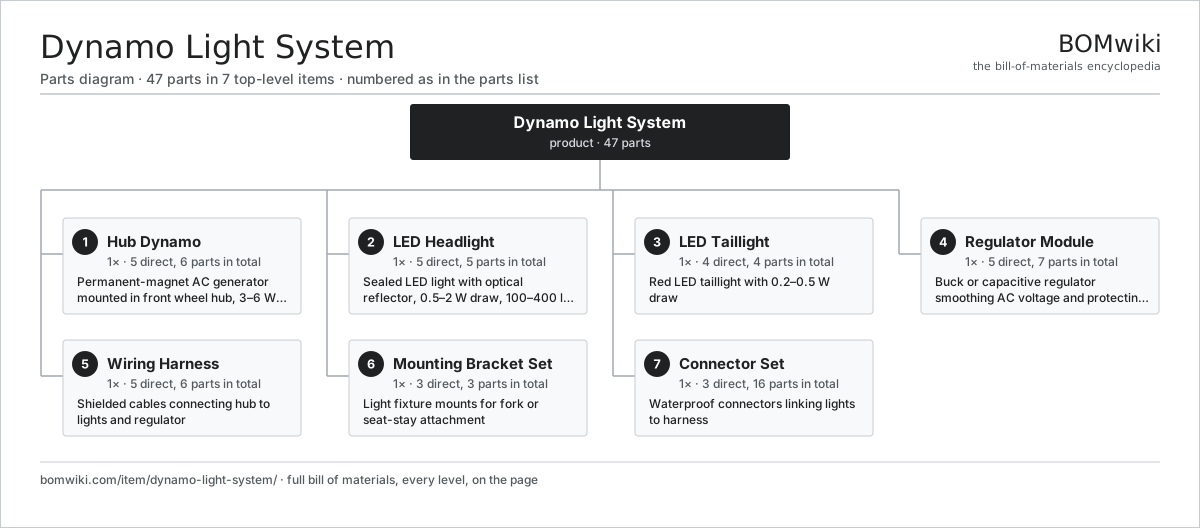
| # | Part | Qty | What it does |
|---|---|---|---|
| 1 | Hub Dynamo 5 parts | 1× | Permanent-magnet AC generator mounted in front wheel hub, 3–6 W output |
| 2 | LED Headlight 5 parts | 1× | Sealed LED light with optical reflector, 0.5–2 W draw, 100–400 lux output |
| 3 | LED Taillight 4 parts | 1× | Red LED taillight with 0.2–0.5 W draw |
| 4 | Regulator Module 5 parts | 1× | Buck or capacitive regulator smoothing AC voltage and protecting lights |
| 5 | Wiring Harness 5 parts | 1× | Shielded cables connecting hub to lights and regulator |
| 6 | Mounting Bracket Set 3 parts | 1× | Light fixture mounts for fork or seat-stay attachment |
| 7 | Connector Set 3 parts | 1× | Waterproof connectors linking lights to harness |
3D model
No 3D model yet. Have a CAD file of this? Add a 3D model. STL renders right on this page; STEP, FreeCAD, and OpenSCAD sources are welcome too (openly licensed, like all 3D models on BOMwiki).
Build & assembly graph
expand / collapse · shared sub-assemblies converge · links to related products · est. labourTap an assembly to expand/collapse · tap a part to open it · use “Open page” for any node · drag to pan, scroll to zoom.
Bill of materials for Dynamo Light System
7 top-level lines · 37 rows shown · 47 parts total · indented to 3 levels| # | Item / sub-assembly | Part no. | Qty/assy | Ext. qty | Parts | Type |
|---|---|---|---|---|---|---|
| 1 | Hub Dynamo 5 parts | dynamo-light-system-hub-dynamo | 1× | 1 | 6 | assembly |
| 1.1 | Hub Shell | dynamo-light-system-hub-shell | 1× | 1 | · | part |
| 1.2 | Magnet Ring | dynamo-light-system-magnet-ring | 1× | 1 | · | part |
| 1.3 | Coil Assembly | dynamo-light-system-coil-assembly | 1× | 1 | · | part |
| 1.4 | Bearing Set | dynamo-light-system-bearing-set | 2× | 2 | · | part |
| 1.5 | Contacts and Brushes | dynamo-light-system-contacts-and-brushes | 1× | 1 | · | part |
| 2 | LED Headlight 5 parts | dynamo-light-system-led-headlight | 1× | 1 | 5 | assembly |
| 2.1 | Headlight Body | dynamo-light-system-headlight-body | 1× | 1 | · | part |
| 2.2 | LED Emitter | dynamo-light-system-led-emitter | 1× | 1 | · | part |
| 2.3 | Headlight Lens Reflector | dynamo-light-system-headlight-lens-reflector | 1× | 1 | · | part |
| 2.4 | Headlight Control Circuitry | dynamo-light-system-headlight-control-circuitry | 1× | 1 | · | part |
| 2.5 | Headlight Weatherproof Seal | dynamo-light-system-headlight-weatherproof-seal | 1× | 1 | · | part |
| 3 | LED Taillight 4 parts | dynamo-light-system-led-taillight | 1× | 1 | 4 | assembly |
| 3.1 | Taillight Body | dynamo-light-system-taillight-body | 1× | 1 | · | part |
| 3.2 | LED Red | dynamo-light-system-led-red | 1× | 1 | · | part |
| 3.3 | Taillight Lens | dynamo-light-system-taillight-lens | 1× | 1 | · | part |
| 3.4 | Taillight Weatherproof Seal | dynamo-light-system-taillight-weatherproof-seal | 1× | 1 | · | part |
| 4 | Regulator Module 5 parts | dynamo-light-system-regulator-module | 1× | 1 | 7 | assembly |
| 4.1 | Rectifier Bridge | dynamo-light-system-rectifier-bridge | 1× | 1 | · | part |
| 4.2 | Voltage Regulator IC | dynamo-light-system-voltage-regulator-ic | 1× | 1 | · | part |
| 4.3 | Capacitive Filter | dynamo-light-system-capacitive-filter | 2× | 2 | · | part |
| 4.4 | Protection Diode | dynamo-light-system-protection-diode | 2× | 2 | · | part |
| 4.5 | Regulator Housing | dynamo-light-system-regulator-housing | 1× | 1 | · | part |
| 5 | Wiring Harness 5 parts | dynamo-light-system-wiring-harness | 1× | 1 | 6 | assembly |
| 5.1 | Hub to Regulator Wire | dynamo-light-system-hub-to-regulator-wire | 1× | 1 | · | part |
| 5.2 | Regulator to Lights Wire | dynamo-light-system-regulator-to-lights-wire | 1× | 1 | · | part |
| 5.3 | Connector Hub End | dynamo-light-system-connector-hub-end | 1× | 1 | · | part |
| 5.4 | Connector Regulator End | dynamo-light-system-connector-regulator-end | 1× | 1 | · | part |
| 5.5 | Connector Light End | dynamo-light-system-connector-light-end | 2× | 2 | · | part |
| 6 | Mounting Bracket Set 3 parts | dynamo-light-system-mounting-bracket-set | 1× | 1 | 3 | assembly |
| 6.1 | Headlight Bracket | dynamo-light-system-headlight-bracket | 1× | 1 | · | part |
| 6.2 | Taillight Bracket | dynamo-light-system-taillight-bracket | 1× | 1 | · | part |
| 6.3 | Bracket Fastener Set | dynamo-light-system-bracket-fastener-set | 1× | 1 | · | part |
| 7 | Connector Set 3 parts | dynamo-light-system-connector-set | 1× | 1 | 16 | assembly |
| 7.1 | Connector Housing | dynamo-light-system-connector-housing | 4× | 4 | · | part |
| 7.2 | Connector Contact | dynamo-light-system-connector-contact | 8× | 8 | · | part |
| 7.3 | Connector Seal Gasket | dynamo-light-system-connector-seal-gasket | 4× | 4 | · | part |
Something wrong in this list? Report a problem with this BOM.
Sourcing: possible vendors
Browse the supplier directory → Prices, MOQ, and lead times are algorithmic estimates, not quotes, and not claims about these companies. Company mappings are curated by keyword; est. price band $200–$12k. How estimates work| Vendor | HQ | Specialty | MOQ | Lead time |
|---|---|---|---|---|
|
🇹🇼Giant
giant-bicycles.com ↗
|
Taichung, TW | Bicycles | 500 units | 6–12 wks |
|
🇺🇸Trek
trekbikes.com ↗
|
Waterloo, US | Bicycles | 500 units | 6–12 wks |
| specialized.com ↗ | Morgan Hill, US | Bicycles | 500 units | 6–12 wks |
|
🇹🇼Merida
merida-bikes.com ↗
|
Yuanlin, TW | Bicycles | 500 units | 6–12 wks |
| cannondale.com ↗ | Wilton, US | Bicycles | 500 units | 6–12 wks |
1,368-word article