Egg Breaking Machine
ProductOverview
Egg breaking machines automate the process of cracking eggs, separating yolks from whites, and collecting the products separately for use in commercial food manufacturing. The rotating carousel holds 12–24 whole eggs in individual cups. As the carousel rotates, pneumatic impact heads positioned above each cup deliver timed strikes to crack the shells. The broken eggs fall into stainless-steel separation cups where perforations allow the clear egg white to drain into a collection line while the yolk is retained or routed separately. Broken shells and residual egg material are fed to a wash drum that sprays and rinses them for safe disposal or animal feed recovery.
The machine separates product streams into three collection tanks: yolks, whites, and a whole-product tank for unbroken eggs or mixed product. Industrial bakeries, pasta manufacturers, and prepared-food producers rely on these machines to process 1200–2400 eggs per hour while maintaining food safety and product consistency. Smaller facilities use manual or semi-automatic models; large operations deploy fully automated units integrated into larger processing lines.
How It Works
Operators load whole eggs into the carousel holding cups, filling 12–24 positions in a single loading. The machine's PLC controller initiates the cycle. The carousel begins rotating at 20–30 rpm. At each of the 12–24 fixed positions around the machine, a pneumatic impact head is positioned above an egg cup.
As the carousel rotates, each egg sequentially passes under an impact head. At the precise moment the egg is positioned directly under the head, a solenoid valve opens, allowing 4–6 bar pneumatic pressure to drive a double-acting cylinder. The cylinder's piston rod (acting as a striker) drives downward, hitting the top of the egg with controlled force. The impact cracks the shell, typically in an arc across the top of the egg.
The operator immediately (or automatically, on advanced machines) twists or pulls the two shell halves apart. The broken egg contents (yolk and white) fall into a separation cup positioned directly below. This cup is perforated with 2 mm holes. Egg white, being liquid, drains quickly through the holes and flows down to the white collection tank. The yolk, being denser and gelatinous, rests on the cup bottom. An operator (or automated mechanism) tips the yolk into an angled funnel that directs it to the yolk tank. Alternatively, if whole-egg product is desired, both yolk and white are mixed and sent to the whole-product tank.
Broken shells and any residual egg material remaining in the cup are swept or gravity-fed into the shell-washing drum. This rotating drum is perforated and spray-washed continuously with recirculating water from a small centrifugal pump. As the drum rotates at 20–30 rpm, shells tumble and are rinsed clean. Cleaned shells drop into a collection tray for disposal; the wash water drains back to the pump.
Design Considerations
Impact force and strike consistency are critical. Too much force shatters the shell, driving fragments into the egg product; too little force fails to crack the shell cleanly, wasting product and delaying the cycle. The pneumatic regulator is typically fixed at 4–6 bar. However, different egg sizes and shell thicknesses (influenced by hen age, diet, and season) may require pressure adjustment. Spring-loaded pressure switches notify operators if pneumatic supply drops below 4 bar.
Timing synchronization between the carousel and the impact heads is essential. If the carousel rotates too quickly, eggs pass under impact heads before they're struck; if too slowly, stroke time extends unacceptably. The gear reduction is typically fixed at 40:1 (resulting in 20–30 rpm carousel speed), and the carousel rotation is manually synchronized with the impact-head solenoid timing via the PLC. Modern machines allow fine adjustment of these parameters via touchscreen interfaces.
Product contamination is a food-safety concern. Any shell fragment or bacteria from the eggshell exterior can contaminate the liquid product. Most machines include an optional white tank with cooling jacket (circulating 2°C water) to slow bacterial growth if the product sits in the tank for hours before downstream processing. Additionally, all stainless-steel contact surfaces must be disassembled and cleaned (sanitized) daily, as dried egg material is tenacious and becomes a pathogen reservoir overnight.
Yolk-white separation efficiency depends on the cup perforations size and surface drainage. 2 mm holes drain quickly, but larger holes (2.5–3 mm) allow yolk fragments to slip through, contaminating the white product. Many machines use a two-stage drainage: an initial coarse drainage (3 mm holes) removing bulk white, followed by a fine-mesh screen (1 mm holes) catching any remaining yolk particles. This dual stage improves product purity.
The shell-washer drum has a finite capacity. As broken shells accumulate, the spray-wash takes longer to clean them thoroughly, and cleaning efficiency decreases. The drum must be emptied every 1–2 hours during high-volume runs. Neglecting to empty it allows dried shells to accumulate and clog the drum.
Egg size handling is a common operational challenge. Most machines are sized for ''medium'' eggs (55–65 g). Very large eggs (extra-large, > 75 g) may not fit snugly in the cup, allowing rolling or shifting during the impact, resulting in missed strikes. Very small eggs (small, < 50 g) may fall through oversized cups. Many operations pre-size eggs via a grading machine before feeding the breaker.
The carousel bearing endures radial and thrust loads from the rotating carousel mass and the impact forces. Heavy-duty deep-groove or spherical-roller bearings are standard. Over time, bearing wear increases carousel runout, causing misalignment of eggs under impact heads and increasing missed-strike frequency. Bearing replacement is a significant maintenance task, typically performed every 2–3 years in high-volume operations.
Modern machines integrate PLC controls allowing operators to store and recall recipes: different impact pressures, carousel speeds, and solenoid timings for different egg sizes or product specifications. This automation reduces operator training and improves consistency. Some advanced systems include optical sensors detecting when each cup is properly loaded with an egg before permitting impact, preventing costly crashes when a cup is empty.
Egg Breaking Machine parts and their functions
7 top-level parts · 36 parts in total · full bill of materials below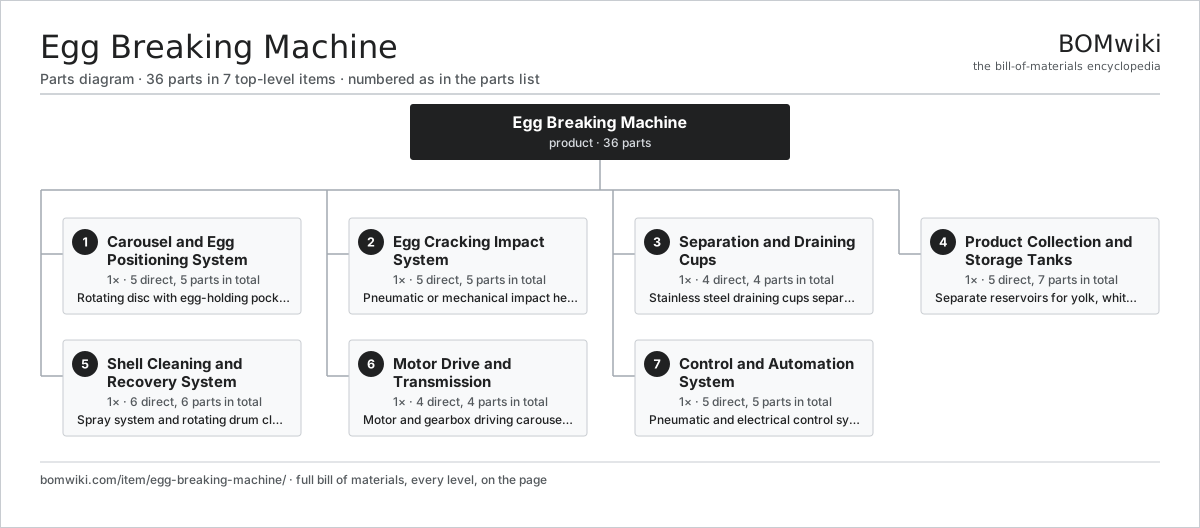
| # | Part | Qty | What it does |
|---|---|---|---|
| 1 | Carousel and Egg Positioning System 5 parts | 1× | Rotating disc with egg-holding pockets and impact heads |
| 2 | Egg Cracking Impact System 5 parts | 1× | Pneumatic or mechanical impact heads breaking eggshells |
| 3 | Separation and Draining Cups 4 parts | 1× | Stainless steel draining cups separating yolk and white |
| 4 | Product Collection and Storage Tanks 5 parts | 1× | Separate reservoirs for yolk, white, and mixed product |
| 5 | Shell Cleaning and Recovery System 6 parts | 1× | Spray system and rotating drum cleaning broken shells |
| 6 | Motor Drive and Transmission 4 parts | 1× | Motor and gearbox driving carousel and washer rotation |
| 7 | Control and Automation System 5 parts | 1× | Pneumatic and electrical control system managing cycle timing |
3D model
No 3D model yet. Have a CAD file of this? Add a 3D model. STL renders right on this page; STEP, FreeCAD, and OpenSCAD sources are welcome too (openly licensed, like all 3D models on BOMwiki).
Build & assembly graph
expand / collapse · shared sub-assemblies converge · links to related products · est. labourTap an assembly to expand/collapse · tap a part to open it · use “Open page” for any node · drag to pan, scroll to zoom.
Bill of materials for Egg Breaking Machine
7 top-level lines · 41 rows shown · 36 parts total · indented to 3 levels| # | Item / sub-assembly | Part no. | Qty/assy | Ext. qty | Parts | Type |
|---|---|---|---|---|---|---|
| 1 | Carousel and Egg Positioning System 5 parts | egg-breaking-machine-carousel-system | 1× | 1 | 5 | assembly |
| 1.1 | Carousel Disc | egg-breaking-machine-carousel-disc | 1× | 1 | · | part |
| 1.2 | Egg Holding Cups | egg-breaking-machine-egg-cups | 1× | 1 | · | part |
| 1.3 | Impact Head Block | egg-breaking-machine-impact-head-block | 1× | 1 | · | part |
| 1.4 | Carousel Bearing | egg-breaking-machine-carousel-bearing | 1× | 1 | · | part |
| 1.5 | Fastener Set | fastener-set | 1× | 1 | · | part |
| 2 | Egg Cracking Impact System 5 parts | egg-breaking-machine-cracking-mechanism | 1× | 1 | 5 | assembly |
| 2.1 | Impact Pneumatic Cylinders | egg-breaking-machine-impact-cylinders | 1× | 1 | · | part |
| 2.2 | Solenoid Valve Bank | egg-breaking-machine-solenoid-valve-bank | 1× | 1 | · | part |
| 2.3 | Air Supply Regulator | egg-breaking-machine-air-supply-regulator | 1× | 1 | · | part |
| 2.4 | Impact Pistons | egg-breaking-machine-impact-pistons | 1× | 1 | · | part |
| 2.5 | Fastener Set | fastener-set | 1× | 1 | · | part |
| 3 | Separation and Draining Cups 4 parts | egg-breaking-machine-separation-cups | 1× | 1 | 4 | assembly |
| 3.1 | Yolk Separation Cup | egg-breaking-machine-yolk-separation-cup | 1× | 1 | · | part |
| 3.2 | Collection Funnel | egg-breaking-machine-collection-funnel | 1× | 1 | · | part |
| 3.3 | White Collection Tube | egg-breaking-machine-white-collection-tube | 1× | 1 | · | part |
| 3.4 | Fastener Set | fastener-set | 1× | 1 | · | part |
| 4 | Product Collection and Storage Tanks 5 parts | egg-breaking-machine-collection-tanks | 1× | 1 | 7 | assembly |
| 4.1 | Yolk Collection Tank | egg-breaking-machine-yolk-tank | 1× | 1 | · | part |
| 4.2 | White Collection Tank | egg-breaking-machine-white-tank | 1× | 1 | · | part |
| 4.3 | Whole-Product Tank | egg-breaking-machine-whole-product-tank | 1× | 1 | · | part |
| 4.4 | Tank Drain Valve | egg-breaking-machine-tank-drain-valve | 3× | 3 | · | part |
| 4.5 | Fastener Set | fastener-set | 1× | 1 | · | part |
| 5 | Shell Cleaning and Recovery System 6 parts | egg-breaking-machine-shell-washer | 1× | 1 | 6 | assembly |
| 5.1 | Shell Washer Drum | egg-breaking-machine-shell-drum | 1× | 1 | · | part |
| 5.2 | Shell Wash Pump | egg-breaking-machine-shell-wash-pump | 1× | 1 | · | part |
| 5.3 | Shell Wash Motor | egg-breaking-machine-shell-wash-motor | 1× | 1 | · | part |
| 5.4 | Spray Nozzles | egg-breaking-machine-spray-nozzles | 1× | 1 | · | part |
| 5.5 | Shell Collection Tray | egg-breaking-machine-shell-collection-tray | 1× | 1 | · | part |
| 5.6 | Fastener Set | fastener-set | 1× | 1 | · | part |
| 6 | Motor Drive and Transmission 4 parts | egg-breaking-machine-motor-drive | 1× | 1 | 4 | assembly |
| 6.1 | Blower Motor | blower-motor | 1× | 1 | · | part |
| 6.2 | Drive Gearbox | egg-breaking-machine-drive-gearbox | 1× | 1 | · | part |
| 6.3 | Motor Coupling | egg-breaking-machine-motor-coupling | 1× | 1 | · | part |
| 6.4 | Fastener Set | fastener-set | 1× | 1 | · | part |
| 7 | Control and Automation System 5 parts | egg-breaking-machine-controls | 1× | 1 | 5 | assembly |
| 7.1 | PLC Controller | egg-breaking-machine-plc-controller | 1× | 1 | · | part |
| 7.2 | Control Panel | egg-breaking-machine-control-panel | 1× | 1 | · | part |
| 7.3 | Pressure Switch | egg-breaking-machine-pressure-switch | 1× | 1 | · | part |
| 7.4 | Relay | relay | 1× | 1 | · | part |
| 7.5 | Fastener Set | fastener-set | 1× | 1 | · | part |
Something wrong in this list? Report a problem with this BOM.
Related products
same domain, ranked by shared parts Chocolate Enrober
470 parts · shares 1 with this page
Chocolate Moulding Line
223 parts · shares 1 with this page
Chocolate Enrober
470 parts · shares 1 with this page
Chocolate Moulding Line
223 parts · shares 1 with this page
Sourcing: possible vendors
Browse the supplier directory → Prices, MOQ, and lead times are algorithmic estimates, not quotes, and not claims about these companies. Company mappings are curated by keyword; est. price band $1k–$500k. How estimates work| Vendor | HQ | Specialty | MOQ | Lead time |
|---|---|---|---|---|
| gea.com ↗ | Düsseldorf, DE | Process technology | 20 units | 12–20 wks |
| buhlergroup.com ↗ | Uzwil, CH | Food & materials processing | 20 units | 12–20 wks |
| tetrapak.com ↗ | Pully, CH | Food packaging & processing | 20 units | 12–20 wks |
| jbtc.com ↗ | Chicago, US | Food processing equipment | 20 units | 12–20 wks |
| alfalaval.com ↗ | Lund, SE | Heat transfer & separation | 20 units | 12–20 wks |
1,187-word article