Electric Combi Boiler
ProductOverview
An electric combi boiler (combi = combination) is a compact, wall-mounted unit that serves dual purposes: space heating (via hot-water circulation to radiators or underfloor systems) and domestic hot water (DHW) on demand. Unlike traditional fossil-fuel boilers with thermal inertia and standing pilots, electric combi units have zero flue gas losses and near-100% conversion efficiency of electrical energy to heat. However, they require substantial electrical infrastructure (typically 3-phase 400 V or 230 V 3-phase) and cannot operate off-grid.
The heating element power is split across 3–6 individual Immersion Heaters, each with its own thermostat cutout. This modular design allows the unit to scale from 2 kW (single element) to full capacity (6+ kW) depending on load. During light load (e.g., DHW only), one or two elements energize; during full space heating demand, all elements fire, delivering up to 24 kW. This staged approach reduces electrical surges and allows operation on lower-capacity service panels than would be required by a single large element.
The Plate Heat Exchanger is the critical component: it is a compact stainless-steel plate stack that separates the primary heating circuit (fed by the Heating Element Block) from the secondary domestic water circuit. On a DHW draw (hot tap opened), the microcontroller senses the pressure drop and energizes the heating block and circulation pump. Water heated by the primary Immersion Heaters circulates to the Plate Heat Exchanger, where it transfers heat to incoming cold mains water at a rate proportional to mains flow and primary water temperature. A thermostatic Thermostatic Mixing Valve on the output blends hot DHW with cold supply to prevent scalding.
How it works
Space heating cycle: A room wall-thermostat senses temperature and sends a demand signal to the Control Module. The controller energizes the first Immersion Heater (1–3 kW) and starts the Circulation Pump Assembly at low speed. Water in the primary circuit (inside the heating block and coil passages) begins to warm. As the electric-combi-boiler-temperature-sensor (typically immersed in the Heating Manifold Block) reads rising temperature, the controller modulates the pump speed: at low temperature, the pump runs slowly to avoid excessive flow (which would cool the element and waste energy). As water approaches setpoint (typically 70°C), pump speed increases, circulating more hot water to radiators or radiant loops.
The Element Thermostat on each element is a mechanical bimetallic cutout rated for a maximum temperature (e.g., 100°C). If the control loop fails and water temperature soars, the element thermostat snaps open and de-energizes that element, providing a fail-safe overheat protection independent of electrical controls.
Domestic hot water cycle: When the user opens a hot tap, mains water pressure drops in the inlet line, and a pressure switch on the Plate Heat Exchanger is triggered. The controller energizes one or more Immersion Heaters and starts the Circulation Pump Assembly at full speed. Hot primary water is forced through one side of the plate heat exchanger while cold mains water flows through the opposite side.
In a plate heat exchanger, thin metal plates are stacked tightly with water flowing in alternating channels, creating a large surface area in a compact envelope. Cold water on one side and hot water on the other side are separated by 0.3–0.5 mm of stainless steel, allowing rapid heat transfer via conduction. The primary circuit (coming from the heating block at, say, 80°C) heats the secondary circuit (incoming mains water at 10°C) to approximately 50–60°C, depending on flow rate and mains temperature. A higher flow rate (opening the tap wider) reduces residence time in the exchanger and lowers outlet temperature; a lower flow rate allows longer contact and hotter output.
The thermostatic Thermostatic Mixing Valve downstream of the heat exchanger provides a safety function: it monitors the hot outlet temperature and blends in cold water if temperature exceeds setpoint (typically 45–48°C for domestic hot water). This eliminates the risk of scalding from uncontrolled high temperatures.
Pressure and expansion: The Expansion Tank is a pre-charged bladder tank (0.5–1 bar initial charge) that absorbs the 2–3% volume expansion of water as it heats from mains temperature to 70–80°C. Without the tank, pressure would rise rapidly and exceed the relief valve, wasting energy and risking leaks at connection points. The tank is sized proportionally to the boiler capacity and target pressure (typically 2–3 bar working pressure).
Electrical integration: Each Immersion Heater connects to a electric-combi-boiler-relay-module on the Control Module. For a 6 kW boiler on 230 V 3-phase (typical European 400 V 3-phase supply), the heating elements are typically distributed across phases, e.g., two 2 kW elements per phase, to balance electrical loading. The controller staggers element activation: element 1 energizes first; if temperature rise is insufficient, element 2 activates after a delay; and so on. This "staged heating" approach limits electrical demand surges and allows smaller circuit breaker ratings.
Installation and water chemistry
Electric combi units require substantial electrical infrastructure. A 12 kW unit demands a 50 A 3-phase circuit; a 24 kW unit may need 100 A service. The electrical contractor must verify that the utility service has available capacity and that local codes permit instantaneous electric heating (some jurisdictions restrict electric heating for environmental reasons).
Water chemistry is critical, especially in hard-water regions (>300 ppm calcium carbonate equivalent). Hard water minerals scale the Plate Heat Exchanger tubes over 2–3 years, reducing heat transfer and eventually blocking flow. Annual descaling with approved de-scaling agents (citric acid or proprietary inhibitor) is essential to maintain efficiency. In very hard water (>400 ppm), a point-of-use water softener upstream of the boiler input may be justified.
The Expansion Tank pressure should be checked annually (requires a tire-pressure gauge and Schrader valve similar to a car tire). If pre-charge is lost, the tank's bladder may have ruptured, and replacement is necessary.
Advantages and limitations
Advantages:
- No flue or venting required; unit can be installed anywhere.
- 99%+ thermal efficiency (no chimney losses).
- Instant DHW on demand; no waiting for water to heat.
- Compact size (1/10th the volume of a traditional boiler).
- Low maintenance; no combustion byproducts or moving parts beyond the pump.
Limitations:
- High electrical demand; requires substantial service upgrade in many homes.
- Operating cost depends on local electricity prices, which are typically higher per BTU than natural gas.
- No off-grid capability; power outage means no heat.
- Limited power output for large homes or cold climates; difficult to exceed ~24 kW without 3-phase industrial service.
- Hard water scaling can degrade performance; descaling adds maintenance burden.
Electric combi boilers are most suitable for well-insulated homes, apartments, or retrofit scenarios where gas infrastructure is unavailable and flue venting is impossible. In climates with cheap electricity or heating demand < 10 kW (e.g., mild winters, high-performance houses), they are economically competitive.
Electric Combi Boiler parts and their functions
8 top-level parts · 29 parts in total · full bill of materials below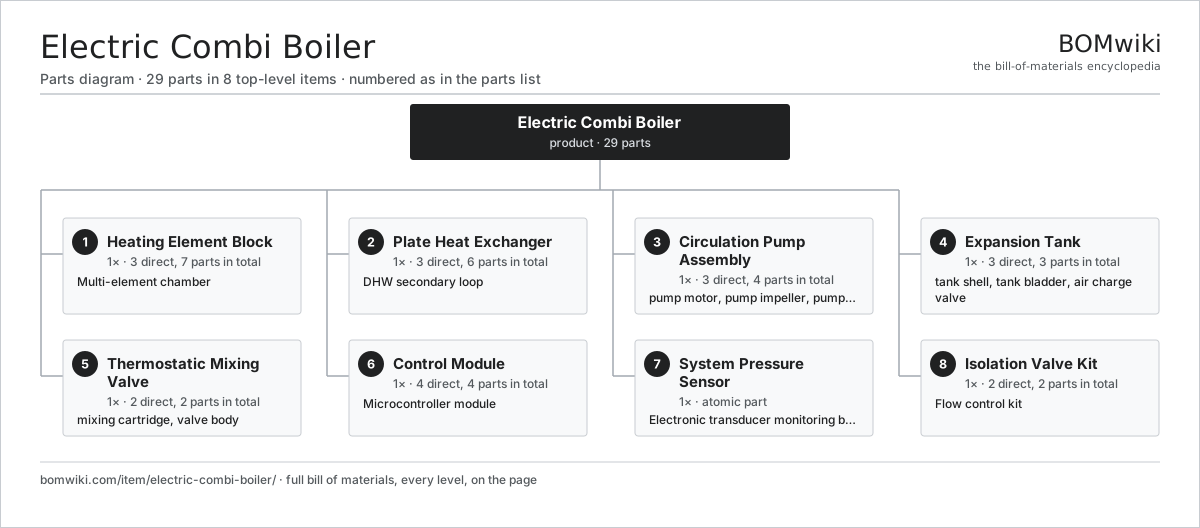
| # | Part | Qty | What it does |
|---|---|---|---|
| 1 | Heating Element Block 3 parts | 1× | Multi-element chamber |
| 2 | Plate Heat Exchanger 3 parts | 1× | DHW secondary loop |
| 3 | Circulation Pump Assembly 3 parts | 1× | Wet-rotor pump circulating heated water from block to radiators or radiant loops. |
| 4 | Expansion Tank 3 parts | 1× | Pre-pressurized bladder tank absorbing heating water expansion. |
| 5 | Thermostatic Mixing Valve 2 parts | 1× | Cartridge-type valve that blends primary heating water with return water to prevent flow temperature spikes. |
| 6 | Control Module 4 parts | 1× | Microcontroller module |
| 7 | System Pressure Sensor | 1× | Electronic transducer monitoring boiler pressure for overpressure alarm. |
| 8 | Isolation Valve Kit 2 parts | 1× | Flow control kit |
3D model
No 3D model yet. Have a CAD file of this? Add a 3D model. STL renders right on this page; STEP, FreeCAD, and OpenSCAD sources are welcome too (openly licensed, like all 3D models on BOMwiki).
Build & assembly graph
expand / collapse · shared sub-assemblies converge · links to related products · est. labourTap an assembly to expand/collapse · tap a part to open it · use “Open page” for any node · drag to pan, scroll to zoom.
Bill of materials for Electric Combi Boiler
8 top-level lines · 28 rows shown · 29 parts total · indented to 3 levels| # | Item / sub-assembly | Part no. | Qty/assy | Ext. qty | Parts | Type |
|---|---|---|---|---|---|---|
| 1 | Heating Element Block 3 parts | electric-combi-boiler-heating-block | 1× | 1 | 7 | assembly |
| 1.1 | Immersion Heater | electric-combi-boiler-heating-element | 3× | 3 | · | part |
| 1.2 | Element Thermostat | electric-combi-boiler-element-thermostat | 3× | 3 | · | part |
| 1.3 | Heating Manifold Block | electric-combi-boiler-heating-block-body | 1× | 1 | · | part |
| 2 | Plate Heat Exchanger 3 parts | electric-combi-boiler-plate-exchanger | 1× | 1 | 6 | assembly |
| 2.1 | Plate Core | electric-combi-boiler-plate-core | 1× | 1 | · | part |
| 2.2 | Plate Gasket Set | electric-combi-boiler-exchanger-gasket | 1× | 1 | · | part |
| 2.3 | Plate Port Manifold | electric-combi-boiler-plate-ports | 4× | 4 | · | part |
| 3 | Circulation Pump Assembly 3 parts | electric-combi-boiler-circulation-pump | 1× | 1 | 4 | assembly |
| 3.1 | Pump Motor | electric-combi-boiler-pump-motor | 1× | 1 | · | part |
| 3.2 | Pump Impeller | electric-combi-boiler-pump-impeller | 1× | 1 | · | part |
| 3.3 | Pump Bearing | electric-combi-boiler-pump-bearing | 2× | 2 | · | part |
| 4 | Expansion Tank 3 parts | electric-combi-boiler-expansion-tank | 1× | 1 | 3 | assembly |
| 4.1 | Tank Shell | electric-combi-boiler-tank-shell | 1× | 1 | · | part |
| 4.2 | Tank Bladder | electric-combi-boiler-tank-bladder | 1× | 1 | · | part |
| 4.3 | Air Charge Valve | electric-combi-boiler-tank-valve | 1× | 1 | · | part |
| 5 | Thermostatic Mixing Valve 2 parts | electric-combi-boiler-mixing-valve | 1× | 1 | 2 | assembly |
| 5.1 | Mixing Cartridge | electric-combi-boiler-mixing-cartridge | 1× | 1 | · | part |
| 5.2 | Valve Body | electric-combi-boiler-mixing-valve-body | 1× | 1 | · | part |
| 6 | Control Module 4 parts | electric-combi-boiler-control-board | 1× | 1 | 4 | assembly |
| 6.1 | Main Control PCB | electric-combi-boiler-main-pcb | 1× | 1 | · | part |
| 6.2 | Display Panel | electric-combi-boiler-display-panel | 1× | 1 | · | part |
| 6.3 | Relay Board | electric-combi-boiler-relay-board | 1× | 1 | · | part |
| 6.4 | Sensor Connector Board | electric-combi-boiler-sensor-interface | 1× | 1 | · | part |
| 7 | System Pressure Sensor | electric-combi-boiler-pressure-sensor | 1× | 1 | · | part |
| 8 | Isolation Valve Kit 2 parts | electric-combi-boiler-isolating-valves | 1× | 1 | 2 | assembly |
| 8.1 | Supply Isolation Valve | electric-combi-boiler-supply-isolation | 1× | 1 | · | part |
| 8.2 | Return Isolation Valve | electric-combi-boiler-return-isolation | 1× | 1 | · | part |
Something wrong in this list? Report a problem with this BOM.
Sourcing: possible vendors
Browse the supplier directory → Prices, MOQ, and lead times are algorithmic estimates, not quotes, and not claims about these companies. Company mappings are curated by keyword; est. price band $100–$20k. How estimates work| Vendor | HQ | Specialty | MOQ | Lead time |
|---|---|---|---|---|
|
🇺🇸Carrier
carrier.com ↗
|
Palm Beach Gardens, US | HVAC | 500 units | 8–14 wks |
| tranetechnologies.com ↗ | Davidson, US | HVAC | 500 units | 8–14 wks |
|
🇯🇵Daikin
daikin.com ↗
|
Osaka, JP | HVAC | 500 units | 8–14 wks |
|
🇺🇸Lennox
lennox.com ↗
|
Richardson, US | HVAC | 500 units | 8–14 wks |
| johnsoncontrols.com ↗ | Milwaukee, US | Building systems | 500 units | 8–14 wks |
1,223-word article