Electric Shower
ProductOverview
An electric shower is a self-contained tankless water heater mounted directly on or behind the shower wall. Cold mains water flows through a heating block containing a high-wattage electric resistance element (3–4 kW), heating the water to 40–45°C in less than a second. The heated water then passes through a thermostatic mixing valve that maintains constant temperature despite variations in mains pressure or temperature, then exits through a low-flow shower head.
Electric showers are ubiquitous in UK, Australian, and South African residences where either no hot water system exists or mains pressure is too low to support a traditional storage tank. They offer instant, unlimited hot water without the energy cost of maintaining a heated tank; the tradeoff is limited simultaneous flow (6–8 liters/minute) and dependence on high electrical power availability.
How it works
When the shower is turned on, cold mains water (typically 10–15°C) enters through the inlet strainer at one side of the heater block. The water flows through internal copper or aluminum passages molded around a high-wattage electric heater element. At 3–4 kW (13–20 A @ 240V), the element rapidly heats water to 50–55°C (depending on inlet temperature and flow rate).
As heated water exits the heater block, it flows into the thermostatic mixing valve, where a wax-element thermostat continuously samples outlet temperature. If temperature exceeds the setpoint (typically 45°C), the thermostat expands and routes some of the heated water back into a bypass chamber, mixing it with cold mains water on the return path. This proportional mixing maintains stable outlet temperature regardless of mains cold-water temperature variation or sudden flow changes.
A second bi-metallic thermal cutout acts as a safety device; if the mixing valve fails and water reaches 75°C, the bi-metal strip opens an electrical contacts, instantly cutting power to the heater element. The operator must manually press a reset button after the system cools to re-engage heating. This prevents scalding hazard from heater runaway.
Water then passes through the shower head fitted with a fine spray aerator and flow restrictor limiting maximum flow to 6–8 liters/minute for water conservation and energy saving.
Components & Design
Heating Block
The heater block is the core thermal component, typically a solid copper or aluminum core with internal water passages molded or drilled through it. At the center is a 3–4 kW immersion electric heater housed in a sealed electric chamber, thermally isolated from mains plumbing but in intimate contact with the water passages. Copper is preferred over aluminum for superior thermal conductivity and corrosion resistance in hard water.
The heater element is a nichrome wire coil wound in a ceramic insulator tube and sealed in a steel sheath. As current flows, resistive heating reaches 600–800°C; the ceramic insulation contains this heat and transfers it to the surrounding copper block. The copper channels conduct this heat to the flowing water. A thermistor or RTD sensor mounted in the outlet measures actual water temperature for control feedback.
Typical heat transfer rate is 3–4 kW at 240V and 13–17 A. This heats 6 liters/minute of 15°C mains water from 15°C to 50°C (35°C temperature rise) in 0.5–1 second residence time. Water-hammer spikes in mains supply can cause thermal shock to the heater core; a check valve in the bypass line prevents backflow surges.
Thermostatic Mixing Valve
The valve assembly is a critical safety component. The thermostatic mixing cartridge contains a small chamber filled with wax or paraffin that expands when heated. As water temperature rises, the wax expands and pushes a spool valve that redirects a portion of heated water into a bypass chamber where it mixes with cold inlet water on the return. The proportional bypass maintains outlet temperature within ±2°C of setpoint (typically 45°C).
The manual knob allows the occupant to adjust the thermostatic setpoint ±5°C; a full counterclockwise turn reduces output temperature to ~38°C (cooler), while full clockwise raises it toward the 45°C limit. The valve body is typically gunmetal (copper-tin-lead alloy) for corrosion resistance.
A precision orifice plate downstream of the mixing valve limits maximum flow to 6–8 liters/minute. In the UK, this is often a legal requirement (water conservation legislation); in Australia and South Africa, it's standard practice. The restrictor is a fixed orifice, not adjustable, changing it requires replacement.
Thermal Safety Devices
Two independent thermal safety systems protect against scalding:
Primary: The thermostatic mixing valve maintains 45°C outlet under normal operation by proportional bypass mixing.
Secondary: The bi-metallic thermal cutout serves as a hard failsafe. If the mixing valve cartridge sticks or fails, allowing 75°C water to reach the outlet, the bi-metal element opens a normally-closed contact, breaking power to the heater element instantly. The element cools, water temperature drops, and the bi-metal cools and re-seats, but the reset button must be manually pressed by the user to re-engage the heating circuit. This design prevents unattended overheat; the occupant notices the shower is cold and calls for service.
Inlet Filtration
Hard water and sediment foul the heater core over time, forming scale (calcium carbonate deposits) that insulates the heating element from water, reducing efficiency. A 100–200 micron sediment strainer at the inlet traps particles and reduces the rate of sediment accumulation. In extremely hard water areas (>300 ppm), chemical descaling every 6–12 months is necessary; in soft water areas (>100 ppm), annual filter cleaning suffices.
Shower Head & Aerator
The shower head body is typically chrome-plated brass with multiple spray ports. The aerator breaks flow into fine droplets (100–150 holes), creating a luxurious feel at reduced flow. The push-button or lever flow control allows the occupant to vary flow from ~3 liters/minute (low) to 8 liters/minute (full). Reducing flow by half reduces heat demand and energy consumption proportionally.
Housing & Electrical
The plastic or metal trim ring conceals the heater block, valves, and electrical connections behind a decorative escutcheon. The mounting plate fastens to wall studs or blocking. A foam gasket prevents water from seeping behind the wall trim.
Electrically, the unit connects to a dedicated wall outlet via a heavy-duty 20–30 A plug (BS 1363 in UK, standard European plug elsewhere). The flexible power cable is 3-core (Live, Neutral, Earth) or 4-core (L, N, E, plus an auxiliary control line). An internal thermal breaker rated 20–30 A protects the heater circuit; this breaker should trip if the element draws excessive current (indicating short-to-ground). Building-level ground-fault circuit interrupter (GFCI/RCD) protection is strongly recommended.
Copper earth bonding connects the heater core and metal trim ring to the power cable earth conductor, ensuring that any exposed metal becomes de-energized if a fault develops.
Energy & Operating Costs
A 3–4 kW electric shower draws 13–17 A at 240V. A typical 10-minute shower at 6 liters/minute uses 60 liters of water and consumes 0.5–0.67 kWh of electrical energy. At £0.25 per kWh (UK average), this costs ~£0.13 per shower, or ~£47/year for daily bathing (365 showers/year).
Compared to a traditional boiler heating a 150-liter storage tank daily (typical boiler ~90% efficient), the electric shower is more economical: a boiler keeping 150 liters at 60°C continuously (30°C above ambient) requires ~3.7 kWh/day or ~£337/year. The electric shower's on-demand heating is inherently more efficient for sporadic use.
However, in climates with mild ambient temperatures or where a boiler serves other heating needs, hybrid solutions (combining low-flow electric shower with a small tank booster heater) achieve better overall efficiency.
Maintenance & Troubleshooting
Scaling in Hard Water
Calcium and magnesium salts precipitate inside the heater core, forming scale. White or yellow deposits on the aerator indicate scaling. Remove the aerator and soak overnight in white vinegar; descale the heater block annually with citric acid solution (1 kg citric acid in 10 liters water) circulated through the inlet port for 2–3 hours.
Loss of Heat
If the shower runs warm but not hot, the heater element may be failed or the inlet strainer heavily fouled. Check the strainer first (sediment purge). If clear, the element typically requires professional replacement (element failure is the most common end-of-life failure mode).
Unstable Temperature (Fluctuating Hot/Cold)
This indicates thermostatic mixing valve stiction or sediment jamming the spool. Reduce inlet pressure if possible (close isolation valve halfway) to lower stress on the spool. If symptoms persist, the cartridge requires replacement.
Tripping of Internal Breaker or Building RCD
Immediate breaker trips indicate an electrical fault (short circuit to ground). Do not attempt to reset; call an electrician. Delayed tripping (after 5–10 seconds) may indicate ground leakage from aging insulation; the unit should be removed from service.
Standards & Regulations
Electric showers are regulated under IEC 60335 (safety of household and similar electrical appliances). Key requirements include temperature-limiting thermostatic mixing valves, bi-metallic thermal cutouts, and electrical protective devices (RCD/GFCI). In the UK, Building Regulations Part G (Sanitation, Hot Water Safety and Water Efficiency) mandates thermostatic mixing valves on all hot water outlets to prevent scalding.
Energy labeling regulations (EU Energy Related Products Directive) require minimum energy efficiency labeling; a 3.5 kW electric shower with basic flow control is rated Class A+ (high efficiency by definition, since it only heats water on demand).
Many water companies (especially in drought-prone regions) mandate flow restrictors <8 liters/minute. The EU Water Using Products Directive limits showerheads to 9 liters/minute; the UK standard is 6–8 liters/minute.
Electric Shower parts and their functions
7 top-level parts · 33 parts in total · full bill of materials below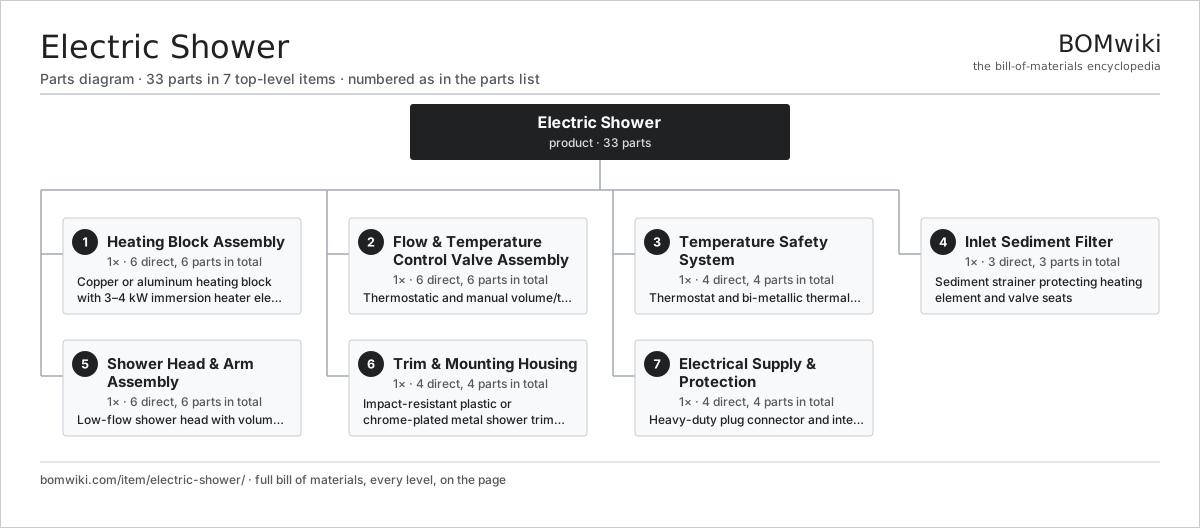
| # | Part | Qty | What it does |
|---|---|---|---|
| 1 | Heating Block Assembly 6 parts | 1× | Copper or aluminum heating block with 3–4 kW immersion heater element |
| 2 | Flow & Temperature Control Valve Assembly 6 parts | 1× | Thermostatic and manual volume/temperature control valves |
| 3 | Temperature Safety System 4 parts | 1× | Thermostat and bi-metallic thermal cutout protecting against overheat |
| 4 | Inlet Sediment Filter 3 parts | 1× | Sediment strainer protecting heating element and valve seats |
| 5 | Shower Head & Arm Assembly 6 parts | 1× | Low-flow shower head with volume regulation and water-saver aerator |
| 6 | Trim & Mounting Housing 4 parts | 1× | Impact-resistant plastic or chrome-plated metal shower trim and trim ring |
| 7 | Electrical Supply & Protection 4 parts | 1× | Heavy-duty plug connector and internal circuit protection |
3D model
No 3D model yet. Have a CAD file of this? Add a 3D model. STL renders right on this page; STEP, FreeCAD, and OpenSCAD sources are welcome too (openly licensed, like all 3D models on BOMwiki).
Build & assembly graph
expand / collapse · shared sub-assemblies converge · links to related products · est. labourTap an assembly to expand/collapse · tap a part to open it · use “Open page” for any node · drag to pan, scroll to zoom.
Bill of materials for Electric Shower
7 top-level lines · 40 rows shown · 33 parts total · indented to 3 levels| # | Item / sub-assembly | Part no. | Qty/assy | Ext. qty | Parts | Type |
|---|---|---|---|---|---|---|
| 1 | Heating Block Assembly 6 parts | electric-shower-heater-block | 1× | 1 | 6 | assembly |
| 1.1 | Copper or Aluminum Core | electric-shower-heater-core | 1× | 1 | · | part |
| 1.2 | Heating Element | heating-element | 1× | 1 | · | part |
| 1.3 | Thermal Cutout Thermostat | electric-shower-thermal-cutout-switch | 1× | 1 | · | part |
| 1.4 | Temperature Sensor | electric-shower-temperature-sensor | 1× | 1 | · | part |
| 1.5 | Water Inlet Port | electric-shower-npt-inlet-port | 1× | 1 | · | part |
| 1.6 | Water Outlet Port | electric-shower-outlet-port | 1× | 1 | · | part |
| 2 | Flow & Temperature Control Valve Assembly 6 parts | electric-shower-flow-control | 1× | 1 | 6 | assembly |
| 2.1 | Thermostatic Mixing Cartridge | electric-shower-thermostatic-cartridge | 1× | 1 | · | part |
| 2.2 | Manual Temperature Override | electric-shower-manual-override | 1× | 1 | · | part |
| 2.3 | Flow Restrictor Orifice | electric-shower-flow-restrictor | 1× | 1 | · | part |
| 2.4 | Valve Body Housing | electric-shower-valve-body | 1× | 1 | · | part |
| 2.5 | Bypass Check Valve | electric-shower-check-valve | 1× | 1 | · | part |
| 2.6 | O-Ring Set | oring-set | 1× | 1 | · | part |
| 3 | Temperature Safety System 4 parts | electric-shower-thermal-cutout | 1× | 1 | 4 | assembly |
| 3.1 | Main Inlet Thermostat | electric-shower-main-thermostat | 1× | 1 | · | part |
| 3.2 | Overheat Safety Cutout | electric-shower-overheat-cutout | 1× | 1 | · | part |
| 3.3 | Thermal Cutout Reset Button | electric-shower-reset-button | 1× | 1 | · | part |
| 3.4 | Temperature Dial Gauge | electric-shower-temperature-gauge | 1× | 1 | · | part |
| 4 | Inlet Sediment Filter 3 parts | electric-shower-inlet-filter | 1× | 1 | 3 | assembly |
| 4.1 | Inlet Filter Cartridge | electric-shower-filter-cartridge | 1× | 1 | · | part |
| 4.2 | Filter Bowl | electric-shower-filter-bowl | 1× | 1 | · | part |
| 4.3 | Filter Drain Plug | electric-shower-filter-drain-screw | 1× | 1 | · | part |
| 5 | Shower Head & Arm Assembly 6 parts | electric-shower-shower-head | 1× | 1 | 6 | assembly |
| 5.1 | Shower Head Housing | electric-shower-head-body | 1× | 1 | · | part |
| 5.2 | Volume Control Button | electric-shower-volume-control-button | 1× | 1 | · | part |
| 5.3 | Spray Aerator | electric-shower-aerator-insert | 1× | 1 | · | part |
| 5.4 | Internal Flow Gate | electric-shower-diverter-gate | 1× | 1 | · | part |
| 5.5 | Shower Arm | electric-shower-shower-arm | 1× | 1 | · | part |
| 5.6 | Fastener Set | fastener-set | 1× | 1 | · | part |
| 6 | Trim & Mounting Housing 4 parts | electric-shower-housing-case | 1× | 1 | 4 | assembly |
| 6.1 | Outer Trim Ring | electric-shower-outer-case | 1× | 1 | · | part |
| 6.2 | Inner Escutcheon | electric-shower-inner-escutcheon | 1× | 1 | · | part |
| 6.3 | Wall Mounting Plate | electric-shower-mounting-plate | 1× | 1 | · | part |
| 6.4 | Trim Ring Gasket | electric-shower-gasket-seal | 1× | 1 | · | part |
| 7 | Electrical Supply & Protection 4 parts | electric-shower-electrical-connector | 1× | 1 | 4 | assembly |
| 7.1 | Electric Shower Plug | electric-shower-power-plug | 1× | 1 | · | part |
| 7.2 | Power Cable | electric-shower-power-cable | 1× | 1 | · | part |
| 7.3 | Internal Circuit Breaker | electric-shower-internal-breaker | 1× | 1 | · | part |
| 7.4 | Earth Bonding Strap | electric-shower-earth-bonding | 1× | 1 | · | part |
Something wrong in this list? Report a problem with this BOM.
Related products
same domain, ranked by shared parts Electronic Bidet Seat
197 parts · shares 2 with this page
Electronic Bidet Seat
197 parts · shares 2 with this page
 Heat-Pump Water Heater
152 parts · shares 2 with this page
Heat-Pump Water Heater
152 parts · shares 2 with this page
 HDPE Pipe Butt-Fusion Machine
110 parts · shares 1 with this page
Condensate Removal Pump
44 parts · shares 1 with this page
Frost-Free Yard Hydrant
16 parts · shares 1 with this page
HDPE Pipe Butt-Fusion Machine
110 parts · shares 1 with this page
Condensate Removal Pump
44 parts · shares 1 with this page
Frost-Free Yard Hydrant
16 parts · shares 1 with this page
 Grease Interceptor
45 parts · shares 1 with this page
Grease Interceptor
45 parts · shares 1 with this page
Sourcing: possible vendors
Browse the supplier directory → Prices, MOQ, and lead times are algorithmic estimates, not quotes, and not claims about these companies. Company mappings are curated by keyword; est. price band $20–$3k. How estimates work| Vendor | HQ | Specialty | MOQ | Lead time |
|---|---|---|---|---|
|
🇺🇸Kohler
kohler.com ↗
|
Kohler, US | Plumbing fixtures | 1,000 units | 6–12 wks |
|
🇯🇵TOTO
toto.com ↗
|
Kitakyushu, JP | Sanitaryware | 1,000 units | 6–12 wks |
|
🇯🇵LIXIL
lixil.com ↗
|
Tokyo, JP | Plumbing (Grohe, American Std) | 1,000 units | 6–12 wks |
|
🇺🇸Moen
moen.com ↗
|
North Olmsted, US | Faucets & fixtures | 1,000 units | 6–12 wks |
|
🇨🇭Geberit
geberit.com ↗
|
Rapperswil, CH | Sanitary systems | 1,000 units | 6–12 wks |
1,787-word article