Electrodynamic Shaker
ProductOverview
An electrodynamic shaker is a closed-loop vibration testing machine that applies precisely controlled sinusoidal, random, or transient (shock) waveforms to test specimens, simulating in-service vibration environments (transportation, rotating machinery, seismic, wind turbulence). The shaker consists of a permanent-magnet armature generating a radial magnetic field, a voice coil (copper wire) suspended in the gap, a power amplifier (10–200 kW) driving the coil with feedback-controlled current, and a real-time controller (DSP) orchestrating waveform synthesis and servo closure at ≥40 kHz.
The force is generated via the Lorentz equation: F = BIL (magnetic flux density × coil current × effective length). By continuously adjusting coil current based on an accelerometer mounted on the shaker head, the controller maintains precise test profiles (e.g., sine sweep 5–500 Hz at 5 g acceleration) per military standards (MIL-STD-810H), automotive (DIN 66262), and aerospace (ASTM D4169) specifications.
How it works
The Magnet and Armature Assembly consists of permanent Neodymium Magnet elements (Grade N52, 1.4–1.5 T flux density) arranged radially around a central axis, with soft-iron Pole Piece components shaping a uniform magnetic gap. The Voice Coil Assembly copper voice coil (>1000 turns of AWG 6 wire wound on an aluminum former) hangs freely in this gap, suspended by a flexible rubber Suspension Membrane and centered by a spring-steel Centering Spider.
The Real-Time Controller real-time DSP generates the test waveform (e.g., sine sweep, random, shock) and outputs a low-level analog signal (±10 V) to the Power Amplifier, a 10–200 kW solid-state power amplifier. The amplifier converts this command into high-current AC (±100 A peak typical) through the voice coil.
The current flowing through the coil in the radial magnetic field produces an axial force (perpendicular to the gap). This force accelerates the coil and the Slip Table (Optional) armature plate upward and downward. An Accelerometer Sensors mounted on the shaker head measures the actual acceleration response and feeds it back to the controller at 40 kHz sampling rate.
The controller''s servo loop compares commanded acceleration (from the waveform) to measured acceleration and adjusts amplifier current to correct deviations in real time. This closed-loop feedback maintains vibration severity ±10% of specification despite payload variation, frequency response of the specimen, or thermal drift in the coil resistance.
Test waveforms include:
- Sine Sweep: frequency increases from 5 Hz to 5 kHz at constant acceleration (e.g., 5 g), simulating resonance-seeking for modal analysis.
- Random Vibration: Gaussian white noise within a frequency band (e.g., 20–500 Hz, 0.1 g²/Hz power spectral density) simulating turbulent or road-roughness environments.
- Shock/Transient: Pyroshock (explosive release) or digital synthesis (half-sine pulse) simulating drop impact or explosive separation.
The Cooling System system (forced-air blower with heat exchanger) removes I²R losses from the voice coil; continuous testing generates 5–15 kW of waste heat and a Temperature Sensor thermostat triggers cooling ramp-up if coil temperature approaches 80°C.
Test protocols and applications
Military MIL-STD-810H defines vibration test profiles by equipment class (e.g., Class 4: fighter-jet avionics = 10–500 Hz, 8–12 g). Automotive suppliers test electronic control units (ECUs) and sensors to DIN 66262 (vibration immunity test for road vehicles) or OEM specifications (e.g., Tesla Model 3 ECU = 5–2000 Hz random, 0.2 g²/Hz for 4 hours). Aerospace suppliers qualify flight components using ASTM D4169 or military standards.
Resonance tracking (sine-sweep modal analysis) identifies natural frequencies and damping ratios, guiding mechanical design of structures and PCBs. Fatigue acceleration factors (FAF) link shaker exposure duration to field failure rates: a 10-hour shaker test may correlate to 1 year of field vibration, depending on frequency content and severity.
Specimen mounting and multi-axis testing
Specimens are rigidly bolted to the Slip Table (Optional) armature plate via T-slot mounting. Fixtures must be stiff (natural frequency >5× test frequency) to avoid distortion and nonlinear dynamics. For three-axis testing (X, Y, Z simultaneous), multiple shakers (electrohydraulic or electrodynamic) are cross-coupled via a custom slip-table frame or a hexapod motion platform controlled by the same real-time controller.
Advantages and limitations
Electrodynamic shakers excel at sinusoidal and random testing from 5 Hz to 5+ kHz with smooth, repeatable waveforms and fast feedback control. Power amplifier efficiency (>90%) makes them cost-effective for long-duration tests. However, they require clean power (stabilized grid or UPS) to avoid control instability, and the voice coil winding is susceptible to thermal stress and overload damage. Servo-hydraulic shakers, by contrast, deliver higher force (<1 MHz bandwidth unsuitable for high-frequency broadband testing) and are preferred for low-frequency, high-amplitude shock (e.g., pyrotechnic separation shock).
Modern systems integrate field-data recording: inertial sensors on in-service equipment capture real vibration profiles (acceleration time-histories), which are then replayed on the shaker in the lab via digital waveform synthesis, dramatically improving correlation between lab test damage and field returns.
Electrodynamic Shaker parts and their functions
7 top-level parts · 25 parts in total · full bill of materials below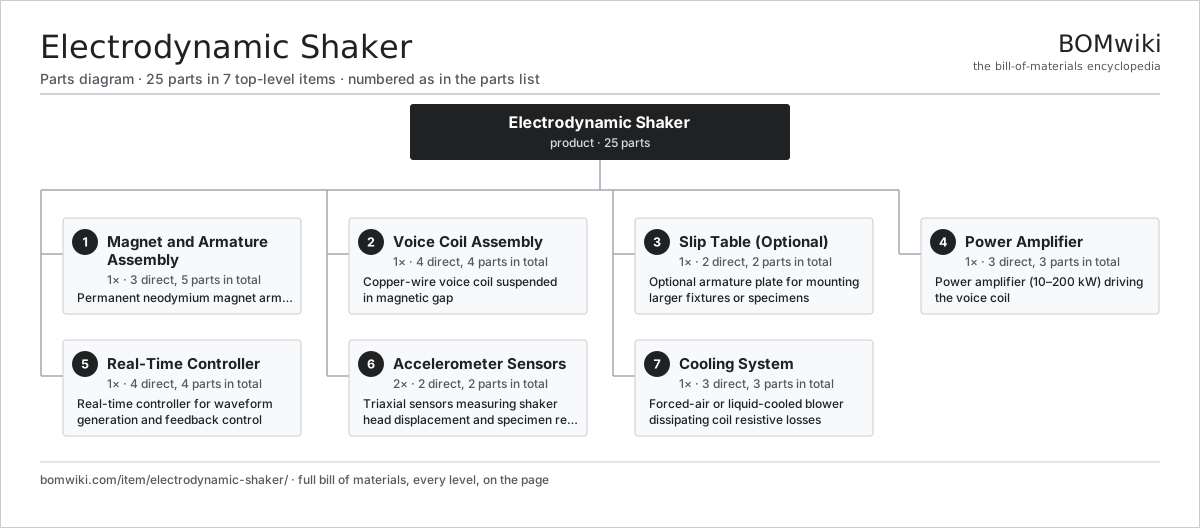
| # | Part | Qty | What it does |
|---|---|---|---|
| 1 | Magnet and Armature Assembly 3 parts | 1× | Permanent neodymium magnet armature and field structure |
| 2 | Voice Coil Assembly 4 parts | 1× | Copper-wire voice coil suspended in magnetic gap |
| 3 | Slip Table (Optional) 2 parts | 1× | Optional armature plate for mounting larger fixtures or specimens |
| 4 | Power Amplifier 3 parts | 1× | Power amplifier (10–200 kW) driving the voice coil |
| 5 | Real-Time Controller 4 parts | 1× | Real-time controller for waveform generation and feedback control |
| 6 | Accelerometer Sensors 2 parts | 2× | Triaxial sensors measuring shaker head displacement and specimen response |
| 7 | Cooling System 3 parts | 1× | Forced-air or liquid-cooled blower dissipating coil resistive losses |
3D model
No 3D model yet. Have a CAD file of this? Add a 3D model. STL renders right on this page; STEP, FreeCAD, and OpenSCAD sources are welcome too (openly licensed, like all 3D models on BOMwiki).
Build & assembly graph
expand / collapse · shared sub-assemblies converge · links to related products · est. labourTap an assembly to expand/collapse · tap a part to open it · use “Open page” for any node · drag to pan, scroll to zoom.
Bill of materials for Electrodynamic Shaker
7 top-level lines · 28 rows shown · 25 parts total · indented to 3 levels| # | Item / sub-assembly | Part no. | Qty/assy | Ext. qty | Parts | Type |
|---|---|---|---|---|---|---|
| 1 | Magnet and Armature Assembly 3 parts | electrodynamic-shaker-magnet-assembly | 1× | 1 | 5 | assembly |
| 1.1 | Neodymium Magnet | neodymium-magnet | 2× | 2 | · | part |
| 1.2 | Pole Piece | electrodynamic-shaker-pole-piece | 2× | 2 | · | part |
| 1.3 | Magnet Backplate | electrodynamic-shaker-backplate | 1× | 1 | · | part |
| 2 | Voice Coil Assembly 4 parts | electrodynamic-shaker-coil-assembly | 1× | 1 | 4 | assembly |
| 2.1 | Copper Winding | copper-winding | 1× | 1 | · | part |
| 2.2 | Voice Coil Former | electrodynamic-shaker-voice-coil-former | 1× | 1 | · | part |
| 2.3 | Suspension Membrane | electrodynamic-shaker-suspension-membrane | 1× | 1 | · | part |
| 2.4 | Centering Spider | electrodynamic-shaker-centering-spider | 1× | 1 | · | part |
| 3 | Slip Table (Optional) 2 parts | electrodynamic-shaker-slip-table | 1× | 1 | 2 | assembly |
| 3.1 | Slip Table Plate | electrodynamic-shaker-table-plate | 1× | 1 | · | part |
| 3.2 | Fastener Set | fastener-set | 1× | 1 | · | part |
| 4 | Power Amplifier 3 parts | electrodynamic-shaker-amplifier | 1× | 1 | 3 | assembly |
| 4.1 | Power Amplifier Module | electrodynamic-shaker-amplifier-module | 1× | 1 | · | part |
| 4.2 | Current Sense Circuit | electrodynamic-shaker-current-sensing | 1× | 1 | · | part |
| 4.3 | Filter Bank | electrodynamic-shaker-filter-bank | 1× | 1 | · | part |
| 5 | Real-Time Controller 4 parts | electrodynamic-shaker-controller | 1× | 1 | 4 | assembly |
| 5.1 | DSP Module | electrodynamic-shaker-dsp-module | 1× | 1 | · | part |
| 5.2 | Multi-Channel ADC/DAC | electrodynamic-shaker-adc-dac | 1× | 1 | · | part |
| 5.3 | Ethernet Interface | electrodynamic-shaker-ethernet-interface | 1× | 1 | · | part |
| 5.4 | LCD Panel | lcd-panel | 1× | 1 | · | part |
| 6 | Accelerometer Sensors 2 parts | electrodynamic-shaker-accelerometer | 2× | 2 | 2 | assembly |
| 6.1 | Head Accelerometer | electrodynamic-shaker-accel-head | 1× | 2 | · | part |
| 6.2 | Specimen Accelerometer | electrodynamic-shaker-accel-specimen | 1× | 2 | · | part |
| 7 | Cooling System 3 parts | electrodynamic-shaker-cooling | 1× | 1 | 3 | assembly |
| 7.1 | Blower Motor | blower-motor | 1× | 1 | · | part |
| 7.2 | Heat Exchanger | electrodynamic-shaker-heat-exchanger | 1× | 1 | · | part |
| 7.3 | Temperature Sensor | electrodynamic-shaker-temperature-sensor | 1× | 1 | · | part |
Something wrong in this list? Report a problem with this BOM.
Related products
same domain, ranked by shared parts Atomic Absorption Spectrometer
648 parts · shares 4 with this page
Freeze Dryer
317 parts · shares 4 with this page
Atomic Absorption Spectrometer
648 parts · shares 4 with this page
Freeze Dryer
317 parts · shares 4 with this page
 Incubated Shaker
342 parts · shares 4 with this page
Incubated Shaker
342 parts · shares 4 with this page
 Laboratory Centrifuge
278 parts · shares 4 with this page
Laboratory Centrifuge
278 parts · shares 4 with this page
 Mass Spectrometer
798 parts · shares 4 with this page
Superconductor Materials Lab
1,846 parts · shares 4 with this page
Mass Spectrometer
798 parts · shares 4 with this page
Superconductor Materials Lab
1,846 parts · shares 4 with this page
Sourcing: possible vendors
Browse the supplier directory → Prices, MOQ, and lead times are algorithmic estimates, not quotes, and not claims about these companies. Company mappings are curated by keyword; est. price band $1k–$500k. How estimates work| Vendor | HQ | Specialty | MOQ | Lead time |
|---|---|---|---|---|
| thermofisher.com ↗ | Waltham, US | Lab instruments | 100 units | 10–18 wks |
|
🇺🇸Agilent
agilent.com ↗
|
Santa Clara, US | Analytical instruments | 100 units | 10–18 wks |
|
🇺🇸Bruker
bruker.com ↗
|
Billerica, US | Scientific instruments | 100 units | 10–18 wks |
|
🇯🇵Shimadzu
shimadzu.com ↗
|
Kyoto, JP | Analytical instruments | 100 units | 10–18 wks |
|
🇺🇸Waters
waters.com ↗
|
Milford, US | Chromatography & MS | 100 units | 10–18 wks |
848-word article