Electronic Shifting Groupset
ProductOverview
Electronic shifting (e-shifting) replaces mechanical cable actuation with motorized derailleurs controlled by wireless shifters and a central battery. The system delivers indexed, precise gear changes at the press of a button, requiring minimal hand effort and no cable adjustments. SRAM AXS (Wireless), Shimano Di2, and Campagnolo EPS dominate the market, with similar architectures: wireless shifters communicate with motor-driven derailleurs via ANT+ or proprietary protocols.
Electronic groupsets represent a step-change in shifting feel and reliability. No missed shifts from cable stretch, no trimming to silence the front derailleur, no cross-chaining errors, the system automatically handles chain line optimization. In competitive cycling, e-shifting is now nearly universal on road and gravel bikes; mountain bikes are slower to adopt due to cost and durability concerns in extreme conditions.
How it works
When the rider presses a shifter button, a wireless radio signal transmits the command (shift up, shift down, or mode change) to a receiver module integrated into the battery pack or junction box. The receiver decodes the signal and sends a voltage pulse to the appropriate derailleur motor.
The motor is a brushless DC motor (5–15 W) that spins a gearbox, which mechanically moves the cage arm or front cage. A position encoder (Hall sensor or optical) feeds back the pulley position after each move. The controller compares the actual position to the target position; if the chain did not fully index onto the next sprocket, it sends another pulse to fine-tune.
This closed-loop correction is invisible to the rider, if a shift is incomplete or sloppy, the system automatically adjusts within milliseconds. The shift time (0.3–0.8 seconds) is faster than mechanical shifting and extremely consistent.
The rear derailleur uses a parallelogram cage linkage with upper (tension) and lower (guide) pulleys, similar to mechanical derailleurs but driven by a motor instead of cable pull. The motor pulses the cage left or right, indexing the chain onto the next sprocket.
The front derailleur is simpler: a solenoid latch mechanism moves the cage between two positions (small ring, large ring). Most modern e-systems are 2x designs (two chainrings) due to the compact drivetrain advantage, no triple chainring complexity, reduced weight.
The battery supplies continuous power at 6–12 V and draws 0.1–0.5 A per shift (averaged over a ride). A typical charge yields 500–1500 km of riding before needing a recharge. Shifters are powered by individual coin-cell batteries (CR2032, 1–2 year lifespan) that transmit the wireless signal; if a shifter battery dies, the other shifter still works.
Wireless protocols
ANT+ is an open standard used by SRAM AXS (road and mountain), Shimano Di2 (road), and others. ANT+ operates at 2.4 GHz and has excellent range (50+ meters) and low latency (<50 ms). The protocol is robust against interference.
Proprietary 2.4 GHz is used by some brands (Shimano Di2 on some mountain bikes, Campagnolo EPS). These are closed systems offering similar performance but no third-party interoperability.
Wired harness systems (older Shimano Di2 on road bikes) use a physical cable harness instead of wireless, reducing latency but requiring more careful cable routing.
All wireless systems offer manual mode fallback: if the battery depletes, mechanical levers on the shifters can manually command the derailleurs via a default safety routine (e.g., pushing hard enough triggers a mechanical detent that shifts one gear).
Architecture variants
SRAM AXS Wireless (road and mountain):
- Fully wireless shifters and derailleurs.
- 1x or 2x drivetrains (gravel favors 1x single chainring).
- Integrated battery on the downtube or seatpost.
- Modular: front/rear derailleurs can be mixed with other AXS components (brakes, dropper posts with wireless actuators).
Shimano Di2 (road, gravel, mountain):
- Wired shifters connected to derailleurs via a harness.
- Can be configured as wired (traditional) or wireless via a wireless unit.
- 2x or 3x options (mountain bikes still support triple chainrings).
- Battery integrated into the seat tube.
Campagnolo EPS (road):
- Mechanical lever feel with electronic actuation.
- Hydraulic-shuttle version (pressure switches trigger shifts) emerging as an alternative.
- Proprietary 2.4 GHz protocol.
Motor and shift quality
Shift quality depends on three factors:
Motor speed and torque: Faster motors (5000+ rpm geared down to ~100 rpm at the cage) shift quicker (0.3–0.5 seconds). Lower torque can cause sluggish shifts on stiff, worn chains.
Chain condition: A worn chain with stretched pitch (elongated links) does not index cleanly. Electronic shifting is less forgiving of chain wear than mechanical shifting.
Controller tuning: Firmware parameters control shift speed, latency, and position correction sensitivity. Manufacturers tune these via field updates (firmware downloads via USB or Bluetooth).
Shift modulation (ability to trim the front derailleur slightly to silence chain rub) is critical in road racing where the chain must angle across multiple sprockets. Electronic systems offer multi-position trim (3–5 steps) via shifter buttons.
Power management and charging
Battery life depends on ride length and shift frequency. A rider shifting every 10 seconds on a 2-hour climb burns perhaps 720 shifts; on a 3000 km battery, that is 4 km per shift, or 750 km per full charge. Real-world range is typically 500–1500 km before the battery needs recharging.
Recharging is via USB-C (standard on newer systems) or proprietary connectors. A full charge takes 2–4 hours from empty. Most riders charge once per week in the off-season, or every 2–3 rides during racing season.
Low battery warning is usually visual (LED on shifter or junction box) or audible (beep). When battery is critically low, the shifter still works but may be sluggish. Some systems have a mechanical fallback (pressing the shifter button hard enough triggers a manual shift).
Coin-cell shifter batteries (CR2032) last 1–2 years and are user-replaceable. Replacement costs $5–$10 per battery.
Durability and maintenance
Electronic groupsets are more durable than mechanical in most conditions. Sealed motor connectors and waterproof shifters resist rain and mud. No cables to stretch, fray, or rust. No cable housing to compress or kink.
However, electronic systems are more complex and less repairable without tools and parts specific to the brand. If a motor fails or a receiver malfunctions, the repair typically requires a dealer visit or full component replacement.
Rim tape inside the battery housing can degrade over 2–3 years, allowing slow moisture ingress. Newer batteries use conformal coating (hydrophobic resin) to protect against corrosion.
Firmware bugs are rare but occasionally corrected via updates downloadable from the manufacturer. Updates are applied via USB connection or wireless pairing.
Chain and cassette maintenance is identical to mechanical systems: clean, lube, replace when worn. Electronic systems have no tolerance for worn chains; a stretched chain will cause repeated missed shifts.
Cost and adoption
Electronic groupsets are expensive: $2500–$4500 for a complete road groupset (shifters, derailleurs, crankset, cassette, chain). This is 2–3x the cost of high-end mechanical systems.
Adoption is highest in road racing (UCI professional level uses 100% electronic) and gravel (SRAM AXS gravel kits are increasingly popular). Mountain biking adoption is slower due to cost and the perception that mechanical shifting is sufficient for technical terrain.
Consumer adoption in developing markets is limited by cost, availability of repairs, and lower upgrade frequency. Mechanical cable systems remain dominant for budget and mid-range bikes.
Recent innovation includes wireless dropper posts (e.g., SRAM AXS Dub dropper) that work seamlessly with AXS groupsets, and wireless brakes with ABS integration, signaling convergence toward fully electronic bike control.
Electronic Shifting Groupset parts and their functions
8 top-level parts · 69 parts in total · full bill of materials below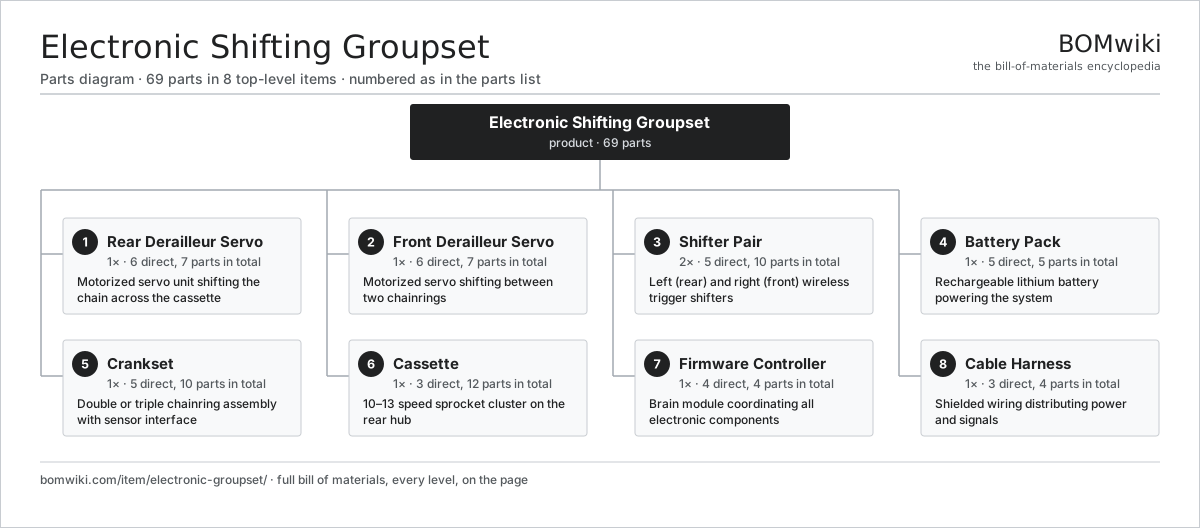
| # | Part | Qty | What it does |
|---|---|---|---|
| 1 | Rear Derailleur Servo 6 parts | 1× | Motorized servo unit shifting the chain across the cassette |
| 2 | Front Derailleur Servo 6 parts | 1× | Motorized servo shifting between two chainrings |
| 3 | Shifter Pair 5 parts | 2× | Left (rear) and right (front) wireless trigger shifters |
| 4 | Battery Pack 5 parts | 1× | Rechargeable lithium battery powering the system |
| 5 | Crankset 5 parts | 1× | Double or triple chainring assembly with sensor interface |
| 6 | Cassette 3 parts | 1× | 10–13 speed sprocket cluster on the rear hub |
| 7 | Firmware Controller 4 parts | 1× | Brain module coordinating all electronic components |
| 8 | Cable Harness 3 parts | 1× | Shielded wiring distributing power and signals |
3D model
No 3D model yet. Have a CAD file of this? Add a 3D model. STL renders right on this page; STEP, FreeCAD, and OpenSCAD sources are welcome too (openly licensed, like all 3D models on BOMwiki).
Build & assembly graph
expand / collapse · shared sub-assemblies converge · links to related products · est. labourTap an assembly to expand/collapse · tap a part to open it · use “Open page” for any node · drag to pan, scroll to zoom.
Bill of materials for Electronic Shifting Groupset
8 top-level lines · 45 rows shown · 69 parts total · indented to 3 levels| # | Item / sub-assembly | Part no. | Qty/assy | Ext. qty | Parts | Type |
|---|---|---|---|---|---|---|
| 1 | Rear Derailleur Servo 6 parts | electronic-groupset-rear-derailleur-servo | 1× | 1 | 7 | assembly |
| 1.1 | Servo Motor | electronic-groupset-servo-motor | 1× | 1 | · | part |
| 1.2 | Motor Gearbox | electronic-groupset-motor-gearbox | 1× | 1 | · | part |
| 1.3 | Cage Arm Assembly | electronic-groupset-cage-arm-assembly | 1× | 1 | · | part |
| 1.4 | Pulley Set | electronic-groupset-pulley-set | 2× | 2 | · | part |
| 1.5 | Position Encoder | electronic-groupset-position-encoder | 1× | 1 | · | part |
| 1.6 | Servo Mounting Bracket | electronic-groupset-servo-mounting-bracket | 1× | 1 | · | part |
| 2 | Front Derailleur Servo 6 parts | electronic-groupset-front-derailleur-servo | 1× | 1 | 7 | assembly |
| 2.1 | Servo Motor | electronic-groupset-servo-motor | 1× | 1 | · | part |
| 2.2 | Motor Gearbox | electronic-groupset-motor-gearbox | 1× | 1 | · | part |
| 2.3 | Cage Plate Pair | electronic-groupset-cage-plate-pair | 2× | 2 | · | part |
| 2.4 | Solenoid Latch | electronic-groupset-solenoid-latch | 1× | 1 | · | part |
| 2.5 | Position Sensor | electronic-groupset-position-sensor | 1× | 1 | · | part |
| 2.6 | Clamp Band | electronic-groupset-clamp-band | 1× | 1 | · | part |
| 3 | Shifter Pair 5 parts | electronic-groupset-shifter-pair | 2× | 2 | 10 | assembly |
| 3.1 | Shifter Body Pair | electronic-groupset-shifter-body-pair | 2× | 4 | · | part |
| 3.2 | Shifter Button Mechanism | electronic-groupset-shifter-button-mechanism | 2× | 4 | · | part |
| 3.3 | Shifter Battery Cell | electronic-groupset-shifter-battery-cell | 2× | 4 | · | part |
| 3.4 | Wireless Transceiver | electronic-groupset-wireless-transceiver | 2× | 4 | · | part |
| 3.5 | Shifter Clamp Mount | electronic-groupset-shifter-clamp-mount | 2× | 4 | · | part |
| 4 | Battery Pack 5 parts | electronic-groupset-battery-pack | 1× | 1 | 5 | assembly |
| 4.1 | Battery Cell Module | electronic-groupset-battery-cell-module | 1× | 1 | · | part |
| 4.2 | Battery BMS | electronic-groupset-battery-bms | 1× | 1 | · | part |
| 4.3 | Battery Connector | electronic-groupset-battery-connector | 1× | 1 | · | part |
| 4.4 | Charging Port | electronic-groupset-charging-port | 1× | 1 | · | part |
| 4.5 | Battery Housing | electronic-groupset-battery-housing | 1× | 1 | · | part |
| 5 | Crankset 5 parts | electronic-groupset-crankset | 1× | 1 | 10 | assembly |
| 5.1 | Crank Arm Pair | electronic-groupset-crank-arm-pair | 2× | 2 | · | part |
| 5.2 | Chainring Pair | electronic-groupset-chainring-pair | 2× | 2 | · | part |
| 5.3 | Crankset Spindle | electronic-groupset-crankset-spindle | 1× | 1 | · | part |
| 5.4 | Cadence Sensor | electronic-groupset-cadence-sensor | 1× | 1 | · | part |
| 5.5 | Crank Fasteners | electronic-groupset-crank-fasteners | 4× | 4 | · | part |
| 6 | Cassette 3 parts | electronic-groupset-cassette | 1× | 1 | 12 | assembly |
| 6.1 | Sprocket Ring | electronic-groupset-sprocket-ring | 10× | 10 | · | part |
| 6.2 | Cassette Spider | electronic-groupset-cassette-spider | 1× | 1 | · | part |
| 6.3 | Cassette Lockring | electronic-groupset-cassette-lockring | 1× | 1 | · | part |
| 7 | Firmware Controller 4 parts | electronic-groupset-firmware-controller | 1× | 1 | 4 | assembly |
| 7.1 | Microcontroller | mcu | 1× | 1 | · | part |
| 7.2 | Wireless Receiver | electronic-groupset-wireless-receiver | 1× | 1 | · | part |
| 7.3 | Power Distribution | electronic-groupset-power-distribution | 1× | 1 | · | part |
| 7.4 | Firmware Memory | electronic-groupset-firmware-memory | 1× | 1 | · | part |
| 8 | Cable Harness 3 parts | electronic-groupset-cable-harness | 1× | 1 | 4 | assembly |
| 8.1 | Power Cable | electronic-groupset-power-cable | 1× | 1 | · | part |
| 8.2 | Signal Cable | electronic-groupset-signal-cable | 1× | 1 | · | part |
| 8.3 | Connector Set | electronic-groupset-connector-set | 2× | 2 | · | part |
Something wrong in this list? Report a problem with this BOM.
Related products
same domain, ranked by shared parts Cargo Bicycle
500 parts · shares 1 with this page
Cargo Bicycle
500 parts · shares 1 with this page
 Cargo E-Bike
366 parts · shares 1 with this page
Cyclocross Bike
309 parts · shares 1 with this page
Cargo E-Bike
366 parts · shares 1 with this page
Cyclocross Bike
309 parts · shares 1 with this page
 E-Bike
234 parts · shares 1 with this page
E-Bike
234 parts · shares 1 with this page
 E-Bike Conversion Kit
133 parts · shares 1 with this page
E-Bike Conversion Kit
133 parts · shares 1 with this page
 Power Meter Crankset
38 parts · shares 1 with this page
Power Meter Crankset
38 parts · shares 1 with this page
Sourcing: possible vendors
Browse the supplier directory → Prices, MOQ, and lead times are algorithmic estimates, not quotes, and not claims about these companies. Company mappings are curated by keyword; est. price band $200–$12k. How estimates work| Vendor | HQ | Specialty | MOQ | Lead time |
|---|---|---|---|---|
|
🇹🇼Giant
giant-bicycles.com ↗
|
Taichung, TW | Bicycles | 500 units | 6–12 wks |
|
🇺🇸Trek
trekbikes.com ↗
|
Waterloo, US | Bicycles | 500 units | 6–12 wks |
| specialized.com ↗ | Morgan Hill, US | Bicycles | 500 units | 6–12 wks |
|
🇹🇼Merida
merida-bikes.com ↗
|
Yuanlin, TW | Bicycles | 500 units | 6–12 wks |
| cannondale.com ↗ | Wilton, US | Bicycles | 500 units | 6–12 wks |
1,252-word article