Electrostatic Separator
ProductOverview
An electrostatic separator is a mineral processing equipment that uses high-voltage electric fields (5–100 kV) to sort particles based on their electrical conductivity and surface charge properties. Particles are either charged by corona discharge or contact charging, then exposed to an electric field where conductive particles are attracted to one electrode and non-conductive particles move elsewhere. The result is a clean separation of conductive (e.g., sulfides, metal oxides, carbon) minerals from non-conductive gangue (e.g., quartz, feldspar).
Electrostatic separators are most effective for particles in the −2 mm to −20 μm range and are widely used in final-stage mineral beneficiation, gemstone sorting, recycling (copper wire from plastic), and industrial mineral upgrading. They are particularly valuable for ores where density or magnetic properties don't provide clear separation, for example, galena (PbS, conductive) from quartz (SiO₂, non-conductive) in the same size fraction.
How it works
Dry ore (moisture must be <1%, typically <0.5%) is fed into a heated hopper to remove any residual moisture and prevent electrostatic cling. A vibrating feeder distributes particles uniformly onto a rotating grounded metal drum at a controlled rate.
As particles are carried by the drum surface into the electric field zone, they are subjected to one or more charging methods:
Corona discharge ionization: A corona electrode at high potential (10–50 kV) generates an electric discharge in the surrounding air. Ions from the discharge attach to particle surfaces, inducing a charge. Conductive minerals are easily charged; insulators charge more slowly or not at all.
Contact charging: Particles rolling on the drum acquire charge by contact; conductive particles pick up electrons or holes from the drum surface.
Once charged, particles encounter the main electric field, typically between a high-voltage electrode (5–100 kV positive or negative) and a grounded electrode. The field is non-uniform (stronger near the electrodes, weaker toward the drum).
Conductive particles (e.g., sulfides, metal oxides):
- Hold a strong charge.
- Experience powerful Coulombic attraction to the opposite-polarity electrode.
- Are pulled off the drum surface toward the electrode.
- Follow a curved path and are deflected into the conductive product chute.
Non-conductive particles (e.g., silicates, quartz, some oxides):
- Hold weak or no charge.
- Experience minimal electrical force.
- Remain on the drum surface under gravitational and centrifugal forces.
- Follow the drum to the opposite discharge, falling into the non-conductive product chute.
The adjustable splitter plates at the discharge end fine-tune the partition between products, allowing recovery/purity trade-offs.
Electrical Principles
The electrostatic force on a charged particle in an electric field is:
F = q E
Where:
- q = particle charge (Coulombs)
- E = electric field strength (V/m)
For a conductive particle of diameter d picking up charge equivalent to several elementary charges (e.g., 1000 electrons):
- q ≈ 1000 × 1.6 × 10⁻¹⁹ C = 1.6 × 10⁻¹⁶ C
In a field of E = 10 MV/m (typical in a 100 kV gap of 10 mm):
- F ≈ 1.6 × 10⁻⁹ N
This force, though tiny in absolute terms, is comparable to gravity on a fine mineral particle and creates strong lateral acceleration.
Conductive minerals (electrical conductivity >10⁻⁸ S/m) include:
- Sulfides: galena (PbS), chalcopyrite (CuFeS₂), sphalerite (ZnS), etc.
- Native metals: gold, copper, silver
- Metal oxides: magnetite (Fe₃O₄), ilmenite (FeTiO₃), hematite (Fe₂O₃)
- Carbon: graphite, coal
Non-conductive minerals (conductivity <10⁻¹⁰ S/m) include:
- Silicates: quartz, feldspar, mica, amphibole
- Carbonates: calcite, dolomite
- Oxides: Al₂O₃ (corundum), SiO₂ (quartz, although some SiO₂ varieties have slight conductivity)
- Sulfates: barite, gypsum
Feed Preparation
Electrostatic separators are extremely sensitive to moisture. Water on the particle surface conducts electricity, destroying the charge differential between conductive and non-conductive particles. All separators include heating:
- Ore is heated to 50–150°C (depending on humidity and mineral type) to evaporate surface moisture.
- A heating system (electric or steam) warms the hopper.
- Ore residence time in the hopper should be 5–15 minutes to allow thermal equilibration.
Particle size is also critical. Fine particles (<5 μm) are poorly charged and difficult to deflect; coarse particles (>2 mm) are hard to accelerate off the drum. Optimal particle size is −500 to −50 μm. Feed screening or wet classification upstream ensures size control.
High-Voltage System
The high-voltage power supply is the core of the apparatus. A DC generator produces 5–100 kV output, adjustable to match the ore and separation goal. The supply includes:
- Voltage regulation: Maintaining output within ±2% for stable separation.
- Current limiting: Resistive or electronic limiters restrict discharge current to <1 mA, protecting operator safety.
- Ripple filtering: Output ripple is typically <1 kV to ensure smooth electric field.
High voltage cables are heavily insulated (silicone or cross-linked polyethylene) and rated for 50–150 kV. All connections are secured with compression fittings to prevent arcing.
A voltage monitor continuously displays output voltage; if voltage drifts or a spark occurs (particle arc), the supply automatically shuts down. Safety interlocks prevent equipment operation if an access door is open.
Separator Configurations
Two main electrode geometries are common:
Parallel-plate separator:
- Two vertical electrodes (one high-voltage, one grounded) create a uniform field.
- Particles fall vertically or horizontally through the field.
- Simple, robust, effective for coarse particles (>100 μm).
Drum or cylindrical separator:
- A rotating drum carries particles through a field created by electrodes nearby.
- More compact; improved separation of fine particles.
- More common in modern installations.
Typical Separation Examples
Example 1: Galena and quartz
- Galena (PbS, conductive) is separated from quartz (SiO₂, non-conductive).
- Voltage: 50 kV
- Recovery: >95% of galena, >5% misplacement to tailings
- Result: Galena concentrate upgrades from 30% Pb in run-of-mine to 80%+ Pb concentrate.
Example 2: Chalcopyrite from gangue
- Chalcopyrite (CuFeS₂, conductive) in quartz-feldspar gangue.
- Voltage: 60–80 kV
- Recovery: 85–92%
- Concentrate: 35–45% Cu (upgraded from 5–8% run-of-mine).
Example 3: Ilmenite from beach sand
- Ilmenite (FeTiO₃, conductive) in zircon/rutile (mixed conductivity).
- Voltage: 80–100 kV (high due to similar electrical properties)
- Recovery: 80–90%
- Result: Ilmenite concentrate suitable for titanium pigment production.
Product Recovery and Discharge
Separated products fall from the discharge chutes into collection bins for storage. Concentrate and tailings are weighed, sampled, and assayed to determine recovery and concentrate grade. Results feed back to the PLC controller, which adjusts voltage, drum speed, or feed rate to optimize performance.
Product moisture is negligible (0.1–0.5%) due to the heating and dry operation, making electrostatic products suitable for direct smelting or further flotation without additional drying.
Advantages and Limitations
Advantages:
- Exploits electrical conductivity differences that gravity or magnetic methods cannot.
- Applicable to difficult separations (similar density, non-magnetic minerals).
- Produces very pure products (90–99% purity common).
- Dry process; no water recycling needed (advantageous in arid regions).
- Compact and low vibration compared to mechanical separators.
- High selectivity for fine particles (−100 μm).
Limitations:
- Extremely sensitive to moisture; air and/or heating required.
- High electrical safety risk (50–100 kV) requires trained operators and proper guarding.
- Modest throughput per unit (0.5–5 t/h) requires multiple units for large plants.
- Capital cost higher than gravity separators ($50k–$150k per unit).
- Electrical power consumption (5–25 kW) is higher than gravity methods.
- Effectiveness depends on ore electrical properties, which vary by deposit.
Maintenance and Safety
Regular maintenance includes:
- Electrode inspection: Check for arcing damage or deposits every month; clean with dry brush if needed.
- High-voltage cable examination: Inspect insulation for cuts or damage quarterly; replace if degradation suspected.
- Drum bearing greasing: Every 3 months.
- Electrical supply servicing: Annual professional inspection of HV supply and safety interlocks.
Safety is paramount. Only trained personnel should operate and maintain the equipment. Personal protective equipment includes:
- Insulating gloves and shoes
- Safety glasses
- Grounding strap for body discharge when working near electrodes
Modern units include sophisticated safety features: automatic shutdown on voltage spike, door interlocks, and low-leakage current (<1 mA) limiting.
Typical Applications
Metal ore concentration:
- Sulfide ore beneficiation (Cu, Pb, Zn ores)
- Tin, tungsten, molybdenum oxide upgrade
Industrial minerals:
- Feldspar separation in mineral sands
- Titanium mineral (rutile, ilmenite) concentration from heavy sand deposits
Gemstone and precious mineral sorting:
- Diamond/corundum from host rock
- Tourmaline, beryl sorting by conductivity
Recycling:
- Copper wire liberation from plastic
- Electronic waste sorting
Coal processing:
- Pyrite (FeS₂, conductive) removal from coal
- Ash reduction in thermal coal
Modern electrostatic technology continues to evolve, with advances in:
- Higher field strengths (140+ kV) for challenging separations
- Improved charge-retention coatings on electrodes
- Automated moisture control and feedback
- Integrated process control via Industry 4.0 systems
The technology remains niche compared to flotation or gravity methods, but for specific ore types and recovery goals, electrostatic separation is irreplaceable.
Electrostatic Separator parts and their functions
8 top-level parts · 29 parts in total · full bill of materials below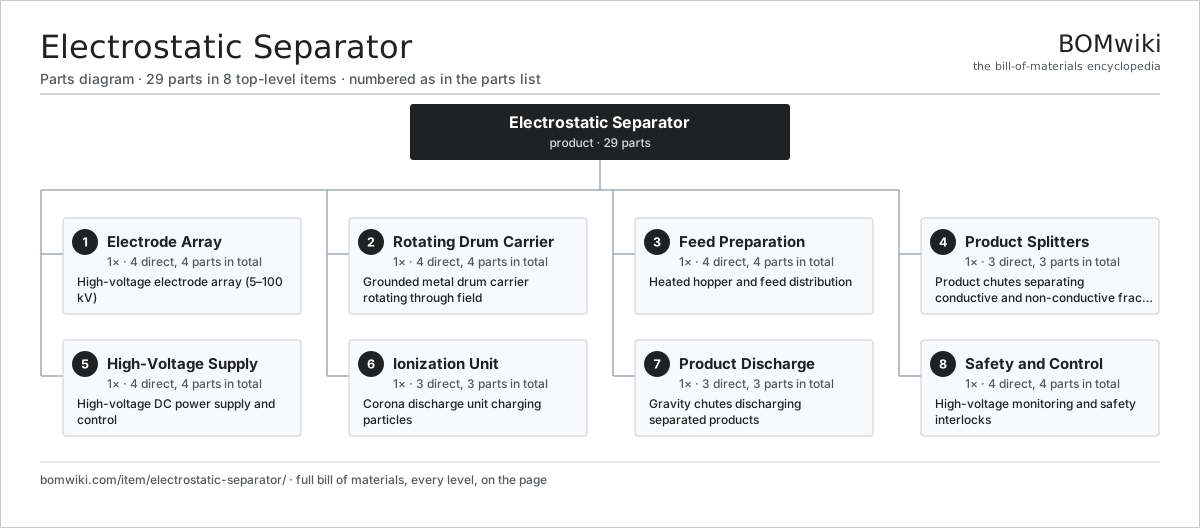
| # | Part | Qty | What it does |
|---|---|---|---|
| 1 | Electrode Array 4 parts | 1× | High-voltage electrode array (5–100 kV) |
| 2 | Rotating Drum Carrier 4 parts | 1× | Grounded metal drum carrier rotating through field |
| 3 | Feed Preparation 4 parts | 1× | Heated hopper and feed distribution |
| 4 | Product Splitters 3 parts | 1× | Product chutes separating conductive and non-conductive fractions |
| 5 | High-Voltage Supply 4 parts | 1× | High-voltage DC power supply and control |
| 6 | Ionization Unit 3 parts | 1× | Corona discharge unit charging particles |
| 7 | Product Discharge 3 parts | 1× | Gravity chutes discharging separated products |
| 8 | Safety and Control 4 parts | 1× | High-voltage monitoring and safety interlocks |
3D model
No 3D model yet. Have a CAD file of this? Add a 3D model. STL renders right on this page; STEP, FreeCAD, and OpenSCAD sources are welcome too (openly licensed, like all 3D models on BOMwiki).
Build & assembly graph
expand / collapse · shared sub-assemblies converge · links to related products · est. labourTap an assembly to expand/collapse · tap a part to open it · use “Open page” for any node · drag to pan, scroll to zoom.
Bill of materials for Electrostatic Separator
8 top-level lines · 37 rows shown · 29 parts total · indented to 3 levels| # | Item / sub-assembly | Part no. | Qty/assy | Ext. qty | Parts | Type |
|---|---|---|---|---|---|---|
| 1 | Electrode Array 4 parts | electrostatic-separator-electrode-system | 1× | 1 | 4 | assembly |
| 1.1 | High-Voltage Electrode | electrostatic-separator-primary-electrode | 1× | 1 | · | part |
| 1.2 | Grounded Electrode | electrostatic-separator-secondary-electrode | 1× | 1 | · | part |
| 1.3 | Electrode Insulation | electrostatic-separator-electrode-insulation | 1× | 1 | · | part |
| 1.4 | Field Shaping Plates | electrostatic-separator-field-shaping-plates | 1× | 1 | · | part |
| 2 | Rotating Drum Carrier 4 parts | electrostatic-separator-rotating-drum | 1× | 1 | 4 | assembly |
| 2.1 | Grounded Drum | electrostatic-separator-drum-cylinder | 1× | 1 | · | part |
| 2.2 | Drum Bearings | electrostatic-separator-drum-bearings | 1× | 1 | · | part |
| 2.3 | Drum Drive Motor | electrostatic-separator-drum-motor | 1× | 1 | · | part |
| 2.4 | Drum Shaft | electrostatic-separator-drum-shaft | 1× | 1 | · | part |
| 3 | Feed Preparation 4 parts | electrostatic-separator-feed-system | 1× | 1 | 4 | assembly |
| 3.1 | Feed Hopper | electrostatic-separator-feed-hopper | 1× | 1 | · | part |
| 3.2 | Heating System | electrostatic-separator-heater | 1× | 1 | · | part |
| 3.3 | Vibrating Feeder | electrostatic-separator-vibrating-feeder | 1× | 1 | · | part |
| 3.4 | Feed Conditioner | electrostatic-separator-feed-conditioner | 1× | 1 | · | part |
| 4 | Product Splitters 3 parts | electrostatic-separator-splitters | 1× | 1 | 3 | assembly |
| 4.1 | Conductive Product Chute | electrostatic-separator-conductive-splitter | 1× | 1 | · | part |
| 4.2 | Non-Conductive Chute | electrostatic-separator-non-conductive-splitter | 1× | 1 | · | part |
| 4.3 | Splitter Adjuster | electrostatic-separator-splitter-positioning | 1× | 1 | · | part |
| 5 | High-Voltage Supply 4 parts | electrostatic-separator-high-voltage-supply | 1× | 1 | 4 | assembly |
| 5.1 | High-Voltage Generator | electrostatic-separator-hv-power-unit | 1× | 1 | · | part |
| 5.2 | HV Control Cabinet | electrostatic-separator-hv-control-cabinet | 1× | 1 | · | part |
| 5.3 | Current Limiter | electrostatic-separator-current-limiter | 1× | 1 | · | part |
| 5.4 | High-Voltage Cables | electrostatic-separator-hv-cables | 1× | 1 | · | part |
| 6 | Ionization Unit 3 parts | electrostatic-separator-ionization-chamber | 1× | 1 | 3 | assembly |
| 6.1 | Corona Discharge Electrode | electrostatic-separator-corona-electrode | 1× | 1 | · | part |
| 6.2 | Corona Chamber | electrostatic-separator-corona-housing | 1× | 1 | · | part |
| 6.3 | Ionization Air Supply | electrostatic-separator-corona-air-supply | 1× | 1 | · | part |
| 7 | Product Discharge 3 parts | electrostatic-separator-product-collection | 1× | 1 | 3 | assembly |
| 7.1 | Concentrate Chute | electrostatic-separator-concentrate-chute | 1× | 1 | · | part |
| 7.2 | Tailings Chute | electrostatic-separator-tailings-chute | 1× | 1 | · | part |
| 7.3 | Collection Bins | electrostatic-separator-collection-bins | 1× | 1 | · | part |
| 8 | Safety and Control 4 parts | electrostatic-separator-control-system | 1× | 1 | 4 | assembly |
| 8.1 | Voltage Monitor | electrostatic-separator-voltage-monitor | 1× | 1 | · | part |
| 8.2 | Safety Interlocks | electrostatic-separator-interlock-switches | 1× | 1 | · | part |
| 8.3 | Grounding System | electrostatic-separator-grounding-system | 1× | 1 | · | part |
| 8.4 | Electrostatic Controller | electrostatic-separator-plc | 1× | 1 | · | part |
Something wrong in this list? Report a problem with this BOM.
Sourcing: possible vendors
Browse the supplier directory → Prices, MOQ, and lead times are algorithmic estimates, not quotes, and not claims about these companies. Company mappings are curated by keyword; est. price band $200k–$5M. How estimates work| Vendor | HQ | Specialty | MOQ | Lead time |
|---|---|---|---|---|
| caterpillar.com ↗ | Irving, US | Construction & mining equipment | made to order | 20–36 wks |
|
🇯🇵Komatsu
komatsu.com ↗
|
Tokyo, JP | Construction & mining equipment | made to order | 20–36 wks |
|
🇸🇪Sandvik
rocktechnology.sandvik ↗
|
Stockholm, SE | Mining & rock technology | made to order | 20–36 wks |
|
🇸🇪Epiroc
epiroc.com ↗
|
Stockholm, SE | Mining & drilling equipment | made to order | 20–36 wks |
|
🇫🇮Metso
metso.com ↗
|
Helsinki, FI | Crushing & minerals processing | made to order | 20–36 wks |
1,528-word article