Spectroscopic Ellipsometer
ProductOverview
Ellipsometry is an optical technique for measuring the thickness and optical constants (refractive index and extinction coefficient) of thin films from the polarization state of reflected light. When linearly polarized light reflects from a film, the amplitude and phase of the reflected s- and p-polarized components change differently, so the reflected light becomes elliptically polarized. By measuring this ellipticity with high precision, using rotating analyzer and polarizer optics, the system deduces the film's thickness and complex refractive index. Spectroscopic ellipsometry extends this across 250–1700 nm, building a refractive-index spectrum and high-precision thickness profile in a single measurement.
The Light Source Assembly emits broadband UV-visible light, coupled through a fiber to the Polarizer Arm Assembly. The Polarizer Arm Assembly rotates a linear polarizer to set the incident polarization state. Light reflects from the sample on the Sample Stage Assembly, where the incident angle is fixed (typically 70°) or motorized through a goniometer. The Analyzer Arm Assembly spins an analyzer to dissect the reflected light's polarization, and the Spectrometer Module measures intensity as a function of wavelength. The Control Electronics synchronizes polarizer and analyzer rotation with spectrometer readout, and the Data Processor Unit iteratively fits the spectrum to a multi-layer film model, returning thickness and refractive index.
How it works
Ellipsometry quantifies the complex reflection coefficients rₚ and ᵣₛ for p- and s-polarized light. The key parameter is tan(ψ) = |rₚ|/|rₛ| and Δ = phase(rₚ) − phase(rₛ). These parameters are measured by rotating the Polarizer Arm Assembly through a sequence of azimuths and recording the reflected light intensity at each angle as the Analyzer Arm Assembly also rotates. Data fitting uses the Fresnel equations for stratified media: for a known substrate (e.g., silicon) and unknown overlying film, software assumes a film model (thickness t, refractive index n), computes its predicted ψ and Δ, and adjusts (t, n) to match the measured values.
Spectroscopic operation repeats this measurement at many wavelengths, typically 400 points across 250–1700 nm. The Spectrometer Module uses a diffraction grating and CCD array; at each wavelength, the reflection coefficient depends on optical constants and film thickness in a way that is highly sensitive to both. By fitting the entire spectrum jointly, the Data Processor Unit uses the wavelength dependence of the refractive index (Kramers-Kronig consistency) and the multiple-reflection interference in the film to constrain the solution, often yielding sub-angstrom accuracy on thickness and precise spectral n(λ) profiles.
The Sample Stage Assembly can be motorized to step the incident angle (45°–75°) or azimuth, allowing the measurement of anisotropic films or mapping spatial variation across a substrate.
Accuracy is limited by light source stability, alignment (calibrated with the Calibration Assembly), and model assumptions. Real samples with roughness, inhomogeneity, or unknown chemistry can introduce systematic errors, so expert judgment is required in model selection.
Applications
Ellipsometry is the standard metrology for semiconductor thin films: gate oxides, dielectric spacers, photoresist thickness, and copper or aluminum interconnects are all verified by ellipsometry. In optical coatings, it measures anti-reflective coatings, high-index and low-index layer thicknesses in multilayer stacks, and coating uniformity. In materials science, it characterizes native oxides on metals, corrosion films, and polymer adsorption layers. In biology, it measures lipid bilayer thickness and protein layer thickness on biosensing chips. In optoelectronics manufacturing, ellipsometry monitors quantum-well layer thickness in epitaxial structures and verifies doping profiles in GRIN lenses.
Spectroscopic Ellipsometer parts and their functions
9 top-level parts · 42 parts in total · full bill of materials below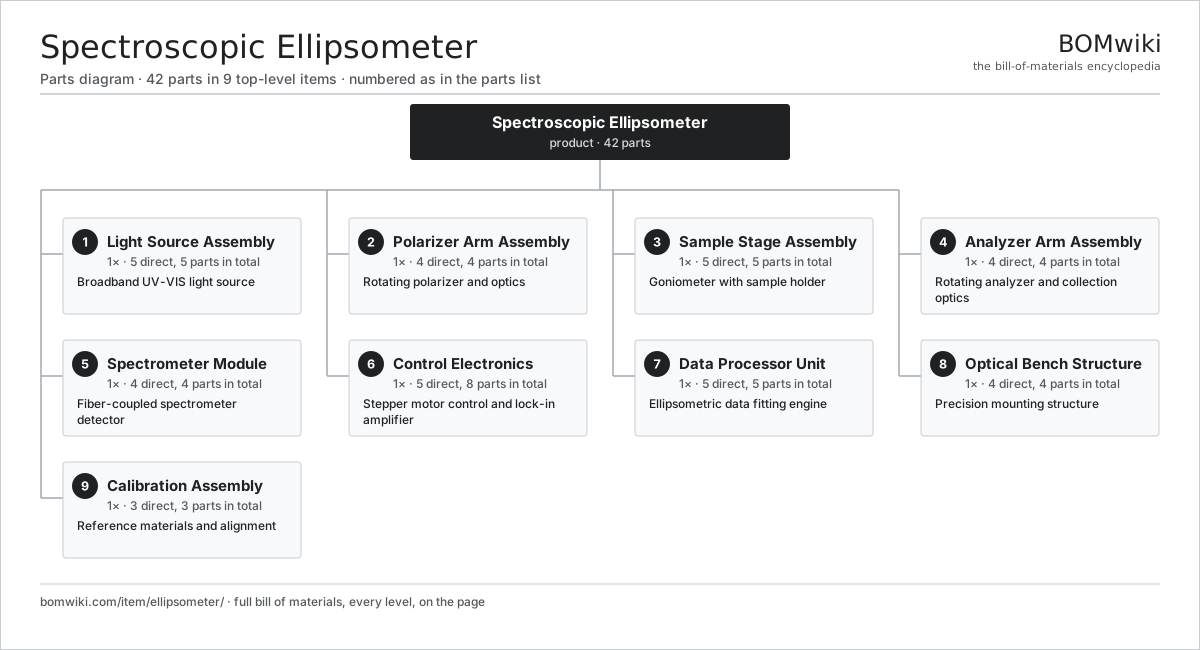
| # | Part | Qty | What it does |
|---|---|---|---|
| 1 | Light Source Assembly 5 parts | 1× | Broadband UV-VIS light source |
| 2 | Polarizer Arm Assembly 4 parts | 1× | Rotating polarizer and optics |
| 3 | Sample Stage Assembly 5 parts | 1× | Goniometer with sample holder |
| 4 | Analyzer Arm Assembly 4 parts | 1× | Rotating analyzer and collection optics |
| 5 | Spectrometer Module 4 parts | 1× | Fiber-coupled spectrometer detector |
| 6 | Control Electronics 5 parts | 1× | Stepper motor control and lock-in amplifier |
| 7 | Data Processor Unit 5 parts | 1× | Ellipsometric data fitting engine |
| 8 | Optical Bench Structure 4 parts | 1× | Precision mounting structure |
| 9 | Calibration Assembly 3 parts | 1× | Reference materials and alignment |
3D model
No 3D model yet. Have a CAD file of this? Add a 3D model. STL renders right on this page; STEP, FreeCAD, and OpenSCAD sources are welcome too (openly licensed, like all 3D models on BOMwiki).
Build & assembly graph
expand / collapse · shared sub-assemblies converge · links to related products · est. labourTap an assembly to expand/collapse · tap a part to open it · use “Open page” for any node · drag to pan, scroll to zoom.
Bill of materials for Spectroscopic Ellipsometer
9 top-level lines · 48 rows shown · 42 parts total · indented to 3 levels| # | Item / sub-assembly | Part no. | Qty/assy | Ext. qty | Parts | Type |
|---|---|---|---|---|---|---|
| 1 | Light Source Assembly 5 parts | ellipsometer-light-source | 1× | 1 | 5 | assembly |
| 1.1 | Xenon Lamp | ellipsometer-lamp | 1× | 1 | · | part |
| 1.2 | Lamp Housing | ellipsometer-lamp-housing | 1× | 1 | · | part |
| 1.3 | Condenser Optics | ellipsometer-condenser-lens | 1× | 1 | · | part |
| 1.4 | Fiber Coupler | ellipsometer-fiber-coupler | 1× | 1 | · | part |
| 1.5 | Lamp Power Supply | ellipsometer-lamp-psu | 1× | 1 | · | part |
| 2 | Polarizer Arm Assembly 4 parts | ellipsometer-polarizer-arm | 1× | 1 | 4 | assembly |
| 2.1 | Polarizer Servo Motor | ellipsometer-servo-motor-p | 1× | 1 | · | part |
| 2.2 | Polarizer Filter | ellipsometer-polarizer-optic | 1× | 1 | · | part |
| 2.3 | Field Aperture | ellipsometer-aperture-p | 1× | 1 | · | part |
| 2.4 | Position Encoder | ellipsometer-encoder-p | 1× | 1 | · | part |
| 3 | Sample Stage Assembly 5 parts | ellipsometer-sample-stage | 1× | 1 | 5 | assembly |
| 3.1 | Goniometer Base | ellipsometer-goniometer-base | 1× | 1 | · | part |
| 3.2 | Azimuth Motor | ellipsometer-azimuth-motor | 1× | 1 | · | part |
| 3.3 | Azimuth Encoder | ellipsometer-azimuth-encoder | 1× | 1 | · | part |
| 3.4 | Vacuum Chuck | ellipsometer-sample-chuck | 1× | 1 | · | part |
| 3.5 | Incident Angle Scale | ellipsometer-angle-scale | 1× | 1 | · | part |
| 4 | Analyzer Arm Assembly 4 parts | ellipsometer-analyzer-arm | 1× | 1 | 4 | assembly |
| 4.1 | Analyzer Servo Motor | ellipsometer-servo-motor-a | 1× | 1 | · | part |
| 4.2 | Analyzer Filter | ellipsometer-analyzer-optic | 1× | 1 | · | part |
| 4.3 | Collection Optics | ellipsometer-collection-lens | 1× | 1 | · | part |
| 4.4 | Analyzer Encoder | ellipsometer-encoder-a | 1× | 1 | · | part |
| 5 | Spectrometer Module 4 parts | ellipsometer-spectrometer | 1× | 1 | 4 | assembly |
| 5.1 | Entrance Slit | ellipsometer-entrance-slit | 1× | 1 | · | part |
| 5.2 | Diffraction Grating | ellipsometer-grating | 1× | 1 | · | part |
| 5.3 | CCD Detector Array | ellipsometer-ccd-detector | 1× | 1 | · | part |
| 5.4 | Spectrometer Housing | ellipsometer-spectrometer-body | 1× | 1 | · | part |
| 6 | Control Electronics 5 parts | ellipsometer-control-electronics | 1× | 1 | 8 | assembly |
| 6.1 | Servo Motor Driver | ellipsometer-servo-driver | 1× | 1 | · | part |
| 6.2 | Lock-in Amplifier Module | ellipsometer-lockin-amp | 1× | 1 | · | part |
| 6.3 | CCD Readout Electronics | ellipsometer-ccd-readout | 1× | 1 | · | part |
| 6.4 | Main Control PCB | ellipsometer-control-board | 1× | 1 | · | part |
| 6.5 | Connector | connector | 4× | 4 | · | part |
| 7 | Data Processor Unit 5 parts | ellipsometer-data-processor | 1× | 1 | 5 | assembly |
| 7.1 | Processor CPU | ellipsometer-processor-cpu | 1× | 1 | · | part |
| 7.2 | Coprocessor GPU | ellipsometer-processor-gpu | 1× | 1 | · | part |
| 7.3 | System Memory Module | ellipsometer-processor-memory | 1× | 1 | · | part |
| 7.4 | Processor PCB | ellipsometer-processor-board | 1× | 1 | · | part |
| 7.5 | Power Supply | power-supply | 1× | 1 | · | part |
| 8 | Optical Bench Structure 4 parts | ellipsometer-optical-bench | 1× | 1 | 4 | assembly |
| 8.1 | Bench Frame | ellipsometer-bench-frame | 1× | 1 | · | part |
| 8.2 | Component Mounts | ellipsometer-component-mounts | 1× | 1 | · | part |
| 8.3 | Fastener Set | fastener-set | 1× | 1 | · | part |
| 8.4 | Isolation Feet Set | vibration-isolation-feet | 1× | 1 | · | part |
| 9 | Calibration Assembly 3 parts | ellipsometer-calibration-module | 1× | 1 | 3 | assembly |
| 9.1 | Reference Thin-Film Substrate | ellipsometer-reference-substrate | 1× | 1 | · | part |
| 9.2 | Calibration Holder | ellipsometer-calibration-holder | 1× | 1 | · | part |
| 9.3 | Alignment He-Ne Laser | ellipsometer-alignment-laser | 1× | 1 | · | part |
Something wrong in this list? Report a problem with this BOM.
Related products
same domain, ranked by shared parts Adaptive Optics System
35 parts · shares 1 with this page
Adaptive Optics System
35 parts · shares 1 with this page
 Camera Motion Control Rig
210 parts · shares 1 with this page
Camera Motion Control Rig
210 parts · shares 1 with this page
 Digital Cinema Camera
305 parts · shares 1 with this page
Digital Cinema Camera
305 parts · shares 1 with this page
 Document Camera
247 parts · shares 1 with this page
Document Camera
247 parts · shares 1 with this page
 High-Speed Camera
183 parts · shares 1 with this page
High-Speed Camera
183 parts · shares 1 with this page
 Industrial 3D Scanner
149 parts · shares 1 with this page
Industrial 3D Scanner
149 parts · shares 1 with this page
Sourcing: possible vendors
Browse the supplier directory → Prices, MOQ, and lead times are algorithmic estimates, not quotes, and not claims about these companies. Company mappings are curated by keyword; est. price band $100–$8k. How estimates work| Vendor | HQ | Specialty | MOQ | Lead time |
|---|---|---|---|---|
|
🇯🇵Canon
canon.com ↗
|
Tokyo, JP | Imaging & optics | 500 units | 10–16 wks |
|
🇯🇵Nikon
nikon.com ↗
|
Tokyo, JP | Imaging & optics | 500 units | 10–16 wks |
|
🇩🇪ZEISS
zeiss.com ↗
|
Oberkochen, DE | Optics & optoelectronics | 500 units | 10–16 wks |
| leica-camera.com ↗ | Wetzlar, DE | Cameras & optics | 500 units | 10–16 wks |
| flir.com ↗ | Wilsonville, US | Thermal imaging | 500 units | 10–16 wks |
571-word article