Envelope Addressing Printer
ProductOverview
An envelope addressing printer is an industrial inkjet system printing delivery addresses, return addresses, and postal barcodes on envelopes at high speed. Used by postal services, mail bureaus, and large organizations sending bulk mailings (insurance companies, utilities), these systems replace manual address labels or handwritten addresses with reliable, barcode-readable addresses.
The technology combines envelope feeding, inline inkjet printing, immediate thermal drying, and output collection into a single-operator workflow capable of 150–300 envelopes per minute.
How It Works
An operator loads a stack of blank envelopes into the Envelope Hopper & Singulation. The Rubber Feed Wheel singulates them onto the Transport Conveyor conveyor belt.
As each envelope moves at 0.3–1.0 m/s under the Industrial Inkjet Printhead, the head fires individual ink droplets from a 256–512 nozzle array at 600 DPI resolution, printing the address. The Print Engine Controller receives address data from a host system (typically a database of mailing addresses) and formats it real-time to match each envelope position.
Immediately after printing, the envelope passes under the Thermal Dryer Bar, a thermal heater bar that dries the ink in 1–2 seconds. The envelope then slides into the Output Stacker output tray.
The entire process is synchronized by the Encoder on the conveyor, which tells the controller when each envelope reaches the print zone.
Inkjet Printing Architecture
The Inkjet Printhead is an industrial multi-channel printhead with 256–512 nozzles firing in parallel across the 50–80 mm address field. Each nozzle is a piezoelectric actuator that vibrates at 5–10 kHz, ejecting droplets of 15–20 picoliters.
The Ink Supply & Circulation supplies ink via a Ink Feed Pump that maintains hydrostatic pressure (0.5–1 bar) in the Ink Reservoir. The Ink Filter removes particles >10 microns that would clog nozzles.
Most commercial systems use black ink for address printing, though CMYK capable heads exist for color graphics (logos, company colors). Black-only systems are simpler and faster; they eject droplets every 200–500 microseconds, sustaining 300 pcs/min.
Timing & Position Control
The Print Engine Controller must know when each envelope is under the printhead to begin firing. The Encoder provides position pulses as the conveyor rotates, allowing the controller to calculate envelope position (which envelope is at what distance along the belt).
For high-speed operation, this synchronization is critical: if an envelope is off-position by 5 mm, the address prints lower on the envelope or even misses entirely. Most systems use closed-loop feedback: the encoder position is compared to the expected envelope motion, and the conveyor motor speed is adjusted to maintain timing.
Multi-head systems (two or more printheads side-by-side) print both front and back addresses simultaneously, halving throughput per envelope but enabling high-volume operations.
Thermal Drying
Inkjet ink is water-based and wet for several seconds after deposition. The Heater Element is typically a 500–1000W resistive bar positioned 20–40 mm above the envelope surface.
The Temperature Sensor monitors temperature; the Heater PWM Driver PWM driver adjusts heater power to maintain 50–70°C surface temperature. At this temperature, drying occurs in 1–2 seconds without scorching the envelope paper.
The Thermal Cutoff thermal cutoff fuse at 80°C prevents runaway heating if the sensor fails.
Ink Delivery & Cartridge Economics
Most systems use bulk Ink Reservoir cartridges of 1–5 liters rather than small disposable cartridges, reducing per-envelope ink cost from 1–2 cents to 0.1–0.2 cents. At 300 envelopes/minute, a 5-liter cartridge prints approximately 50,000 envelopes before refilling.
Ink formulations are optimized for:
- Quick dry time (water content balanced)
- Low odor (reducing workplace exposure)
- High contrast (dark black for barcode readability)
- Water resistance (some envelopes are weather-sealed)
Envelope Compatibility
Standard envelope sizes (DL 110×220 mm, C5 162×229 mm, C4 229×324 mm) are baseline. The Height Adjustment hopper adjustment allows operation on various thickness envelopes (60–120 g/m² paper weight).
Specialty envelopes (windowed, padded) can jam if not fed cleanly. Operators must verify envelope type before production runs.
Integration & Data Flow
Most systems connect via USB or Ethernet to a host server running mailing list software. Address data is typically formatted as:
''' John Smith 123 Main St Anytown, USA 12345 '''
The Print Engine Controller receives this as a print job, formats it to fit the envelope field (typically 3–5 lines, font size 10–14pt), and begins printing the batch.
Barcode imprinting (POSTNET, Intelligent Mail barcode) is common: the address is printed along with a barcode encoding the ZIP+4 code, allowing postal sorting machines to read and sort envelopes automatically.
Maintenance & Failure Recovery
Nozzle clogs are the primary failure mode. If a nozzle clogs, a white stripe appears in the address (missing vertical line). Recovery involves running a nozzle cleaning cycle: the printhead spits ink onto a waste pad, clearing blockages.
Ink filter life is 6–12 months; filters clog if particle contamination is high (poor envelope stock or dirty environment). Filter replacement is a 10-minute procedure.
Conveyor belt slippage reduces throughput; belt tension is checked monthly.
Market & Adoption
Postal services in developed countries have deployed these systems since the 1990s; modern USPS mail processing machines integrate them inline. Direct mail bureaus use them for personalized catalogs and offers. As bulk mail volume declines in digital-first markets, older systems are being retired, but transactional mail (invoices, statements) still drives demand.
Cost-per-envelope is now <$0.01 for full-color inkjet printing, making it economical for even small print runs (500 envelopes) compared to pre-printed stock.
Envelope Addressing Printer parts and their functions
8 top-level parts · 32 parts in total · full bill of materials below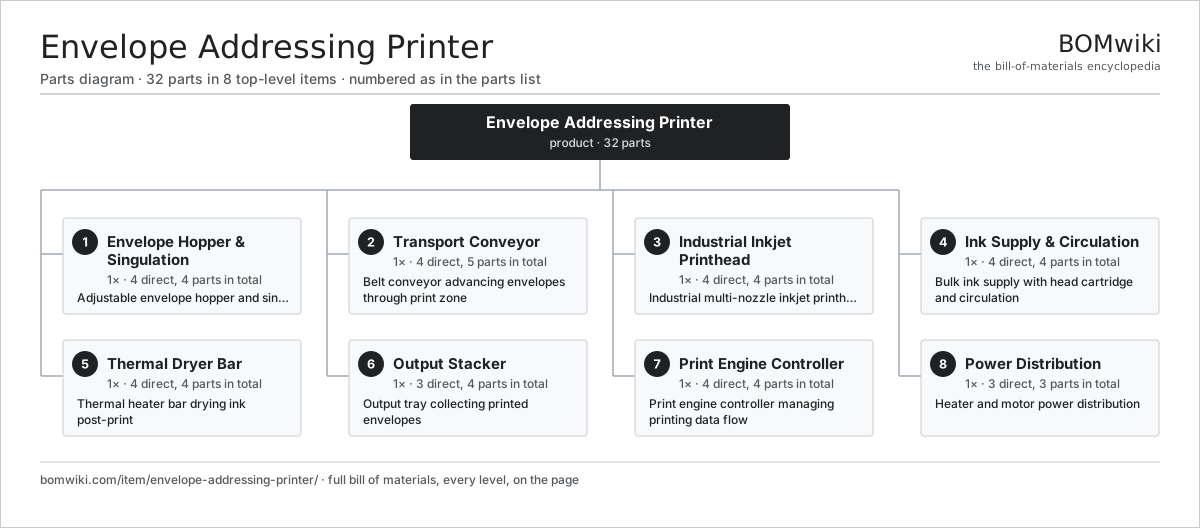
| # | Part | Qty | What it does |
|---|---|---|---|
| 1 | Envelope Hopper & Singulation 4 parts | 1× | Adjustable envelope hopper and singulation wheel |
| 2 | Transport Conveyor 4 parts | 1× | Belt conveyor advancing envelopes through print zone |
| 3 | Industrial Inkjet Printhead 4 parts | 1× | Industrial multi-nozzle inkjet printhead 600 DPI |
| 4 | Ink Supply & Circulation 4 parts | 1× | Bulk ink supply with head cartridge and circulation |
| 5 | Thermal Dryer Bar 4 parts | 1× | Thermal heater bar drying ink post-print |
| 6 | Output Stacker 3 parts | 1× | Output tray collecting printed envelopes |
| 7 | Print Engine Controller 4 parts | 1× | Print engine controller managing printing data flow |
| 8 | Power Distribution 3 parts | 1× | Heater and motor power distribution |
3D model
No 3D model yet. Have a CAD file of this? Add a 3D model. STL renders right on this page; STEP, FreeCAD, and OpenSCAD sources are welcome too (openly licensed, like all 3D models on BOMwiki).
Build & assembly graph
expand / collapse · shared sub-assemblies converge · links to related products · est. labourTap an assembly to expand/collapse · tap a part to open it · use “Open page” for any node · drag to pan, scroll to zoom.
Bill of materials for Envelope Addressing Printer
8 top-level lines · 38 rows shown · 32 parts total · indented to 3 levels| # | Item / sub-assembly | Part no. | Qty/assy | Ext. qty | Parts | Type |
|---|---|---|---|---|---|---|
| 1 | Envelope Hopper & Singulation 4 parts | envelope-addressing-printer-feeder | 1× | 1 | 4 | assembly |
| 1.1 | Envelope Hopper | envelope-addressing-printer-hopper | 1× | 1 | · | part |
| 1.2 | Rubber Feed Wheel | envelope-addressing-printer-feed-wheel | 1× | 1 | · | part |
| 1.3 | Feeder Motor | envelope-addressing-printer-feed-motor | 1× | 1 | · | part |
| 1.4 | Height Adjustment | envelope-addressing-printer-height-adjust | 1× | 1 | · | part |
| 2 | Transport Conveyor 4 parts | envelope-addressing-printer-transport | 1× | 1 | 5 | assembly |
| 2.1 | Transport Motor | envelope-addressing-printer-motor | 1× | 1 | · | part |
| 2.2 | Transport Belt | envelope-addressing-printer-belt | 1× | 1 | · | part |
| 2.3 | Transport Roller | envelope-addressing-printer-roller | 2× | 2 | · | part |
| 2.4 | Encoder | encoder | 1× | 1 | · | part |
| 3 | Industrial Inkjet Printhead 4 parts | envelope-addressing-printer-inkjet-head | 1× | 1 | 4 | assembly |
| 3.1 | Inkjet Printhead | envelope-addressing-printer-print-head | 1× | 1 | · | part |
| 3.2 | Nozzle Array Plate | envelope-addressing-printer-nozzle-plate | 1× | 1 | · | part |
| 3.3 | Piezo Pressure Transducer | envelope-addressing-printer-head-pressure | 1× | 1 | · | part |
| 3.4 | Printhead Mount | envelope-addressing-printer-head-mount | 1× | 1 | · | part |
| 4 | Ink Supply & Circulation 4 parts | envelope-addressing-printer-ink-system | 1× | 1 | 4 | assembly |
| 4.1 | Ink Reservoir | envelope-addressing-printer-ink-tank | 1× | 1 | · | part |
| 4.2 | Ink Feed Pump | envelope-addressing-printer-feed-pump | 1× | 1 | · | part |
| 4.3 | Ink Filter | envelope-addressing-printer-ink-filter | 1× | 1 | · | part |
| 4.4 | Pressure Regulator | envelope-addressing-printer-pressure-reg | 1× | 1 | · | part |
| 5 | Thermal Dryer Bar 4 parts | envelope-addressing-printer-dryer | 1× | 1 | 4 | assembly |
| 5.1 | Heater Element | envelope-addressing-printer-heater-element | 1× | 1 | · | part |
| 5.2 | Heater PWM Driver | envelope-addressing-printer-heater-control | 1× | 1 | · | part |
| 5.3 | Temperature Sensor | envelope-addressing-printer-thermal-sensor | 1× | 1 | · | part |
| 5.4 | Thermal Cutoff | envelope-addressing-printer-heater-safety | 1× | 1 | · | part |
| 6 | Output Stacker 3 parts | envelope-addressing-printer-stacker | 1× | 1 | 4 | assembly |
| 6.1 | Output Tray | envelope-addressing-printer-tray | 1× | 1 | · | part |
| 6.2 | Side Guide | envelope-addressing-printer-guide | 2× | 2 | · | part |
| 6.3 | Eject Lever | envelope-addressing-printer-eject-lever | 1× | 1 | · | part |
| 7 | Print Engine Controller 4 parts | envelope-addressing-printer-controller | 1× | 1 | 4 | assembly |
| 7.1 | CPU Processor | envelope-addressing-printer-cpu | 1× | 1 | · | part |
| 7.2 | Print Interface | envelope-addressing-printer-print-interface | 1× | 1 | · | part |
| 7.3 | Memory Module | envelope-addressing-printer-memory | 1× | 1 | · | part |
| 7.4 | Voltage Regulator | envelope-addressing-printer-voltage-reg | 1× | 1 | · | part |
| 8 | Power Distribution 3 parts | envelope-addressing-printer-power | 1× | 1 | 3 | assembly |
| 8.1 | Main Power Supply | envelope-addressing-printer-main-psu | 1× | 1 | · | part |
| 8.2 | Heater Power Supply | envelope-addressing-printer-heater-psu | 1× | 1 | · | part |
| 8.3 | Motor Controller | envelope-addressing-printer-motor-psu | 1× | 1 | · | part |
Something wrong in this list? Report a problem with this BOM.
Related products
same domain, ranked by shared parts Cash Deposit Machine
64 parts · shares 1 with this page
Coin Counting Kiosk
63 parts · shares 1 with this page
Cash Deposit Machine
64 parts · shares 1 with this page
Coin Counting Kiosk
63 parts · shares 1 with this page
 Guillotine Paper Cutter
261 parts · shares 1 with this page
Library Book Sorter
68 parts · shares 1 with this page
Guillotine Paper Cutter
261 parts · shares 1 with this page
Library Book Sorter
68 parts · shares 1 with this page
Sourcing: possible vendors
Browse the supplier directory → Prices, MOQ, and lead times are algorithmic estimates, not quotes, and not claims about these companies. Company mappings are curated by keyword; est. price band $50–$15k. How estimates work| Vendor | HQ | Specialty | MOQ | Lead time |
|---|---|---|---|---|
|
🇯🇵Canon
canon.com ↗
|
Tokyo, JP | Imaging & optics | 500 units | 8–12 wks |
|
🇯🇵Ricoh
ricoh.com ↗
|
Tokyo, JP | Office imaging | 500 units | 8–12 wks |
|
🇺🇸Xerox
xerox.com ↗
|
Norwalk, US | Printers & copiers | 500 units | 8–12 wks |
|
🇯🇵Epson
epson.com ↗
|
Suwa, JP | Printers & projectors | 500 units | 8–12 wks |
|
🇯🇵Brother
brother.com ↗
|
Nagoya, JP | Printers & sewing | 500 units | 8–12 wks |
975-word article