Envelope Making Machine
ProductOverview
Envelope making machines convert flat printed blanks (pre-cut and pre-printed sheets) into finished, sealed envelopes ready for mailing. They combine folding, gluing, and bottom-sealing in a single automated line, making them essential equipment in mailroom and commercial envelope production facilities.
Unlike envelope printing presses (which print and create envelopes in one pass), envelope making machines accept pre-printed blanks and focus on converting them into finished envelopes. This separation allows print shops to print blanks offline and convert them as demand warrants, providing flexibility and reducing inventory.
Modern machines can apply optional window patches (transparent film), improving performance for statement or bill envelope use. Production speeds range from 3,000 to 8,000 envelopes/hour depending on size and features.
How it works
An operator loads a stack of pre-printed and pre-cut envelope blanks into the Blank Feeder. The Feed Drive Motor advances single blanks into the forming station at a rate synchronized with machine cycle speed (typically 50-140 envelopes/second).
The Folding Station receives the blank. Three hardened-steel fold blades (left, right, and back) work in sequence to fold the blank sides inward and create the flap. The blank is now in the basic envelope shape: bottom open, flap folded down.
If the envelope requires a window, the Window Patching Station station applies a transparent film patch to the address area of the envelope front. A motorized film unwind feeds polyester or polypropylene film, and a pressure roller bonds it. A trim blade cuts excess film at the edges.
The Gumming Station applies adhesive (water-activated starch, hot-melt, or pressure-sensitive) to the underside of the flap using a Adhesive Roller. The adhesive is distributed from a Adhesive Tank via a Adhesive Pump.
The envelope advances to the Bottom Forming Station station. The Bottom Fold Block folds the bottom flaps inward, and a Bottom Adhesive Applicator applies adhesive. The Bottom Press presses and seals the bottom, creating a sealed cavity ready to receive mail.
Finally, the Sizing Station precisely trims all four edges (top, bottom, left, right) using four guillotine blades driven by a synchronous motor. The finished envelope drops onto the Delivery Section conveyor and is stacked automatically.
An electronic Envelope Counter counts each envelope, allowing operators to stop production at a target count or track hourly throughput.
Folding Precision
Envelope quality depends on fold precision. Side folds must be square (perpendicular to the blank edge), and the back fold must be centered. Misaligned folds cause:
- Flap misalignment (flap off-center)
- Gum application on the fold line instead of the flap face
- Bottom sealing failure if bottom flaps are folded at an angle
The fold blades are hardened steel and are positioned via mechanical cams. Adjustment is typically a manual setup per envelope size, though high-end machines offer pneumatic blade positioning.
Adhesive Chemistry
Water-activated adhesive (starch-based) is the traditional choice for envelopes. It requires moisture to activate and is the most economical. However, it requires careful tank maintenance (adhesive can mold or dry out) and is slower-acting.
Hot-melt adhesive (polyethylene-based) activates instantly upon contact and is faster. However, it requires heated tanks (150-160 C) and is more expensive per gram.
Pressure-sensitive adhesive (rubberized acrylic) requires no external activation and is fastest, but its cost is highest, and envelopes may seal prematurely if stacked while warm.
Most machines are configurable for multiple adhesive types, though changing adhesive requires tank cleaning and motor speed adjustment.
Window Patching
Window patching adds transparency to envelope fronts for billing or statement use. The film is bonded with hot-melt or adhesive-coated film. The patch must align precisely with the envelope address area, misalignment is visible and unprofessional.
The Patch Applicator Roller applies pressure to bond the film without bubbles. A Patch Trim Blade cuts excess film at all edges.
Films used are typically 30-50 microns polyester or polypropylene (PP). Thicker films reduce transparency but are more durable; thinner films are cheaper.
Bottom Sealing Variations
Three methods exist for bottom sealing:
Fold and glue: Sides and back flaps are folded inward (inward-folding envelope, IF), and adhesive seals the seams. This is the most common.
Pasting: Bottom flaps are pasted to the envelope side walls (pasted envelope). This method uses more adhesive and is slower.
Stitching: For heavy-duty envelopes, staples or thread can supplement adhesive. This requires a separate stitching head.
Most machines handle folded-and-glued bottom envelopes because they are fastest.
Sizing and Trim
Final trim ensures precise dimensions and removes any manufacturing fuzz. Four guillotine blades cut all edges in rapid sequence. Blade timing is critical: if blades fire out of order, the envelope may jam.
Trim position is adjustable per envelope size. Modern machines store size recipes and automatically adjust blade position when an operator selects a job from memory.
Production Speeds
Typical production speeds:
- Small envelopes (DL, 110×220 mm): 6,000-8,000/hour
- Standard envelopes (C6, 114×162 mm): 4,000-6,000/hour
- Large envelopes (C4, 229×324 mm): 2,000-3,000/hour
Speed depends on blank stack height, feed reliability, and adhesive drying time. Stack heights of 2-4 meters are typical for production runs, requiring frequent refilling.
Adhesive Maintenance
Water-activated adhesive tanks require daily attention. The adhesive must be stirred to maintain consistency and checked for mold. Additives (preservatives, softeners) extend tank life but add cost.
Hot-melt adhesive requires temperature monitoring to prevent scorching (>165 C) or cooling (crystallization <140 C). A thermostatic heater maintains 150-160 C continuously.
Adhesive residue on the glue roller and the gumming station block surfaces must be cleaned weekly to prevent buildup and inconsistent gumming.
Envelope Quality Issues
Common defects:
- Seal failure: Weak adhesive (expired, wrong temperature, or mold growth). Retest adhesive and tank temperature.
- Flap curl: Humidity-induced curl after sealing. Common in dry climates. Solution: slightly increase adhesive or add a backing layer.
- Window misalignment: Indicates film-patching mechanism needs adjustment.
- Trim misalignment: Blade timing or position sensors drifting. Recalibrate trim station.
Maintenance Schedule
Daily: Check adhesive level and temperature, verify fold blade alignment, clean trim blade debris.
Weekly: Deep-clean gumming roller and tank, inspect feed vacuum system, verify counter accuracy.
Monthly: Service all bearings and pivot points, inspect and replace worn fold blades ($200-$500 per blade), recalibrate positioning sensors.
Annual: Professional maintenance of motor and gearbox, bearing inspection, seal replacement in hydraulic (if present) or pneumatic systems.
Envelope Making Machine parts and their functions
8 top-level parts · 38 parts in total · full bill of materials below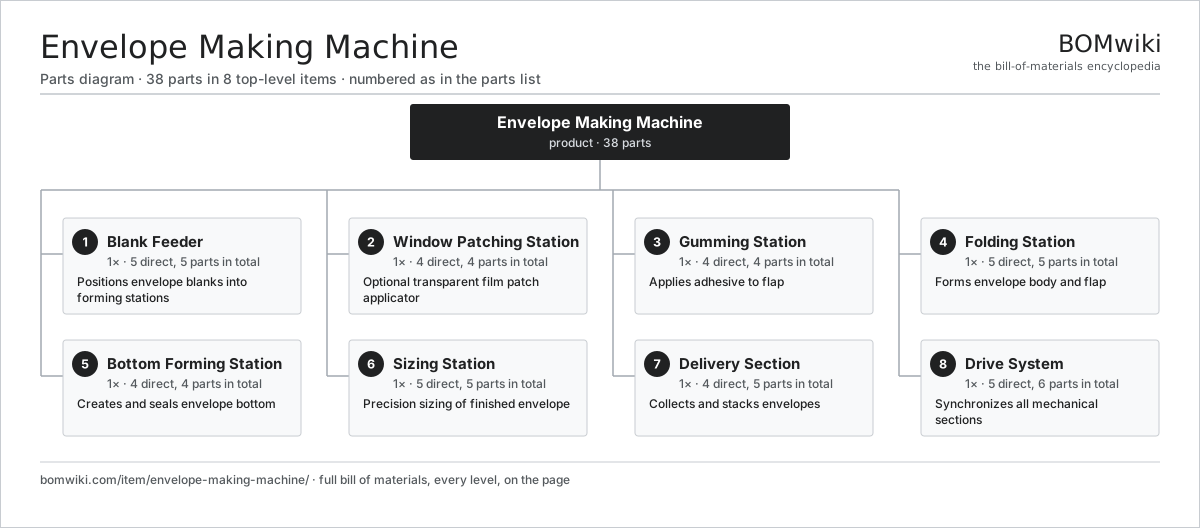
| # | Part | Qty | What it does |
|---|---|---|---|
| 1 | Blank Feeder 5 parts | 1× | Positions envelope blanks into forming stations |
| 2 | Window Patching Station 4 parts | 1× | Optional transparent film patch applicator |
| 3 | Gumming Station 4 parts | 1× | Applies adhesive to flap |
| 4 | Folding Station 5 parts | 1× | Forms envelope body and flap |
| 5 | Bottom Forming Station 4 parts | 1× | Creates and seals envelope bottom |
| 6 | Sizing Station 5 parts | 1× | Precision sizing of finished envelope |
| 7 | Delivery Section 4 parts | 1× | Collects and stacks envelopes |
| 8 | Drive System 5 parts | 1× | Synchronizes all mechanical sections |
3D model
No 3D model yet. Have a CAD file of this? Add a 3D model. STL renders right on this page; STEP, FreeCAD, and OpenSCAD sources are welcome too (openly licensed, like all 3D models on BOMwiki).
Build & assembly graph
expand / collapse · shared sub-assemblies converge · links to related products · est. labourTap an assembly to expand/collapse · tap a part to open it · use “Open page” for any node · drag to pan, scroll to zoom.
Bill of materials for Envelope Making Machine
8 top-level lines · 44 rows shown · 38 parts total · indented to 3 levels| # | Item / sub-assembly | Part no. | Qty/assy | Ext. qty | Parts | Type |
|---|---|---|---|---|---|---|
| 1 | Blank Feeder 5 parts | envelope-making-machine-blank-feeder | 1× | 1 | 5 | assembly |
| 1.1 | Feed Drive Motor | envelope-making-machine-feed-motor | 1× | 1 | · | part |
| 1.2 | Feeder Vacuum Pump | envelope-making-machine-vacuum-pump-feeder | 1× | 1 | · | part |
| 1.3 | Separator Finger | envelope-making-machine-separator-finger | 1× | 1 | · | part |
| 1.4 | Blank Alignment Guide | envelope-making-machine-blank-alignment | 1× | 1 | · | part |
| 1.5 | Feed Position Sensor | envelope-making-machine-feed-sensor | 1× | 1 | · | part |
| 2 | Window Patching Station 4 parts | envelope-making-machine-window-patching | 1× | 1 | 4 | assembly |
| 2.1 | Patch Film Unwind | envelope-making-machine-patch-film-unwind | 1× | 1 | · | part |
| 2.2 | Patch Applicator Roller | envelope-making-machine-patch-applicator-roller | 1× | 1 | · | part |
| 2.3 | Patch Trim Blade | envelope-making-machine-patch-trim-blade | 1× | 1 | · | part |
| 2.4 | Patch Motor | envelope-making-machine-patch-motor | 1× | 1 | · | part |
| 3 | Gumming Station 4 parts | envelope-making-machine-gumming-station | 1× | 1 | 4 | assembly |
| 3.1 | Adhesive Pump | envelope-making-machine-glue-pump | 1× | 1 | · | part |
| 3.2 | Adhesive Roller | envelope-making-machine-glue-roller | 1× | 1 | · | part |
| 3.3 | Adhesive Tank | envelope-making-machine-glue-tank | 1× | 1 | · | part |
| 3.4 | Adhesive Sensor | envelope-making-machine-glue-sensor | 1× | 1 | · | part |
| 4 | Folding Station 5 parts | envelope-making-machine-folding-station | 1× | 1 | 5 | assembly |
| 4.1 | Left Fold Blade | envelope-making-machine-fold-blade-left | 1× | 1 | · | part |
| 4.2 | Right Fold Blade | envelope-making-machine-fold-blade-right | 1× | 1 | · | part |
| 4.3 | Back Fold Blade | envelope-making-machine-fold-blade-back | 1× | 1 | · | part |
| 4.4 | Fold Drive Motor | envelope-making-machine-fold-motor | 1× | 1 | · | part |
| 4.5 | Fold Sensor | envelope-making-machine-fold-sensor | 1× | 1 | · | part |
| 5 | Bottom Forming Station 4 parts | envelope-making-machine-bottom-forming | 1× | 1 | 4 | assembly |
| 5.1 | Bottom Fold Block | envelope-making-machine-bottom-fold-station | 1× | 1 | · | part |
| 5.2 | Bottom Adhesive Applicator | envelope-making-machine-bottom-glue-applicator | 1× | 1 | · | part |
| 5.3 | Bottom Press | envelope-making-machine-bottom-press | 1× | 1 | · | part |
| 5.4 | Bottom Drive Motor | envelope-making-machine-bottom-motor | 1× | 1 | · | part |
| 6 | Sizing Station 5 parts | envelope-making-machine-sizing-station | 1× | 1 | 5 | assembly |
| 6.1 | Top Trim Blade | envelope-making-machine-trim-blade-top | 1× | 1 | · | part |
| 6.2 | Bottom Trim Blade | envelope-making-machine-trim-blade-bottom | 1× | 1 | · | part |
| 6.3 | Left Trim Blade | envelope-making-machine-trim-blade-left | 1× | 1 | · | part |
| 6.4 | Right Trim Blade | envelope-making-machine-trim-blade-right | 1× | 1 | · | part |
| 6.5 | Trim Drive Motor | envelope-making-machine-trim-motor | 1× | 1 | · | part |
| 7 | Delivery Section 4 parts | envelope-making-machine-delivery-section | 1× | 1 | 5 | assembly |
| 7.1 | Delivery Conveyor Belt | envelope-making-machine-delivery-belt | 1× | 1 | · | part |
| 7.2 | Delivery Motor | envelope-making-machine-delivery-motor | 1× | 1 | · | part |
| 7.3 | Envelope Counter | envelope-making-machine-envelope-counter | 1× | 1 | · | part |
| 7.4 | Ball Bearing | ball-bearing | 2× | 2 | · | part |
| 8 | Drive System 5 parts | envelope-making-machine-drive-system | 1× | 1 | 6 | assembly |
| 8.1 | Main Drive Motor | envelope-making-machine-main-motor | 1× | 1 | · | part |
| 8.2 | Main Gearbox | envelope-making-machine-gearbox-main | 1× | 1 | · | part |
| 8.3 | Timing Belt | envelope-making-machine-timing-belt | 1× | 1 | · | part |
| 8.4 | Timing Pulley | envelope-making-machine-pulley | 2× | 2 | · | part |
| 8.5 | Shaft Coupler | envelope-making-machine-shaft-coupler | 1× | 1 | · | part |
Something wrong in this list? Report a problem with this BOM.
Sourcing: possible vendors
Browse the supplier directory → Prices, MOQ, and lead times are algorithmic estimates, not quotes, and not claims about these companies. Company mappings are curated by keyword; est. price band $10k–$3M. How estimates work| Vendor | HQ | Specialty | MOQ | Lead time |
|---|---|---|---|---|
| heidelberg.com ↗ | Heidelberg, DE | Printing presses | 10 units | 12–22 wks |
|
🇨🇭Bobst
bobst.com ↗
|
Lausanne, CH | Packaging machinery | 10 units | 12–22 wks |
| koenig-bauer.com ↗ | Würzburg, DE | Printing presses | 10 units | 12–22 wks |
| wuh-group.com ↗ | Lengerich, DE | Flexible packaging machines | 10 units | 12–22 wks |
| markandy.com ↗ | Chesterfield, US | Label presses | 10 units | 12–22 wks |
1,128-word article