Equatorial Mount
ProductAlso known as: equatorial telescope mount
Overview
The equatorial mount is the astronomer's choice for long-exposure work. By aligning its polar axis with Earth's axis of rotation, it can track a star with a single motor turning at sidereal rate, the same speed Earth rotates. This eliminates field rotation, keeps an object centered in the eyepiece for hours, and is essential for astrophotography where exposures might last minutes or hours.
The mount has two axes: the right ascension (RA) axis points toward the north celestial pole and rotates once per sidereal day, and the declination (Dec) axis is perpendicular and sweeps from north to south. The RA Motor Drive turns the RA axis at an exact sidereal rate, approximately one turn per 23 hours 56 minutes, so a telescope mounted on the head appears stationary in the sky. The Dec Motor Drive allows the observer or autoguider to adjust declination to correct drift or to slew to nearby targets.
At the Support Tripod, a stable three-legged base supports the entire assembly at a height comfortable for viewing. The Counterweight System balances the telescopes's weight so the motors work against light friction rather than fighting gravity, improving tracking stability and motor longevity.
How it works
The key insight is that by tilting the RA axis to match your latitude, a single rotation becomes true tracking. The RA axis points toward the north celestial pole, the spot directly above the Earth's north pole in the sky. As this axis turns once per day, any telescope attached to it rotates with the celestial sphere itself, keeping the same stars in view with zero apparent motion.
The RA Motor Drive is the heart of this system. A synchronous motor turns at exactly sidereal rate, about 0.25 revolutions per hour. (Early designs used synchronous AC motors running at 60 Hz, which naturally rotate at 3600 rpm; gearing reduces this to sidereal rate.) Modern designs use stepper motors and microcontroller timing to achieve the same result. The motor drives a worm gear paired with a worm wheel, a design that offers high mechanical advantage and inherent friction, a worm wheel cannot backdrive the worm, so the mount holds position without slip.
The Declination Axis is independent. A variable-speed stepper motor can slew the scope north or south to target any declination. Once a target is in the field, the observer leaves the RA motor running and makes corrections only in declination.
Polar alignment is the setup ritual every equatorial mount demands. The RA axis must point at the celestial pole, or tracking will be off. Most mounts include a small low-power refractor aligned with the RA axis. The observer rotates the mount until a known pole star (Polaris in the northern hemisphere) appears in the reticle, and with some fine-tuning, the mount is ready. A poorly aligned mount will cause stars to drift eastward or westward during an exposure.
The Counterweight System serves balance. An unbalanced mount requires the RA motor to push against gravity constantly, wasting power and introducing periodic error. A sliding counterweight on the Dec axis shifts to match the payload, bringing the center of mass back to the axis of rotation. With proper balance, the mount moves smoothly and holds position with the motors powered off.
Most equatorial mounts are German equatorial or fork designs. German mounts use a pillar rising from the tripod with the RA axis at the top; a Dec axis crosses it horizontally, and the scope hangs from a fork-shaped bracket. Fork mounts use a U-shaped yoke with the RA axis as the base pivot and the Dec axis between the prongs, simplifying setup but limiting declination range. Both designs serve professional observatories and serious amateurs equally well.
Equatorial Mount parts and their functions
10 top-level parts · 95 parts in total · full bill of materials below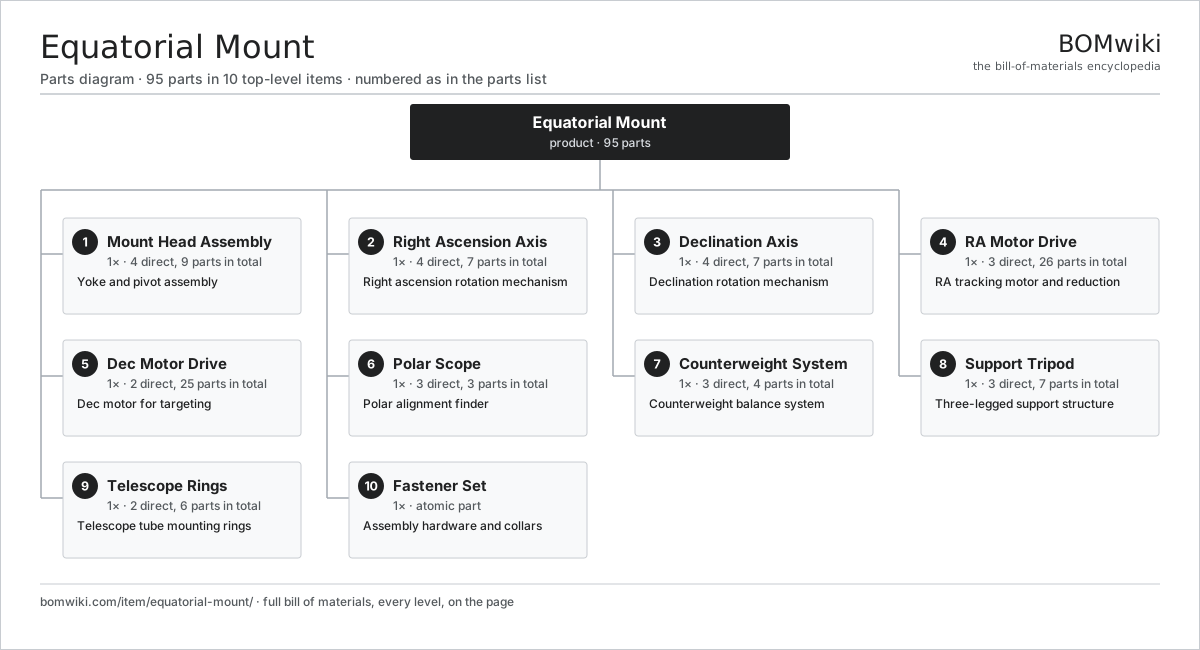
| # | Part | Qty | What it does |
|---|---|---|---|
| 1 | Mount Head Assembly 4 parts | 1× | Yoke and pivot assembly |
| 2 | Right Ascension Axis 4 parts | 1× | Right ascension rotation mechanism |
| 3 | Declination Axis 4 parts | 1× | Declination rotation mechanism |
| 4 | RA Motor Drive 3 parts | 1× | RA tracking motor and reduction |
| 5 | Dec Motor Drive 2 parts | 1× | Dec motor for targeting |
| 6 | Polar Scope 3 parts | 1× | Polar alignment finder |
| 7 | Counterweight System 3 parts | 1× | Counterweight balance system |
| 8 | Support Tripod 3 parts | 1× | Three-legged support structure |
| 9 | Telescope Rings 2 parts | 1× | Telescope tube mounting rings |
| 10 | Fastener Set | 1× | Assembly hardware and collars |
3D model
No 3D model yet. Have a CAD file of this? Add a 3D model. STL renders right on this page; STEP, FreeCAD, and OpenSCAD sources are welcome too (openly licensed, like all 3D models on BOMwiki).
Build & assembly graph
expand / collapse · shared sub-assemblies converge · links to related products · est. labourTap an assembly to expand/collapse · tap a part to open it · use “Open page” for any node · drag to pan, scroll to zoom.
Bill of materials for Equatorial Mount
10 top-level lines · 46 rows shown · 95 parts total · indented to 3 levels| # | Item / sub-assembly | Part no. | Qty/assy | Ext. qty | Parts | Type |
|---|---|---|---|---|---|---|
| 1 | Mount Head Assembly 4 parts | equatorial-mount-head | 1× | 1 | 9 | assembly |
| 1.1 | Yoke Structure | equatorial-mount-yoke | 1× | 1 | · | part |
| 1.2 | RA Bearing Block | equatorial-mount-ra-bearing-block | 2× | 2 | · | part |
| 1.3 | Dec Bearing Block | equatorial-mount-dec-bearing-block | 2× | 2 | · | part |
| 1.4 | Connector Plate | equatorial-mount-connector-plates | 4× | 4 | · | part |
| 2 | Right Ascension Axis 4 parts | equatorial-mount-ra-axis | 1× | 1 | 7 | assembly |
| 2.1 | RA Shaft | equatorial-mount-ra-shaft | 1× | 1 | · | part |
| 2.2 | RA Worm Gear | equatorial-mount-ra-worm-gear | 1× | 1 | · | part |
| 2.3 | RA Worm Wheel | equatorial-mount-ra-worm-wheel | 1× | 1 | · | part |
| 2.4 | Ball Bearing | ball-bearing | 4× | 4 | · | part |
| 3 | Declination Axis 4 parts | equatorial-mount-dec-axis | 1× | 1 | 7 | assembly |
| 3.1 | Dec Shaft | equatorial-mount-dec-shaft | 1× | 1 | · | part |
| 3.2 | Dec Worm Gear | equatorial-mount-dec-worm-gear | 1× | 1 | · | part |
| 3.3 | Dec Worm Wheel | equatorial-mount-dec-worm-wheel | 1× | 1 | · | part |
| 3.4 | Ball Bearing | ball-bearing | 4× | 4 | · | part |
| 4 | RA Motor Drive 3 parts | equatorial-mount-ra-motor-drive | 1× | 1 | 26 | assembly |
| 4.1 | Servo Motor 4 parts | servo-motor | 1× | 1 | 24 | assembly |
| 4.1.1 | Stator Assembly 3 parts + deeper › | stator-assembly | 1× | 1 | 3 | assembly |
| 4.1.2 | Rotor Assembly 4 parts + deeper › | rotor-assembly | 1× | 1 | 19 | assembly |
| 4.1.3 | Encoder | encoder | 1× | 1 | · | part |
| 4.1.4 | Motor Housing | motor-housing | 1× | 1 | · | part |
| 4.2 | RA Reduction Gear Set | equatorial-mount-ra-reduction-gears | 1× | 1 | · | part |
| 4.3 | Motor Coupling | equatorial-mount-motor-coupling | 1× | 1 | · | part |
| 5 | Dec Motor Drive 2 parts | equatorial-mount-dec-motor-drive | 1× | 1 | 25 | assembly |
| 5.1 | Servo Motor 4 parts | servo-motor | 1× | 1 | 24 | assembly |
| 5.1.1 | Stator Assembly 3 parts + deeper › | stator-assembly | 1× | 1 | 3 | assembly |
| 5.1.2 | Rotor Assembly 4 parts + deeper › | rotor-assembly | 1× | 1 | 19 | assembly |
| 5.1.3 | Encoder | encoder | 1× | 1 | · | part |
| 5.1.4 | Motor Housing | motor-housing | 1× | 1 | · | part |
| 5.2 | Dec Reduction Gear Set | equatorial-mount-dec-reduction-gears | 1× | 1 | · | part |
| 6 | Polar Scope 3 parts | equatorial-mount-polar-scope | 1× | 1 | 3 | assembly |
| 6.1 | Polar Scope Barrel | equatorial-mount-polar-scope-barrel | 1× | 1 | · | part |
| 6.2 | Polar Scope Lens | equatorial-mount-polar-scope-lens | 1× | 1 | · | part |
| 6.3 | Polar Scope Reticle | equatorial-mount-polar-scope-reticle | 1× | 1 | · | part |
| 7 | Counterweight System 3 parts | equatorial-mount-counterweight-shaft | 1× | 1 | 4 | assembly |
| 7.1 | Counterweight Rod | equatorial-mount-counterweight-shaft-rod | 1× | 1 | · | part |
| 7.2 | Counterweight Ring | equatorial-mount-counterweight-rings | 2× | 2 | · | part |
| 7.3 | Balance Clamp | equatorial-mount-balance-clamp | 1× | 1 | · | part |
| 8 | Support Tripod 3 parts | equatorial-mount-tripod | 1× | 1 | 7 | assembly |
| 8.1 | Tripod Leg | equatorial-mount-tripod-legs | 3× | 3 | · | part |
| 8.2 | Tripod Apex | equatorial-mount-tripod-apex | 1× | 1 | · | part |
| 8.3 | Tripod Spreader | equatorial-mount-tripod-spreaders | 3× | 3 | · | part |
| 9 | Telescope Rings 2 parts | equatorial-mount-head-rings | 1× | 1 | 6 | assembly |
| 9.1 | Ring Shell Half | equatorial-mount-ring-shells | 2× | 2 | · | part |
| 9.2 | Ring Collar | equatorial-mount-ring-collars | 4× | 4 | · | part |
| 10 | Fastener Set | fastener-set | 1× | 1 | · | part |
Something wrong in this list? Report a problem with this BOM.
Related products
same domain, ranked by shared parts Camera Motion Control Rig
210 parts · shares 12 with this page
Camera Motion Control Rig
210 parts · shares 12 with this page
 Digital Cinema Camera
305 parts · shares 12 with this page
Digital Cinema Camera
305 parts · shares 12 with this page
 Digital Cinema Projector
383 parts · shares 12 with this page
Digital Cinema Projector
383 parts · shares 12 with this page
 Industrial 3D Scanner
149 parts · shares 12 with this page
Industrial 3D Scanner
149 parts · shares 12 with this page
 Laser Tracker
142 parts · shares 12 with this page
Laser Tracker
142 parts · shares 12 with this page
 Microfilm Scanner
348 parts · shares 12 with this page
Microfilm Scanner
348 parts · shares 12 with this page
Sourcing: possible vendors
Browse the supplier directory → Prices, MOQ, and lead times are algorithmic estimates, not quotes, and not claims about these companies. Company mappings are curated by keyword; est. price band $100–$8k. How estimates work| Vendor | HQ | Specialty | MOQ | Lead time |
|---|---|---|---|---|
|
🇯🇵Canon
canon.com ↗
|
Tokyo, JP | Imaging & optics | 500 units | 10–16 wks |
|
🇯🇵Nikon
nikon.com ↗
|
Tokyo, JP | Imaging & optics | 500 units | 10–16 wks |
|
🇩🇪ZEISS
zeiss.com ↗
|
Oberkochen, DE | Optics & optoelectronics | 500 units | 10–16 wks |
| leica-camera.com ↗ | Wetzlar, DE | Cameras & optics | 500 units | 10–16 wks |
| flir.com ↗ | Wilsonville, US | Thermal imaging | 500 units | 10–16 wks |
679-word article