Evaporative Condenser
ProductOverview
An evaporative condenser rejects refrigeration heat through a hybrid mechanism: hot refrigerant vapor flows through a tube bundle while water is sprayed externally over the tubes, and ambient air is drawn upward through the bundle by an axial fan. As the water film evaporates on the coil surface, it absorbs latent heat from the refrigerant, enabling condensation at temperatures much lower than air-only cooling would allow. This achieves 30–300 kW heat rejection from a compact unit suitable for food processing, industrial refrigeration, and hydrocarbon vapor recovery applications.
The tube bundle receives hot vapor at 50–80 °C from a compressor discharge line. A recirculating water loop applies 10–50 m³/h to the coil surface via spray nozzles, forming a thin film. An axial fan draws ambient air upward through the bundle at 1–4 m/s; water evaporates from the tube surfaces, removing latent heat (~2400 kJ/kg for water), while the refrigerant inside condenses and returns as liquid to the expansion valve.
Evaporative condensers consume 30–50% less energy than air-cooled units because water evaporation amplifies heat transfer far beyond air's sensible cooling capacity. However, they require on-site water supply (city water, well, or reclaimed), water treatment (minerals and algae control), and compliance with local water-conservation regulations.
How it works
Refrigerant circuit: Superheated discharge gas enters the inlet manifold at 50–80 °C and 15–25 bar (depending on refrigerant and load). As the gas travels through the tube coil (typically 6–12 rows deep, each tube paralleled for low pressure drop), it loses sensible heat first (desuperheating phase), then undergoes phase change to liquid (condensing phase), exiting as subcooled liquid at 10–20 °C and near-saturated pressure. A discharge manifold collects liquid and delivers it via isolation valves to the refrigeration circuit.
Evaporative water loop: The pump (1–3 kW motor-driven centrifugal type) draws water from the basin at 200–2000 L inventory and pressurizes it to 2–3 bar. Water sprays across the coil header via 6–12 hollow-cone nozzles, forming a fine mist that wets the tube bundle. Water drains by gravity back to the sump; some fraction evaporates (latent heat removal) and is replenished by float-controlled makeup water from the facility supply.
Air draft: The fan motor (2–5 kW) spins an aluminum propeller at 1800 RPM, drawing 1–4 m³/s of ambient air upward through the coil and drift eliminator. The air contacts the wet tube surfaces and water droplets, absorbing sensible heat (warm-up) and latent heat (evaporation). Humid exhaust air exits at 5–10 °C above ambient wet-bulb temperature (approach of 3–5 °C is typical). The eliminator pads capture 95–99% of entrained water droplets, preventing water loss and visible plume.
Water quality control: Mineral buildup (calcium, magnesium salts from hard water) and algae growth are managed via chemical treatment (oxidizing or non-oxidizing biocides, scale inhibitors). A float switch triggers low-level alarms if evaporation rate exceeds makeup; this alerts operators to blockages in supply or spray nozzles. The basin drain allows periodic bleed-down of concentrated minerals (5–10% of basin volume replaced daily in hard-water regions).
Temperature & pressure control: A condensing temperature sensor (RTD or thermostat) monitors the bulk liquid temperature. If condensing pressure rises (indicating fouled coil), the fan speed controller ramps the fan from 0–100% via 0–10 V proportional input, modulating airflow to stabilize discharge pressure. Many designs include manual inlet dampers for load-shedding during low-ambient operation.
Thermodynamic Advantage
Energy balance:
- Latent heat of water evaporation: ~2400 kJ/kg (vs. sensible air capacity ~1.0 kJ/kg·K).
- A 100 kW load requiring 10 kg/s air alone needs massive fan/ductwork.
- The same load evaporating 0.05 kg/s water (120 L/h) achieves equivalent duty with 10–50% less fan power.
Approach & range:
- Approach (°C): Temperature difference between condensing temp and ambient wet-bulb. Typical 3–5 °C.
- Range (°C): Temperature rise of the circulated water (inlet to outlet). Typical 8–15 °C.
- Effectiveness: (Range / (Range + Approach)) × 100%. Evaporative condensers achieve 70–80% effectiveness vs. 40–50% for dry air-cooled.
Installation & Water Supply
Makeup water source:
- City water: Treated, but high mineral content (hardness >200 ppm) requires softening.
- Well water: Variable hardness and iron content; filtration and chemical treatment essential.
- Reclaimed/recirculated water: Possible with aggressive biocide programs; local regulations vary.
Discharge: Blowdown (basin drain) typically 5–10% of circulated flow daily; must meet local environmental codes (stormwater, wastewater treatment).
Legionella risk: Warm water (25–35 °C) and biofilm can harbor Legionella pneumophila. Compliance requires:
- Biocide program (oxidizing chlorine or Bromo-chloro-5,5-dimethyl-hydantoin).
- Temperature monitoring; avoid 20–45 °C stagnation zones.
- Regular basin cleaning and drift-eliminator maintenance.
Maintenance & Seasonal Operation
Monthly: Inspect nozzles for mineral buildup; clean with citric acid solution if flow reduces >10%.
Quarterly: Drain basin, flush accumulated sludge; replace makeup water with treated supply.
Winter shutdown: Drain all water if freezing is possible; glycol-based antifreeze option if glyerol additives are compatible with refrigerant.
Coil cleaning: Every 2–3 years, chemical descaling (mild acid or chelant) removes mineral scale from tube surfaces.
Standards & Compliance
- ASHRAE 15: Safety code for refrigerants and safe pressure vessels.
- ASHRAE 90.1: Efficiency minimum; evaporative condensers preferred over air-cooled in water-rich climates.
- EPA WaterSense: Water efficiency labeling (low-blowdown designs).
- OSHA PSM: Process Safety Management for systems >threshold quantities of refrigerant.
- Local legionella codes: Vary by jurisdiction (some mandate testing and certification).
Comparison with Alternatives
| Feature | Evaporative | Air-Cooled | Chilled-Water |
|---|---|---|---|
| Energy efficiency | Highest (30–50% less fan power) | Moderate | Depends on chiller source |
| Water consumption | 5–20 m³/day typical | None | Minimal (HTX cooling only) |
| Footprint | Compact (2–4 m) | Large (4–6 m) | Modular, multiple units |
| Install complexity | Medium (water supply required) | Low | Medium (chiller loop) |
| Noise | 75–85 dB | 70–80 dB | 55–70 dB |
| Maintenance | Moderate (water treatment) | Low | Low |
Evaporative condensers dominate in climates with low wet-bulb temp (desert, high altitude) and plentiful water; air-cooled units are preferred where water is scarce or regulations prohibit discharge.
Evaporative Condenser parts and their functions
8 top-level parts · 53 parts in total · full bill of materials below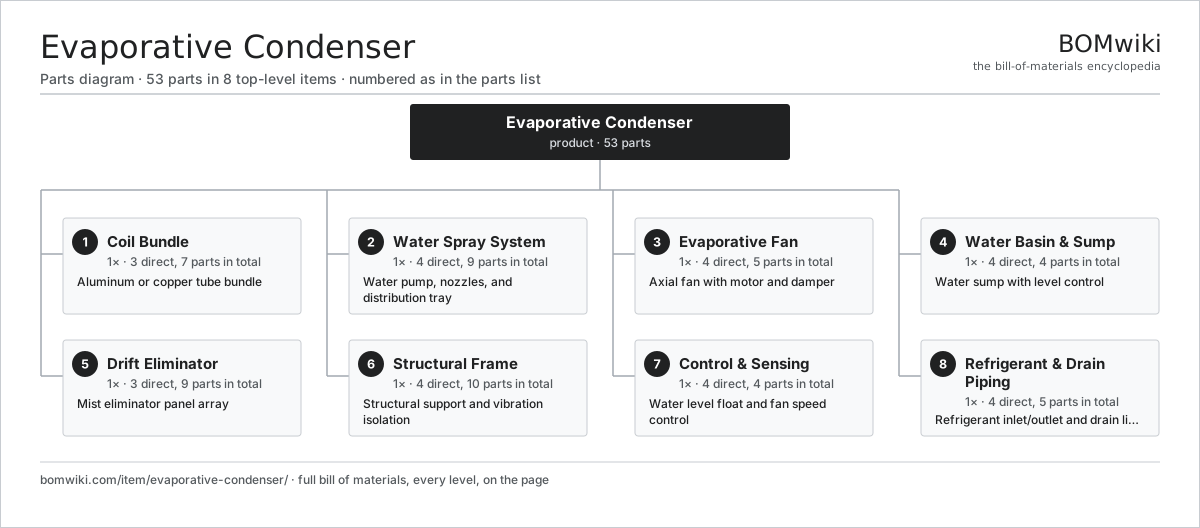
| # | Part | Qty | What it does |
|---|---|---|---|
| 1 | Coil Bundle 3 parts | 1× | Aluminum or copper tube bundle |
| 2 | Water Spray System 4 parts | 1× | Water pump, nozzles, and distribution tray |
| 3 | Evaporative Fan 4 parts | 1× | Axial fan with motor and damper |
| 4 | Water Basin & Sump 4 parts | 1× | Water sump with level control |
| 5 | Drift Eliminator 3 parts | 1× | Mist eliminator panel array |
| 6 | Structural Frame 4 parts | 1× | Structural support and vibration isolation |
| 7 | Control & Sensing 4 parts | 1× | Water level float and fan speed control |
| 8 | Refrigerant & Drain Piping 4 parts | 1× | Refrigerant inlet/outlet and drain lines |
3D model
No 3D model yet. Have a CAD file of this? Add a 3D model. STL renders right on this page; STEP, FreeCAD, and OpenSCAD sources are welcome too (openly licensed, like all 3D models on BOMwiki).
Build & assembly graph
expand / collapse · shared sub-assemblies converge · links to related products · est. labourTap an assembly to expand/collapse · tap a part to open it · use “Open page” for any node · drag to pan, scroll to zoom.
Bill of materials for Evaporative Condenser
8 top-level lines · 38 rows shown · 53 parts total · indented to 3 levels| # | Item / sub-assembly | Part no. | Qty/assy | Ext. qty | Parts | Type |
|---|---|---|---|---|---|---|
| 1 | Coil Bundle 3 parts | evaporative-condenser-coil-bundle | 1× | 1 | 7 | assembly |
| 1.1 | Tube Header | evaporative-condenser-tube-manifold | 1× | 1 | · | part |
| 1.2 | Tube Coil | evaporative-condenser-tube-coil | 4× | 4 | · | part |
| 1.3 | Coil Support | evaporative-condenser-coil-support | 2× | 2 | · | part |
| 2 | Water Spray System 4 parts | evaporative-condenser-spray-system | 1× | 1 | 9 | assembly |
| 2.1 | Spray Pump | evaporative-condenser-spray-pump | 1× | 1 | · | part |
| 2.2 | Distribution Tray | evaporative-condenser-distribution-tray | 1× | 1 | · | part |
| 2.3 | Spray Nozzle | evaporative-condenser-spray-nozzle | 6× | 6 | · | part |
| 2.4 | Pump Motor | evaporative-condenser-pump-motor | 1× | 1 | · | part |
| 3 | Evaporative Fan 4 parts | evaporative-condenser-fan | 1× | 1 | 5 | assembly |
| 3.1 | Fan Blade | evaporative-condenser-fan-blade | 1× | 1 | · | part |
| 3.2 | Fan Motor | evaporative-condenser-fan-motor | 1× | 1 | · | part |
| 3.3 | Inlet Damper | evaporative-condenser-damper | 1× | 1 | · | part |
| 3.4 | Motor Bearing | evaporative-condenser-motor-bearing | 2× | 2 | · | part |
| 4 | Water Basin & Sump 4 parts | evaporative-condenser-basin | 1× | 1 | 4 | assembly |
| 4.1 | Basin Pan | evaporative-condenser-basin-pan | 1× | 1 | · | part |
| 4.2 | Float Switch | evaporative-condenser-water-level-float | 1× | 1 | · | part |
| 4.3 | Makeup Water Line | evaporative-condenser-makeup-water-line | 1× | 1 | · | part |
| 4.4 | Basin Drain Valve | evaporative-condenser-drain-valve | 1× | 1 | · | part |
| 5 | Drift Eliminator 3 parts | evaporative-condenser-drift-eliminator | 1× | 1 | 9 | assembly |
| 5.1 | Eliminator Frame | evaporative-condenser-eliminator-frame | 1× | 1 | · | part |
| 5.2 | Eliminator Pad | evaporative-condenser-eliminator-pad | 4× | 4 | · | part |
| 5.3 | Eliminator Gasket | evaporative-condenser-eliminator-gasket | 4× | 4 | · | part |
| 6 | Structural Frame 4 parts | evaporative-condenser-frame | 1× | 1 | 10 | assembly |
| 6.1 | Frame Beam | evaporative-condenser-frame-beam | 1× | 1 | · | part |
| 6.2 | Mounting Leg | evaporative-condenser-mounting-leg | 4× | 4 | · | part |
| 6.3 | Isolation Pad | evaporative-condenser-isolation-pad | 4× | 4 | · | part |
| 6.4 | Fastener Kit | evaporative-condenser-bolt-set | 1× | 1 | · | part |
| 7 | Control & Sensing 4 parts | evaporative-condenser-controls | 1× | 1 | 4 | assembly |
| 7.1 | Level Sensor | evaporative-condenser-water-level-sensor | 1× | 1 | · | part |
| 7.2 | Low-Level Alarm | evaporative-condenser-low-level-alarm | 1× | 1 | · | part |
| 7.3 | Speed Controller | evaporative-condenser-fan-speed-controller | 1× | 1 | · | part |
| 7.4 | Temperature Probe | evaporative-condenser-temperature-probe | 1× | 1 | · | part |
| 8 | Refrigerant & Drain Piping 4 parts | evaporative-condenser-piping | 1× | 1 | 5 | assembly |
| 8.1 | Inlet Manifold | evaporative-condenser-inlet-manifold | 1× | 1 | · | part |
| 8.2 | Outlet Manifold | evaporative-condenser-outlet-manifold | 1× | 1 | · | part |
| 8.3 | Isolation Valve | evaporative-condenser-isolation-valve | 2× | 2 | · | part |
| 8.4 | Drain Line | evaporative-condenser-drain-line | 1× | 1 | · | part |
Something wrong in this list? Report a problem with this BOM.
Sourcing: possible vendors
Browse the supplier directory → Prices, MOQ, and lead times are algorithmic estimates, not quotes, and not claims about these companies. Company mappings are curated by keyword; est. price band $100–$20k. How estimates work| Vendor | HQ | Specialty | MOQ | Lead time |
|---|---|---|---|---|
|
🇺🇸Carrier
carrier.com ↗
|
Palm Beach Gardens, US | HVAC | 500 units | 8–14 wks |
| tranetechnologies.com ↗ | Davidson, US | HVAC | 500 units | 8–14 wks |
|
🇯🇵Daikin
daikin.com ↗
|
Osaka, JP | HVAC | 500 units | 8–14 wks |
|
🇺🇸Lennox
lennox.com ↗
|
Richardson, US | HVAC | 500 units | 8–14 wks |
| johnsoncontrols.com ↗ | Milwaukee, US | Building systems | 500 units | 8–14 wks |
1,129-word article