Poultry Evisceration Line
ProductOverview
A poultry evisceration line is a fully automated or semi-automated conveyor system that removes internal organs and viscera from plucked, chilled poultry carcasses. The line operates continuously, moving birds on overhead shackles through a sequence of processing stations: abdominal opening (cutting), viscera drawing and extraction, inspection, and final washing and cooling. A modern line processes 600–1800 birds per hour, with each bird spending 3–6 minutes on the conveyor from opening to final chill discharge.
The evisceration line is the central hub of a poultry processing plant, positioned downstream of the Poultry Plucker and upstream of cutting and portioning. It is the most labor-intensive stage in traditional plants (historically 8–15 operators per line) but increasingly automated with pneumatic and robotic viscera extractors and machine-vision inspection systems. Modern fully automated lines (rare in 2025) require only 2–4 attendants for quality monitoring and rejection handling.
How it Works
The Overhead Shackle Conveyor is an overhead chain-driven shackle system. Each bird is individually suspended from a stainless steel shackle that grips the leg and is attached to a motorized Conveyor Chain. The chain runs on an overhead structural steel rail (I-beam or tube, 200–400 mm tall) that spans the entire line length. The chain is driven by a motorized drive sprocket and variable-frequency motor, allowing the operator to adjust conveyor speed (0.1–0.4 m/s) via control panel. At maximum speed (0.4 m/s), a line produces ~1800 broilers/hour; at slower speeds, throughput decreases proportionally.
Birds are manually hung from the shackles at the upstream end or automatically loaded by a deplucker or hanging system. As the chain advances, birds are carried through each processing station in sequence.
At the opening station, an automated cutting blade (typically a reciprocating stainless surgical blade or small circular saw, driven by pneumatic or servo actuator) makes a precise 30–50 mm incision in the lower abdomen, from the sternum toward the cloaca. The position sensor detects bird arrival and triggers the blade (50–100 mm stroke, ~60 cycles/min), cutting only through skin and muscle without puncturing the viscera. A properly positioned cut opens the abdominal cavity for manual or robotic drawing in the next station.
At the drawing station, a pneumatic or robotic gripper arm extends into the open carcass and grabs the viscera (the interconnected mass of intestines, stomach, liver, spleen, and mesentery). The gripper pulls sharply outward, separating the viscera from the carcass wall. Simultaneously, a blade severs the trachea (upper) and mesentery (connective tissue), freeing the entire viscera pack. In semi-automated lines, a skilled operator uses manual hooks to perform the same task. The extracted viscera drops into a waste tray, where edible organs (liver, heart) are manually sorted, or in fully automated plants, sorted by vision-guided robotic arms into a separate Giblet Harvester system.
At the inspection station, an automated vision system or manual operator visually examines the open carcass cavity for retained viscera fragments, contamination, discoloration, or other defects. A bird detected with defects is automatically diverted via a pneumatic reject gate to a secondary inspection or disposal conveyor.
In the washing section, the carcass passes under overhead spray manifolds delivering clean water (1.5–2 bar, 1–2 m³/min) inside and outside the cavity, rinsing away loose viscera fragments and blood clots. Water is supplied by a stainless high-pressure pump.
Finally, in the chilling section, the carcass is immersed in an ice water tank (0–2 °C, typically glycol-refrigerated via chiller unit) for 1–2 minutes, rapidly cooling the internal temperature to 4 °C or below. This halts bacterial growth and sets the carcass for subsequent cuts and packaging.
Conveyor and Shackle System
The Conveyor Chain is stainless steel AISI 304 welded link, 25 mm pitch, continuous. The shackles are spaced 150–200 mm apart (center-to-center), accommodating broilers (spaced closer, faster handling) or larger turkeys (spaced wider). Each shackle is a stainless or galvanized steel U-bolt that grips the bird's upper leg bone, suspending the carcass vertically. Shackles must be readily removable for cleaning and sanitization; quick-change clips allow replacement in seconds.
The overhead rail is structural steel (100–150 mm box section or I-beam) supported by cross-members every 2–3 m. The rail must be rigid to prevent deflection (which causes uneven bird position at stations) and must withstand the full chain and bird weight (3–8 tons depending on line length and capacity). Flanged wheel sets (150–200 mm diameter, mounted in pillow blocks) run on the top or inside surface of the rail, guided by the flange.
The drive is at one end: a three-phase VFD motor (3–5 kW, 1400 rpm) couples through a gearbox (10–20:1 ratio) to the drive sprocket, which meshes with the chain. A spring-loaded chain tensioner maintains consistent tension.
Opening Station Design
The abdominal incision is critical: too shallow and the viscera are not fully exposed; too deep and the blade enters the intestinal cavity, contaminating the meat. The Cutting Blade is typically a reciprocating linear blade (25–50 mm stroke, driven by a 40–60 mm pneumatic cylinder) or a small 50–80 mm diameter circular saw blade. Blade speed is 50–80 Hz (cycles/min) to match the conveyor pace.
The position sensor (optical or mechanical proximity switch) detects bird arrival at the station (from shackle position or bird size estimation) and triggers a single stroke at the precise moment the abdomen is centered under the blade. Timing accuracy is ±20–30 mm; poor timing results in off-center cuts that leave viscera partially exposed or cause blade contact with ribs or spine.
The blade guard is a polycarbonate or stainless steel hood enclosing the blade area, protecting operators from spray and accidental contact. Safety interlocks prevent blade activation if the guard is open.
Drawing Station: Manual vs. Robotic
In traditional semi-automated lines, the Viscera Drawing and Separation is staffed by 3–5 operators positioned along a 5–10 m section. Each operator uses manual stainless steel extraction hooks to grasp the viscera pack and pull it from the opened carcass in a single sharp motion. Mesentery is severed with a small knife, freeing the pack. Extracted viscera drop into a shared tray or conveyor beneath the shackle line.
Fully automated or robotic systems replace manual operators with a pneumatic or servo gripper arm mounted on a linear actuator. The arm extends at the arrival of each bird, grabs the viscera with a suction cup or claw gripper, retracts sharply, and pauses for a motorized cutter to sever connective tissue. Processing time is 2–4 seconds per bird, matching a conveyor speed of 0.3–0.5 m/s. Robotic systems are prevalent in large European and North American plants, less common in smaller or low-cost producers because capital cost is high (~150,000–250,000 EUR per robotic cell).
The waste tray beneath the drawing station slopes toward a discharge point, where viscera either drop to a secondary Giblet Harvester system for organ sorting or to a waste conveyor for disposal.
Inspection and Defect Diversion
Modern lines employ machine-vision inspection. An industrial camera (5–8 MP, 60–120 fps) captures high-resolution images of the open carcass cavity as it passes under a fixed lighting rig (LED or fluorescent lamps at ~1500 lux). The camera feeds to an embedded industrial PC running vision software that classifies defects: retained viscera, bile staining, blood clots, bruises, etc.
Defect thresholds are adjustable; typical settings reject carcasses with >5 mm² of visible retained tissue, >10 mm² of bile staining, or any obvious contamination. Rejected birds are automatically diverted via a solenoid-actuated pneumatic gate or manual lever to a secondary line or inspection stand. Detection accuracy is typically 92–97% for visible defects; human inspectors are still required for final quality validation.
Small plants rely entirely on manual visual inspection by trained line workers (1–2 inspectors), walking the line and verbally directing rejects.
Washing and Chilling
The spray manifold is mounted directly above the conveyor, with 6–12 fixed nozzles (0.8–1.2 mm orifice) spraying clean water at 1.5–2 bar. Water enters the open cavity and the exterior, rinsing away loose fragments and surface contamination. Wash water is supplied by a stainless centrifugal pump (1–2 m³/min, 20–30 bar) independent of the main facility water system; this allows temperature control and recycling.
The ice bath is a stainless steel tank (500–1000 liters) filled with slurry ice (small ice crystals suspended in water, maintained at 0–2 °C). Birds are submerged for 60–120 seconds as the conveyor moves through. The ice bath is continually replenished with crushed ice (fed from an off-line ice maker) and glycol-chilled water via a refrigeration compressor unit (5–10 kW capacity, using R404A or propylene glycol) that maintains the setpoint. The cold interior temperature (rising from 0 to ~12 °C due to carcass mass) is critical for food safety: USDA and EU regulations require carcasses to reach 4 °C within 4 hours post-evisceration. Submerged chilling accelerates this dramatically, allowing products to be packed and shipped within 1 hour.
Drive and Controls
The three-phase VFD motor (3–5 kW) is the single drive source. The VFD (variable-frequency drive) converts fixed 50 Hz mains to variable frequency (5–100 Hz), allowing the operator to adjust conveyor speed from 0.1 m/s (30 birds/min) to 0.4 m/s (120 birds/min) via a control knob or touchscreen. All downstream pneumatic and electric operations (blade actuation, gripper timing, inspection gates) are coordinated by a main PLC that synchronizes with conveyor position.
Compressed air (~7–8 bar) is supplied by an rotary screw or piston compressor (5–10 kW), with an air filter–regulator–lubricator (FRL) system ensuring ISO 4406 16/14/11 air quality (clean and dry). Demand peaks at 50–150 L/min during opening and drawing cycles.
Emergency stop buttons are mounted at multiple stations along the line, instantly de-energizing all motors and solenoids.
Safety and Hygiene
The structural frame is welded ASTM A36 steel (100–150 mm sections), with stainless steel railings (1050 mm high, per ISO 4413 machinery directive) surrounding the conveyor. Operators work behind the railings, accessing the conveyor only through interlocked safety gates that stop the conveyor when opened.
All food-contact surfaces are stainless steel (AISI 304/316) or FDA-approved plastics. The conveyor is designed for CIP (clean-in-place): spray balls or low-pressure wash headers clean the rail, chain, and shackles daily. Shackles are removed and machine-washed in a dedicated cage washer.
Integration and Performance Metrics
The evisceration line receives fully plucked, drained birds from the Poultry Plucker (either in baskets for batch delivery or continuously from a dedicated feeder) and outputs fully eviscerated, chilled carcasses ready for cutting (splitting, de-boning) or whole bird packaging.
Throughput depends on:
- Conveyor speed: 0.2 m/s = ~600 broilers/hour; 0.4 m/s = ~1200/hour.
- Bird size: Large turkeys require longer opening and drawing times, reducing throughput proportionally.
- Defect rate: High reject percentages (>5%) slow line pace if manual reprocessing is required.
- Automation level: Fully robotic lines achieve higher speeds but have higher capital and maintenance costs.
Cycle time (station-to-station) is typically 30–45 seconds for broilers at 0.3 m/s, including 5 sec opening, 8–10 sec drawing, 3 sec inspection, 5–8 sec wash, 60 sec ice bath. The ice bath is the bottleneck; some plants optimize by running two or three parallel chilling sections.
Labor requirements vary widely: manual plants (3–8 operators) to semi-robotic (2–4 operators) to fully automated (1–2 quality monitors). ROI on automation is typically 3–5 years for large plants (>600 birds/hour) in high-labor-cost regions.
Poultry Evisceration Line parts and their functions
7 top-level parts · 96 parts in total · full bill of materials below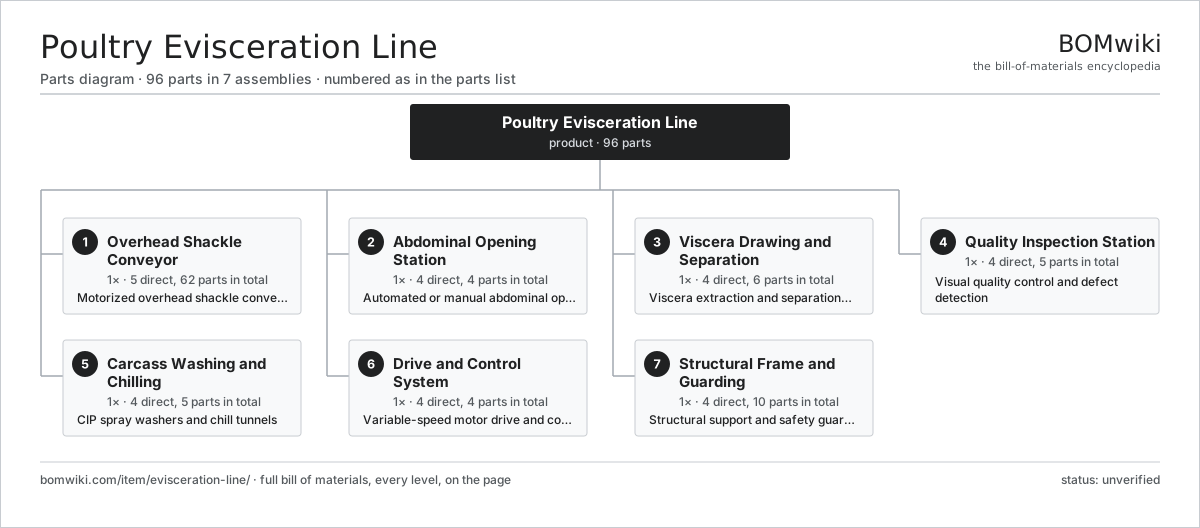
| # | Part | Qty | What it does |
|---|---|---|---|
| 1 | Overhead Shackle Conveyor 5 parts | 1× | Motorized overhead shackle conveyor |
| 2 | Abdominal Opening Station 4 parts | 1× | Automated or manual abdominal opening tools |
| 3 | Viscera Drawing and Separation 4 parts | 1× | Viscera extraction and separation assembly |
| 4 | Quality Inspection Station 4 parts | 1× | Visual quality control and defect detection |
| 5 | Carcass Washing and Chilling 4 parts | 1× | CIP spray washers and chill tunnels |
| 6 | Drive and Control System 4 parts | 1× | Variable-speed motor drive and controls |
| 7 | Structural Frame and Guarding 4 parts | 1× | Structural support and safety guarding |
3D model
No 3D model yet. Have a CAD file of this? Add a 3D model. STL renders right on this page; STEP, FreeCAD, and OpenSCAD sources are welcome too (openly licensed, like all 3D models on BOMwiki).
Build & assembly graph
expand / collapse · shared sub-assemblies converge · links to related products · est. labourTap an assembly to expand/collapse · tap a part to open it · use “Open page” for any node · drag to pan, scroll to zoom.
Bill of materials for Poultry Evisceration Line
7 top-level lines · 36 rows shown · 96 parts total · indented to 3 levels| # | Item / sub-assembly | Part no. | Qty/assy | Ext. qty | Parts | Type |
|---|---|---|---|---|---|---|
| 1 | Overhead Shackle Conveyor 5 parts | evisceration-line-conveyor | 1× | 1 | 62 | assembly |
| 1.1 | Conveyor Chain | evisceration-line-conveyor-chain | 1× | 1 | · | part |
| 1.2 | Drive Sprocket Assembly | evisceration-line-conveyor-sprocket-drive | 1× | 1 | · | part |
| 1.3 | Overhead Support Rail | evisceration-line-conveyor-rail | 2× | 2 | · | part |
| 1.4 | Bird Shackles | evisceration-line-shackles | 50× | 50 | · | part |
| 1.5 | Idler and Drive Wheels | evisceration-line-conveyor-wheel | 8× | 8 | · | part |
| 2 | Abdominal Opening Station 4 parts | evisceration-line-opening-station | 1× | 1 | 4 | assembly |
| 2.1 | Cutting Blade | evisceration-line-opening-blade | 1× | 1 | · | part |
| 2.2 | Blade Actuator | evisceration-line-opening-actuator | 1× | 1 | · | part |
| 2.3 | Safety Blade Guard | evisceration-line-opening-guard | 1× | 1 | · | part |
| 2.4 | Position Sensing | evisceration-line-opening-positioning | 1× | 1 | · | part |
| 3 | Viscera Drawing and Separation 4 parts | evisceration-line-drawing-station | 1× | 1 | 6 | assembly |
| 3.1 | Viscera Grasper Arm | evisceration-line-drawing-grasper | 1× | 1 | · | part |
| 3.2 | Extraction Hooks | evisceration-line-drawing-hooks | 3× | 3 | · | part |
| 3.3 | Mesentery Cutter | evisceration-line-drawing-cutter | 1× | 1 | · | part |
| 3.4 | Waste Chute | evisceration-line-drawing-chute | 1× | 1 | · | part |
| 4 | Quality Inspection Station 4 parts | evisceration-line-inspection | 1× | 1 | 5 | assembly |
| 4.1 | Machine Vision Camera | evisceration-line-inspection-camera | 1× | 1 | · | part |
| 4.2 | Inspection Lighting | evisceration-line-inspection-lighting | 2× | 2 | · | part |
| 4.3 | Reject Divert Gate | evisceration-line-inspection-divert | 1× | 1 | · | part |
| 4.4 | Vision PLC Controller | evisceration-line-inspection-control | 1× | 1 | · | part |
| 5 | Carcass Washing and Chilling 4 parts | evisceration-line-washers | 1× | 1 | 5 | assembly |
| 5.1 | Spray Headers | evisceration-line-wash-headers | 2× | 2 | · | part |
| 5.2 | Wash Water Pump | evisceration-line-wash-pump | 1× | 1 | · | part |
| 5.3 | Ice Water Tank | evisceration-line-ice-bath | 1× | 1 | · | part |
| 5.4 | Glycol Chiller Unit | evisceration-line-chill-circulation | 1× | 1 | · | part |
| 6 | Drive and Control System 4 parts | evisceration-line-drive | 1× | 1 | 4 | assembly |
| 6.1 | Drive Motor with VFD | evisceration-line-motor | 1× | 1 | · | part |
| 6.2 | Speed Reduction Gearbox | evisceration-line-gearbox | 1× | 1 | · | part |
| 6.3 | Main Control PLC | evisceration-line-drive-control | 1× | 1 | · | part |
| 6.4 | Pneumatic Compressor | evisceration-line-air-compressor | 1× | 1 | · | part |
| 7 | Structural Frame and Guarding 4 parts | evisceration-line-frame | 1× | 1 | 10 | assembly |
| 7.1 | Main Structural Frame | evisceration-line-frame-main | 1× | 1 | · | part |
| 7.2 | Safety Guard Railings | evisceration-line-guards | 3× | 3 | · | part |
| 7.3 | Interlocked Access Gates | evisceration-line-access-gates | 2× | 2 | · | part |
| 7.4 | Fastener Set | fastener-set | 4× | 4 | · | part |
Something wrong in this list? Report a problem with this BOM.
Sourcing: possible vendors
Browse the supplier directory → Prices, MOQ, and lead times are algorithmic estimates, not quotes, and not claims about these companies. Company mappings are curated by keyword; est. price band $1k–$500k. How estimates work| Vendor | HQ | Specialty | MOQ | Lead time |
|---|---|---|---|---|
| gea.com ↗ | Düsseldorf, DE | Process technology | 20 units | 12–20 wks |
| buhlergroup.com ↗ | Uzwil, CH | Food & materials processing | 20 units | 12–20 wks |
| tetrapak.com ↗ | Pully, CH | Food packaging & processing | 20 units | 12–20 wks |
| jbtc.com ↗ | Chicago, US | Food processing equipment | 20 units | 12–20 wks |
| alfalaval.com ↗ | Lund, SE | Heat transfer & separation | 20 units | 12–20 wks |
2,168-word article