eVTOL Air Taxi
ProductOverview
An eVTOL (electric vertical-takeoff-and-landing) air taxi is a piloted passenger aircraft that combines the vertical-launch convenience of a helicopter with the cruise efficiency of an airplane. The aircraft lifts off vertically using electric rotors, transitions to horizontal flight with a fixed wing, and lands vertically at the destination, all without runway infrastructure.
The enabling technology is the high-energy-density battery: modern lithium-ion cells store ~250 Wh/kg, enough to support 15–30 minute flights carrying 4–5 passengers. Electric motors are far simpler than turbine engines, with redundancy built into multiple independent motor-rotor pairs. The flight-control system manages the complex transition from hover to cruise, using fly-by-wire to blend rotor thrust with wing lift seamlessly.
Airframe
The Airframe Structure is a carbon-fiber composite design: a Fuselage monocoque pressure hull (2–3 m long) seating 4–5 passengers side-by-side, a high-aspect-ratio Fixed Wing optimized for cruise efficiency (~20–30 m² area), and standard Tail Empennage horizontal and vertical tail surfaces. The structure must handle both the hovering weight (all lift from rotors) and cruise aerodynamic loads (wing generating most lift).
Passenger Window Assembly windows are multi-pane acrylic or polycarbonate, providing sightlines and emergency egress, typical air-taxi marketing emphasizes the view of the city from 1000–2000 m altitude.
Vertical lift: rotor system
The critical component is the Rotor Transition System: typically two or four tilting rotors (one on each wing pylon, and optionally tail). Each rotor is driven by an electric Electric Motor (100+ kW) through a Rotor Gearbox speed reducer. A large composite Rotor Blade (5–8 m) at low RPM (200–500 rpm) generates lift silently, far quieter than a helicopter's turbine engine.
The Transition Actuator is the transition manager: a servo cylinder tilting each rotor nacelle from vertical (90° in hover) toward horizontal (0° in cruise) over 30–60 seconds. As the rotor tilts horizontal, it becomes a propeller pushing the aircraft forward; simultaneously, the Fixed Wing wing begins generating lift. The Flight Control System autopilot continuously blends rotor and wing contributions, maintaining speed and altitude throughout the transition.
Power source: battery and motors
Energy storage is the limiting factor: the High-Energy Battery Pack houses 50–150 kWh of lithium-ion cells, typically organized as pouch or cylindrical Li-ion Cell, 18650 units in series/parallel arrangements. A sophisticated Pack Controller manages cell balancing, monitors temperature, and enforces discharge limits. The Thermal Management system circulates glycol-water coolant through the battery and motor jackets, dissipating the 20–30 kW of waste heat during full-power hover.
Four Electric Motor permanent-magnet synchronous motors (200–400 kW combined) draw current from the High-Voltage Bus (400–800 V DC). Each motor has an independent Motor Controller inverter converting DC to three-phase AC. If one motor fails, the remaining three provide 75% thrust, sufficient to land safely (though with reduced climb performance).
Typical energy consumption: hover burns ~300 kW (all lift from rotors). Transition to cruise takes 2–3 min, averaging ~250 kW. Cruise at 200 km/h burns only ~150 kW (wing lift reduces rotor load). A 100 kWh battery provides ~25 min endurance in hover, ~20 min mixed profile, ~30 min if the flight is mostly cruise.
Flight control and safety
The Flight Control System system is the linchpin: dual-channel Flight Control Computer flight control computers running fail-operational autopilot logic certified to DO-178C (highest civil aviation standard). The IMU Suite uses triple-redundant inertial measurement, voting on attitude to prevent sensor failures from causing loss of control. Barometric and Altimeter radar altimeters provide altitude feedback during the critical hover-landing phase.
The Autopilot Actuator command elevator, rudder, and aileron deflections to follow the desired flight path. During transition, the autopilot simultaneously commands rotor tilt via the Transition Actuator, managing a complex multi-axis problem: as rotors tilt and wing lift increases, the aircraft's aerodynamic center shifts, requiring trim adjustments to prevent pitch-up or pitch-down.
Redundancy and fail-safe
Most eVTOL designs feature distributed electric propulsion: four or six independent motor-rotor pairs rather than two main engines. If one motor fails, the others compensate. The Power Distribution Unit unit includes dual Main Contactor battery isolation switches and redundant Motor Controller inverters on critical paths.
The High-Energy Battery Pack controller enforces discharge limits, preventing over-discharge that could leave the aircraft unable to complete a safe landing. If remaining energy drops below a computed threshold (dependent on current altitude and distance to nearest landing site), the autopilot initiates emergency descent.
Passenger comfort
The Passenger Cabin seats 4–5 passengers with Seat Assembly crash-rated seats rated for 9 G loads. The Door System gull-wing or side-opening door provides easy entry/exit from a vertiport platform. The Cabin Environmental ventilation system maintains comfortable air quality during flight.
Noise is a key advantage: electric rotors at low RPM are inherently quiet (~70–85 dB at 100 m distance, vs. 90–100 dB for combustion helicopters). This allows operation from urban vertiports (rooftops, city parks) without disturbing ground residents.
Operational model
Current eVTOLs (Joby, Archer, Lilium, Archer) are piloted, a licensed commercial pilot operates the aircraft while the autopilot handles transition and cruise stabilization. Ride costs are projected at $100–200 per seat for a 50 km urban flight (comparable to helicopter rides today, but higher capacity).
Fully autonomous eVTOL air taxis (no pilot) are a future vision, requiring higher reliability thresholds and regulatory framework development. Current certification focuses on piloted operations, with the autopilot as a safety aid rather than primary control.
eVTOL Air Taxi parts and their functions
8 top-level parts · 261 parts in total · full bill of materials below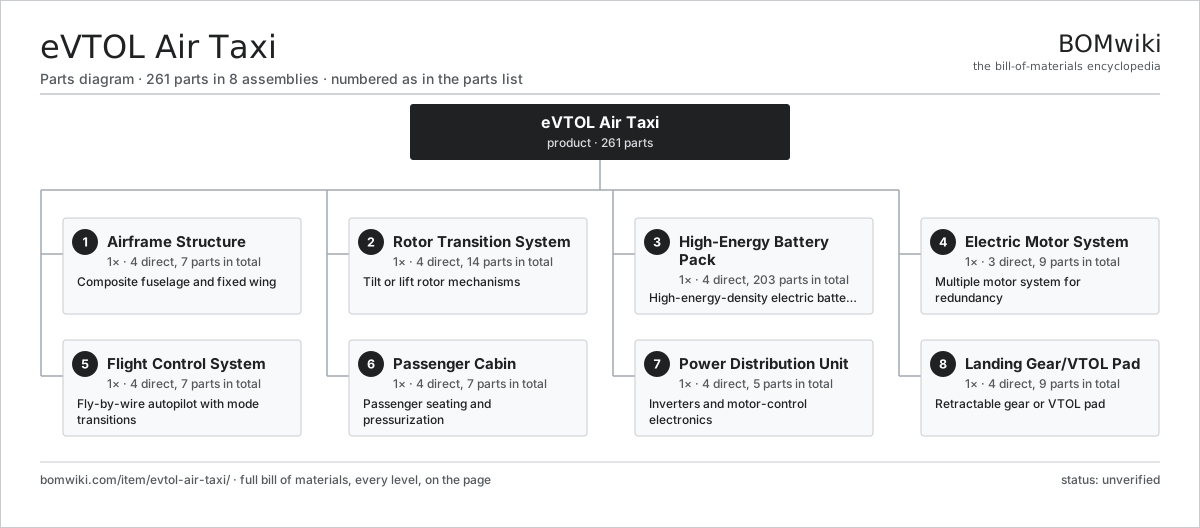
| # | Part | Qty | What it does |
|---|---|---|---|
| 1 | Airframe Structure 4 parts | 1× | Composite fuselage and fixed wing |
| 2 | Rotor Transition System 4 parts | 1× | Tilt or lift rotor mechanisms |
| 3 | High-Energy Battery Pack 4 parts | 1× | High-energy-density electric battery |
| 4 | Electric Motor System 3 parts | 1× | Multiple motor system for redundancy |
| 5 | Flight Control System 4 parts | 1× | Fly-by-wire autopilot with mode transitions |
| 6 | Passenger Cabin 4 parts | 1× | Passenger seating and pressurization |
| 7 | Power Distribution Unit 4 parts | 1× | Inverters and motor-control electronics |
| 8 | Landing Gear/VTOL Pad 4 parts | 1× | Retractable gear or VTOL pad |
3D model
No 3D model yet. Have a CAD file of this? Add a 3D model — STL renders right on this page; STEP, FreeCAD, and OpenSCAD sources are welcome too (openly licensed, like all 3D models on BOMwiki).
Build & assembly graph
expand / collapse · shared sub-assemblies converge · links to related products · est. labourTap an assembly to expand/collapse · tap a part to open it · use “Open page” for any node · drag to pan, scroll to zoom.
Bill of materials for eVTOL Air Taxi
8 top-level lines · 39 rows shown · 261 parts total · indented to 3 levels| # | Item / sub-assembly | Part no. | Qty/assy | Ext. qty | Parts | Type |
|---|---|---|---|---|---|---|
| 1 | Airframe Structure 4 parts | evtol-air-taxi-airframe | 1× | 1 | 7 | assembly |
| 1.1 | Fuselage | evtol-air-taxi-fuselage | 1× | 1 | · | part |
| 1.2 | Fixed Wing | evtol-air-taxi-fixed-wing | 1× | 1 | · | part |
| 1.3 | Tail Empennage | evtol-air-taxi-tail-empennage | 1× | 1 | · | part |
| 1.4 | Window Assembly | evtol-air-taxi-window-assembly | 4× | 4 | · | part |
| 2 | Rotor Transition System 4 parts | evtol-air-taxi-rotor-system | 1× | 1 | 14 | assembly |
| 2.1 | Tilt-Rotor Nacelle | evtol-air-taxi-tilt-rotor | 2× | 2 | · | part |
| 2.2 | Rotor Gearbox | evtol-air-taxi-rotor-gearbox | 2× | 2 | · | part |
| 2.3 | Transition Actuator | evtol-air-taxi-transition-actuator | 2× | 2 | · | part |
| 2.4 | Rotor Blade | evtol-air-taxi-rotor-blade | 8× | 8 | · | part |
| 3 | High-Energy Battery Pack 4 parts | evtol-air-taxi-battery-pack | 1× | 1 | 203 | assembly |
| 3.1 | Li-ion Cell, 18650 | li-cell-18650 | 200× | 200 | · | part |
| 3.2 | Pack Controller | evtol-air-taxi-pack-controller | 1× | 1 | · | part |
| 3.3 | Thermal Management | evtol-air-taxi-thermal-management | 1× | 1 | · | part |
| 3.4 | High-Voltage Bus | evtol-air-taxi-high-voltage-bus | 1× | 1 | · | part |
| 4 | Electric Motor System 3 parts | evtol-air-taxi-electric-motors | 1× | 1 | 9 | assembly |
| 4.1 | Electric Motor | evtol-air-taxi-electric-motor | 4× | 4 | · | part |
| 4.2 | Motor Controller | evtol-air-taxi-motor-controller | 4× | 4 | · | part |
| 4.3 | Power Cables | evtol-air-taxi-power-cables | 1× | 1 | · | part |
| 5 | Flight Control System 4 parts | evtol-air-taxi-flight-control | 1× | 1 | 7 | assembly |
| 5.1 | Flight Control Computer | evtol-air-taxi-fcc | 2× | 2 | · | part |
| 5.2 | IMU Suite | evtol-air-taxi-imu-suite | 2× | 2 | · | part |
| 5.3 | Altimeter | evtol-air-taxi-altimeter | 2× | 2 | · | part |
| 5.4 | Autopilot Actuator | evtol-air-taxi-autopilot-actuators | 1× | 1 | · | part |
| 6 | Passenger Cabin 4 parts | evtol-air-taxi-cabin | 1× | 1 | 7 | assembly |
| 6.1 | Seat Assembly | evtol-air-taxi-seat-assembly | 4× | 4 | · | part |
| 6.2 | Door System | evtol-air-taxi-door-system | 1× | 1 | · | part |
| 6.3 | Cabin Environmental | evtol-air-taxi-cabin-environmental | 1× | 1 | · | part |
| 6.4 | Emergency Equipment | evtol-air-taxi-emergency-equipment | 1× | 1 | · | part |
| 7 | Power Distribution Unit 4 parts | evtol-air-taxi-power-distribution | 1× | 1 | 5 | assembly |
| 7.1 | Main Contactor | evtol-air-taxi-main-contactor | 2× | 2 | · | part |
| 7.2 | HVDC Bus | evtol-air-taxi-hvdc-bus | 1× | 1 | · | part |
| 7.3 | Auxiliary Converter | evtol-air-taxi-auxiliary-converter | 1× | 1 | · | part |
| 7.4 | Fuse Panel | evtol-air-taxi-fuse-panel | 1× | 1 | · | part |
| 8 | Landing Gear/VTOL Pad 4 parts | evtol-air-taxi-landing-system | 1× | 1 | 9 | assembly |
| 8.1 | Landing Gear | evtol-air-taxi-landing-gear | 1× | 1 | · | part |
| 8.2 | Wheel Assembly | evtol-air-taxi-wheel-assembly | 3× | 3 | · | part |
| 8.3 | Brake System | evtol-air-taxi-brake-system | 1× | 1 | · | part |
| 8.4 | Damper | evtol-air-taxi-damper | 4× | 4 | · | part |
Sourcing: possible vendors
Prices, MOQ, and lead times are algorithmic estimates, not quotes, and not claims about these companies. Company mappings are curated by keyword; est. price band $50k–$300M. How estimates work| Vendor | HQ | Specialty | MOQ | Lead time |
|---|---|---|---|---|
|
🇺🇸Boeing
boeing.com ↗
|
Arlington, US | Aerospace OEM | made to order | 40–80 wks |
|
🇫🇷Airbus
airbus.com ↗
|
Toulouse, FR | Aerospace OEM | made to order | 40–80 wks |
| lockheedmartin.com ↗ | Bethesda, US | Aerospace & defense | made to order | 40–80 wks |
|
🇧🇷Embraer
embraer.com ↗
|
São José dos Campos, BR | Aircraft OEM | made to order | 40–80 wks |
| txtav.com ↗ | Wichita, US | Aircraft OEM | made to order | 40–80 wks |
1,024-word article