Explosion-Proof Light Fixture
ProductOverview
An explosion-proof light fixture illuminates places where the air itself can ignite: oil refineries, offshore platforms, chemical plants, paint shops, grain elevators, and fuel terminals. The name is precise but often misread. The fixture is not built to survive an external explosion, it is built so that an ignition inside the fixture cannot propagate out into the surrounding flammable atmosphere. Arcing relays, a failing driver, or a cracked LED board may ignite gas that has diffused into the enclosure; the design guarantees that this internal event stays internal.
The dominant protection concept for luminaires is Ex d, "flameproof enclosure," embodied here in the Ex-d Flameproof Housing. The light source is the LED Module, powered from the Driver Compartment, shining through the Glass Assembly, with every penetration controlled by the Cable Entry System system.
The flameproof principle
Gases seep through any practical joint, so an Ex d enclosure does not try to be gas-tight. Instead it makes two guarantees. First, the Body Casting and Cover Casting withstand the pressure of a worst-case internal explosion, certification testing fires the actual gas mixture inside the enclosure and requires it to survive 1.5 times the measured reference pressure, which is why the walls run 5–10 mm thick and the fixture weighs 8–20 kg.
Second, the joints act as flame arresters. The Flame Path Joints are machined mating surfaces that are long and narrow: hot combustion gases escaping through them expand and shed heat to the metal, emerging too cool to ignite the outside atmosphere. The allowable gap is the "maximum experimental safe gap" of the target gas group, under 0.1 mm for group IIC gases such as hydrogen and acetylene. This is why flameproof joints must never be painted, gasketed, or scratched, and why a dropped cover is scrapped rather than dressed with a file. Threaded joints achieve the same arrest through engagement length, typically a minimum of five full threads.
Every hole is part of the boundary. The Ex-d Cable Glands are barrier glands whose compound blocks flame travel along the spaces between cable cores; unused entries take a certified Stopping Plug, because a single open hole voids the rating. North American conduit installations pour a compound-filled Conduit Sealing Fitting near the enclosure instead. A sintered Breather/Drain lets the enclosure breathe and shed condensate through a matrix too fine for flame to pass.
Temperature class
Containment handles sparks; the second ignition route is hot surfaces. Every Ex fixture carries a temperature class, T4 means no external surface exceeds 135 °C under any fault condition, below the autoignition temperature of most hydrocarbons. This constrains the thermal design more than efficiency does. LED heat must travel from the LED Array through the Thermal Interface into the finned casting, the only heatsink a sealed enclosure has, and the Temperature Sensor dims or cuts the array before the limit is approached. LEDs made this far easier than the 250–400 W high-pressure sodium and metal halide lamps they replaced, whose arc tubes ran at hundreds of degrees; an LED unit delivers the same lumens at a third the power and a fraction of the surface temperature, while extending relamping intervals from one or two years to L70 lifetimes beyond 60,000 hours, a major cost in plants where every maintenance task needs a gas-test permit.
Electrical design
Many fixtures split into two chambers: the flameproof main chamber holding the Power Supply driver, and an increased-safety (Ex e) wiring chamber with the Ex-e Terminal Block, so an electrician can loop supply cables fixture-to-fixture without ever opening the flameproof volume. A Surge Protector rated 6–10 kV protects the driver on long outdoor supply runs, a Thermal Fuse backs up the electronic protections, and internal and external Earth Lug points bond the casting into the plant earth grid. The casting alloy is copper-free aluminum because copper-bearing alloys can strike incendive sparks when struck by rusty steel.
Optics, window, and mounting
The Tempered Borosilicate Glass window is structural: 8–15 mm of thermally toughened borosilicate that takes its share of the explosion pressure, passes a 7 J impact test, and shrugs off the thermal shock of a cold hose stream on a hot lens. The Glass Retaining Ring both clamps the glass and forms a flame path at its threads, with O-Ring Set seals providing the IP66/67 weatherproofing, and a Wire Guard fends off tool strikes. Beam shaping happens at the LED Optics, with distributions for high-bay, aisle, and floodlighting duty.
Mounting reflects plant reality: the Pendant Hook hangs the unit from conduit stanchions over process areas, the Yoke Bracket aims it from walls and platforms, and a Safety Wire catches the fixture if the primary fixing fails above a walkway. Certification markings, for example Ex db IIC T4 Gb, encode the protection concept, gas group, temperature class, and equipment protection level, and the fixture may only be installed in zones its marking covers.
Explosion-Proof Light Fixture parts and their functions
6 top-level parts · 31 parts in total · full bill of materials below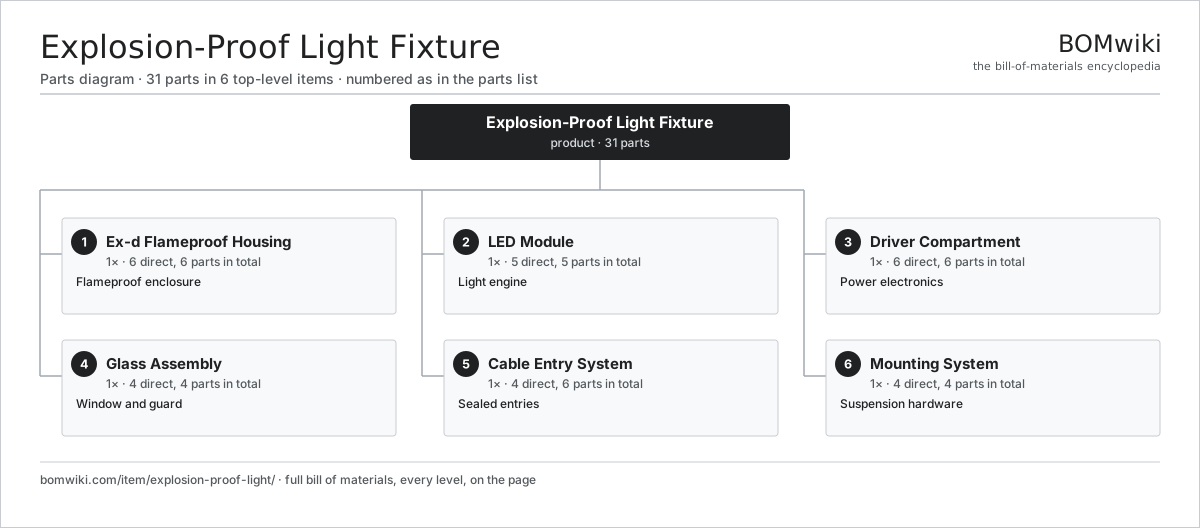
| # | Part | Qty | What it does |
|---|---|---|---|
| 1 | Ex-d Flameproof Housing 6 parts | 1× | Flameproof enclosure |
| 2 | LED Module 5 parts | 1× | Light engine |
| 3 | Driver Compartment 6 parts | 1× | Power electronics |
| 4 | Glass Assembly 4 parts | 1× | Window and guard |
| 5 | Cable Entry System 4 parts | 1× | Sealed entries |
| 6 | Mounting System 4 parts | 1× | Suspension hardware |
3D model
No 3D model yet. Have a CAD file of this? Add a 3D model. STL renders right on this page; STEP, FreeCAD, and OpenSCAD sources are welcome too (openly licensed, like all 3D models on BOMwiki).
Build & assembly graph
expand / collapse · shared sub-assemblies converge · links to related products · est. labourTap an assembly to expand/collapse · tap a part to open it · use “Open page” for any node · drag to pan, scroll to zoom.
Bill of materials for Explosion-Proof Light Fixture
6 top-level lines · 35 rows shown · 31 parts total · indented to 3 levels| # | Item / sub-assembly | Part no. | Qty/assy | Ext. qty | Parts | Type |
|---|---|---|---|---|---|---|
| 1 | Ex-d Flameproof Housing 6 parts | explosion-proof-light-ex-housing | 1× | 1 | 6 | assembly |
| 1.1 | Body Casting | explosion-proof-light-body-casting | 1× | 1 | · | part |
| 1.2 | Cover Casting | explosion-proof-light-cover-casting | 1× | 1 | · | part |
| 1.3 | Flame Path Joints | explosion-proof-light-flame-paths | 1× | 1 | · | part |
| 1.4 | Breather/Drain | explosion-proof-light-breather-drain | 1× | 1 | · | part |
| 1.5 | Epoxy Coating | explosion-proof-light-epoxy-coating | 1× | 1 | · | part |
| 1.6 | Fastener Set | fastener-set | 1× | 1 | · | part |
| 2 | LED Module 5 parts | explosion-proof-light-led-module | 1× | 1 | 5 | assembly |
| 2.1 | LED Array | explosion-proof-light-led-array | 1× | 1 | · | part |
| 2.2 | LED Optics | explosion-proof-light-led-optics | 1× | 1 | · | part |
| 2.3 | Thermal Interface | explosion-proof-light-thermal-interface | 1× | 1 | · | part |
| 2.4 | Temperature Sensor | explosion-proof-light-temp-sensor | 1× | 1 | · | part |
| 2.5 | Connector | connector | 1× | 1 | · | part |
| 3 | Driver Compartment 6 parts | explosion-proof-light-driver-compartment | 1× | 1 | 6 | assembly |
| 3.1 | Power Supply | power-supply | 1× | 1 | · | part |
| 3.2 | Surge Protector | explosion-proof-light-surge-protector | 1× | 1 | · | part |
| 3.3 | Ex-e Terminal Block | explosion-proof-light-terminal-block | 1× | 1 | · | part |
| 3.4 | Thermal Fuse | thermal-fuse | 1× | 1 | · | part |
| 3.5 | SMD Passive (R/C/L) | smd-passives | 1× | 1 | · | part |
| 3.6 | Wire Bundle | wire-bundle | 1× | 1 | · | part |
| 4 | Glass Assembly 4 parts | explosion-proof-light-glass-assembly | 1× | 1 | 4 | assembly |
| 4.1 | Tempered Borosilicate Glass | explosion-proof-light-tempered-glass | 1× | 1 | · | part |
| 4.2 | Glass Retaining Ring | explosion-proof-light-glass-retainer | 1× | 1 | · | part |
| 4.3 | O-Ring Set | oring-set | 1× | 1 | · | part |
| 4.4 | Wire Guard | explosion-proof-light-wire-guard | 1× | 1 | · | part |
| 5 | Cable Entry System 4 parts | explosion-proof-light-cable-entry | 1× | 1 | 6 | assembly |
| 5.1 | Ex-d Cable Glands | explosion-proof-light-ex-glands | 2× | 2 | · | part |
| 5.2 | Stopping Plug | explosion-proof-light-stopping-plug | 1× | 1 | · | part |
| 5.3 | Earth Lug | explosion-proof-light-earth-lug | 2× | 2 | · | part |
| 5.4 | Conduit Sealing Fitting | explosion-proof-light-conduit-seal | 1× | 1 | · | part |
| 6 | Mounting System 4 parts | explosion-proof-light-mounting | 1× | 1 | 4 | assembly |
| 6.1 | Pendant Hook | explosion-proof-light-pendant-hook | 1× | 1 | · | part |
| 6.2 | Yoke Bracket | explosion-proof-light-mounting-bracket | 1× | 1 | · | part |
| 6.3 | Safety Wire | explosion-proof-light-safety-wire | 1× | 1 | · | part |
| 6.4 | Fastener Set | fastener-set | 1× | 1 | · | part |
Something wrong in this list? Report a problem with this BOM.
Related products
same domain, ranked by shared parts Aviation Obstruction Light
192 parts · shares 3 with this page
Aviation Obstruction Light
192 parts · shares 3 with this page
 Heliport Beacon
39 parts · shares 3 with this page
Long-Range Searchlight
252 parts · shares 3 with this page
Industrial UV Curing Lamp
300 parts · shares 2 with this page
Heliport Beacon
39 parts · shares 3 with this page
Long-Range Searchlight
252 parts · shares 3 with this page
Industrial UV Curing Lamp
300 parts · shares 2 with this page
 Studio Strobe Light
48 parts · shares 1 with this page
Studio Strobe Light
48 parts · shares 1 with this page
 LED Street Light
155 parts · shares 2 with this page
LED Street Light
155 parts · shares 2 with this page
Sourcing: possible vendors
Browse the supplier directory → Prices, MOQ, and lead times are algorithmic estimates, not quotes, and not claims about these companies. Company mappings are curated by keyword; est. price band $3–$2k. How estimates work| Vendor | HQ | Specialty | MOQ | Lead time |
|---|---|---|---|---|
|
🇳🇱Signify
signify.com ↗
|
Eindhoven, NL | Lighting (Philips Hue) | 2,000 units | 6–10 wks |
| acuitybrands.com ↗ | Atlanta, US | Lighting & controls | 2,000 units | 6–10 wks |
|
🇦🇹Zumtobel
zumtobelgroup.com ↗
|
Dornbirn, AT | Lighting | 2,000 units | 6–10 wks |
| creelighting.com ↗ | Racine, US | LED lighting | 2,000 units | 6–10 wks |
|
🇮🇳Havells
havells.com ↗
|
Noida, IN | Electrical & lighting | 2,000 units | 6–10 wks |
900-word article