Explosive Trace Detector
ProductOverview
Explosive Trace Detectors (ETDs) are analytical instruments deployed at airport security checkpoints, mail facilities, and border inspection posts to detect minute quantities of explosive residue on luggage, mail, or cargo surfaces. The most widely deployed variant uses Ion Mobility Spectrometry (IMS), a technique sensitive to the unique molecular signatures of explosive compounds.
An operator swipes a cotton swab across a passenger's luggage, cargo, or skin, collecting any residual explosive particles or vapor. The swab is inserted into the ETD's heated sample chamber, where explosive molecules are thermally vaporized. The vapor enters an ionization cell where molecules are ionized, then separated by drift time through a low-pressure electrode region. Different explosive types have different drift times, allowing the instrument to identify which explosive (if any) is present.
Typical false alarm scenarios, positive results on clean samples, are caused by:
- IGNITERS IN POWDER AMMUNITION: Shooters who handle ammunition-loaded primers and then touch luggage may transfer lead residue; some lead compounds mimic explosive drift signatures.
- LEGITIMATE INDUSTRIAL CHEMICALS: Nitrate fertilizers, certain pharmaceutical precursors have similar drift times to some explosives.
- Environmental BACKGROUND: Urban air contains trace nitrates; direct sampling of luggage interior may pick up environmental contamination.
Proper operator training (baseline calibration, understanding false alarm mechanisms) reduces false positive rates to <1% in well-maintained systems.
Ion Mobility Spectrometry Principles
Ionization & Drift Separation
The ETD operates via these steps:
- Sample heating (desorption): Thermal desorber heats swab to 200 °C, vaporizing explosive molecules.
- Ionization: Vaporized molecules enter ionization chamber where a beta emitter (Ni-63) or corona discharge ionizes molecules, creating molecular ions M⁺ or M⁻.
- Drift separation: Ionized molecules are accelerated into a low-pressure drift region under an electric field (8 kV across 150 mm = 53 kV/m). Each ion experiences a constant force from the electric field but loses energy colliding with neutral drift gas (N₂). An equilibrium is reached where ion velocity = K × E (K = mobility constant, E = electric field).
- Detection: Ions exit drift region and strike Faraday cup detector, where arrival time is measured to <1 microsecond precision.
Key insight: Different molecules have different collision cross-sections (size and shape), thus different mobility constants K. This variation creates distinct arrival times (drift times) for different explosive types:
- TNT: drift time ~7 ms
- RDX: drift time ~9 ms
- PETN: drift time ~6.5 ms
- C-4: drift time ~9.2 ms (RDX base, similar signature)
The console displays arrival time spectrum as a histogram. Peaks at expected drift times for known explosives trigger an alarm.
Sensitivity & Limits of Detection
The IMS can detect explosives at extremely low concentrations:
- Vapor detection limit: <1 ppb (parts per billion). A single molecule of TNT in a billion air molecules can be detected if ionization efficiency and detector sensitivity align favorably.
- Particle detection limit: <0.1 µg (micrograms). A swab from luggage touched by a person who recently handled explosives may carry only a few micrograms residue; IMS is sensitive enough to detect this.
Real-world sensitivity example: A person who fired a rifle (containing RDX-based smokeless powder) will have <0.5 mg residue on their hands. A swab of that hand collects maybe 1 µg of RDX. The IMS vaporizes this, ionizes it, and detects it reliably.
System Components
Thermal Desorber
The thermal desorber is critical for sensitivity. Explosive molecules can be volatile (TNT, PETN vapor) or non-volatile (large molecular weight compounds, polymeric explosives). Heating to 200 °C ensures even non-volatile explosives are vaporized.
Temperature optimization: 200 °C is a compromise:
- Too low (<150 °C): Non-volatile explosives remain particles; IMS only detects vapor-phase.
- Too high (>250 °C): Explosive molecules begin to decompose (TNT decomposes >250 °C), altering drift signature.
The aluminum heating block maintains tight temperature control (±5 °C) via feedback from a thermistor.
Vacuum System
Low pressure in the drift region (0.5–1 torr) is essential for IMS operation:
- Ion mean free path: At 1 torr, mean free path is ~10 mm, comparable to drift distance. Ions collide with drift gas at controlled rate.
- Ionization efficiency: At atmospheric pressure, ions recombine too quickly; drift time becomes unmeasurable.
The rotary vane pump maintains this vacuum continuously. A needle valve throttles pump inlet to prevent overdepletion.
Threat Library & Detection Algorithm
The console PC stores a threat library of drift time signatures for 40+ explosive types:
| Explosive | Drift Time (ms) | Molecular Weight | Ionization Mode |
|---|---|---|---|
| TNT | 7.0–7.2 | 227 | Negative ion |
| RDX | 9.0–9.2 | 222 | Positive ion |
| PETN | 6.5–6.7 | 316 | Negative ion |
| NG (nitroglycerin) | 6.8–7.0 | 227 | Negative ion |
| Smokeless powder | 9.1–9.3 (RDX) | Varies | Positive |
| Dynamite | 7.0–7.5 (DNT/TNT mix) | 182–227 | Negative |
Upon detection, the console software:
- Searches for peaks in the measured drift-time histogram.
- Compares peak position (±0.2 ms tolerance) against threat library.
- If match found: ALARM (red light, 85 dB buzzer).
- If no match: CLEAR (green light).
Confidence scoring: Peak intensity and shape are also checked. A strong, sharp peak indicates genuine explosive; a broad, weak peak may indicate background contamination or instrumental noise.
Operational Workflow
Luggage Screening
- Swab collection: Operator wipes cotton swab over luggage surface (handle, lock, corner seams), areas where particles accumulate.
- Swab insertion: Swab is inserted into heated cartridge holder on instrument.
- Analysis start: Operator presses "ANALYZE" button; heater activates, desorber reaches 200 °C in ~10 seconds.
- Vapor injection: Vaporized explosives are drawn into IMS drift tube via vacuum pump.
- Results: Within 10–30 seconds, drift-time spectrum appears on LCD display.
- Interpretation: If alarm threshold exceeded, operator queries secondary screening (physical search, X-ray) or alerts law enforcement.
Secondary Verification
If an alarm is triggered, best practice includes:
- Baseline check: Run a blank swab (uncontaminated) to confirm analyzer baseline. If baseline shows false positive, instrument may require recalibration.
- Re-sample: Swab different area of same luggage; re-test to confirm.
- Cross-check with other method: Canine unit (trained to detect explosives by scent) can provide independent verification.
False Alarm Mitigation
Common False Positive Sources
Ammunition shooters: Lead azide primers used in ammunition can produce drift signatures overlapping with some explosives.
- Mitigation: Ask passenger about recent firearm use during interview. If confirmed, secondary screening may be waived or de-prioritized.
Fertilizer handling: Ammonium nitrate (fertilizer) and calcium nitrate have drift signatures within explosive range.
- Mitigation: Baseline library includes agricultural nitrogen compound reference peaks; algorithm discriminates based on exact drift time match.
Mail facility cross-contamination: Previous mail items containing explosives residue can contaminate sorting equipment.
- Mitigation: Regular swab-testing of mail equipment; documented baseline for known contamination patterns.
Environmental background: Nitrates from vehicle exhaust or industrial sources settle on luggage.
- Mitigation: Baseline calibration accounts for regional environmental background.
Tuning: Each facility customizes detector sensitivity based on local background. Airport in urban area may have higher baseline nitrate background than rural border post; sensitivity thresholds are adjusted accordingly.
Maintenance & Calibration
Weekly
- Reference check: Run test cartridge containing known explosive simulant (usually PETN or TNT standard). Confirm drift time matches expected value ±0.2 ms.
- Vacuum system check: Verify pump operates smoothly; vacuum gauge should read 0.5–1.0 torr.
- Temperature stability: Monitor desorber temperature; confirm heater maintains 200 ±5 °C during idle.
Monthly
- Detector calibration: If drift time standard shifts >0.3 ms, recalibrate using external reference source (often a certified explosive standard, handled by trained technician).
- Threat library update: Check manufacturer for firmware updates; download new threat signatures for recently discovered explosives or variants.
- Pump oil change: Replace rotary vane pump oil (synthetic PAO grade); old oil absorbs moisture and reduces pump efficiency.
Annually
- Full service: Manufacturer-authorized technician performs:
- Replacement of ionization source (Ni-63 decays; after ~3 years, activity is insufficient for reliable ionization).
- Electrode cleaning (carbon residue can accumulate, affecting drift field uniformity).
- Detector sensitivity verification (photoelectron gain may drift).
- Vacuum system leak-check (using helium mass spectrometer).
Annual service cost: ~$2,000–3,000.
Radiation Safety
The ionization source uses Ni-63 (10 mCi typical activity). Ni-63 emits beta particles (electrons) with a half-life of 96 years. Radiation safety concerns:
- Beta shielding: Beta particles are stopped by ~5 mm of plastic or aluminum; no special X-ray shielding required.
- Operator exposure: Device is sealed; no direct operator contact with radioactive source. Dose rate at surface: <5 mrem/year, safe for continuous occupational use.
- Disposal: At end-of-life (typically 5–10 years), device must be returned to manufacturer for radioactive source recovery and disposal per NRC regulations.
Standards & Regulatory
- IAEA: Recognizes IMS as accepted method for explosive detection per IAEA Security Series 13.
- TSA: Standard equipment at U.S. airport security checkpoints (required by TSA directive).
- EU: Directive 2013/61/EU mandates explosive trace detection capability at EU airport security.
- NRC 10 CFR 35: Regulatory framework for radioactive sealed sources (Ni-63 in ETD).
Performance & Throughput
- Detection sensitivity: >95% for standard explosives at regulatory threshold (typically 100 ng/sample).
- False positive rate: <1% with proper baseline calibration and operator training.
- Sample throughput: 180–300 swabs per 8-hour shift (including collection, analysis, interpretation).
- Mean time between failures: 10,000+ operating hours (with preventive maintenance).
- System availability: 99%+ uptime target (instrument-limited by heating startup and vacuum pump conditioning).
Economics
A single-lane ETD checkpoint installation (instrument, console, installation, training) costs $80,000–150,000. Operating costs (consumables, maintenance, staffing) run ~$30,000/year. Assuming 5–10 year system life, cost per passenger screened is $0.05–0.15. For airports processing 10M+ passengers annually, automated threat screening via ETD is economically justified and often mandated by security regulations.
Explosive Trace Detector parts and their functions
7 top-level parts · 28 parts in total · full bill of materials below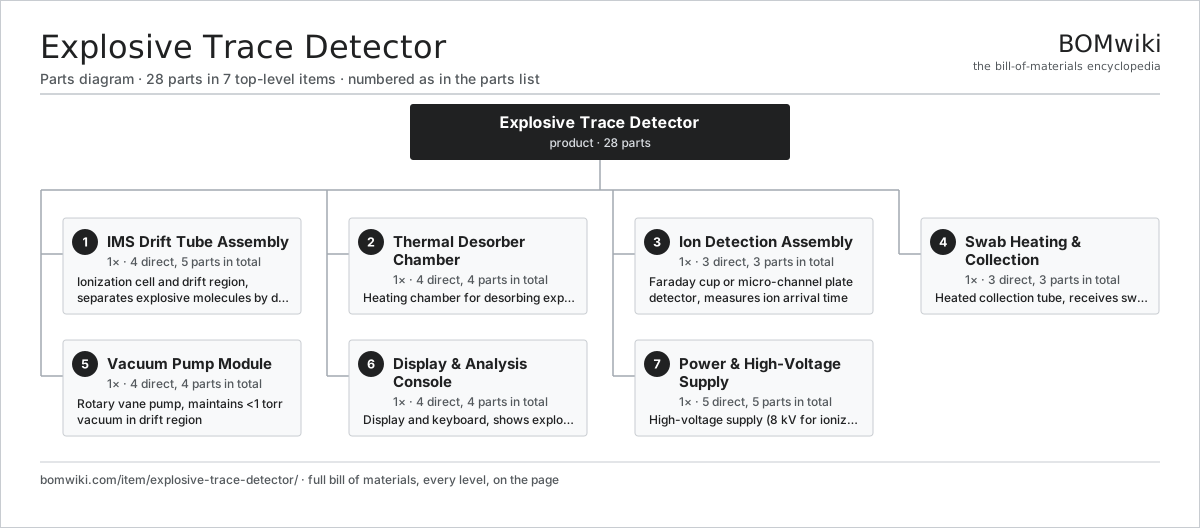
| # | Part | Qty | What it does |
|---|---|---|---|
| 1 | IMS Drift Tube Assembly 4 parts | 1× | Ionization cell and drift region, separates explosive molecules by drift time |
| 2 | Thermal Desorber Chamber 4 parts | 1× | Heating chamber for desorbing explosive particles from swabs |
| 3 | Ion Detection Assembly 3 parts | 1× | Faraday cup or micro-channel plate detector, measures ion arrival time |
| 4 | Swab Heating & Collection 3 parts | 1× | Heated collection tube, receives swab samples from luggage/cargo |
| 5 | Vacuum Pump Module 4 parts | 1× | Rotary vane pump, maintains <1 torr vacuum in drift region |
| 6 | Display & Analysis Console 4 parts | 1× | Display and keyboard, shows explosive threat library and results |
| 7 | Power & High-Voltage Supply 5 parts | 1× | High-voltage supply (8 kV for ionization), heating power for desorber |
3D model
No 3D model yet. Have a CAD file of this? Add a 3D model. STL renders right on this page; STEP, FreeCAD, and OpenSCAD sources are welcome too (openly licensed, like all 3D models on BOMwiki).
Build & assembly graph
expand / collapse · shared sub-assemblies converge · links to related products · est. labourTap an assembly to expand/collapse · tap a part to open it · use “Open page” for any node · drag to pan, scroll to zoom.
Bill of materials for Explosive Trace Detector
7 top-level lines · 34 rows shown · 28 parts total · indented to 3 levels| # | Item / sub-assembly | Part no. | Qty/assy | Ext. qty | Parts | Type |
|---|---|---|---|---|---|---|
| 1 | IMS Drift Tube Assembly 4 parts | explosive-trace-detector-ims-drift-tube | 1× | 1 | 5 | assembly |
| 1.1 | Ionization Source | explosive-trace-detector-ionization-source | 1× | 1 | · | part |
| 1.2 | Drift Electrode Plate | explosive-trace-detector-drift-region-electrode | 2× | 2 | · | part |
| 1.3 | Ultra-Pure Nitrogen Gas | explosive-trace-detector-drift-gas-supply | 1× | 1 | · | part |
| 1.4 | Drift Tube Housing | explosive-trace-detector-drift-tube-housing | 1× | 1 | · | part |
| 2 | Thermal Desorber Chamber 4 parts | explosive-trace-detector-sample-desorber | 1× | 1 | 4 | assembly |
| 2.1 | Aluminum Heating Block | explosive-trace-detector-heating-block | 1× | 1 | · | part |
| 2.2 | Resistive Heating Element | explosive-trace-detector-heating-resistor | 1× | 1 | · | part |
| 2.3 | Temperature Thermistor | explosive-trace-detector-thermistor-sensor | 1× | 1 | · | part |
| 2.4 | Quartz Sample Tube | explosive-trace-detector-desorber-tube | 1× | 1 | · | part |
| 3 | Ion Detection Assembly 3 parts | explosive-trace-detector-ion-detector | 1× | 1 | 3 | assembly |
| 3.1 | Faraday Cup Detector | explosive-trace-detector-faraday-cup | 1× | 1 | · | part |
| 3.2 | Ion Current Preamp | explosive-trace-detector-preamp-circuitry | 1× | 1 | · | part |
| 3.3 | Timing Comparator | explosive-trace-detector-timing-discriminator | 1× | 1 | · | part |
| 4 | Swab Heating & Collection 3 parts | explosive-trace-detector-swab-interface | 1× | 1 | 3 | assembly |
| 4.1 | Heated Tube Jacket | explosive-trace-detector-heating-tube-jacket | 1× | 1 | · | part |
| 4.2 | Spring-Loaded Swab Cartridge | explosive-trace-detector-swab-inlet | 1× | 1 | · | part |
| 4.3 | Direct Contact Heat Plate | explosive-trace-detector-swab-contact-heater | 1× | 1 | · | part |
| 5 | Vacuum Pump Module 4 parts | explosive-trace-detector-vacuum-pump | 1× | 1 | 4 | assembly |
| 5.1 | Rotary Vane Pump | explosive-trace-detector-rotary-vane-pump | 1× | 1 | · | part |
| 5.2 | Vacuum Gauge | explosive-trace-detector-vacuum-gauge | 1× | 1 | · | part |
| 5.3 | Pump Drive Motor | explosive-trace-detector-pump-motor | 1× | 1 | · | part |
| 5.4 | Vacuum Regulator Valve | explosive-trace-detector-vacuum-regulator | 1× | 1 | · | part |
| 6 | Display & Analysis Console 4 parts | explosive-trace-detector-operator-console | 1× | 1 | 4 | assembly |
| 6.1 | Embedded Analysis PC | explosive-trace-detector-console-pc | 1× | 1 | · | part |
| 6.2 | 7-inch LCD Display | explosive-trace-detector-lcd-panel | 1× | 1 | · | part |
| 6.3 | Thermal Receipt Printer | explosive-trace-detector-thermal-printer | 1× | 1 | · | part |
| 6.4 | Audio Alarm Buzzer | explosive-trace-detector-alarm-buzzer | 1× | 1 | · | part |
| 7 | Power & High-Voltage Supply 5 parts | explosive-trace-detector-power-supply | 1× | 1 | 5 | assembly |
| 7.1 | Mains Transformer | explosive-trace-detector-mains-transformer | 1× | 1 | · | part |
| 7.2 | 8 kV HV Supply | explosive-trace-detector-hv-power-supply | 1× | 1 | · | part |
| 7.3 | 24 VDC Heating Supply | explosive-trace-detector-heating-power-supply | 1× | 1 | · | part |
| 7.4 | 24 VDC Control Supply | explosive-trace-detector-control-power-supply | 1× | 1 | · | part |
| 7.5 | Main Power Breaker | explosive-trace-detector-main-breaker | 1× | 1 | · | part |
Something wrong in this list? Report a problem with this BOM.
Sourcing: possible vendors
Browse the supplier directory → Prices, MOQ, and lead times are algorithmic estimates, not quotes, and not claims about these companies. Company mappings are curated by keyword; est. price band $200–$100M. How estimates work| Vendor | HQ | Specialty | MOQ | Lead time |
|---|---|---|---|---|
| smithsdetection.com ↗ | London, GB | Security screening | made to order | 24–52 wks |
|
🇺🇸Leidos
leidos.com ↗
|
Reston, US | Security & screening | made to order | 24–52 wks |
|
🇺🇸Rapiscan
rapiscansystems.com ↗
|
Torrance, US | X-ray screening | made to order | 24–52 wks |
|
🇫🇷Thales
thalesgroup.com ↗
|
Paris, FR | Defense electronics | made to order | 24–52 wks |
| baesystems.com ↗ | London, GB | Defense | made to order | 24–52 wks |
1,668-word article