Eyeleting Machine
ProductOverview
Eyelets are small metal or plastic rings that reinforce holes in shoe uppers where laces pass through. A typical shoe has 5–8 eyelets, and setting them requires precise placement and sufficient force to clinch the metal firmly to the leather. The eyeleting machine automates this operation, which was traditionally done by hand with hammer and anvil, a skilled but labor-intensive craft.
Modern eyeleting machines range from simple mechanical presses (operator-controlled with foot pedal) to fully automatic systems feeding eyelets and positioning shoes. Most footwear factories use semi-automatic machines where the operator positions the shoe and presses a pedal to activate the setting cycle.
Eyelet Anatomy and Materials
A typical shoe eyelet consists of two components:
- Tubular cup (eyelet proper): A small metal or plastic ring, 8–12 mm outer diameter and 4–8 mm tall. The tube has a flange (wider ring) at the top and a hollow center.
- Clinch ring or washer (optional): Some eyelets are two-piece; a separate washer is placed under the leather, and the cup is pressed down over it, clinching the washer to the leather from below.
Material Selection
- Brass eyelets: Traditional, attractive gold color, naturally corrosion-resistant. Cost: $0.05–0.10 per eyelet.
- Nickel-plated steel: Lower cost, shiny finish, requires plating for corrosion protection. Cost: $0.02–0.05.
- Anodized aluminum: Lightweight, moderate corrosion resistance. Cost: $0.03–0.08.
- Plastic (nylon or acetal): Lowest cost, minimal strength, used in budget shoes or temporary wear. Cost: <$0.01.
High-end dress shoes use solid brass or nickel-plated steel eyelets; budget athletic shoes may use plastic.
Setting Mechanism: Punch and Die
The setting punch is a hardened steel tool shaped like a shallow cup. When the press head descends, the punch contacts the eyelet's flange and applies force, pressing the eyelet downward. As the eyelet descends, it contacts the clinching die, an anvil-shaped tool with a precisely-sized hole in its center.
The sequence:
- Initial contact: Eyelet flange is positioned on the leather surface, centered over the pre-drilled hole.
- Press stroke begins: Punch descends at 600–1000 rpm (typical mechanical press rhythm).
- Eyelet clinching: As punch pressure increases, the eyelet's thin lower edge is forced into the clinching die's hole. The die's shape deforms the eyelet's edge, creating a mechanical lock, the metal fibers of the eyelet are cold-worked, binding irreversibly to the leather fibers.
- Peak pressure: 1000–1500 N typical for brass eyelets (enough to create permanent deformation without tearing the leather).
- Press releases: Spring or cam mechanism returns ram to rest position.
Result: A firmly-set eyelet with no relative motion possible between eyelet and leather. Pulling on the eyelet with hand force cannot remove it.
Eyelet Hole Preparation
Before eyeleting, shoe uppers must have pre-drilled or pre-punched holes at each eyelet position. Hole diameter is typically 6–8 mm, slightly smaller than the eyelet outer diameter. This allows the eyelet edges to grip the leather fibers during clinching.
Hole quality matters:
- Too small (<6 mm): Eyelet edges are forced into leather fibers, potentially tearing or delaminating the leather.
- Too large (>8 mm): Insufficient leather edge to clinch; eyelet may pull through during wear.
- Rough edges: Burrs or uneven edges reduce clinching effectiveness. Holes should be cleanly punched or drilled, then lightly deburned.
Operator Technique and Positioning
Most eyeleting machines require manual shoe positioning. The operator:
- Places the shoe upper on the work table fixture.
- Aligns the first eyelet hole with the eyelet hopper, which has automatically dispensed a single eyelet into the punch position.
- Positions the shoe so the eyelet hole is directly under the punch and die opening.
- Presses a foot pedal or hand lever, activating the press cycle.
- The press head descends, sets the eyelet, and automatically returns.
- Operator rotates the shoe to align the next eyelet hole and repeats.
For a 6-eyelet shoe, the entire process takes 2–3 minutes, including manual positioning and press time. Higher-volume factories use automatic positioning systems (CNC-controlled turntables) to eliminate manual alignment, reducing cycle time to <1 minute per shoe.
Eyelet Feeder System
The eyelet hopper is a clever mechanical device that singulates eyelets from a bulk pile:
- Hopper bowl: A conical container holding 100–500 eyelets in bulk.
- Vibratory feeder: An electromagnetically-driven vibrating plate at the bowl base, oscillating at 50–60 Hz (same frequency as AC power). This vibration causes eyelets to tumble upward along a machined spiral track.
- Track guide: A narrow groove sized to accept only a single eyelet at a time. As eyelets tumble up the spiral, they're singulated (separated), and the track directs each eyelet sequentially toward the punch position.
- Eyelet stop: A mechanical or photoelectric stop prevents multiple eyelets from falling into the punch at once.
Result: One eyelet is automatically available at the punch position every time the press completes and resets. The operator never has to manually load eyelets, they flow automatically from the hopper.
Press Force Adjustment
Different eyelet sizes and materials require different setting pressures:
- Small brass eyelets (8 mm OD): 800–1200 N.
- Large brass eyelets (12 mm OD): 1200–1800 N.
- Plastic eyelets: 200–500 N (less force, avoid cracking plastic).
The force adjuster is typically an eccentric screw or adjustable spring stack. Operators turn the adjuster screw to vary spring pre-compression or eccentric arm angle, changing peak press force. Most machines have a calibration chart showing setpoint values for common eyelet types.
Some modern machines include a load cell and pressure display, allowing operators to read and verify actual press force without guessing or trial-and-error.
Quality Defects and Troubleshooting
- Loose eyelet (rotates freely): Insufficient press force; turn force adjuster to increase pressure. Also check that eyelet hole is properly sized (not too large).
- Split or torn eyelet: Excessive press force or eyelet material too brittle (cold-worked beyond limit). Reduce force and check eyelet supplier quality.
- Eyelet won't feed: Hopper vibrator may be misaligned or fatigued spring. Check vibrator frequency and replace if worn.
- Multiple eyelets in punch position: Eyelet stop mechanism failed (photocell misaligned or mechanical stop worn). Adjust or replace stop.
Eyelet Strength and Shoe Durability
The eyelet clinch quality directly impacts shoe longevity. During wear, laces are tensioned repeatedly (pulling with 10–20 N force per lace), and loose eyelets will rotate or pull through the leather, enlarging the hole. A properly clinched eyelet resists >50 N pulling force without moving, far more than lacing stress.
Quality control testing includes:
- Peel test: Technician attempts to manually pull eyelet out of leather. A properly set eyelet cannot be removed by hand.
- Rotating stress test: Eyelet is mechanically rotated 100 times under lacing tension; no movement should occur.
- Tensile strength: Laces are tensioned to 25 N and held for 24 hours; shoe geometry should not deform.
Most footwear standards (ISO 20344 for safety shoes, EN 13287 for ski boots) include eyelet strength specifications.
Automation and Production Scaling
Small factories (producing <1000 pairs/day) typically use manual eyeleting with 1–2 machines and 1 operator per machine. Medium factories (1000–5000 pairs/day) use semi-automatic machines with eyelet feeding. Large factories (>10,000 pairs/day) often employ fully automatic inline systems: shoes move on conveyor past multiple eyelet stations, eyelets are automatically positioned and set via robotic arms, and operators monitor rather than actively set each eyelet.
Automated systems cost $100k–500k but reduce per-shoe labor cost from $0.50 to <$0.10, making them economical only in high-volume environments.
Eyeleting Machine parts and their functions
8 top-level parts · 27 parts in total · full bill of materials below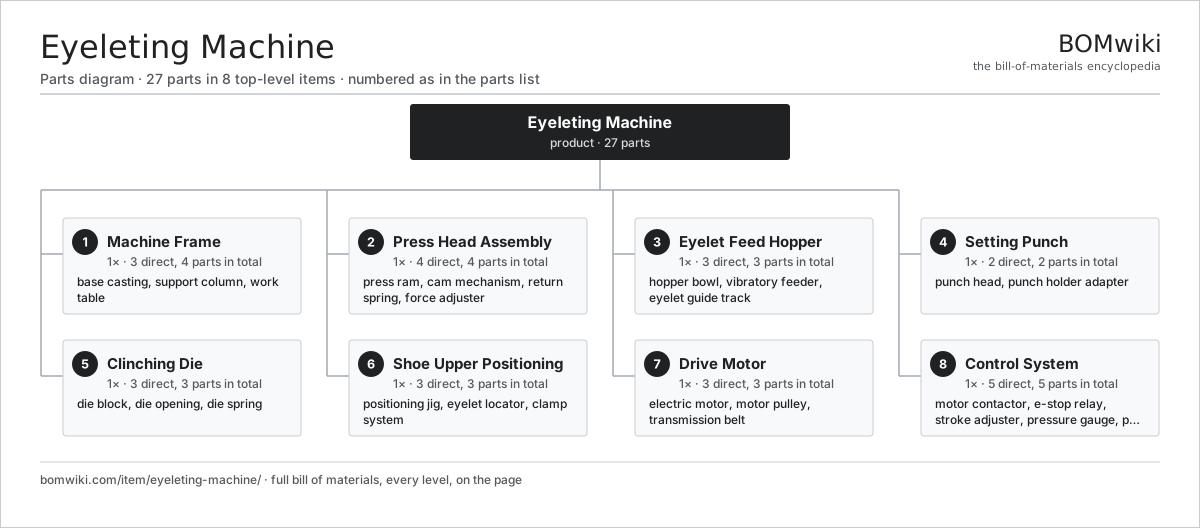
| # | Part | Qty | What it does |
|---|---|---|---|
| 1 | Machine Frame 3 parts | 1× | Rigid cast iron frame supporting press head and work table. |
| 2 | Press Head Assembly 4 parts | 1× | Reciprocating press head driven by cam or eccentric, applying pressure to eyelet setting punch. |
| 3 | Eyelet Feed Hopper 3 parts | 1× | Gravity-feed hopper delivering individual eyelets to the setting punch position. |
| 4 | Setting Punch 2 parts | 1× | Top pressing tool shaped to form eyelet cup and flange around shoe leather edge. |
| 5 | Clinching Die 3 parts | 1× | Lower anvil die supporting leather and eyelet from below during punch striking. |
| 6 | Shoe Upper Positioning 3 parts | 1× | Work-holding fixture that positions shoe upper so each eyelet hole aligns with punch and die. |
| 7 | Drive Motor 3 parts | 1× | Electric motor powering press head and eyelet feeder. |
| 8 | Control System 5 parts | 1× | Electrical enclosure with motor starter, emergency stop, and eyelet size adjustment. |
3D model
No 3D model yet. Have a CAD file of this? Add a 3D model. STL renders right on this page; STEP, FreeCAD, and OpenSCAD sources are welcome too (openly licensed, like all 3D models on BOMwiki).
Build & assembly graph
expand / collapse · shared sub-assemblies converge · links to related products · est. labourTap an assembly to expand/collapse · tap a part to open it · use “Open page” for any node · drag to pan, scroll to zoom.
Bill of materials for Eyeleting Machine
8 top-level lines · 34 rows shown · 27 parts total · indented to 3 levels| # | Item / sub-assembly | Part no. | Qty/assy | Ext. qty | Parts | Type |
|---|---|---|---|---|---|---|
| 1 | Machine Frame 3 parts | eyeleting-machine-frame | 1× | 1 | 4 | assembly |
| 1.1 | Base Casting | eyeleting-machine-base-casting | 1× | 1 | · | part |
| 1.2 | Support Column | eyeleting-machine-side-supports | 2× | 2 | · | part |
| 1.3 | Work Table | eyeleting-machine-work-table | 1× | 1 | · | part |
| 2 | Press Head Assembly 4 parts | eyeleting-machine-press-head | 1× | 1 | 4 | assembly |
| 2.1 | Press Ram | eyeleting-machine-press-ram | 1× | 1 | · | part |
| 2.2 | Cam Mechanism | eyeleting-machine-cam-mechanism | 1× | 1 | · | part |
| 2.3 | Return Spring | eyeleting-machine-pressure-spring | 1× | 1 | · | part |
| 2.4 | Force Adjuster | eyeleting-machine-press-force-adjuster | 1× | 1 | · | part |
| 3 | Eyelet Feed Hopper 3 parts | eyeleting-machine-eyelet-hopper | 1× | 1 | 3 | assembly |
| 3.1 | Hopper Bowl | eyeleting-machine-hopper-bowl | 1× | 1 | · | part |
| 3.2 | Vibratory Feeder | eyeleting-machine-vibratory-feeder | 1× | 1 | · | part |
| 3.3 | Eyelet Guide Track | eyeleting-machine-eyelet-track | 1× | 1 | · | part |
| 4 | Setting Punch 2 parts | eyeleting-machine-setting-punch | 1× | 1 | 2 | assembly |
| 4.1 | Punch Head | eyeleting-machine-punch-head | 1× | 1 | · | part |
| 4.2 | Punch Holder Adapter | eyeleting-machine-punch-holder | 1× | 1 | · | part |
| 5 | Clinching Die 3 parts | eyeleting-machine-clinching-die | 1× | 1 | 3 | assembly |
| 5.1 | Die Block | eyeleting-machine-die-block | 1× | 1 | · | part |
| 5.2 | Die Opening | eyeleting-machine-die-opening | 1× | 1 | · | part |
| 5.3 | Die Spring | eyeleting-machine-die-support-spring | 1× | 1 | · | part |
| 6 | Shoe Upper Positioning 3 parts | eyeleting-machine-feed-system | 1× | 1 | 3 | assembly |
| 6.1 | Positioning Jig | eyeleting-machine-positioning-jig | 1× | 1 | · | part |
| 6.2 | Eyelet Locator | eyeleting-machine-eyelet-locator | 1× | 1 | · | part |
| 6.3 | Clamp System | eyeleting-machine-clamp-system | 1× | 1 | · | part |
| 7 | Drive Motor 3 parts | eyeleting-machine-motor | 1× | 1 | 3 | assembly |
| 7.1 | Electric Motor | eyeleting-machine-main-motor | 1× | 1 | · | part |
| 7.2 | Motor Pulley | eyeleting-machine-motor-pulley | 1× | 1 | · | part |
| 7.3 | Transmission Belt | eyeleting-machine-transmission-belt | 1× | 1 | · | part |
| 8 | Control System 5 parts | eyeleting-machine-control-panel | 1× | 1 | 5 | assembly |
| 8.1 | Motor Contactor | eyeleting-machine-motor-contactor | 1× | 1 | · | part |
| 8.2 | E-Stop Relay | eyeleting-machine-estop-relay | 1× | 1 | · | part |
| 8.3 | Stroke Adjuster | eyeleting-machine-stroke-adjuster | 1× | 1 | · | part |
| 8.4 | Pressure Gauge | eyeleting-machine-pressure-gauge | 1× | 1 | · | part |
| 8.5 | Power Supply | power-supply | 1× | 1 | · | part |
Something wrong in this list? Report a problem with this BOM.
Sourcing: possible vendors
Browse the supplier directory → Prices, MOQ, and lead times are algorithmic estimates, not quotes, and not claims about these companies. Company mappings are curated by keyword; est. price band $10k–$1M. How estimates work| Vendor | HQ | Specialty | MOQ | Lead time |
|---|---|---|---|---|
|
🇨🇭Rieter
rieter.com ↗
|
Winterthur, CH | Spinning machinery | 10 units | 14–24 wks |
| truetzschler.com ↗ | Mönchengladbach, DE | Textile machinery | 10 units | 14–24 wks |
|
🇧🇪Picanol
picanol.be ↗
|
Ypres, BE | Weaving machines | 10 units | 14–24 wks |
| karlmayer.com ↗ | Obertshausen, DE | Warp knitting machines | 10 units | 14–24 wks |
|
🇨🇭Saurer
saurer.com ↗
|
Arbon, CH | Spinning & embroidery | 10 units | 14–24 wks |
1,316-word article