Fabric Spreading Machine
ProductOverview
A fabric-spreading machine is the first step in the pattern-cutting workflow for garment manufacturers. It takes bolts or rolls of fabric and lays them in parallel, aligned plies across a long cutting table, creating a "lay-up", a stack of many plies ready for simultaneous cutting. A single operator feeds one fabric bolt into the machine; the carriage automatically spreads the fabric across the table width, using sensors to keep edges aligned, and then repeats this for the next ply, laying them in a tight stack. Once enough plies are built up (typically 10–20 depending on the fabric and pattern), the machine triggers the cutter, which severs all plies at once. The finished lay-up is ejected and moved to a pattern-cutting station.
The Main Frame is a long, rigid cutting table with precision Guide Rail. The Spreading Carriage is a self-propelled platform carrying the Fabric Cradle (which supports the fabric), and runs the length of the table on these rails. As the carriage moves, the fabric unrolls from the bolt and spreads across the table width. The Edge Sensor Array continuously monitor both fabric edges, and the Control Unit adjusts carriage position or speed to correct edge drift. After each pass, the carriage retracts to the starting position and the next ply is spread. Once the desired number of plies is laid, the operator triggers the Cutter Unit, which cuts all plies to length. The End Catcher Assembly then remove the cut lay-up.
How it works
The operator loads a fabric roll onto the carriage cradle or feeds the end of a bolt into the Fabric Cradle. The Motor Drive System accelerates the carriage forward at 10–100 m/min, a speed that depends on fabric weight and stretch. As the carriage moves forward, the fabric unrolls and spreads across the table width. The Fabric Cradle applies back-tension to keep the fabric taut and prevent wrinkles or puckering.
Crucially, the Edge Sensor Array monitor the position of both the left and right edges of the fabric as it spreads. Four optical sensors positioned at strategic points detect the fabric edges in real time. If an edge drifts, perhaps due to fabric skew, uneven thread, or carriage vibration, the control logic detects this and adjusts the carriage position or applies steering correction to bring the edge back into alignment. This continuous feedback ensures plies are laid parallel and edges are aligned to within ±5 mm, which is critical for pattern matching and efficient cutting.
Once the carriage reaches the end of the table, it decelerates, stops, and retracts to the home position. The operator removes the empty roll (or the machine auto-feeds the next roll on some models), and the carriage spreads the next ply. The stack builds layer by layer. Most garments use 10–20 plies for efficient cutting; a 20-ply lay-up allows 20 identical garment parts to be cut with a single blade pass.
Cutting and lay-up removal
Once the desired number of plies is reached, the operator enters the required cut length into the Control Unit and presses "Cut." The Cutter Unit, either a reciprocating or rotary blade, advances along the length of the table, severing all plies simultaneously. Because the plies are parallel and tightly stacked, a single cut through one ply cuts all of them.
After cutting, the End Catcher Assembly, pneumatic or mechanical arms, grip the cut lay-up and remove it from the table, placing it on a rollout cart. The table is now clear and ready for the next lay-up. On high-speed operations, the spreading and cutting happen continuously: while one lay-up is being cut, a second carriage might be spreading plies for the next lay-up, or the same carriage immediately begins the next spread cycle.
Edge alignment and fabric properties
The Edge Sensor Array are critical because many fabrics stretch or shrink slightly when spreading. Knit fabrics are particularly prone to lateral stretch; woven fabrics are more stable but still subject to bias growth. Asymmetrical weaves can develop a pronounced skew because one direction stretches more than the other. The machine must constantly correct for this.
Some fabrics are sprayed with a temporary sizing or starch to improve handling; this can affect edge frictio and detection. The Sensor Bracket positions the sensors at a height and angle suited to the expected fabric weight; too high and the sensor might miss thin fabrics, too low and it drags and disturbs the fabric. Operators adjust sensor sensitivity for lightweight versus heavyweight fabrics via the control panel.
The Fabric Cradle tension is also critical. Too much tension causes elongation and distortion; too little allows wrinkles and puckering. Tension is typically 0.5–5 kg depending on fabric weight and width. For heavy fabrics (suiting, denim), higher tension holds the fabric stable; for lightweight synthetics, lower tension prevents stress marks.
Automation and efficiency
Modern spreading machines achieve 50–100 m/min carriage speed, meaning a 40 m long lay-up takes 24–48 seconds to spread (plus retraction time). With automatic edge sensing, operator touch is minimal, they load bolts and clear lay-ups. Efficiency gains are significant: one operator running a spreading machine can prepare 50–100 lay-ups per shift, compared to 10–20 per shift with manual spreading (using hand feeds and manual alignment). This is why spreading machines are standard equipment in any facility cutting more than a few hundred garments per day.
The machine's productivity is often the bottleneck that drives overall cutting throughput. A fast cutter can process 5–10 lay-ups per hour, but if the spreading machine can only prepare 4 lay-ups per hour, the system is unbalanced. This is why manufacturers invest in higher-speed carriage motors and wider tables, they increase spreading throughput and allow the cutter and marker to operate at full capacity.
Fabric Spreading Machine parts and their functions
8 top-level parts · 97 parts in total · full bill of materials below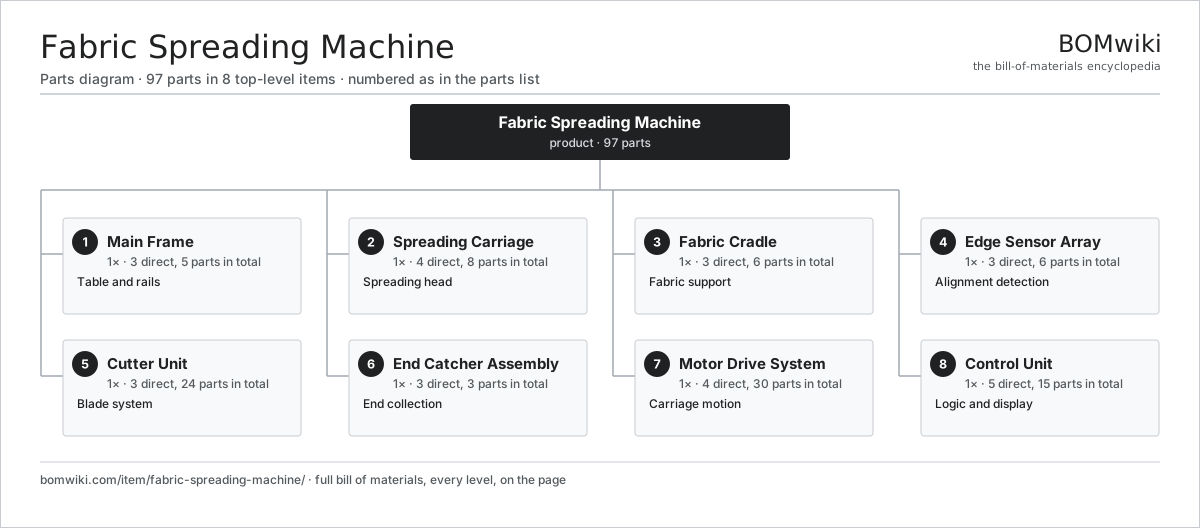
| # | Part | Qty | What it does |
|---|---|---|---|
| 1 | Main Frame 3 parts | 1× | Table and rails |
| 2 | Spreading Carriage 4 parts | 1× | Spreading head |
| 3 | Fabric Cradle 3 parts | 1× | Fabric support |
| 4 | Edge Sensor Array 3 parts | 1× | Alignment detection |
| 5 | Cutter Unit 3 parts | 1× | Blade system |
| 6 | End Catcher Assembly 3 parts | 1× | End collection |
| 7 | Motor Drive System 4 parts | 1× | Carriage motion |
| 8 | Control Unit 5 parts | 1× | Logic and display |
3D model
No 3D model yet. Have a CAD file of this? Add a 3D model. STL renders right on this page; STEP, FreeCAD, and OpenSCAD sources are welcome too (openly licensed, like all 3D models on BOMwiki).
Build & assembly graph
expand / collapse · shared sub-assemblies converge · links to related products · est. labourTap an assembly to expand/collapse · tap a part to open it · use “Open page” for any node · drag to pan, scroll to zoom.
Bill of materials for Fabric Spreading Machine
8 top-level lines · 44 rows shown · 97 parts total · indented to 3 levels| # | Item / sub-assembly | Part no. | Qty/assy | Ext. qty | Parts | Type |
|---|---|---|---|---|---|---|
| 1 | Main Frame 3 parts | fabric-spreading-machine-main-frame | 1× | 1 | 5 | assembly |
| 1.1 | Table Base | fabric-spreading-machine-table-base | 1× | 1 | · | part |
| 1.2 | Guide Rail | fabric-spreading-machine-guide-rails | 2× | 2 | · | part |
| 1.3 | End Frame | fabric-spreading-machine-end-frame | 2× | 2 | · | part |
| 2 | Spreading Carriage 4 parts | fabric-spreading-machine-carriage | 1× | 1 | 8 | assembly |
| 2.1 | Carriage Block | fabric-spreading-machine-carriage-block | 1× | 1 | · | part |
| 2.2 | Drive Wheel | fabric-spreading-machine-drive-wheel | 2× | 2 | · | part |
| 2.3 | Ball Bearing | ball-bearing | 4× | 4 | · | part |
| 2.4 | Cradle Mount | fabric-spreading-machine-cradle-mount | 1× | 1 | · | part |
| 3 | Fabric Cradle 3 parts | fabric-spreading-machine-fabric-cradle | 1× | 1 | 6 | assembly |
| 3.1 | Cradle Roller | fabric-spreading-machine-cradle-roller | 4× | 4 | · | part |
| 3.2 | Cradle Vacuum | fabric-spreading-machine-cradle-vacuum | 1× | 1 | · | part |
| 3.3 | Tension Adjuster | fabric-spreading-machine-tension-adjuster | 1× | 1 | · | part |
| 4 | Edge Sensor Array 3 parts | fabric-spreading-machine-edge-sensors | 1× | 1 | 6 | assembly |
| 4.1 | Optical Edge Sensor | fabric-spreading-machine-optical-sensor | 4× | 4 | · | part |
| 4.2 | Sensor Bracket | fabric-spreading-machine-sensor-bracket | 1× | 1 | · | part |
| 4.3 | Alignment Display | fabric-spreading-machine-alignment-display | 1× | 1 | · | part |
| 5 | Cutter Unit 3 parts | fabric-spreading-machine-cutter | 1× | 1 | 24 | assembly |
| 5.1 | Cutting Blade | fabric-spreading-machine-cutting-blade | 1× | 1 | · | part |
| 5.2 | Blade Guard | fabric-spreading-machine-blade-guard | 1× | 1 | · | part |
| 5.3 | Cutter Motor 2 parts | fabric-spreading-machine-cutter-motor | 1× | 1 | 22 | assembly |
| 5.3.1 | Stator Assembly 3 parts + deeper › | stator-assembly | 1× | 1 | 3 | assembly |
| 5.3.2 | Rotor Assembly 4 parts + deeper › | rotor-assembly | 1× | 1 | 19 | assembly |
| 6 | End Catcher Assembly 3 parts | fabric-spreading-machine-end-catchers | 1× | 1 | 3 | assembly |
| 6.1 | Catcher Arm | fabric-spreading-machine-catcher-arm | 1× | 1 | · | part |
| 6.2 | Catcher Clamp | fabric-spreading-machine-catcher-clamp | 1× | 1 | · | part |
| 6.3 | Catcher Motor | fabric-spreading-machine-catcher-motor | 1× | 1 | · | part |
| 7 | Motor Drive System 4 parts | fabric-spreading-machine-motor-drive | 1× | 1 | 30 | assembly |
| 7.1 | Drive Motor 3 parts | fabric-spreading-machine-drive-motor | 1× | 1 | 24 | assembly |
| 7.1.1 | Stator Assembly 3 parts + deeper › | stator-assembly | 1× | 1 | 3 | assembly |
| 7.1.2 | Rotor Assembly 4 parts + deeper › | rotor-assembly | 1× | 1 | 19 | assembly |
| 7.1.3 | Ball Bearing | ball-bearing | 2× | 2 | · | part |
| 7.2 | Drive Gearbox 3 parts | fabric-spreading-machine-drive-gearbox | 1× | 1 | 4 | assembly |
| 7.2.1 | Gearbox Housing | gearbox-housing | 1× | 1 | · | part |
| 7.2.2 | Helical Gear Pair | gear-pair | 1× | 1 | · | part |
| 7.2.3 | Ball Bearing | ball-bearing | 2× | 2 | · | part |
| 7.3 | Drive Chain | fabric-spreading-machine-drive-chain | 1× | 1 | · | part |
| 7.4 | Encoder | encoder | 1× | 1 | · | part |
| 8 | Control Unit 5 parts | fabric-spreading-machine-control-unit | 1× | 1 | 15 | assembly |
| 8.1 | PLC Board | fabric-spreading-machine-plc-board | 1× | 1 | · | part |
| 8.2 | VFD Module | fabric-spreading-machine-vfd | 1× | 1 | · | part |
| 8.3 | Relay | relay | 4× | 4 | · | part |
| 8.4 | Connector | connector | 8× | 8 | · | part |
| 8.5 | Power Supply | power-supply | 1× | 1 | · | part |
Something wrong in this list? Report a problem with this BOM.
Related products
same domain, ranked by shared parts Automatic Fabric Cutting Machine
1,695 parts · shares 1 with this page
Automatic Pocket Welt Machine
98 parts · shares 1 with this page
Automatic Winding Machine
288 parts · shares 1 with this page
Belt Loop Attaching Machine
84 parts · shares 1 with this page
Blindstitch Hemming Machine
67 parts · shares 1 with this page
Automatic Fabric Cutting Machine
1,695 parts · shares 1 with this page
Automatic Pocket Welt Machine
98 parts · shares 1 with this page
Automatic Winding Machine
288 parts · shares 1 with this page
Belt Loop Attaching Machine
84 parts · shares 1 with this page
Blindstitch Hemming Machine
67 parts · shares 1 with this page
Sourcing: possible vendors
Browse the supplier directory → Prices, MOQ, and lead times are algorithmic estimates, not quotes, and not claims about these companies. Company mappings are curated by keyword; est. price band $10k–$1M. How estimates work| Vendor | HQ | Specialty | MOQ | Lead time |
|---|---|---|---|---|
|
🇨🇭Rieter
rieter.com ↗
|
Winterthur, CH | Spinning machinery | 10 units | 14–24 wks |
| truetzschler.com ↗ | Mönchengladbach, DE | Textile machinery | 10 units | 14–24 wks |
|
🇧🇪Picanol
picanol.be ↗
|
Ypres, BE | Weaving machines | 10 units | 14–24 wks |
| karlmayer.com ↗ | Obertshausen, DE | Warp knitting machines | 10 units | 14–24 wks |
|
🇨🇭Saurer
saurer.com ↗
|
Arbon, CH | Spinning & embroidery | 10 units | 14–24 wks |
1,032-word article