Tower Fall Arrest System
ProductOverview
A tower fall arrest system is a permanent safety installation on cellular or broadcast towers, allowing technicians to work at height with minimal risk of serious injury or death. The system consists of a Lifeline Rail, intermediate Anchor Hardware, a Traveller Device that clips to the climber, and personal protective equipment (PPE) including a Body Harness and Lanyard Assembly.
The core concept is simple: the climber is always connected to the lifeline via the traveller carriage. If the climber slips or loses grip, the carriage automatically clamps the cable, decelerating the fall within a few feet and dissipating impact energy in the Energy Absorber. This limits the fall distance and deceleration force to safe levels, preventing the severe injuries or death that would result from an uncontrolled fall.
Fall arrest systems are mandatory on towers >35 feet tall in most jurisdictions (OSHA, FCC, NFPA 1100). They significantly reduce fatalities and serious injuries on towers, which historically have been among the deadliest occupations.
Components and How They Work
The Lifeline Rail is a 3/8 inch galvanized steel aircraft cable running the full height of the tower, attached at intervals (typically 20–30 feet) via Anchor Hardware that are bolted or welded to the tower legs. The cable is kept under static tension (500–1000 lb) by a Tension Adjuster at the base or top, ensuring it remains straight and stable.
The climber wears a Body Harness, a full-body apparatus distributing forces across the shoulders, waist, and thighs. The harness has two D-rings: one on the dorsal (back) surface for rappelling or backup support, and one on the ventral (front) surface for normal climbing. During ascent, the ventral D-ring is clipped to the Traveller Device.
The traveller carriage is a small aluminum or steel device with rollers that run on the cable. As the climber ascends, the carriage slides freely along the cable. If the climber falls, the carriage's Cable Grip Jaw engages the cable via increased load, clamping it with serrated teeth or magnetic force. The Lanyard Assembly (a 4–6 foot tether with an Energy Absorber) connects the harness D-ring to the carriage, so when the carriage clamps, the lanyard jerks tight, decelerating the climber over a 3–5 foot stopping distance.
The energy absorber is typically a tear-Web or friction device that rips or slips under load, dissipating fall energy as heat. A fall from 10 feet (gravitational potential energy ~1000 J) is absorbed and distributed over a few feet of deceleration, limiting the peak force to <1.5 G (330 lbs for a 220 lb person). This is well below the 2–2.5 G threshold for broken ribs or internal injuries.
Installation and Inspection
Fall arrest systems are installed by specialized contractors under engineering supervision. The cable is strung between permanent anchor points at the top and base of the tower, and intermediate anchors are bolted at regular intervals. The cable tension is checked, and all hardware is torqued to specification. The system is then load-tested with a weighted dummy to verify the carriage engages and the absorber functions correctly.
Annual inspections are mandatory. Inspectors look for:
- Cable fraying, corrosion, or kinks
- Anchor bolt torque and integrity
- Traveller carriage smoothness and jaw engagement
- Lanyard and absorber for damage, burn marks, or previous use
Any sign of distress or previous fall engagement requires replacement of the affected component. If a fall has occurred and the energy absorber activated, that unit is retired and replaced; the absorber is single-use and cannot be re-tensioned.
Climbers are trained annually on fall arrest procedures, harness donning, and proper clipping. They are taught to clip the lanyard to the carriage before beginning ascent, to keep the clip within reach as they climb, and to report any anomalies (carriage stiffness, cable slack) immediately.
Standards and Regulations
Fall arrest systems on towers are governed by:
- OSHA 1910.268: Telecommunications standard requiring full-body harness, lanyard, and anchor point with breaking strength ≥5000 lb
- ANSI Z359: American National Standard for fall protection and rescue
- NFPA 1100: Standard for fire and emergency services personal protective equipment
- FCC 47 CFR 17.61: Technical rules for antenna systems, recommending or requiring fall protection
Most operator networks and tower companies have additional internal standards, often exceeding OSHA minimums. Some require dual lanyards (two attachment points to avoid single-point failure), specialized training certifications, and quarterly instead of annual inspections.
Maintenance and Safety
Harnesses and lanyards have a service life of 5–10 years depending on exposure to UV, chemicals, and mechanical wear. They are replaced on a schedule or immediately if damage is detected.
The carriage requires smooth operation; any stiffness or difficulty moving along the cable indicates bearing wear or cable misalignment. Stiffness can prevent proper engagement in a fall, so the unit must be serviced or replaced.
Proper use is essential: climbers must remain clipped at all times while on the tower, never unclip to reach a tool or avoid an obstacle. Statistics show that the vast majority of fatal falls occur when climbers unclip to work on an unprotected section or circumvent the system to "move faster." Training and culture emphasizing zero unclipped time is the most effective safety measure.
Tower Fall Arrest System parts and their functions
6 top-level parts · 48 parts in total · full bill of materials below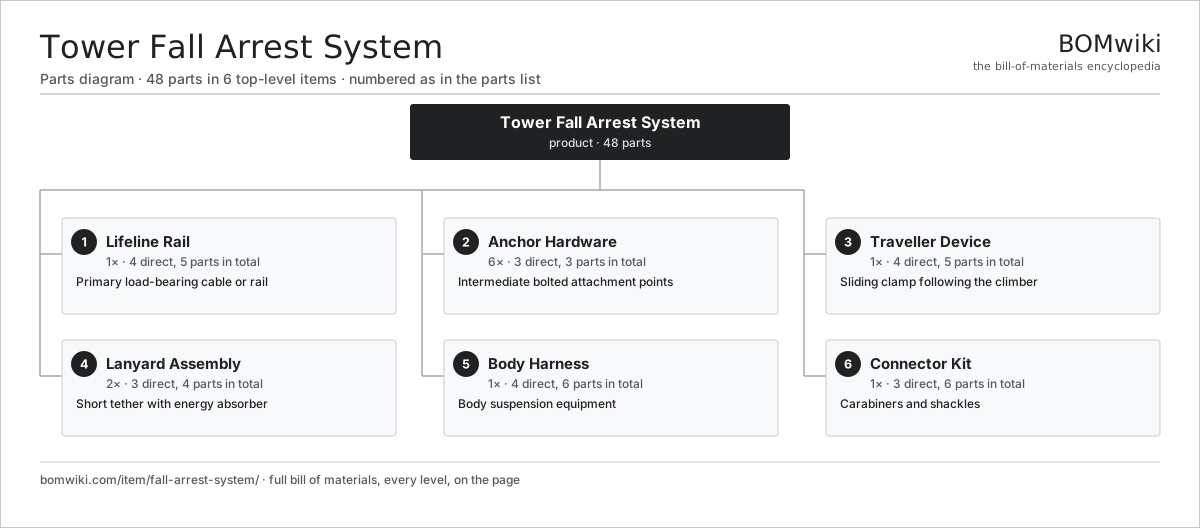
| # | Part | Qty | What it does |
|---|---|---|---|
| 1 | Lifeline Rail 4 parts | 1× | Primary load-bearing cable or rail |
| 2 | Anchor Hardware 3 parts | 6× | Intermediate bolted attachment points |
| 3 | Traveller Device 4 parts | 1× | Sliding clamp following the climber |
| 4 | Lanyard Assembly 3 parts | 2× | Short tether with energy absorber |
| 5 | Body Harness 4 parts | 1× | Body suspension equipment |
| 6 | Connector Kit 3 parts | 1× | Carabiners and shackles |
3D model
No 3D model yet. Have a CAD file of this? Add a 3D model. STL renders right on this page; STEP, FreeCAD, and OpenSCAD sources are welcome too (openly licensed, like all 3D models on BOMwiki).
Build & assembly graph
expand / collapse · shared sub-assemblies converge · links to related products · est. labourTap an assembly to expand/collapse · tap a part to open it · use “Open page” for any node · drag to pan, scroll to zoom.
Bill of materials for Tower Fall Arrest System
6 top-level lines · 27 rows shown · 48 parts total · indented to 3 levels| # | Item / sub-assembly | Part no. | Qty/assy | Ext. qty | Parts | Type |
|---|---|---|---|---|---|---|
| 1 | Lifeline Rail 4 parts | fall-arrest-system-lifeline-rail | 1× | 1 | 5 | assembly |
| 1.1 | Cable Core | fall-arrest-system-cable-core | 1× | 1 | · | part |
| 1.2 | Cable Sleeves | fall-arrest-system-cable-sleeves | 1× | 1 | · | part |
| 1.3 | Termination Lugs | fall-arrest-system-termination-lugs | 2× | 2 | · | part |
| 1.4 | Tension Adjuster | fall-arrest-system-tension-adjuster | 1× | 1 | · | part |
| 2 | Anchor Hardware 3 parts | fall-arrest-system-anchor-hardware | 6× | 6 | 3 | assembly |
| 2.1 | Anchor Plate | fall-arrest-system-anchor-plate | 1× | 6 | · | part |
| 2.2 | Anchor Bolt | fall-arrest-system-anchor-bolt | 1× | 6 | · | part |
| 2.3 | Guide Ring | fall-arrest-system-anchor-guide-ring | 1× | 6 | · | part |
| 3 | Traveller Device 4 parts | fall-arrest-system-traveller-carriage | 1× | 1 | 5 | assembly |
| 3.1 | Carriage Body | fall-arrest-system-carriage-body | 1× | 1 | · | part |
| 3.2 | Roller Set | fall-arrest-system-roller-set | 2× | 2 | · | part |
| 3.3 | Cable Grip Jaw | fall-arrest-system-cable-grip-jaw | 1× | 1 | · | part |
| 3.4 | Load Indicator | fall-arrest-system-load-indicator | 1× | 1 | · | part |
| 4 | Lanyard Assembly 3 parts | fall-arrest-system-lanyard-assembly | 2× | 2 | 4 | assembly |
| 4.1 | Energy Absorber | fall-arrest-system-energy-absorber | 1× | 2 | · | part |
| 4.2 | Lanyard Webbing | fall-arrest-system-lanyard-webbing | 1× | 2 | · | part |
| 4.3 | Lanyard Connector | fall-arrest-system-lanyard-connector | 2× | 4 | · | part |
| 5 | Body Harness 4 parts | fall-arrest-system-harness | 1× | 1 | 6 | assembly |
| 5.1 | Harness Webbing | fall-arrest-system-harness-webbing | 1× | 1 | · | part |
| 5.2 | D-Ring Attachment | fall-arrest-system-d-ring | 2× | 2 | · | part |
| 5.3 | Buckles | fall-arrest-system-buckles | 2× | 2 | · | part |
| 5.4 | Padding | fall-arrest-system-padding | 1× | 1 | · | part |
| 6 | Connector Kit 3 parts | fall-arrest-system-connector-kit | 1× | 1 | 6 | assembly |
| 6.1 | Carabiner | fall-arrest-system-carabiner | 3× | 3 | · | part |
| 6.2 | Shackle Set | fall-arrest-system-shackle-set | 2× | 2 | · | part |
| 6.3 | Safety Hardware | fall-arrest-system-safety-hardware | 1× | 1 | · | part |
Something wrong in this list? Report a problem with this BOM.
Sourcing: possible vendors
Browse the supplier directory → Prices, MOQ, and lead times are algorithmic estimates, not quotes, and not claims about these companies. Company mappings are curated by keyword; est. price band $30–$50k. How estimates work| Vendor | HQ | Specialty | MOQ | Lead time |
|---|---|---|---|---|
|
🇺🇸Cisco
cisco.com ↗
|
San Jose, US | Networking | 500 units | 8–14 wks |
|
🇺🇸Juniper
juniper.net ↗
|
Sunnyvale, US | Networking | 500 units | 8–14 wks |
| arista.com ↗ | Santa Clara, US | Networking | 500 units | 8–14 wks |
|
🇫🇮Nokia
nokia.com ↗
|
Espoo, FI | Telecom equipment | 500 units | 8–14 wks |
|
🇨🇳Huawei
huawei.com ↗
|
Shenzhen, CN | Networking & telecom | 500 units | 8–14 wks |
914-word article