Fat Bike
ProductOverview
A fat bike is an off-road bicycle designed for surfaces that swallow ordinary tires: snow, sand, bog, and frozen rivers. The defining component is the tire, 4.0 to 5.0 inches wide, run at pressures as low as 0.2 bar (3 psi), and everything else on the bike exists to make room for it. The modern category crystallized in two places independently in the late 1980s and 1990s: Alaska, where riders of the Iditabike race welded rims side by side to ride snowmobile trails, and New Mexico, where Ray Molina built wide-rimmed bikes for desert arroyo sand. Surly's 2005 Pugsley made the format a production item.
Why the tire works
At 0.3 bar, a 4.8 in Fat Tire flattens into a contact patch several times the area of a mountain bike tire's. Ground pressure drops low enough that the wheel floats on packed snow rather than trenching into it, the same principle as a snowshoe. The tire also conforms over roots and frozen ruts, providing 50 mm or more of effective suspension travel, which is why most fat bikes are fully rigid: at these pressures a suspension fork is largely redundant. For glare ice, studded versions of the tire carry 200 or more tungsten-carbide studs. The penalty is weight and drag, each tire weighs 1,200-1,600 g, and a Tube / Sealant Fill inner tube adds another 450 g, which is why tubeless conversion (saving close to a kilogram of rotating mass) is one of the most effective upgrades.
Making room: the widened chassis
Clearing a 120 mm-wide tire forced new standards throughout the Frameset. The Fat Bike Frame spaces its rear dropouts at 197 mm, versus 148 mm on a modern mountain bike, and bows its chainstays around a 100 mm-wide bottom bracket shell. The Fat Fork spreads to 150 mm spacing. Both wheels clamp with oversized Thru-Axle Pair (15×150 front, 12×197 rear). In the Fat Wheelset, the Fat Rim runs 65-100 mm wide, usually drilled with large cutouts to claw back some of its considerable weight, and the Front Hub and Rear Hub place their flanges far apart, which gives the spokes in each Spoke Set set a strong bracing angle and makes fat wheels laterally stiff despite their mass.
The wide shell pushes the whole Drivetrain outboard. The Fat Crankset uses a long spindle producing a Q-factor (lateral distance between pedals) of 200-230 mm against roughly 170 mm on a normal mountain bike, noticeable to most riders for the first hour and forgotten afterward. A single 28-30T narrow-wide chainring drives a 10-51T Cassette through a Clutch Rear Derailleur with a clutch; the 510 % range matters because soft snow can require walking-pace gears for sustained periods.
Cold-weather engineering
A fat bike is often a -20 to -30 °C machine, and the details reflect it. Greases in the Headset and hub bearings are selected not to stiffen in deep cold. The Chain runs cold-rated lube because standard formulations thicken below about -10 °C. In the Brake System, mineral-oil hydraulics or cable-actuated calipers are preferred since DOT fluid systems can slow in extreme cold, and the Brake Pads are sintered metallic, which hold their friction coefficient when wet and frozen. Riders favor the cable-actuated Trigger Shifter and mechanical dropper Seatpost options for the same reliability reasons, and the Platform Pedals are big pinned platforms because clipless mechanisms pack solid with ice.
The cockpit shows the most visible winter adaptation: Pogies, insulated mitts that enclose the Lock-On Grips, brake levers, and shifter on the Handlebar, letting the rider wear thin liner gloves at -20 °C with full control feel. The bar itself is wide (740-780 mm) because a tire at 0.3 bar resists steering input and needs leverage; the Stem is kept short to compensate.
Operation
Pressure tuning is the core skill of fat biking. The difference between 0.35 and 0.55 bar is the difference between floating on a snowmachine trail and washing out on it; riders carry low-range pressure gauges and adjust several times in a ride as snow conditions change. On firm surfaces pressures rise toward 0.8-1 bar to reduce the tire squirm that makes a soft fat tire self-steer. Race events such as the 1,000-mile Iditarod Trail Invitational are ridden entirely on this platform, with complete bikes in the 12-16 kg range carrying expedition loads at temperatures below -40 °C.
Fat Bike parts and their functions
7 top-level parts · 49 parts in total · full bill of materials below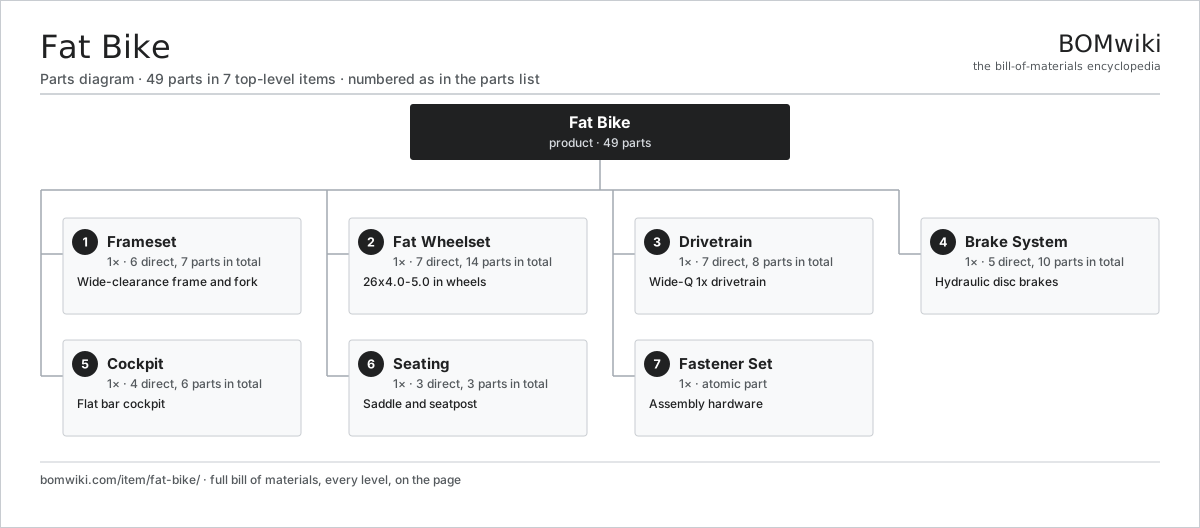
| # | Part | Qty | What it does |
|---|---|---|---|
| 1 | Frameset 6 parts | 1× | Wide-clearance frame and fork |
| 2 | Fat Wheelset 7 parts | 1× | 26x4.0-5.0 in wheels |
| 3 | Drivetrain 7 parts | 1× | Wide-Q 1x drivetrain |
| 4 | Brake System 5 parts | 1× | Hydraulic disc brakes |
| 5 | Cockpit 4 parts | 1× | Flat bar cockpit |
| 6 | Seating 3 parts | 1× | Saddle and seatpost |
| 7 | Fastener Set | 1× | Assembly hardware |
3D model
No 3D model yet. Have a CAD file of this? Add a 3D model. STL renders right on this page; STEP, FreeCAD, and OpenSCAD sources are welcome too (openly licensed, like all 3D models on BOMwiki).
Build & assembly graph
expand / collapse · shared sub-assemblies converge · links to related products · est. labourTap an assembly to expand/collapse · tap a part to open it · use “Open page” for any node · drag to pan, scroll to zoom.
Bill of materials for Fat Bike
7 top-level lines · 39 rows shown · 49 parts total · indented to 3 levels| # | Item / sub-assembly | Part no. | Qty/assy | Ext. qty | Parts | Type |
|---|---|---|---|---|---|---|
| 1 | Frameset 6 parts | fat-frameset | 1× | 1 | 7 | assembly |
| 1.1 | Fat Bike Frame | fat-frame | 1× | 1 | · | part |
| 1.2 | Fat Fork | fat-fork | 1× | 1 | · | part |
| 1.3 | Headset | fat-headset | 1× | 1 | · | part |
| 1.4 | Thru-Axle Pair | fat-thru-axles | 2× | 2 | · | part |
| 1.5 | Derailleur Hanger | fat-derailleur-hanger | 1× | 1 | · | part |
| 1.6 | Seatpost Clamp | fat-seatpost-clamp | 1× | 1 | · | part |
| 2 | Fat Wheelset 7 parts | fat-wheelset | 1× | 1 | 14 | assembly |
| 2.1 | Fat Rim | fat-rim | 2× | 2 | · | part |
| 2.2 | Front Hub | fat-hub-front | 1× | 1 | · | part |
| 2.3 | Rear Hub | fat-hub-rear | 1× | 1 | · | part |
| 2.4 | Spoke Set | fat-spokes | 2× | 2 | · | part |
| 2.5 | Fat Tire | fat-tire | 2× | 2 | · | part |
| 2.6 | Tube / Sealant Fill | fat-tube-or-sealant | 2× | 2 | · | part |
| 2.7 | Ball Bearing | ball-bearing | 4× | 4 | · | part |
| 3 | Drivetrain 7 parts | fat-drivetrain | 1× | 1 | 8 | assembly |
| 3.1 | Fat Crankset | fat-crankset | 1× | 1 | · | part |
| 3.2 | Bottom Bracket | fat-bottom-bracket | 1× | 1 | · | part |
| 3.3 | Cassette | fat-cassette | 1× | 1 | · | part |
| 3.4 | Chain | fat-chain | 1× | 1 | · | part |
| 3.5 | Clutch Rear Derailleur | fat-rear-derailleur | 1× | 1 | · | part |
| 3.6 | Trigger Shifter | fat-shifter | 1× | 1 | · | part |
| 3.7 | Platform Pedals | fat-pedals | 2× | 2 | · | part |
| 4 | Brake System 5 parts | fat-brakeset | 1× | 1 | 10 | assembly |
| 4.1 | Brake Caliper | fat-brake-caliper | 2× | 2 | · | part |
| 4.2 | Disc Rotor | fat-rotor | 2× | 2 | · | part |
| 4.3 | Brake Pads | fat-brake-pads | 2× | 2 | · | part |
| 4.4 | Brake Hose | fat-brake-hose | 2× | 2 | · | part |
| 4.5 | Brake Levers | fat-brake-levers | 2× | 2 | · | part |
| 5 | Cockpit 4 parts | fat-cockpit | 1× | 1 | 6 | assembly |
| 5.1 | Handlebar | fat-handlebar | 1× | 1 | · | part |
| 5.2 | Stem | fat-stem | 1× | 1 | · | part |
| 5.3 | Lock-On Grips | fat-grips | 2× | 2 | · | part |
| 5.4 | Pogies | fat-pogies | 2× | 2 | · | part |
| 6 | Seating 3 parts | fat-seating | 1× | 1 | 3 | assembly |
| 6.1 | Saddle | fat-saddle | 1× | 1 | · | part |
| 6.2 | Seatpost | fat-seatpost | 1× | 1 | · | part |
| 6.3 | Saddle Rail Clamp | fat-saddle-clamp | 1× | 1 | · | part |
| 7 | Fastener Set | fastener-set | 1× | 1 | · | part |
Something wrong in this list? Report a problem with this BOM.
Sourcing: possible vendors
Browse the supplier directory → Prices, MOQ, and lead times are algorithmic estimates, not quotes, and not claims about these companies. Company mappings are curated by keyword; est. price band $200–$12k. How estimates work| Vendor | HQ | Specialty | MOQ | Lead time |
|---|---|---|---|---|
|
🇹🇼Giant
giant-bicycles.com ↗
|
Taichung, TW | Bicycles | 500 units | 6–12 wks |
|
🇺🇸Trek
trekbikes.com ↗
|
Waterloo, US | Bicycles | 500 units | 6–12 wks |
| specialized.com ↗ | Morgan Hill, US | Bicycles | 500 units | 6–12 wks |
|
🇹🇼Merida
merida-bikes.com ↗
|
Yuanlin, TW | Bicycles | 500 units | 6–12 wks |
| cannondale.com ↗ | Wilton, US | Bicycles | 500 units | 6–12 wks |
773-word article