Feather Hydrolyzer
ProductOverview
Feather meal is a high-protein byproduct of poultry slaughter containing 80–85% crude protein, but in an indigestible form, α-keratin, a tough structural protein forming the feather shaft. Raw feathers are useless as animal feed.
The Feather Hydrolyzer converts feathers to hydrolyzed feather meal, a digestible protein ingredient, via pressure steam hydrolysis. Keratin chains are broken into amino acids and short peptides through thermal denaturation and chemical hydrolysis. The result is poultry meal suitable for petfood, aquaculture, and livestock feed.
Hydrolysis chemistry
Keratin is a fibrous protein cross-linked by disulfide bonds (cystine residues) and hydrogen bonding. At atmospheric pressure and 100°C, keratin is essentially insoluble. At elevated pressure and temperature (120–160°C, 10–50 bar), steam penetrates the fiber and hydrolysis accelerates. Water molecules break peptide bonds through acid-catalyzed hydrolysis (from residual acids in raw feathers) and direct thermal cleavage.
The reaction is represented schematically as:
Keratin + H₂O → shorter peptide chains, amino acids, and branched oligomers
The degree of hydrolysis depends on cooking time and temperature. Longer cooking or higher temperature yields smaller molecules (more completely hydrolyzed), improving digestibility but potentially reducing sulfur amino acid content through side reactions.
Process in the Feather Hydrolyzer
Raw poultry feathers, a heterogeneous mix of flight feathers, down, and broken quills, are charged into the Pressure Cooking Chamber. Water is added at 20–40% by weight of feathers to create a slurry.
The Steam Supply System system raises temperature to 120–160°C at 10–50 bar pressure. Pressure is maintained by a Pressure Regulator fed by high-pressure steam (15–25 bar). The Mixing Agitator rotates at 10–30 rpm, mixing the slurry to ensure uniform heating and exposure.
Cooking duration is 1–3 hours depending on target amino acid profile and digestibility. The Temperature Sensor and Pressure Sensor monitor conditions; a Safety Relief Valve prevents overpressure (set at 110% of rated working pressure per ASME code).
Discharge and integration with dryer
Once cooking is complete, the Discharge System system engages. The Discharge Pump pressurizes the hot, thin slurry (consistency similar to pumpkin puree) and pushes it through the Dryer Feed Line directly into a downstream Blood Coagulator/Dryer (spray dryer or disc dryer). The overhead Vapor Condenser and Return captures steam and returns condensate, conserving heat and minimizing vapor emissions.
The transition from cooker to dryer must be insulated and rapid, the slurry begins to set as it cools, and delay risks line blockage.
Nutritional composition
Hydrolyzed feather meal contains:
- Crude Protein: 85–90% (dry basis)
- Amino Acids (dry %):
- Leucine: 7–8%
- Lysine: 2–3% (limiting amino acid)
- Methionine: 0.8–1.0% (second limiting)
- Tyrosine: 3–4% (high)
- Histidine: 1.0–1.2%
The amino acid balance suits poultry and fish, but lysine insufficiency requires blending with other meals in ruminant rations.
Digestibility (in vitro and animal trials):
- Peptide-bound amino acids: 70–85% digestible
- Free amino acids: > 95% digestible
Longer hydrolysis increases free amino acid content and digestibility but costs energy.
Quality control
Feed mills and petfood manufacturers analyze feather meal for:
- Crude Protein (Kjeldahl method): target > 85%
- Amino Acid Profile (HPLC): verification of lysine, methionine
- Moisture: typically 8–12% (post-drying)
- Ash: < 3% (indicates mineral contamination)
- Hygiene (CFU/g): bacterial counts post-drying
By-products and waste
The vapor stream exiting the Vapor Condenser and Return contains ammonia and mercaptans (sulfur compounds responsible for odor). In modern facilities, this overhead is condensed and the liquid is treated as wastewater; volatile organics may be incinerated in a thermal oxidizer.
Sustainability and circular economy
Feather processing is a quintessential upcycling process, poultry feathers are a pure byproduct from slaughter with no other value. Converting them to feed ingredient recovers protein that would otherwise be composted or burned. In integrated poultry processing, feather hydrolysis can be co-located and heat-integrated with Rendering Cooker operations to share steam and condensate treatment systems.
Comparison to alternative protein sources
Hydrolyzed feather meal is cost-competitive with fish meal in aquaculture and petfood formulations, though lysine limitation requires careful blending. The high methionine content (unusual among plant proteins) and rapid digestibility make it attractive for young poultry and high-performing fish diets.
Feather Hydrolyzer parts and their functions
8 top-level parts · 32 parts in total · full bill of materials below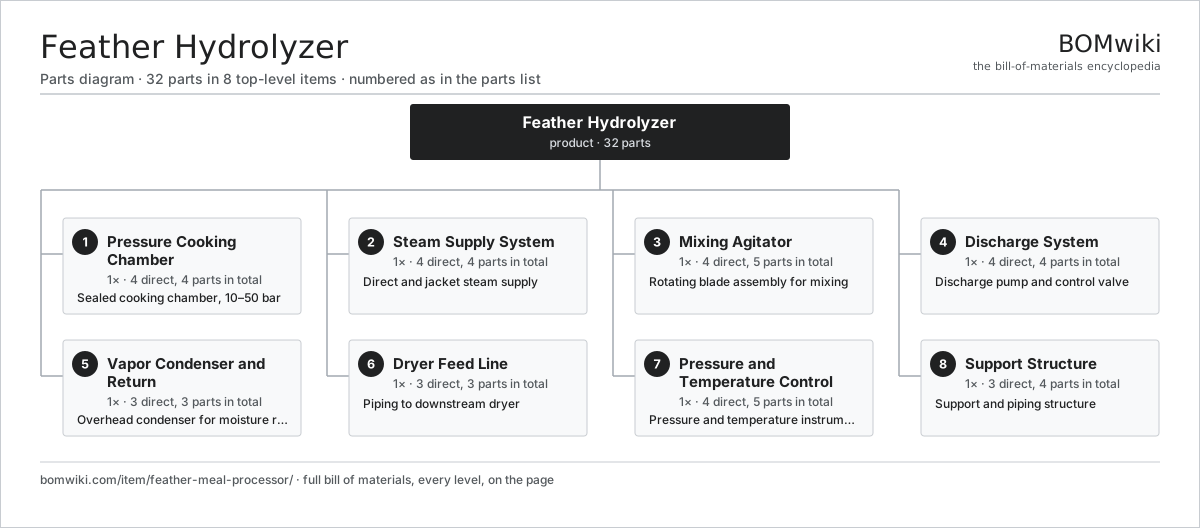
| # | Part | Qty | What it does |
|---|---|---|---|
| 1 | Pressure Cooking Chamber 4 parts | 1× | Sealed cooking chamber, 10–50 bar |
| 2 | Steam Supply System 4 parts | 1× | Direct and jacket steam supply |
| 3 | Mixing Agitator 4 parts | 1× | Rotating blade assembly for mixing |
| 4 | Discharge System 4 parts | 1× | Discharge pump and control valve |
| 5 | Vapor Condenser and Return 3 parts | 1× | Overhead condenser for moisture recovery |
| 6 | Dryer Feed Line 3 parts | 1× | Piping to downstream dryer |
| 7 | Pressure and Temperature Control 4 parts | 1× | Pressure and temperature instrumentation |
| 8 | Support Structure 3 parts | 1× | Support and piping structure |
3D model
No 3D model yet. Have a CAD file of this? Add a 3D model. STL renders right on this page; STEP, FreeCAD, and OpenSCAD sources are welcome too (openly licensed, like all 3D models on BOMwiki).
Build & assembly graph
expand / collapse · shared sub-assemblies converge · links to related products · est. labourTap an assembly to expand/collapse · tap a part to open it · use “Open page” for any node · drag to pan, scroll to zoom.
Bill of materials for Feather Hydrolyzer
8 top-level lines · 37 rows shown · 32 parts total · indented to 3 levels| # | Item / sub-assembly | Part no. | Qty/assy | Ext. qty | Parts | Type |
|---|---|---|---|---|---|---|
| 1 | Pressure Cooking Chamber 4 parts | feather-meal-processor-pressure-vessel | 1× | 1 | 4 | assembly |
| 1.1 | Vessel Shell | feather-meal-processor-vessel-shell | 1× | 1 | · | part |
| 1.2 | Vessel Lid | feather-meal-processor-vessel-lid | 1× | 1 | · | part |
| 1.3 | Vessel Gasket | feather-meal-processor-gasket | 1× | 1 | · | part |
| 1.4 | Fastener Set | fastener-set | 1× | 1 | · | part |
| 2 | Steam Supply System 4 parts | feather-meal-processor-steam-injection | 1× | 1 | 4 | assembly |
| 2.1 | Heating Element | heating-element | 1× | 1 | · | part |
| 2.2 | Steam Injector Tube | feather-meal-processor-steam-injector | 1× | 1 | · | part |
| 2.3 | Pressure Regulator | feather-meal-processor-pressure-regulator | 1× | 1 | · | part |
| 2.4 | Pressure Sensor | pressure-sensor | 1× | 1 | · | part |
| 3 | Mixing Agitator 4 parts | feather-meal-processor-agitator | 1× | 1 | 5 | assembly |
| 3.1 | Agitator Shaft | feather-meal-processor-agitator-shaft | 1× | 1 | · | part |
| 3.2 | Ball Bearing | ball-bearing | 2× | 2 | · | part |
| 3.3 | Rotating Seal Pack | feather-meal-processor-rotating-seal | 1× | 1 | · | part |
| 3.4 | Fastener Set | fastener-set | 1× | 1 | · | part |
| 4 | Discharge System 4 parts | feather-meal-processor-discharge | 1× | 1 | 4 | assembly |
| 4.1 | Discharge Pump | feather-meal-processor-discharge-pump | 1× | 1 | · | part |
| 4.2 | Discharge Valve | feather-meal-processor-discharge-valve | 1× | 1 | · | part |
| 4.3 | Pressure Sensor | pressure-sensor | 1× | 1 | · | part |
| 4.4 | Fastener Set | fastener-set | 1× | 1 | · | part |
| 5 | Vapor Condenser and Return 3 parts | feather-meal-processor-vapor-condenser | 1× | 1 | 3 | assembly |
| 5.1 | Condenser Unit | feather-meal-processor-condenser-unit | 1× | 1 | · | part |
| 5.2 | Return Pump | feather-meal-processor-condensate-pump | 1× | 1 | · | part |
| 5.3 | Pressure Sensor | pressure-sensor | 1× | 1 | · | part |
| 6 | Dryer Feed Line 3 parts | feather-meal-processor-dryer-interface | 1× | 1 | 3 | assembly |
| 6.1 | Feed Line | feather-meal-processor-feed-pipe | 1× | 1 | · | part |
| 6.2 | Inline Strainer | feather-meal-processor-strainer | 1× | 1 | · | part |
| 6.3 | Fastener Set | fastener-set | 1× | 1 | · | part |
| 7 | Pressure and Temperature Control 4 parts | feather-meal-processor-controls | 1× | 1 | 5 | assembly |
| 7.1 | Temperature Sensor | feather-meal-processor-thermostat | 1× | 1 | · | part |
| 7.2 | Pressure Sensor | pressure-sensor | 1× | 1 | · | part |
| 7.3 | Relay | relay | 2× | 2 | · | part |
| 7.4 | Safety Relief Valve | feather-meal-processor-relief-valve | 1× | 1 | · | part |
| 8 | Support Structure 3 parts | feather-meal-processor-frame | 1× | 1 | 4 | assembly |
| 8.1 | Frame Steel | feather-meal-processor-frame-steel | 1× | 1 | · | part |
| 8.2 | Sheet Metal Panel | sheet-panel | 1× | 1 | · | part |
| 8.3 | Fastener Set | fastener-set | 2× | 2 | · | part |
Something wrong in this list? Report a problem with this BOM.
Related products
same domain, ranked by shared parts Bakery Deck Oven
44 parts · shares 3 with this page
Blood Coagulator/Dryer
38 parts · shares 3 with this page
Continuous Frying System
118 parts · shares 3 with this page
Dough Rounding Machine
212 parts · shares 3 with this page
Bakery Deck Oven
44 parts · shares 3 with this page
Blood Coagulator/Dryer
38 parts · shares 3 with this page
Continuous Frying System
118 parts · shares 3 with this page
Dough Rounding Machine
212 parts · shares 3 with this page
 Edible Oil Refining Line
3,224 parts · shares 3 with this page
Edible Oil Refining Line
3,224 parts · shares 3 with this page
Sourcing: possible vendors
Browse the supplier directory → Prices, MOQ, and lead times are algorithmic estimates, not quotes, and not claims about these companies. Company mappings are curated by keyword; est. price band $1k–$500k. How estimates work| Vendor | HQ | Specialty | MOQ | Lead time |
|---|---|---|---|---|
| gea.com ↗ | Düsseldorf, DE | Process technology | 20 units | 12–20 wks |
| buhlergroup.com ↗ | Uzwil, CH | Food & materials processing | 20 units | 12–20 wks |
| tetrapak.com ↗ | Pully, CH | Food packaging & processing | 20 units | 12–20 wks |
| jbtc.com ↗ | Chicago, US | Food processing equipment | 20 units | 12–20 wks |
| alfalaval.com ↗ | Lund, SE | Heat transfer & separation | 20 units | 12–20 wks |
718-word article