Feed Hammer Mill
ProductOverview
The hammer mill is a versatile and robust grinding machine used extensively in feed manufacturing to reduce whole grains or coarse meals into fine particles for animal feed blending. Unlike Flour Roller Mill systems, which use gentle pressure, the hammer mill employs high-speed impact, rotating steel hammers strike material against a perforated screen, to shatter and pulverize grain rapidly.
The hammer mill excels at handling oily seeds, fiber-rich materials, and ingredients that would clog roller mills. The screen determines product fineness; changing from 6 mm to 100 mesh instantly converts the mill from coarse cracking to fine flour. This flexibility makes the machine essential in feed mills where multiple products and particle sizes are needed.
How it works
Material enters through the Material Feed System, controlled by a Feeder Motor driving the Feeder Auger Screw. It drops into the Steel Mill Chamber, a steel chamber where the Rotor and Hammer Assembly rotate at high speed (1800–3600 rpm).
The Hammer Strike Blade strike the falling grain with tremendous force, shattering it. The impacted particles are thrown outward by centrifugal force toward the Interchangeable Screen Grid, which surrounds the rotor. Particles smaller than the screen openings pass through and fall into the Product Discharge and Collection. Larger particles are struck again until they fit through the mesh, or they eventually break down.
Fine dust generated during grinding is drawn upward by the Dust Aspiration and Collection fan through the Dust Exhaust Duct into a Dust Cyclone Separator for collection. The Dust Filter Cartridge captures ultra-fine particles, recovering valuable fines.
The Wear Liner Panel inside the housing absorbs impact and wear, protecting the structural Mill Chamber Sides and making replacement of consumables straightforward.
Hammer types and rotor design
Hammer Strike Blade come in two main configurations:
Pivoting hammers: Hinged on the High-Speed Rotor Shaft by Hammer Pivot Pin, they swing freely during rotor rotation. Light hammers swing outward at higher speeds, maximizing impact surface. As material jams the rotor, the hammers swing inward, reducing impact force, a self-protecting feature. This design is common in coarser mills.
Fixed hammers: Rigidly bolted to the rotor, they rotate at constant velocity and impart consistent impact. Fixed designs produce more uniform fineness and can handle dense materials better than pivoting hammers, but are less self-protecting if material clogs the mill.
Screen selection and fineness control
The Grinding Screen Mesh is the critical parameter controlling product size:
- Coarse (6–12 mm holes): Cracked grain, suitable for ruminant feedstuffs, 3–5 min grinding time
- Medium (2–3 mm holes): Poultry and swine grind, 5–10 min
- Fine (100–200 mesh): Premium flour or supplement, 15–30 min
Finer screens require longer residence time and higher power, so feed rate must be reduced to maintain mill efficiency. Quick-release Screen Quick-Release Clamp clamps allow operators to change screens in minutes, pivoting the mill to multiple product grades throughout the day.
Dust control and recovery
The Dust Aspiration and Collection system is essential for both safety and product recovery. Uncontrolled grain dust is an explosion hazard in mills. The aspiration fan draws fine dust from the chamber, preventing dangerous accumulation.
The Dust Cyclone Separator recovers bulk ground material while the Dust Filter Cartridge captures ultra-fine particles. Regular filter cleaning (by reverse-pulse or manual) is necessary; clogged filters reduce airflow and can cause pressure buildup that stalls the rotor.
Motor and gearbox sizing
The Speed-Reducing Gearbox reduces motor speed 2:1 to 4:1, keeping the rotor at 1800–3600 rpm. Higher rotor speeds produce finer finishes faster but accelerate hammer wear. Motor power requirement scales with fineness target:
- 2 kW mills: Coarse cracks only
- 10 kW mills: Medium fineness for general feed
- 30 kW mills: Fine flour or premium supplements with fast throughput
Energy consumption is typically 30–80 kWh per ton of feed produced, depending on screen fineness and material hardness.
Maintenance and wear
Hammer Strike Blade and Wear Liner Panel wear continuously from impact and are the primary consumables. Hammer life is 500–2000 hours depending on screen fineness and material abrasiveness. Worn hammers reduce impact force, requiring more passes through the mill and reducing capacity. Liners last 1000–3000 hours before replacement.
The Rotor Bearing Unit must be inspected regularly; bearing life is typically 2000–5000 hours. Lubrication is critical; under-lubrication accelerates wear and can lead to seizure and rotor imbalance.
Screen inspection for tears or cracks is essential; a damaged screen allows oversized material to discharge, contaminating the product.
Comparative advantages
The hammer mill is superior to Flour Roller Mill systems for:
- Oily seeds and meals (which gum up rollers)
- Fiber-rich materials (legumes, rice bran)
- Wide range of fineness with single screen change
- Robust handling of foreign material (small stones, metal shavings)
It is inferior for:
- Maintaining product quality in delicate flour (generates heat)
- Consistent fineness across large batches (more variation than roller mills)
- Low dust products (hammer mills are inherently dusty)
Modern feed mills often use hammer mills for initial grinding and Flour Roller Mill or Plansifter for final refining and grading of premium products.
Feed Hammer Mill parts and their functions
8 top-level parts · 88 parts in total · full bill of materials below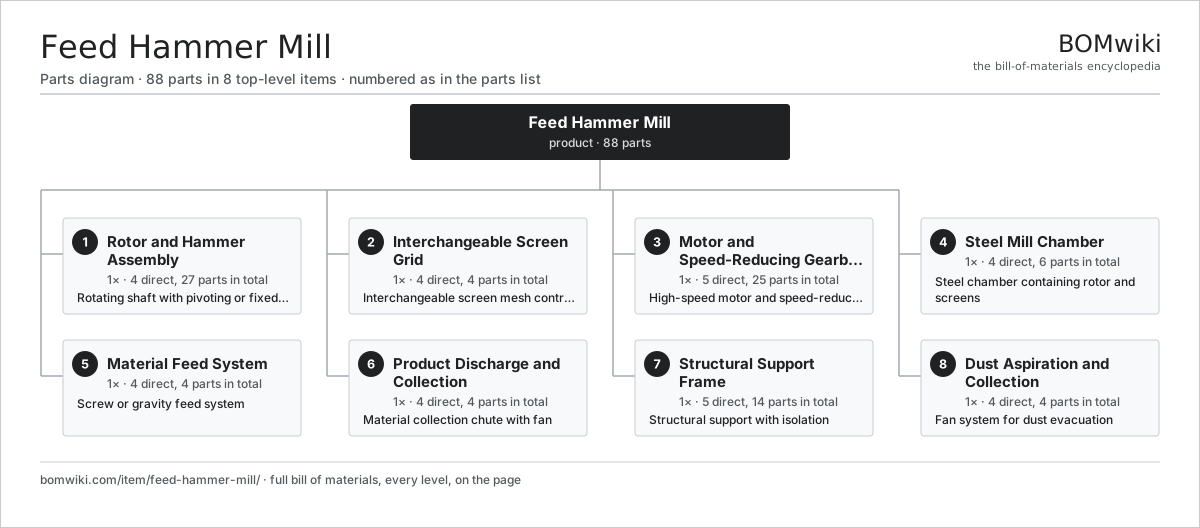
| # | Part | Qty | What it does |
|---|---|---|---|
| 1 | Rotor and Hammer Assembly 4 parts | 1× | Rotating shaft with pivoting or fixed hammers |
| 2 | Interchangeable Screen Grid 4 parts | 1× | Interchangeable screen mesh controlling discharge size |
| 3 | Motor and Speed-Reducing Gearbox 5 parts | 1× | High-speed motor and speed-reducing gearbox |
| 4 | Steel Mill Chamber 4 parts | 1× | Steel chamber containing rotor and screens |
| 5 | Material Feed System 4 parts | 1× | Screw or gravity feed system |
| 6 | Product Discharge and Collection 4 parts | 1× | Material collection chute with fan |
| 7 | Structural Support Frame 5 parts | 1× | Structural support with isolation |
| 8 | Dust Aspiration and Collection 4 parts | 1× | Fan system for dust evacuation |
3D model
No 3D model yet. Have a CAD file of this? Add a 3D model. STL renders right on this page; STEP, FreeCAD, and OpenSCAD sources are welcome too (openly licensed, like all 3D models on BOMwiki).
Build & assembly graph
expand / collapse · shared sub-assemblies converge · links to related products · est. labourTap an assembly to expand/collapse · tap a part to open it · use “Open page” for any node · drag to pan, scroll to zoom.
Bill of materials for Feed Hammer Mill
8 top-level lines · 49 rows shown · 88 parts total · indented to 3 levels| # | Item / sub-assembly | Part no. | Qty/assy | Ext. qty | Parts | Type |
|---|---|---|---|---|---|---|
| 1 | Rotor and Hammer Assembly 4 parts | feed-hammer-mill-rotor-hammers | 1× | 1 | 27 | assembly |
| 1.1 | High-Speed Rotor Shaft | feed-hammer-mill-rotor-shaft | 1× | 1 | · | part |
| 1.2 | Hammer Strike Blade | feed-hammer-mill-hammer-blade | 8× | 8 | · | part |
| 1.3 | Hammer Pivot Pin | feed-hammer-mill-hammer-pin | 16× | 16 | · | part |
| 1.4 | Rotor Bearing Unit | feed-hammer-mill-rotor-bearing | 2× | 2 | · | part |
| 2 | Interchangeable Screen Grid 4 parts | feed-hammer-mill-screen-grate | 1× | 1 | 4 | assembly |
| 2.1 | Screen Holder Frame | feed-hammer-mill-screen-frame | 1× | 1 | · | part |
| 2.2 | Grinding Screen Mesh | feed-hammer-mill-screen-mesh | 1× | 1 | · | part |
| 2.3 | Screen Quick-Release Clamp | feed-hammer-mill-screen-fastener | 1× | 1 | · | part |
| 2.4 | Screen Support Reinforcement | feed-hammer-mill-screen-support-bar | 1× | 1 | · | part |
| 3 | Motor and Speed-Reducing Gearbox 5 parts | feed-hammer-mill-motor-gearbox | 1× | 1 | 25 | assembly |
| 3.1 | Motor Housing | motor-housing | 1× | 1 | · | part |
| 3.2 | Rotor Assembly 4 parts | rotor-assembly | 1× | 1 | 19 | assembly |
| 3.2.1 | Rotor Shaft | rotor-shaft | 1× | 1 | · | part |
| 3.2.2 | Rotor Core | rotor-core | 1× | 1 | · | part |
| 3.2.3 | Neodymium Magnet | neodymium-magnet | 16× | 16 | · | part |
| 3.2.4 | Ball Bearing | ball-bearing | 1× | 1 | · | part |
| 3.3 | Stator Assembly 3 parts | stator-assembly | 1× | 1 | 3 | assembly |
| 3.3.1 | Stator Core (laminations) | stator-core | 1× | 1 | · | part |
| 3.3.2 | Copper Winding | copper-winding | 1× | 1 | · | part |
| 3.3.3 | Slot Insulation | stator-insulation | 1× | 1 | · | part |
| 3.4 | Speed-Reducing Gearbox | feed-hammer-mill-gearbox | 1× | 1 | · | part |
| 3.5 | Connector | connector | 1× | 1 | · | part |
| 4 | Steel Mill Chamber 4 parts | feed-hammer-mill-housing | 1× | 1 | 6 | assembly |
| 4.1 | Mill Chamber Sides | feed-hammer-mill-chamber-body | 1× | 1 | · | part |
| 4.2 | Chamber Top/Lid | feed-hammer-mill-chamber-top | 1× | 1 | · | part |
| 4.3 | Wear Liner Panel | feed-hammer-mill-chamber-liner | 2× | 2 | · | part |
| 4.4 | Rotor Bearing Housing | feed-hammer-mill-bearing-block | 2× | 2 | · | part |
| 5 | Material Feed System 4 parts | feed-hammer-mill-feeder | 1× | 1 | 4 | assembly |
| 5.1 | Feed Hopper Tank | feed-hammer-mill-hopper | 1× | 1 | · | part |
| 5.2 | Feeder Auger Screw | feed-hammer-mill-feed-screw | 1× | 1 | · | part |
| 5.3 | Feeder Motor | feed-hammer-mill-feed-motor | 1× | 1 | · | part |
| 5.4 | Feed Rate Control Gate | feed-hammer-mill-feed-gate | 1× | 1 | · | part |
| 6 | Product Discharge and Collection 4 parts | feed-hammer-mill-discharge-spout | 1× | 1 | 4 | assembly |
| 6.1 | Discharge Chute Tube | feed-hammer-mill-discharge-chute | 1× | 1 | · | part |
| 6.2 | Collection Hopper | feed-hammer-mill-collector-hopper | 1× | 1 | · | part |
| 6.3 | Bag Mounting Frame | feed-hammer-mill-bagging-frame | 1× | 1 | · | part |
| 6.4 | Fastener Set | fastener-set | 1× | 1 | · | part |
| 7 | Structural Support Frame 5 parts | feed-hammer-mill-frame | 1× | 1 | 14 | assembly |
| 7.1 | Base Frame Plate | feed-hammer-mill-frame-base | 1× | 1 | · | part |
| 7.2 | Support Post | feed-hammer-mill-support-posts | 4× | 4 | · | part |
| 7.3 | Cross-Brace Member | feed-hammer-mill-cross-brace | 4× | 4 | · | part |
| 7.4 | Vibration Isolation Foot | feed-hammer-mill-isolation-feet | 4× | 4 | · | part |
| 7.5 | Fastener Set | fastener-set | 1× | 1 | · | part |
| 8 | Dust Aspiration and Collection 4 parts | feed-hammer-mill-aspiration | 1× | 1 | 4 | assembly |
| 8.1 | Dust Extraction Fan | feed-hammer-mill-aspiration-fan | 1× | 1 | · | part |
| 8.2 | Dust Exhaust Duct | feed-hammer-mill-dust-duct | 1× | 1 | · | part |
| 8.3 | Dust Cyclone Separator | feed-hammer-mill-cyclone-separator | 1× | 1 | · | part |
| 8.4 | Dust Filter Cartridge | feed-hammer-mill-filter-bag | 1× | 1 | · | part |
Something wrong in this list? Report a problem with this BOM.
Related products
same domain, ranked by shared parts Bottle Washing Machine
2,388 parts · shares 10 with this page
Brine Chilling System
239 parts · shares 10 with this page
Bottle Washing Machine
2,388 parts · shares 10 with this page
Brine Chilling System
239 parts · shares 10 with this page
 Bucket Conveyor
109 parts · shares 10 with this page
Bucket Conveyor
109 parts · shares 10 with this page
 Candy Cane Machine
258 parts · shares 10 with this page
Candy Cane Machine
258 parts · shares 10 with this page
Sourcing: possible vendors
Browse the supplier directory → Prices, MOQ, and lead times are algorithmic estimates, not quotes, and not claims about these companies. Company mappings are curated by keyword; est. price band $1k–$500k. How estimates work| Vendor | HQ | Specialty | MOQ | Lead time |
|---|---|---|---|---|
| gea.com ↗ | Düsseldorf, DE | Process technology | 20 units | 12–20 wks |
| buhlergroup.com ↗ | Uzwil, CH | Food & materials processing | 20 units | 12–20 wks |
| tetrapak.com ↗ | Pully, CH | Food packaging & processing | 20 units | 12–20 wks |
| jbtc.com ↗ | Chicago, US | Food processing equipment | 20 units | 12–20 wks |
| alfalaval.com ↗ | Lund, SE | Heat transfer & separation | 20 units | 12–20 wks |
897-word article