Fiber Splice Closure
ProductOverview
A fiber splice closure is an outdoor junction box protecting the delicate splices between two fiber optic cables. When running long fiber-optic links across a region, it is impractical to order a single unbroken cable from one city to another. Instead, cables are spliced at intermediate points (every 2–5 km), and each splice point needs environmental protection. The closure provides a sealed housing that keeps water, dust, UV light, and mechanical stress away from the splice joints, which are vulnerable to contamination and bending.
A typical deployment involves two incoming fiber cables, each with 4–12 strands. Inside the closure, these strands are fusion-spliced in pairs (e.g., fiber A1 from cable 1 splices to fiber A1 of cable 2), and each splice is protected by a heat-shrink sleeve. Slack fiber and strain relief guides are organized on a splice tray, and the whole assembly sits in a sealed plastic or stainless enclosure.
Splice protection
A fusion splice is made by cleanly cleaving two fiber ends, placing them in contact under a microscope, and fusing them with an electric arc. The resulting joint has extremely low loss (<0.1 dB) but is as fragile as the fiber itself: bending it too sharply (below 30 mm radius) induces micro-cracks that degrade the signal over months. UV light can degrade the fiber cladding, and moisture can diffuse into the splice region, affecting refractive index and introducing loss.
The heat-shrink tubing with adhesive lining is the primary protection. When heated (after splicing), the tubing shrinks down, and the adhesive melts, creating a seal that is waterproof and provides mechanical protection. The splice tray cradles these sleeves in grooved holders, preventing sharp bends.
Closure design
The body comes in two halves that clamp together with a flange and gasket. The dome top is usually transparent (to see the splices inside) or translucent. The base holds the splice tray and has cable entry ports fitted with compression glands.
For outdoor installation, the closure must be sealed against rain. A silicone or EPDM gasket surrounds the flange interface. Each cable entry port has its own compression seal: a sealing ring tightens around the incoming cable sheath, compressing it into the gland body. As the cable is pulled through, the seal crushes the cable jacket, creating a watertight interface. A drain hole at the bottom prevents water from pooling inside if condensation forms.
Installation workflow
A technician brings two incoming cables to the closure, feeds them through cable glands, and strips the outer jacket and buffer tube from a few meters of fiber. The individual fibers (now bare) are organized on the tray, each identified with a color-coded label band.
The technician works on one pair at a time: cleanly cleaves two fiber ends using a specialized cleaver tool, inserts them into a fusion splicer, presses the arc button, and the arc melts the fibers together in a few seconds. The splicer displays loss; if it exceeds 0.15 dB, the operator may re-splice. Once the splice is confirmed good, the pre-cut heat-shrink sleeve (already threaded onto one of the fibers) is positioned over the splice, and a heat pen or oven shrinks it. The splice is now protected and can be placed in the tray groove.
After all splices are done, the technician organizes the slack fiber in coiled storage loops to maintain minimum bend radius, seals the gaskets and cable gland nuts with silicone compound, and clamps the dome to the base. The finished closure is mounted on a pole or buried, typically at a street-level junction between neighborhood segments.
Strain relief and bend management
A critical challenge is preventing the splices from bending. Incoming cables experience tension from their own weight and environmental loads. The bend radius guide inside the closure forms a large-radius curve that the fibers follow, preventing sharp bends. Routing clips secure the fiber path so it doesn't slide around during thermal expansion.
The protective tape wrapped around bare fibers reduces friction against the tray, so fibers can move smoothly with thermal cycles without abrasion. Over years, thermal expansion and contraction cause cables to expand and contract; a well-designed closure accommodates this by allowing fibers to slide gently in the guides without kinking.
Environmental sealing
Outdoor closures face UV, temperature swings, and moisture. A polycarbonate closure discolors and degrades over 20–30 years if exposed to direct UV, but stainless-steel closures resist UV indefinitely, making them preferred in harsh climates. The gasket materials (silicone, EPDM) are stable to −40 to +70 °C, preventing seal failure across temperature ranges found in deserts and arctic regions.
For submarine or heavily submerged closures, IP68-rated units with potting compound and full encapsulation are used, ensuring the interior never floods.
Redundancy and protection
In critical networks, splice closures are often installed in pairs (Y-junction), allowing a single cable break to be immediately patched. For example, two paths from city A to city B, each with splices at intermediate junctions, provide automatic failover: if one path is cut, traffic diverts to the other.
Each closure is numbered and documented in a network inventory; technicians use GPS and fiber-trace tools to locate them for maintenance or repairs.
Fiber Splice Closure parts and their functions
8 top-level parts · 54 parts in total · full bill of materials below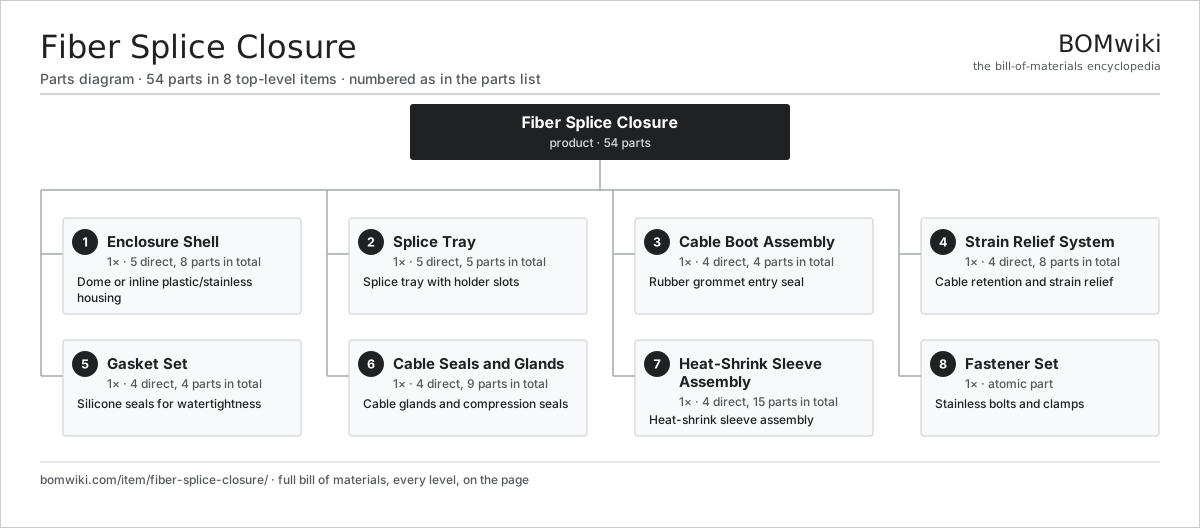
| # | Part | Qty | What it does |
|---|---|---|---|
| 1 | Enclosure Shell 5 parts | 1× | Dome or inline plastic/stainless housing |
| 2 | Splice Tray 5 parts | 1× | Splice tray with holder slots |
| 3 | Cable Boot Assembly 4 parts | 1× | Rubber grommet entry seal |
| 4 | Strain Relief System 4 parts | 1× | Cable retention and strain relief |
| 5 | Gasket Set 4 parts | 1× | Silicone seals for watertightness |
| 6 | Cable Seals and Glands 4 parts | 1× | Cable glands and compression seals |
| 7 | Heat-Shrink Sleeve Assembly 4 parts | 1× | Heat-shrink sleeve assembly |
| 8 | Fastener Set | 1× | Stainless bolts and clamps |
3D model
No 3D model yet. Have a CAD file of this? Add a 3D model. STL renders right on this page; STEP, FreeCAD, and OpenSCAD sources are welcome too (openly licensed, like all 3D models on BOMwiki).
Build & assembly graph
expand / collapse · shared sub-assemblies converge · links to related products · est. labourTap an assembly to expand/collapse · tap a part to open it · use “Open page” for any node · drag to pan, scroll to zoom.
Bill of materials for Fiber Splice Closure
8 top-level lines · 38 rows shown · 54 parts total · indented to 3 levels| # | Item / sub-assembly | Part no. | Qty/assy | Ext. qty | Parts | Type |
|---|---|---|---|---|---|---|
| 1 | Enclosure Shell 5 parts | fiber-closure-shell | 1× | 1 | 8 | assembly |
| 1.1 | Dome Cover | fiber-closure-dome-cover | 1× | 1 | · | part |
| 1.2 | Base Body | fiber-closure-base-body | 1× | 1 | · | part |
| 1.3 | Sealing Flange | fiber-closure-flange-ring | 1× | 1 | · | part |
| 1.4 | Cable Gland Port | fiber-closure-inlet-port | 4× | 4 | · | part |
| 1.5 | Drain Port | fiber-closure-drain-hole | 1× | 1 | · | part |
| 2 | Splice Tray 5 parts | fiber-closure-tray | 1× | 1 | 5 | assembly |
| 2.1 | Tray Frame | fiber-tray-frame | 1× | 1 | · | part |
| 2.2 | Splice Slots | fiber-tray-splice-slots | 1× | 1 | · | part |
| 2.3 | Slack Storage | fiber-tray-slack-storage | 1× | 1 | · | part |
| 2.4 | Tray Dividers | fiber-tray-separators | 1× | 1 | · | part |
| 2.5 | Mounting Feet | fiber-tray-mounting-foot | 1× | 1 | · | part |
| 3 | Cable Boot Assembly 4 parts | fiber-closure-boot | 1× | 1 | 4 | assembly |
| 3.1 | Entry Gland | fiber-boot-entry-gland | 1× | 1 | · | part |
| 3.2 | Rubber Insert | fiber-boot-rubber-seal | 1× | 1 | · | part |
| 3.3 | Strain Cleat | fiber-boot-strain-cleat | 1× | 1 | · | part |
| 3.4 | Waterproof Wrap | fiber-boot-wrap-layer | 1× | 1 | · | part |
| 4 | Strain Relief System 4 parts | fiber-closure-strain-relief | 1× | 1 | 8 | assembly |
| 4.1 | Bend Radius Guide | fiber-relief-bend-radius-guide | 1× | 1 | · | part |
| 4.2 | Routing Clip | fiber-relief-retention-clip | 4× | 4 | · | part |
| 4.3 | Tie-Down Point | fiber-relief-tie-down-point | 2× | 2 | · | part |
| 4.4 | Protective Tape | fiber-relief-friction-tape | 1× | 1 | · | part |
| 5 | Gasket Set 4 parts | fiber-closure-gasket-set | 1× | 1 | 4 | assembly |
| 5.1 | Main Gasket | fiber-gasket-main-flange | 1× | 1 | · | part |
| 5.2 | Port Gaskets | fiber-gasket-port-set | 1× | 1 | · | part |
| 5.3 | Buffer Ring | fiber-gasket-buffer-ring | 1× | 1 | · | part |
| 5.4 | Spare Gasket Kit | fiber-gasket-replacement-kit | 1× | 1 | · | part |
| 6 | Cable Seals and Glands 4 parts | fiber-closure-cable-seals | 1× | 1 | 9 | assembly |
| 6.1 | Single-Cable Gland | fiber-seal-single-fiber-gland | 2× | 2 | · | part |
| 6.2 | Multi-Cable Gland | fiber-seal-multi-fiber-gland | 1× | 1 | · | part |
| 6.3 | Compression Ring | fiber-seal-compression-washer | 4× | 4 | · | part |
| 6.4 | End Cap | fiber-seal-cap-seal | 2× | 2 | · | part |
| 7 | Heat-Shrink Sleeve Assembly 4 parts | fiber-closure-heatshrink | 1× | 1 | 15 | assembly |
| 7.1 | Heat-Shrink Sleeve | fiber-heatshrink-sleeve | 12× | 12 | · | part |
| 7.2 | Adhesive Sleeve | fiber-heatshrink-adhesive-lined | 1× | 1 | · | part |
| 7.3 | Color Ring | fiber-heatshrink-color-code | 1× | 1 | · | part |
| 7.4 | Storage Strips | fiber-heatshrink-holder-strips | 1× | 1 | · | part |
| 8 | Fastener Set | fastener-set | 1× | 1 | · | part |
Something wrong in this list? Report a problem with this BOM.
Sourcing: possible vendors
Browse the supplier directory → Prices, MOQ, and lead times are algorithmic estimates, not quotes, and not claims about these companies. Company mappings are curated by keyword; est. price band $30–$50k. How estimates work| Vendor | HQ | Specialty | MOQ | Lead time |
|---|---|---|---|---|
|
🇺🇸Cisco
cisco.com ↗
|
San Jose, US | Networking | 500 units | 8–14 wks |
|
🇺🇸Juniper
juniper.net ↗
|
Sunnyvale, US | Networking | 500 units | 8–14 wks |
| arista.com ↗ | Santa Clara, US | Networking | 500 units | 8–14 wks |
|
🇫🇮Nokia
nokia.com ↗
|
Espoo, FI | Telecom equipment | 500 units | 8–14 wks |
|
🇨🇳Huawei
huawei.com ↗
|
Shenzhen, CN | Networking & telecom | 500 units | 8–14 wks |
986-word article